Emancipating the Archive (2011)


Download work documentation as PDF (8.4 Mb)

Cognitive Architecture. From Bio-politics to Noo-politics
Edited by Deborah Hauptmann and Warren Neidich, published by 010 Publishers, Rotterdam.
Download table of contents and feature essay from Warren Neidich:
From Noopower to Neuropower: How Mind Becomes Matter (1.4 Mb)

Acceptable Differences
Acceptable Differences
January 2011
Belgrade Cultural Center, Belgrade
Curated by Maja Ciric
Lazar Trifunovic considered art to be a complex phenomenon wherein a lot of other complex phenomena fit in,1 but he pointed out that art, if it is to live with the times wherein it is created, must listen to its sounds, its problems and pains.2
If it is to be relevant in the 21st century, the gallery must simultaneously be an open network, a black box, a white cube, a temple, a laboratory and a situation. It must take on the form of a creative partnership between a curator and a producer, between an art object and the idea of art.3
In view of the fact that contemporary art is merely another niche within the framework of the overall intensive cultural production, especially within the surroundings of web 2.0, art criticism is addressed to a small number of insiders who, even when they really are interested in reading it, do not have too much time for doing so. If criticism has no market value and logic, its chances of finding its own space within the framework of cultural production lies in its being inscribed into curatorial practice.
If the purpose of practice is action itself,4 the kind of action that characterises curatorial practice is aimed at creating a context wherein worlds meet and where continual negotiation between various regimes of knowledge, between art and its public, is stimulated. The policy that I am advocating is not necessarily directed towards finding final solutions but rather towards stimulating dialogues and understandings inside the times wherein we act in combination with historical precedents, theoretical reflections and concrete processes.
Paul O’Neill speaks of the difference between a co-dependent and independent curator.5 According to him, it is not possible to be a curator without being dependent on institutions which one is in continual negotiation with. He stresses the dysfunctional aspect of this relationship, which is often unidirectional and emotionally destructive. Even though the majority of projects come into being through such cooperation, the independence of my being an agent is marked by my determination not to reproduce the system but to introduce a different perspective into institutional operations. An independent perspective is based on information and knowledge characteristic of transnational networks that I belong to, which specifically engage the methodology of curatorial practices. Pursuing this further, I try to ponder how the role of art is modifying the institutional socio-political paradigm.
Contemporary art, without utopian expectations, enables us to reread and reconsider the views of Lazar Trifunovic. My aim here was to stimulate the multiple ontologies of painting and conceptual art and to point out the outdatedness of an essentialist notion of art, reflected in the following view: art has never been so banal and so concrete as to make distinctions between certain political and economic systems – nor is it today.If social systems differ, do people differ as well? Are men/women different today merely because they live within the framework of different productive processes? Art has never counted on elements limited to the ‘national’, in the narrow sense of the term or upon specific socio-economic processes in the broader sense. Rather it has come into being as a product of the spirit, as a result of its conscience. Art has nothing in common with the outer, physical landscape and collective social relations. It only depends on the inner psychological landscape of the creator, on his/her personality.6
What we can conclude from these statements is that Trifunovic is arguing for essentialist things. As such his entire argument calls for the emancipation of the individual from his surroundings and strives for the production of an apolitical art. For art and curatorial practice based on poststructuralism, the discourse of the surroundings is essential. They are both the result of discursive production. Today, through reconstructing the cultural landscape, different formations are created. Post-structuralism is also important for Warren Neidich’s culturally inflected Becoming Brain model whereupon ideas like feminism, post-colonialism and queer theory play as important roles as science in generating knowledge and in sculpting neural networks and its counterpart contemplation.
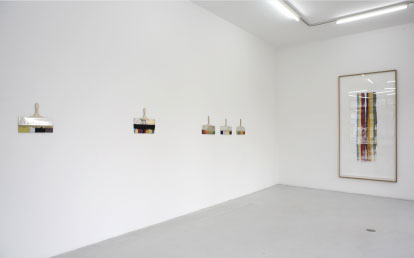
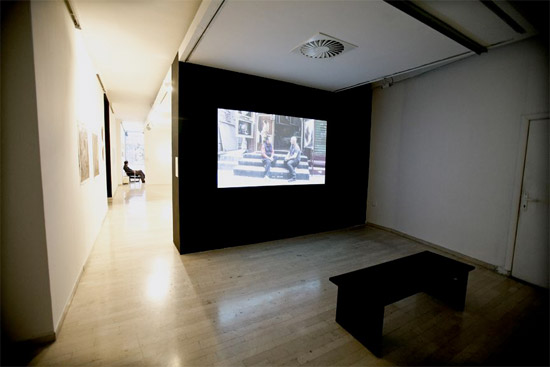
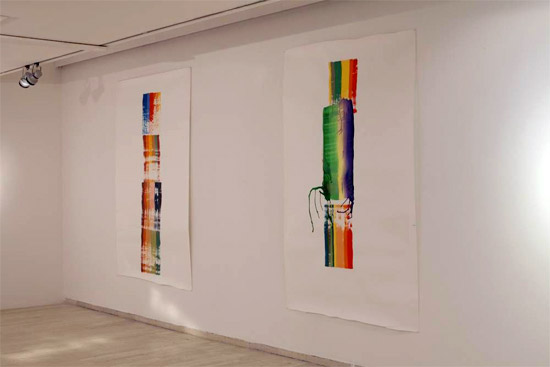
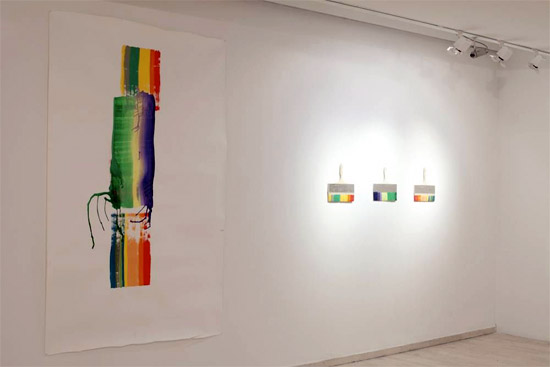
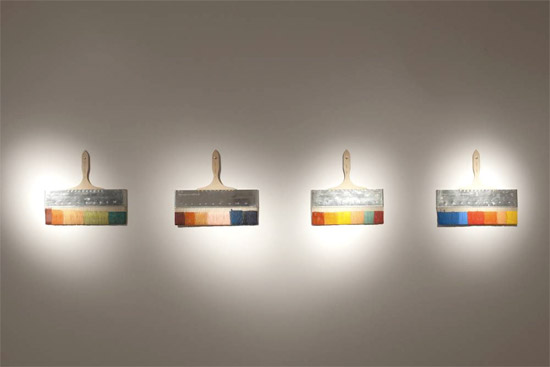
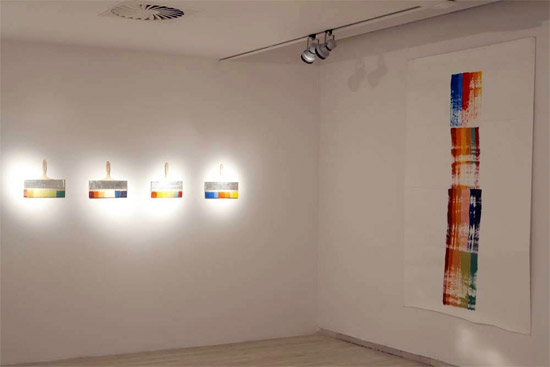
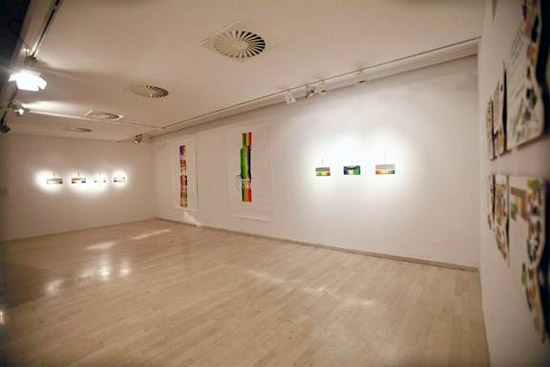
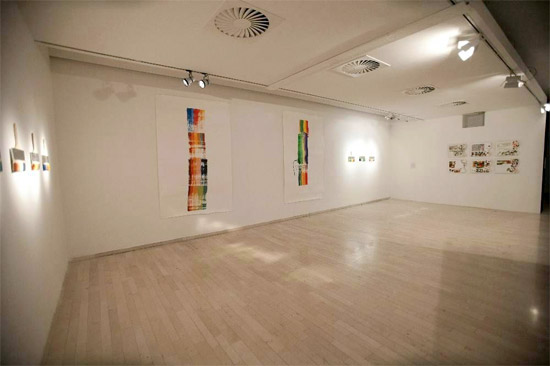
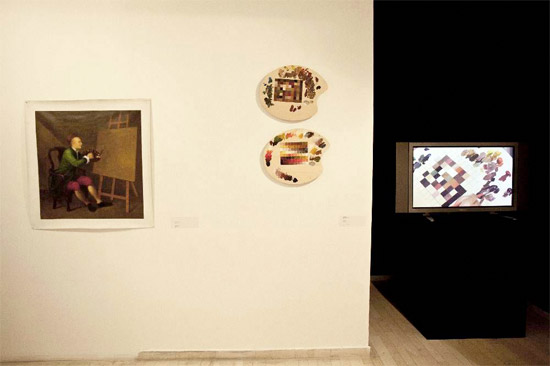
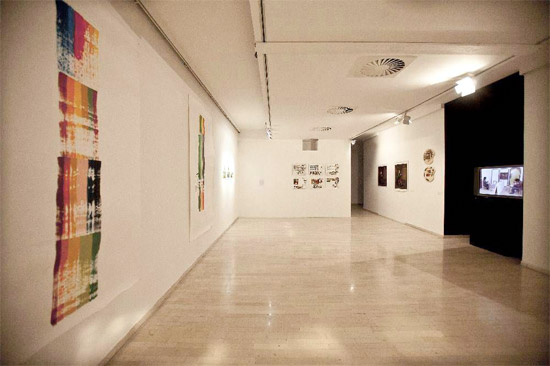
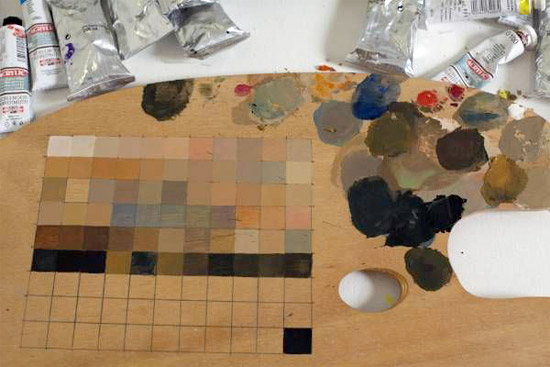
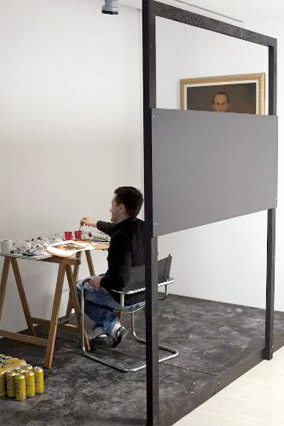
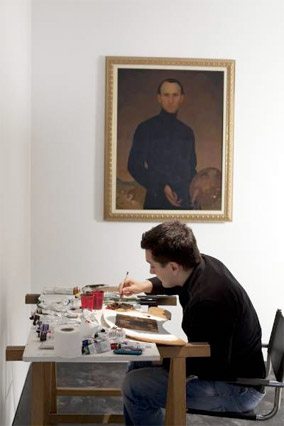
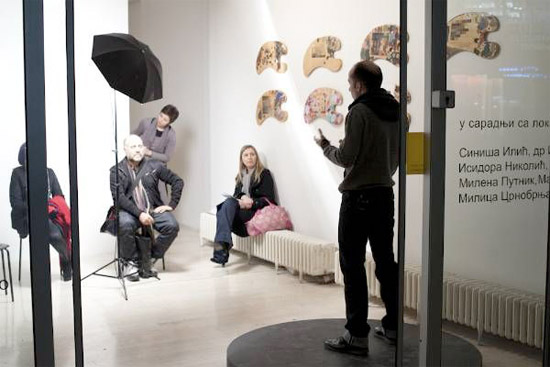
The exhibition of Neidich is an intellectual horizon that complements the public sphere by revitalising and reinterpreting art history, activating experimentation and theoretical reflections, evaluating process, dialogue and participation. His works exhibited here, Education of the Eye (2010) and Rainbow Brushes (2008) understand art as an existentialist investment, a set of ideas, and redefine the relationship between form and the conceptual gesture, with a view to critically setting the system in motion.
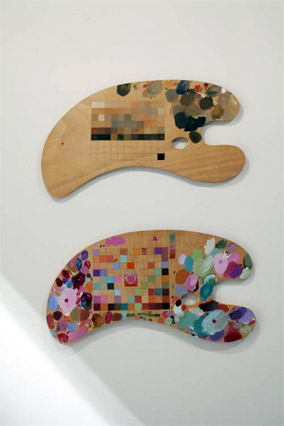
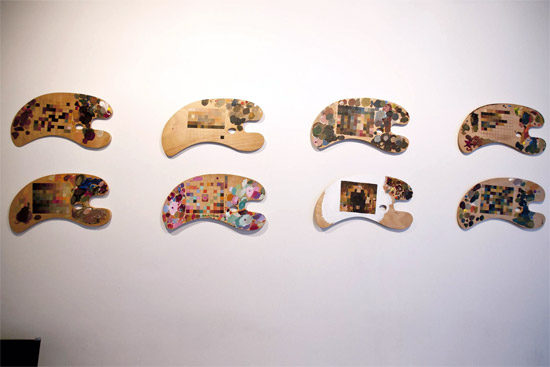
Neidich’s gesture counts on power as the modifier of the neurobiological architecture, coupled to the machinic assemblage of the socio political economic cultural system at large set in motion by its surroundings and context, and uses memories in order to create a plan for future decisions and action.7 This approach enables him to shift away from a rigid and normative understanding of artistic practice, on the one hand, and from an essentialist one, on the other, and to review what Maurizio Lazzarato refers to as “noopolitics”,8 that the focus of power and the technology at its disposal is not the materiality of the body but its psychic life, especially its memory an attention.9 The self-portrait of the artist with a palette, created by Vasa Pomoricac and dating from 1932,10 as well as the overall context of the Lazar Trifunovic Award, have been repositioned, through form and performance, within the framework of a collective process of self-orientated individuals whose interests were joined in order to discover what painting and criticism presuppose today and how they can be relevant. Historical heritage is an integral part of contemporary experience, and the participation of ten contemporary artists and five experts in an experiment created new possibilities of critical engagement. Neidich has staged his historical dialectic dramaturgy at the Belgrade Cultural Center to illustrate a paradigm shift from previously known biopolitics to noo- power – information power: objects no longer change brains, It is information that changes them. Through this project, contemporary art makes it possible for us to create an awareness of differences that are conditioned by various forms of power acting in geopolitical, ideological, economic and scientific contexts. While science is finding similarities and consistencies, art is about creating difference and unleashing the pluripotentiality. One artist and one artwork has the potential to reset artistic parameters and change the history of art.
– Maja Ciric

On Visualized Vision In The Early Photographic Work Of Warren Neidich

On Visualized Vision in the Early Photographic Work of Warren Neidich
Volume 27 Issue 7/8 (December 2010) by Susanne Neubauer
ABSTRACT: This article contains an analysis of Warren Neidich’s early photographic work of 1997 until 2002. These works which are linked to the extensive theoretical production of the artists are contextualized with the concept of the dispositif and apparatus which was developed by Michel Foucault, Gilles Deleuze and recently Maurizio Lazarrato. The article provides a close description of the parameters of four pivotal work groups of Neidich’s early practice, Brain Wash (1997), Double Vision (1997-2000), Short Reverse Shot (2001) and Law of Loci (1998-1999). These works were realized with the aid of low-tech devices stemming from neuro-ophthalmology, marking the interface between current neuro-philosophical discourses such as bio-politics, the plasticity of the brain, the apparatti of visual, i.e. analog and digital culture, and the philosophy of memory. It is suggested that Neidich, even though he intervenes and contributes importantly to these intermingling discourses in a broad manner, is particularly interested in the degraded and infirmed implementations of human vision in order to explore new sensations and habits of perception.
TEXT: When one reads about Warren Neidich’s early work of the 1990s, particularly about American History Reinvented,(1) most of the focus concerns an interpretation of the technical aspects of the production of his oeuvre through a media-philosophical scrim upon which an exploration of the cultural milieu is made possible. Foucault’s notion of Apparatus(2) and the dispositif, developed further by French film theorist Jean-Louis Baudry in the mid-seventies (Baudry, 1975), are relevant to any exploration of Neidich’s work.(3) Having imported optical devices, mainly from the realm of neuro-ophthalmology, for the production of his art works one can utilize these aforementioned theoretical concepts in order to understand his projects more concisely especially those produced and discussed in this paper between 1997 and 2003. The apparatus as a technical term hints at the practical elements of the “machines of seeing” of our “scopic regimes” (Jay, 1988: 3-27) such as photo, film and video camera, projectors as well as the projection space of a cinema (or lecture hall), and finds its counterpart in the idea of the dispositif which supplements – in a more general way – these two closely aligned concepts of structuralism and early structuralist film theory and a more recent counterpart in Maurizio Lazzarato’s media theoretical concept of Noo-politics. For him power establishes itself over the brains of the multitude from afar through the use of contemporary apparatti like the internet and particularly software agents which limit difference and create homogeny by administrating attention and memory (Lazzarato, 2003: 186).
However fascinating the mechanisms of seeing in modern times became when thinking of amateurish photo practice or visits to the movie theatre, the history of vision is above all a history of consumerism and paternalism one hand, and of eagerness for knowledge in the scientific domain on the other. Considering these complex interwoven territories, where vision (in the sense of perception) is subject to the power of knowledge, one can trace back in history its incredible power of infatuation, a danger that is embedded and reproduced more than ever in the digital image.
The idea of a ‘seduced vision’ through an analysis in time both backwards and forward as opposed to one that is simply linear and positivistic to produce, if you will, a-temporal machinic assemblages is inspiring. During the 19th century, scientific photography did not only bring to light until then unknown pictures such as Auguste-Adolphe Bertsch’s mites and other species which were unable to be seen with the naked eye or Josef Maria Eder and Eduard Valenta’s radiographs of animals. Fascination for micro-photography went so far that until the 1860s scientists still believed it possible to see more in a photographic detail when it was blown up. For instance, grains in the film emulsion became when blown-up proof of the existence sub-cellular particles and organelles. That was a tragic misinterpretation of the photographic ontology (Breidbach, 2002[1998]: 221-250). This also calls to mind the intricate investigations on Secondo Pias first photographic capturing of the Holy Shroud in 1898. Photography is, as it may seem, the medium per se to “search for something” (Geimer, 2002: 143-145) that is in flux in its state and hardly recognizable let alone visible.
That these misinterpretations were finally discussed tells one that vision and history cannot be understood separately from each other. Jonathan Crary’s Techniques of the Observer. On Vision and Modernity in the Nineteenth Century (1990) is considered to be an important reference in the delineation of the evolutionary history of modern vision linking it, as it does, to the use and forms of diverse optical devices invented and used during the century of the Industrial Revolution. Crary made clear that an optical machine as primitive as it may look for us today was a device of wonder, fascination and fantasy then. Notwithstanding, it is striking enough that even simple devices such as the stereoscope, which can be tested in many museums of film history these days, are still appealing to us.(4) Stereoscopes, stroboscopes and zoetropes (and the photographic camera) – all pre-cinematic devices have not only been set up in amusement parks of the 19th and early 20th century (Maase, 1997), but were simultaneously used as objects to probe visual capacities such as “time-sense” and “space-sense” perception. Hugo Münsterberg, a German American pioneer in film theory and author of The Photoplay: A Psychological Study (1916), anticipated, as Giuliana Bruno in an extensive essay made strikingly clear, the “neuroaesthetic approach” (Bruno, 2009: 92) which has been developed by Neidich among others and which is being discussed widely in Anglosaxon and German art criticism since the turn of the 21st century.(5) Naming an example, Münsterberg investigated at Harvard Psychological Laboratory how film montage – motion – is able to affect emotion and empathy (Bruno, 2009: 102-103), i.e. in neuroaesthetic terms the shaping of the brain as it were.
This essay is not able to investigate how optical devices influence one’s brain structure in the sense of its changing neuro-physiological states from a scientific neuro-psychological point of view, nor does it explore the artistically less interesting phenomenon of evocating certain visual stimuli in order to surprise or manipulate the viewer as one can see it in works using mirrors or light for example. It shall trace back Neidich’s artistic interpretation of low-tech devices from neuro-ophthalmology such as the prism bar and Lancaster glass, which became adequate items with which to explore their possibilities as hybrid interfaces. These Hybrid Dialectics, as he calls them, are neither diagnostic devices used to determine abnormalities of the brain, nor are they meant to merely obtain particular artistic expressions, but a middle ground with which to “produce new kinds of images in the hope of enlisting in the viewer new sensations and habits of perception.”(6) In this context, the idea of the extended cognition plays a mediating role in Neidich’s thinking as there is the “plastic brain” (Clark, 2008: 68) which is subject to constantly altering states, for instance in the man made milieu in which a series of designed and engineered apparatti are embedded in analogue and digital culture in order to make scopic regimes immediately usable. By linking the history of vision to processes such as cinematic suture, Neidich’s interest lies interestingly enough less in extending the perceptual cognitive apparatus, but in discovering its degraded and infirmed margins.(7) It is the field of rupture and manipulation of the institutionality of visual culture that Neidich intervenes pushing forward the discussion on the idea of the “distribution of the sensible” (Rancière, 2006)(8) and the so-called “economy of attention”, the economic concept of the cyberspace and its urge to bind attention (Mandel and Van der Leun, 1996).(9) The focus of this essay lies therefore in this intriguing relationship between the exploration of a tool (the optical devices) as a metaphor for occidental cultural thinking and its literal use following self-conscious representational strategies. In this sense it can be seen that the exploration of technical and optical devices in the field of art practice is very often misleading viewer’s attention to the wrong site most notably when visual phenomena evoke first of all sensational pleasure. In the case of Warren Neidich’s early photographic pieces one can see how he oscillates between the techné of the artistic process and the realm of the artistic invention.
One of Warren Neidich’s first artworks is a video called Brain Wash from 1997. A man sits at a table and focuses on a rotating black and white striped drum. It’s a so-called “optokinetic drum”(10) which is used as a simple device for stimulation and assessment of optokinetic nystagmus, an involuntary eye movement, respectively. Brain Wash was Neidich’s first application of his Hybrid Dialectics and was closely aligned with the concept based on Marcel Duchamp’s idea of the objet trouvé by which the double-sided, hybrid character of a work of art as dependent on its authoritative context is made strikingly clear for the first time in art history. The camera/viewer observes the man staring at the drum and a close-up of the eyes shows the particular eye movement of the protagonist. This kind of subtle vibration of the eyeballs is followed by a cut away shot of the eyes of the man at a distance which now move rhythmically to and fro, left and right. In the next scene the viewer visualizes a 180 degree pan of the horizon which is made to shake and tilt. The purposeful shaking of the hand held camera in this sequence is a direct reference to the type of unstable frame that characterizes Lars von Trier’s aesthetics of Dogma. The notable linkage of the camera as apparatus connected to the apparatus of seeing was a nod to Duchamp’s Handmade Stereopticon Slide (c. 1918-1919) which fuses geometry, projection and perception paradigmatically showing the horizon of the sea and an octahedron. As Neidich pointed out, this particular sequence depicts the “eratic spaces of a world in transition.”(11) At the conclusion of the 180 degree camera pan movement there is a cut to the man again (revealing that it was apparently not he who was looking), followed by a close-up of the eyes again looking left and right, ending in a fade-out of the rotating optokinetic drum. The whole story is accompanied by a fast-paced sound track from the Japanese pop group Pizzicato Five.
Brainwash can be seen as sort of a comedy. Its narration is based on different filmic strategies such as the use of the linear arrangement of sequences at the beginning in which tracking shots, cutting in and away and the close-up are assembled together. This virtual movement is traditionally perceived as a stringent development of a simple time-space-relationship as can be observed in the early films of the Lumière brothers. The other strategy, the more elaborate one, is the shot reverse shot, a film technique that imitates throwing a glance at another person, often off-screen, in order to make clear to the spectator which protagonists are looking at each other. Simply said, each device which interrupts the traditional filmic eagerness to imitate human perception gives evidence to the factitiousness of the film. This happens in Brainwash in a quite tricky way when filmic conventions are broken up by juxtaposing sequences that give one the impression that they fit – nevertheless, they don’t. The piece is therefore even more of a caricature in the sense of E. H. Gombrich’s definition of identities that “do not depend on the imitation of individual features so much as on configurations of clues (…)” (Gombrich, 1986: 292). Similarly, Neidich does not seem to guide the perception of the viewer to clues just in order to communicate a content, but to the quite opposite, paradox direction. Having the optokinetic nystagmus caricatured by eyes moving is one such paradox for from a neuro-scientific point of view one has nothing to do with the other. This example displays how two divergent concepts collide. Even more obviously is the tilting shore as a sequence which depicts the internalised vision of the protagonist. Again, it is neither nor. As the camera moves around and stops at the body of the man, the sequence of the shore is a “double-vision” film convention, unclear of course who is who and who sees what. Nevertheless, this is Neidich’s manipulation of the cinematic gaze and – above all – his engagement in the philosophy of perception.
Brainwash can be considered a relevant example to introduce Warren Neidich’s medium comprehensive practice. His practice is shaped by a thorough knowledge of the physiognomy of the eye and the brain, the psychology of perception and the history of art. He uses optical devices as a starting point from which he explores his core questions. As one can understand in seeing Brainwash he uses low-tech devices and, as in this case, filmic (that is perceptional) conventions, in order to visualize what effects and shapes the brain, but also deceives the eye. The optokinetic drum in the beginning and the end of the video serves as a parenthesis. If Neidich would have executed this image as a painting, it could have been something such as Bridget Rileys’ Cataract 3 (1967) whose title, it is not without reason, is also a notion from ophthalmology. Strikingly, Riley’s and Neidich’s artistic expression is inspired by a negative connotation: the defect of vision. Working with the negative(12) Neidich reformulates what is considered a damage to or a loss in vision. Another series of work, his photographs Double Vision (1997-2000), among others, take up this idea and transfer it into a paradoxical but positive result. Double vision, or diplopia, is a dysfunction of one or both eyes, so to speak a misalignment of the eyes which results in seeing double. Interestingly enough the brain is able to correct and suppress the information of one eye because movement through space proves evolutionarily speaking difficult and even dangerous.
Double Vision, Louse Point (1997-1998) is a series of photographs that shows scenarios of bathing people at the beach of Louse Point on East Hampton, New York. The images are a reminder of the recreational gatherings of the well-known artists and writers Willem de Kooning, Jackson Pollock, Lee Krasner, Helen Frankenthaler, Clement Greenberg and others in the 1950s. Neidich’s images obtain a touch of nostalgia by equilibrating the photographic colours, mainly by reducing magenta that gives the impression as if the photographs had been exposed to too much sun.(13) The images show an unusual element: translucent blue and red circles, reminding one of the strange phenomenona of orbs.(14) Unlike the opaque blobs on John Baldessari’s faces, Neidich’s spheres do not replace, mask or abstract, but float and shimmer translucently like extraordinary atmospheric phenomena – blue tinted lunar eclipses, red fireballs, but also the diaphanous coloured glass of a Claude’s glass. There is something mythical about them with their coronas, as they seem to move “spot lighting” the outer world like a light ray either ignoring people in the image or aiming directly at them. By being translucent, the coloured circular surface marks undoubtedly an area between the viewer and the scenery.
The phenomenon of double vision is not seen here as a misalignment but as a movement into visual depth towards the vanishing point. Being created by placing a Lancaster glass in front of the camera lens,(15) Neidich’s apparatus refers to the single point perspective construction as an expression of the outer world’s symbolic form in Erwin Panofky’s sense (Panofsky, 1991). However, there is also the artist’s other interest in visual perception in a more physiological way than Panofsky. One can argue, that Neidich’s photographic work also marks a spot as an area of afterimage, pointing out unknown areas of the science of neurology with a hint to “cognitive ergonomics” as he calls it (Neidich, 2003: 21). The phenomenon of afterimage can serve here as a metaphor of what can be seen in this image production, an amalgam of remembrance, inner perception in the shape of visualized visual traces of the brain cortex, and most of all the result of an artistic process to break up the mimetic function of photographic representation.
Warren Neidich makes ample use of optical devices in his early art works. Another work, Shot Reverse Shot is a series of performances, resulting in a video and a series of photographs. Again, he is not reformulating the traditional filmic strategy of the shot reverse shot, but uses the technique literally in order to obtain not only unknown visual experiences but also distinct viewing structures. The prism bar, which is held in front of the protagonist’s eyes, fans out perception revealingly in both ways. The object is a neurological and ophthalmological device to measure an eye’s deviation after a stroke or a trauma for the later surgical reconstruction of the misalignment and reconstitution of single vision. In Shot Reverse Shot it is used as a cadenced glass to look through, a window which is in itself the traditional metaphor of vision since the picture pane depictions by Leon Battista Alberti in De Pictura (1435) and Albrecht Dürer in Underweysung der Messung (1538). Exploring the situation of the two protagonists – viewers, one of them filming the scene – who look through the prism bar standing in front of each other and experiencing a refracted view, one is immediately reminded of another concept of perception which is Jacques Lacan’s often cited three diagrams from The Four Fundamental Concepts (1981). As Martin Jay pointed out, Lacan was very much inspired by his friend of the Surrealist magazine Minotaure, Roger Caillois, who introduced a dihedron to “clarify the relation between eye and gaze (…) in his 1935 essay on ‘Mimétisme et psychasthénie légendaire’” (Jay, 1993: 365). Lacan developed the idea of the screen (écran) which is the site of correlation between one’s eye looking at an object and the gaze (marked as “light”) looking back. It is intriguing to see that Lacan is using the metaphor of the camera to come to the second diagram(16) and to his understanding, that what “was looking at me at the level of the point of light, the point of light, the point at which everything that looks at me is situated.” (Lacan, 1981: 95 and Jay, 1998: 365).(17) In his concept the screen is the place of the subject who is not only “caught, manipulated, captured in the field of vision,” (Lacan, 1981: 92 and Jay, 1998: 364) but who also embodies the paradox of being in between light and the opaque simultaneously. With the screen concept the single focus of the God’s eye-view is clearly abandoned. Coming back to Neidich’s work Shot Reverse Shot one can trace back such concepts by understanding the prism bar as a place of interference. The viewing structure is antidromic, even equally administered between different protagonists who are all from mixed ethnical background. Each one embodies different historical conceptions using the analogue simple device of a prism bar or the digital video camera. One can even argue that the gaze of the protagonists, being documented on one side, experienced unmediated on the other, is a paradigm of an altering subjectivity in process by the aid of a prosthesis and a clue to the neo-liberal global world order governed by the WWW.(18) This would also sync up with Lacan’s notion of the screen as a place of mediation. Kaja Silverman commenting on this relationship proposed that Lacan’s screen is also subject to social and historical interpretations “by describing it as that culturally generated image or repertoire of images through which subjects are not constituted, but differentiated in relation to class, race, sexuality, age and nationality,” (Silverman, 1989: 75-76) an observation which also possesses validity in Neidich’s work.
Using the prism bar in a direct way such as in the Shot Reverse Shot project one can also observe that in its playful use it instigates the dissolution of personal space and boundaries that determine personal interactions. Even though vision is refracted, the process of seeing not only more but above all unconventionally is, as mentioned above, crucial and is very much related to Neidich’s neuro-biopolitical interests. Whereas Shot Reverse Shot can be seen as part of Neidich’s interactive projects the last photographic series being discussed in this paper is dedicated to photography as a medium of guarding the past (actually the present in its moment of capturing) for the future. It is also part of Neidich’s extensive explorations into the “History of Consciousness”.
Law of Loci was undertaken by Neidich in a short time span of approximately fifteen months in 2002-2003 when the artist visited his ill father’s home outside New York City regularly. The term describes the main mind memory aid of the Antique world delineated by Cicero in De Oratore. Cicero himself employed the method to memorize his speeches by walking mentally through the area of the Forum romanum. Simonides of Ceos, the legendary inventor cited by Cicero, found out that by using the spatial relationship of the imagination of a house one is able to recall things better. Instead of walking mentally through the space of the house he grew up in he instead physically wandered from room to room as well as outside revisiting spaces of his childhood and adolescence where things had happened to him. This physical component of the project became pivotal. By moving through his parents’ house and its environments the artist explored and questioned what is one of the core functions of photography: capturing traces of actuality. As Roland Barthes has showed so poignantly in Camera lucida (1981) the photograph occupies the place of remembrance and mourning. It is still striking that capturing images of beloved persons and places, the present of that particular moment is inscribed into the surface of the filmic material as soon as it is taken and is turned into the past the very moment. Neidich’s series of Law of Loci above all visualises this paradoxical nature of photography.
The photographs of Law of Loci were taken through a prism bar with positive-negative Polaroid film material. They depict a fragmentary vision of the house, selected views from its inside such as photographs hanging on a wall, curtains, and also Neidich’s father. They also show its close surrounding, a lake, a shack, tables and chairs in a garden, and trees. The pictures are sometimes blurred, often tilted, and black and white. Having used Polaroid film material the idea was to capture a snapshot instantly, finding a visual analogy of an experience that cannot be caught in a picture without undergoing essential transformations. As Thierry de Duve argues, the “snapshot is a theft; it steals life. Intended to signify natural movement, it only produces a petrified analogue of it. It shows an unperformed movement that refers to an impossible posture. The paradox is that in reality the movement has indeed been performed, while in the image the posture is frozen.” (De Duve, 1978: 114). Neidich’s way to produce these images was not only to move physically through space in order to find views which represented his remembrances of the house at that particular moment. He also had to move the prism bar in order to split up his own vision and receive an aesthetic expression which in some ways mimics early movement studies of the history of photography. Therefore, the effect of instant photography was not based on capturing the fluidity of life, but on seeing the effects of the prism movement in the moment when the images were taken. As de Duve argues, not only the image is frozen, but in Neidich’s case even movement is brought to a standstill. By using this unorthodox photographic practice Neidich found a way to match the physical world with an analogue of his mental vision of the non-depictable, arguing that memories are unable to be captured in a picture and can only be visualised by finding a metaphorical counterpart. Memory is considered non-representional, continual and performative, as Gerald Edelman and Giullo Tononi recently argued: “(…) memory in global mappings is not a store of fixed or coded attributes to be called up and assembled in a replicative fashion as in a computer. Instead, memory results from a process of continual recategorization (…) There is no prior set of determinant codes governing the categories of memory, only the previous population structure of the network, the state of the value systems, and the physical acts carried out at a given moment.” (Edelmann and Tononi, 2000: 97-99).
This understanding of a performative mutating memory could be also seen in relation to the German film theorist Siegfried Kracauer’s concept of the photographed object or person as a ghost. In the early essay “The Photograph” (1927) Kracauer describes how capturing a photograph of an actuality is gradually sliding into the far past and that there is always a drifting away of the past from the present. As German film theorist Heide Schlüpmann pointed out, Kracauer’s concept of photography in the interwar times was very much influenced by Marcel Proust’s A la recherche du temps perdu where the French novelist delineates his encounter with a photograph of his grandmother (Schlüpmann, 1991: 115).(19) The image of the grandmother plays an equivalent crucial role in Kracauer’s essay because he had recognised a sort of estrangement in it (Schlüpmann, 1991: 116)(20). Kracauer sees a dichotomy between the photograph and the memory arguing that memory “encompasses neither the entire spatial appearance of a state of affairs nor its entire temporal course. Compared to photography, memory’s records are full of gaps,” therefore “memory images retain what is given only insofar as it has significance. Since what is significant is not reducible to either merely spatial or merely temporal terms, memory images are at odds with photographic representation.” (Kracauer, 1995[1927]: 50). Kracauer’s understanding of photography is not primarily based on the ontological concept of the analogue print with a reference to positivist science as can exemplarily be seen in Roland Barthes’ concept of the referent. He recognises different temporal states of a photograph and made clear that even though temporality is written into the process of registering an image, the photographic image does not conserve the depicted but rather destroys it. This can be seen in his extensive exploration of the photographs of different women such as his grandmother. Most importantly his research is based on a present evaluation of the photographic effect and in distance to the various pasts which are trapped in the photographs.
Neidich’s Law of Loci is not only an example of photographic imagery which is not able to preserve the past in a constant way, even less as a visualization of personal memories. His conceptual approach is based on pivotal theories of photography and the mnemosyne dealing with the idea of capturing the personal and the present which is in flux of being lost, becoming the past immediately. Admittedly, the process of production is insofar technical and a re-evaluation of photographically registered movement as it is based on the structure of the apparatus. And even though the images of Law of Loci recall Etienne-Jules Marey’s geometric chronophotographs or Eliot Eliofson’s photograph of Marcel Duchamp decending a staircase (21), Neidich’s process is less conducted towards an exploration of the physical conditions of light exposure and film speed. The so obviously registered movement is produced on a third spot, namely with the help of an optical device which is linked to the science of perception and, not to forget, the failure of human vision. Even though quintessentially analogue the pictures of Law of Loci have to be understood as unfathomably detached from the referential nature of its production. The question remains unanswered if an understanding of these works necessarily ask for a clarification of its production process, if one remembers the examples from the past when magnifying glasses made so far unknown worlds visible. Neidich’s early photography serves both ways, and its conceptual nature makes a deep understanding of the metaphorical meaning of the artist’s use of optical devices visible. However, despite the media-philosophical and the literal use of these objects, the photographic works also can be seen as a sort of enigmatic pictures that link the nature of these images not to the visible world, but to notions of the unreachable.
References
Barthes, R. (1981) Camera lucid: reflections on photography. New York: Hill and Wang.
Baudry, J.-L. (1975) ‘Le dispositif: approches métapsychologiques de l’impression de réalité’, Communications 23: 56-72.
Breidbach, O. (1998) ‘Der sichtbare Mikrokosmos. Zur Geschichte der Mikrofotografie im 19. Jahrhundert’, Fotogeschichte, Beiträge zur Geschichte und Ästhetik der Fotografie 68/69: 131-142; English reprinted in Breidbach, O. (2002) ‘Representation of the microcosm – The claim for objectivity in 19th century scientific microphotography’, Journal of the History of Biology 35: 221-250.
Breidbach O. and Clausberg K. (1999), Video ergo sum: Repräsentation nach innen und aussen zwischen Kunst- und Neurowissenschaften. Hamburg: Verlag Hans-Bredow-Institut.
Bruno, G. ‘Film, Aesthetics, Science: Hugo Münsterberg’s Laboratory of Moving Images’, Grey Room 36 (Summer 2009): 88-113.
Clausberg K. (1999) Neuronale Kunstgeschichte: Selbstdarstellung als Gestaltungsprinzip. Wien, et al.: Springer, 1999.
Clark, A. (2008) Supersizing the Mind: Embodiment, Action, and Cognitive Extension. Oxford, New York: Oxford University Press.
De Duve, T. (1978) ‘Time Exposure and Snapshot: The Photograph as Paradox’, October 5: 113-125.
Dietz, S. (1989) American History Invented. New York: Aperture.
Foucault, M. (1980) Power/Knowledge: Selected Interviews and Other writings, 1972-1977, ed. and trans. C. Gordon. Brighton: Harvester Press.
Geimer, P. (2002) ‘Searching for Something. On Photographic Revelations’, in Iconoclash: beyond the image wars in science, religion and art, ed. Bruno Latour, Peter Weibel. Cambridge, Mass., et al.: MIT Press.
Gombrich, E. H. (1986[1960]) Art & Illusion. A study in the psychology of pictorial representation. London: Phaidon.
Jay, M. (1988) ‘Scopic Regime of Modernity’, in Vision and Visuality, ed. Hal Foster. Seattle: Bay Press.
Jay, M. (1993) Downcast Eyes: The Denigration of vision in Twentieth-Century French Thought. Berkeley: University of California Press.
Kracauer, S., (1995 [1927]) ‘Photography’, in Kracauer, S. The mass ornament: Weimer essays, edited by Thomas Y. Levin. Massachussetts/London: Harward University Press.
Lacan, J. (1981[1964]) The Four Fundamental Concepts of Psycho-analysis, ed. Jacques-Alain Miller. New York: W.W. Norton & Co.
Lazzarato, M. (2006) ‘Life and the Living in the Societies of Control,’ in Fuglsang, M. and Meier Sorensen, B. Deleuze and the Social. Edinburgh: Edinburgh University Press, 2006 page 186
Linke, D. B. (2001) Kunst und Gehirn : Die Eroberung des Unsichtbaren. Reinbek bei Hamburg: Rowohlt-Taschenb.-Verlag.
Livingstone, M. (2002) Vision and art: the biology of seeing. New York, NY: Abrams.
Maase, K. (1997) Grenzenloses Vergnügen : der Aufstieg der Massenkultur 1850 – 1970. Frankfurt am Main: Fischer-Taschenbuch-Verlag.
Maharaj, S. (2005-2007) ‘From the Afterlife to the Atmospherics reassessing our basic assumption’, in Journal of Neuro-Aesthetic Theory 4, http://www.artbrain.org/from-the-afterlife-to-the-atmospherics-reassessing-our-basic-assumptions/ (accessed February 12, 2010).
Mandel, T. and Van der Leun, G. (1996), Rules of the Net. On-Line Operating Instructions for Human Beings. New York: Hyperion Books.
Neidich, W. (2003) Blow-up: Photography, Cinema and the Brain. New York: D.A.P./Distributed Art Publishers.
Neidich, W. (2008). Earthling, New York: Pointed Leaf Press.
Neidich, W., et al., (2009a) ‘Some cursory comments on the nature of my diagrammatic drawing’, in Warren Neidich: Lost Between the Extensivity/Intensivity Exchange. Eindhoven: Onomatopee.
Neidich, W., et al. (2009b) “The Neuro-Aesthetic Library”, in in Warren Neidich: Lost Between the Extensivity/Intensivity Exchange. Eindhoven: Onomatopee: 114-119.
Panofsky, E. (1991[1927]) Perspective as symbolic form; transl. Christopher S. Wood. New York: Zone Books; Cambridge, Mass.: MIT Press.
Rancière, J. (2006) The politics of aesthetics.:The distribution of the sensible, ed. and trans. Gabriel Rockhill. London; New York: Continuum.
Schlüpmann, H. (1991), ‘The Subject of Survival: On Kracauer’s Theory of Film’, New German Critique 54: 111-126.
Silverman, K. (1989) ‘Fassbinder and Lacan: A Reconsideration of Gaze, Look, and Image’, Camera obscura 7: 54-85.
Stafford, B. M. and Terpak, F. (2001) Devices of wonder : from the world in a box to images on a screen. Los Angeles, Calif.: Getty Publ..
Zeki S. (1999) Inner vision : an exploration of art and the brain. Oxford, et al.: Oxford University Press.
Susanne Neubauer is a freelance curator and art historian. She was curator at Kunstmuseum Luzern, Switzerland, from 2002-2009 and is currently a PhD candidate of the University of Zurich. She is the author of numerous articles on contemporary art and the art of the 1970s. Her main interest is in the documentation and publication of ephemeral art, curatorial strategies and the reception of Latin American art in Europe. Her recent essays are on Ree Morton, Lygia Clark and Paul Thek.
Endnotes:
[1] The work American History Invented from 1989 is a thoughtful use of different historical printing materials, camera lenses, and archival display methods. See (Dietz, 1989).
[2] “The apparatus is thus always linked to certain limits of knowledge that arise from it and, to an equal degree, condition it”. See Michel Foucault’s understanding of the apparatus which is of particular interest for Neidich: (Foucault, 1980: 194-196).
[3] As are the works of Michael Snow, Stan Brakhage and Jean-Luc Godard. Neidich’s interest lies above all in the unveiled processes of the cinematic production as can be seen in Snow’s Wavelength (CAN, 1967), Brakhage Prelude: Dog Star Man (USA, 1961) and Godard’s Le mépris (F, 1963).
[4] The contrary case, I would suggest, is a walkable camera obscura where the projected image, depending on the weather outside, is usually not very well visible – and for your habits a disappointing matter.
[5] Neidich began lecturing on Neuroaesthetics in 1995 at the School of Visual Arts New York. See on his take on neuroaesthetics and the concept of neural plasticity: Journal of Neuro-Aesthetic Theory (www.artbrain.org; founded by Warren Neidich), (Neidich, 2009b: 114-119), (Livingstone, 2002), (Stafford and Terpak, 2001), (Linke, 2001), (Zeki, 1999), (Breidbach and Clausberg, 1999), (Clausberg, 1999).
[5] Email to the author, April 19, 2010.
[6] On the “intoxicated sight” see (Neidich, 2003).
[7] Neidich has referred several times to the work of Jacques Rancière, claiming that particularly in the mutation of the so-called “distribution of the sensible” the power of art can be found. Reformulated as “redistribution of the sensible” Neidich’s own theoretical writing links the concepts of power of Michel Foucault and Gilles Deleuze to Maurizio Lazarrato’s concept of “noo-power.” On this discussion see (Neidich, 2009a).
[8] In the sense of Thomas Mandel and Gerade Van der Leun, “attention is the hard currency of cyberspace.” (Mandel and Van der Leun, 1996).
[9] I do not agree in seeing a zoetrope in this device as many other writers have referred to when explaining Brainwash, including the artist. A zoetrope is a precinematic device which is created by a round cylinder obtaining observation slits and a series of images such as a galloping horse which are attached in the inside. While looking at a turning zoetrope, one’s eyes focus on the image(s) inside which causes the effect of the illusion of a moving image. There is no eye movement in itself which distinguishes the core function of a zoetrope from a optokinetic drum.
[10] “At the heart of this video is the notion of the cataclysmic shift of the viewer of the late 19th century as he or she transitioned into the early 20th century. A viewer in which cinema not photography would produce the conditions of perception and cognition.” Email correspondence with the author, April 19, 2010.
[11] Stan Brakhage’s experimental film Prelude: Dog Star Man (USA, 1961) where he scratches analogous film material or uses distorting lenses in order to receive unknown imagery to the eye is another example.
[12] Photographs change their colors due to chemical instability of the photographic paper. Magenta and yellow is reduced when photographs receive too much light, cyan and yellow are more instable in darkness.
[13] Some people believe that orbs are paranormal balls of light on photographs or video film.
[14] Neidich’s sculptural and photographic works, also the Hybrid Dialectic Device, were shown in the exhibition “The Mutated Observer, part 1” at California Museum of Photography in 2001.
[15] On Lacan’s use of the camera as metaphor or an “imaginary apparatus” see (Silverman 1989: 72).
[16] In this passage Lacan offers an anecdote of a floating sardine can in water. Lacan explained that the can “was looking at me, all the same. It was looking at me at the level of the point of light, the point of light, the point at which everything that looks at me is situated – and I am not speaking metaphorically.” (Lacan, 1981: 95), cited after (Jay, 1998: 365).
[17] The exploration of this condition influenced Neidich’s later work, Earthling. See (Neidich, 2008).
[18] „I was in the room, or rather I was not yet in the room since she was not aware of my presence… Of myself… there was present only the witness, the observer with a hat and traveling coat, the stranger who does not belong to the house, the photographer who has called to take a photograph of places which one will never see again. The process that mechanically occurred in my eyes when I caught sight of my grandmother was indeed a photograph.” Marcel Proust, In Search of Lost Time. Swann’s Way, quoted by (Schlüpmann, 1991, 115).
[19] Schlüpmann argues that this photograph in the 1920s was retrospectively already part of film, as its concept represented “the repression of death, the continuation of life”. (Schlüpmann, 1991: 116).
[20] Reproduced in Life Magazine, Nr. 284, New York,

Education of the Eye, 2010


Time Out New York | Book Exchange at Glenn Horowitz
Art day trips: Warren Neidich’s “Book Exchange” at Glenn Horowitz Bookseller
By: T.J. Carlin | Article Link
If you’re looking for some culture and an investigation of patriotism with your sun this holiday weekend, try artist Warren Neidich’s gorgeous show at Glenn Horowitz Bookseller, a bookstore and gallery in East Hampton, New York. The central piece is a handsome steel bookshelf fashioned after a Constructivist aesthetic that houses all of the books Sarah Palin attempted to have banned from the Wasilla, Alaska, library. Whether or not these attempts at banning were successful is unknown; however, Neidich has enabled us to exert some control and rewrite history a bit in our own fashion: The participatory piece invites locals, over the course of the exhibition, to visit the bookstore bearing a red book and exchange it for one of the verboten. From 3 to 5pm today, there will be a book release for Neidich’s new artist’s book, The Sarah L. Palin Library of Censored Books. Fri, Sat, Mon 10am–5pm; Sun noon–4pm. Through Monday, July 5.
Reinventing History: Warren Neidich, Photography, Re-enactment, and Contemporary Event Culture

Visual Resources
Reinventing History: Warren Neidich, Photography, Re‐enactment, and Contemporary Event Culture
Volume 26 Number 2 (June 2010) by Kathy Kubicki
The role of the historian and the notion of what constitutes historical evidence have become more unstable in recent decades, particularly with digital imaging technology. In Warren Neidich’s project (and 1989 book) American History Reinvented, the photographer anticipated the myriad current art practices that engage with re-enactment, where artists restage past events to investigate current political and social condition. Rather than simply perpetuating a complacent nostalgia for the past, a re-enactment as an art project may have the potential to prompt a critical reevaluation of historical narratives. A consideration of additional, more recent, photography suggests how Neidich’s American History Reinvented can be understood as a precursor to the work of contemporary practitioners negotiating the territory of re- enactment, particularly the UK artists Jeremy Deller (b. 1966), who won the Turner Prize in 2004; Tom McCarthy (b. 1969) and Rod Dickinson (b. 1965) in their collaborative projects; and photographer Jim Naughten.
In 1989, Warren Neidich published his American History Reinvented, a vast project, using the medium of photography to engage in a discourse that goes further than the mere interpretation of history.11 Within Neidich’s many reconfigurations of history, a complex story is retold with layered and intricate methodologies, taking the viewer beyond memory, to uncharted territory where the line between truth and fiction becomes blurred. As Neidich’s philosophy is deeply rooted in cognitive science, he claims that the human brain is currently undergoing a phase of “cyborgisation,” due to immense and sudden changes in our media-centered technological environment. In his book Blow-up: Photography, Cinema and the Brain (D. A. P., 2003), Neidich proposes a model in which natural memory (those memories recorded through experience with the real world) and photographic memory (the production of memory constituted through the mind’s interaction with the plethora of mediated images found in books, advertising posters, in family albums, museums, billboards, and film) are in competition for neural space.12
Given Neidich’s emphasis on the formation of memories and their relationship to both authentic, lived experience and to photographic imagery, American History Reinvented can best be discussed in the context of theories of replay, sampling, and re-enactment, and as part of event culture and mass media. Neidich is playful in his reinterpretation of historical events in American history, and tests notions of truth within the history of photography, particularly within photojournalism. His reinventions go beyond the world of historical evidence, and into the realm of creative photography, where the notion of truth is subjected to the bizarre, surreal ambience of staged museum settings and the other institutional spaces that Neidich has critiqued. (See, for example, “Gallery,” p. 000: “Recoding American History, Roping off History,” 1986.) Neidich’s project crosses the line between documentary practice and conceptual art. As Pavel Büchler has argued:
A critical attitude towards older or concurrent (competing) modes of production is one of the most distinctive features of modern art. At its most radical, as for instance in 1960’s conceptual art, it was this systematic scrutiny of the traditions and conventions of modernist photography that brought to the fore the possibilities of integrating photography’s broader social functions, within art.13
Büchler puts forward the notion of “investigation” as the driving force behind this type of photography, and in this respect, Neidich’s practice corresponds to the work of Victor Burgin (b. 1941), David Hilliard (b. 1964), and Bernd (1931–2007) and Hilla Becher (b. 1934). A consideration of more recent photography suggests how Neidich’s American History Reinvented can be understood as a precursor to projects of contemporary practitioners negotiating the territory of re-enactment, particularly UK artists such as Jeremy Deller (b. 1966), who won the Turner Prize in 2004, Tom McCarthy (b. 1969) and Rod Dickinson (b. 1965) in their collaborative projects, and photographer Jim Naughten.
History and Re-Enactment, Then and Now
The role of the historian and the notion of what constitutes historical evidence have become more unstable in recent decades. The intervention of digital technology has revolutionized history-in-the-making, as well as the analysis and distribution of recordings of events. Neidich’s 1989 project interrogated these changes at the very beginning of this paradigm shift, highlighting the speedy, almost seamless, revolutionary changes within the culture of information technology. Simultaneously, Neidich’s work investigates issues of identity politics, and his method of exploration using historical evidence as a construction has only become more meaningful over time, and as the number of texts relating to these issues has increased.
Neidich’s project questions the supposedly harmless nostalgia offered by “living history” museums and re-enactments, revealing their one-dimensional view of events, and unmasking the information received in this context as inauthentic and fictional. It is the institutional context of the museum and the presumption of photography’s truthfulness that verifies the meanings attached to the reconstructed scenes. As one commentator has put it, “Neidich engages in an act of cynicism and originality…a fictional rectification of social roles that both pre- and postdates the famous Farm Security Administration Project that established the important role of the photographer in America’s social conscience.”14
Theorist of photography Vilém Flusser has claimed that the machine has dominated the postindustrial age, but specifically in the mode of what he calls “apparatus”: camera, computer, agencies of state, and market forces. Flusser insists that, “apparatuses were invented in order to function automatically, in other words independent of future human involvement. This is the intention with which they were created: that the human being would be ruled out.”15 What Flusser puts forward is the notion of the photographer as a “passive” interloper in the photographic experience, secondary to what is made possible by the technology at hand. The machine controls the processes, and even though the photographer makes a choice in relation to how the photograph is taken and processed, he or she is secondary to an outcome predetermined by the existing technologies. Neidich’s practice consistently and deliberately questions the apparatus as paradigm in his conceptual approach to reinterpretation, and in his groundbreaking project, he has self-consciously chosen handmade technologies in his interventions on prestructured historical events.
Neidich’s exploration of photography, history, and reinterpretation includes, for example, the juxtaposition of albumen prints with a set of photographs after retouching, printed at an amateur photo lab on RC paper, a cheap plasticized imitation of real paper (“Gallery,” p. 000: “Pseudo Event, Free Soil,” 1987–1988). The rationale for this choice is threefold: firstly, to draw attention to the importance of photographic materials and their symbolic function in the determination of photographic meaning. We are reminded that photographic history itself is not, as Beaumont Newhall suggests in his canonical chronicle of the medium, a linear progression of techniques, technologies, and creative potential.16 Secondly, the use of RC paper draws attention to the material distinctions between the handmade prints throughout the history of photography and the mass-reproduced machine prints of today. Finally, this decision binds these images, through their materiality, to other images that derive from library files in which one never has a chance to inspect the original archive or touch the original prints.
Later in Neidich’s ongoing project, he uses the giant Polaroid format in his appropriation and reshooting of the Associated Press propaganda photographs depicting Japanese Americans interned in relocation camps during World War II, fraudulentlymposed as happy and thriving individuals (“Gallery,” p. 000: “News from No-Place, Return of Loved Ones,” 1988–1989). These images operate alongside Neidich’s staged photos of African Americans inhabiting the life and roles of the nineteenth-century bourgeoisie in America. In this section (“Pseudo Event: the Politics of Appropriation”), the staging of historical events and their subsequent manipulation and falsification calls attention to the well-documented instances of similar alterations in archives such as those manufactured by Joseph Stalin and Mao Zedong, who felt it necessary to manipulate their own national photographic record in the hopes of solidifying personal legacies.17
Viewing and reinterpreting these photographs requires a leap of faith on the part of the viewer, for in the context of the institutional archive, we are predisposed to believe unquestioningly what the photograph tells us. Neidich’s interventions reveal how the use of RC prints in archives becomes part of the inbuilt illusion of “authenticity,” as the resin-coated paper in this process is sealed by two polyethylene layers, making it impenetrable to liquids. Since no chemicals or water are absorbed into the paper base, the time needed for processing, washing, and drying is significantly reduced in comparison to fiber-based papers. Resin paper prints can be finished and dried within twenty to thirty minutes. Resin-coated papers have improved dimensional stability, and do not curl upon drying. And so, as we observe the quickening of time, photos made in haste, and the intervention of modern photographic processes, there is the emphasis on durability over fragility and on the distance from the original photographic processes.
Neidich’s photographs are typically taken onsite with a 4 × 5 camera and rephotographed with a 35 mm camera to make the doppelganger in an act of self-appropriation. This type of assemblage is found in many of the series that make up American History Reinvented, as falsification becomes the believable norm. Each series utilizes a different kind of camera, lens, and format.
For “Aerial Reconnaissance Photographs: The Battle of Chickamauga” (this event originally took place 19–20 September 1863), the artist hired a twin-engine plane to fly over a Civil War re-enactment at a historic battlefield outside Chattanooga, Tennessee, in order to photograph it from the air; he then processed the resulting images in the archaic tintype format (“Gallery,” p. 000: “The Battle of Chickamauga,” 1990–1991, and “Chickamauga Double Line-up,” 1990). Here Neidich re-enacts Félix Nadar’s legendary balloon journey above Paris in 1858, but he also produces a dialogue with Edward Steichen’s famous aerial photographs first delineated in Allan Sekula’s pivotal study “The Instrumental Image: Steichen at War.”18 Again, Neidich’s use of tintypes oppositionally foregrounds the contemporary modernization of information gathering, museum culture, and memory. For this series, Neidich used a 35 mm camera with three different lenses—wide-angle, normal, and telephoto—to make pictures of the re-enactments.
Neidich’s work also draws our attention to present-day staged news events. From George W. Bush’s triumphant landing on an aircraft carrier to the annual Academy Awards ceremonies, we are overwhelmed by what Daniel Boorstin referred to as “pseudo-events” in which make-believe events are created only to be documented and distributed through media circuits for profit.19 These are woven into the daily menu of disasters, scandals, and gossip to be distributed worldwide on twenty-four-hour news channels hungry for fresh stories to disseminate to a public riveted to television sets and computer screens. In this evolving cultural-visual landscape, the conditions of the truth of the image can vary enormously.
Contemporary Art Practice and Re-enactment
One can trace a genealogy for Neidich’s work in early experimental art photography, including that of the Surrealists, whose “staged” photographs provoke visual discord, questioning the relationship between representation and reality. Here, silent dramas enhance for the viewer the strangeness of unlikely juxtapositions, as in the staged montages of Antonin Artaud (1896–1948) and Eli Lotar (1905–1969). The “performed image” creates dissonance for the viewer, placing him or her in a separate, third space of observation, between reality and unreality. The questioning of what is real becomes a part of the viewer’s experience, but the scopophilic drive and desire to encounter the truth overrides and suspends the viewer’s disbelief.
As in Surrealism, Neidich’s camera acts as a scientific instrument that takes the place of the organ of sight in the detection of strange and reinvented realities. In Neidich’s framing and cropping, insertions, and playful rearrangements of reality, he offers up a hypertrophied real, where the viewer remains in a liminal state, between what has happened in the past and what changes have occurred in the re-enactment, and observes the actual physical interventions in the photographs that mediate between the two.
Neidich’s American History Reinvented looked forward perspicuously to myriad current art practices that engage with re-enactment, and in which artists restage events as investigations of current political and social conditions. Neidich’s work is also an examination of the problems of authentically performing the past. He analyzes re-enactment both as a cultural phenomenon and as a series of performances that aim to recreate past events accurately. Rather than simply perpetuating a complacent nostalgia for the past, a re-enactment as an art project may have the potential to prompt a critical reevaluation of historical narratives as singular isolated events.
Until recently, with the notable exception of Richard Schechner, there has been little written about the phenomena of the historical re-enactment.20 In the last two decades, however, studies on re-enactment produced within the fields of visual arts and performance studies have increased dramatically. Recently, scholars including Rebecca Schneider,21 Peggy Phelan,22 Baz Kershaw,23 and Mike Pearson and Michael Shanks,24 have been involved in a critical reevaluation of this field of investigation. A reexamination of Neidich’s photos within this discourse will contribute to scholarship in the field of performance studies regarding the role of repetition, mediatization, and disappearance in performance, while simultaneously examining the key problems of performing the past in postmodern culture, with particular focus on the emergent notion of authenticity or authentic experience.
Double-Take: Re-enactment in recent work
Jeremy Deller, the collaborators Tom McCarthy and Rod Dickinson, and Jim Naughten are influential and controversial UK-based artists experimenting in the area of event culture, and have all made re-enactment central to their oeuvre. By recreating on film the violent clash of the 18 June 1984 miners’ strike which took place in Orgreave, a small town near Rotherham in South Yorkshire, UK, on Sunday, 17 June 2001, the day before the seventeenth anniversary of the original strife, Deller offered a restaging of a political event that occurred during a period of immense change in UK politics under then-prime minister Margaret Thatcher. Artangel, the London-based public art commissioning agency, engaged Deller to film this re-enactment within an art context (Plates 1–2). This work has become pivotal in event culture, linked to art, and viewed in the cultural arena. What is striking is that Deller’s live re-enactment was so realistic that it is virtually impossible to differentiate the recreated action from footage of the original confrontation. Deller has taken a further step in the falsification of historical evidence, as his intention to create a “double take” was also linked with the need to reinstate some of the trauma of that event. He described the undertaking this way:
Despite unpleasant cold & wet weather (in stark contrast to the blazing heat of June 1984), our 800 re-enactors and extras threw themselves into their roles. Because of the weather, uniform/period clothing was not fully worn until Sunday morning. “Riot Policemen” square-bashed and were trained by Lancashire Constabulary instructors in the use of long and short shields, whilst the “bobbies” practiced forming a cordon and holding their ground against the expected “pushes” by the “miners”. The latter practiced advancing and running away in loose formation, looking unorganised although for the purposes of our re-enactment, being highly organised through a “command structure” not dissimilar to our “police”.25
In addition to re-enactors, miners who were present at the historical event also took part, as did 280 local people. For these participants, a feeling of déjà vu became part of the experience. For Deller, this sense of the uncanny was intentional, as the experience of cultural forgetting became one impetus to make this work. By moving the context of viewing this work from newsreel/documentary film to art museum, Deller has discovered a new audience and generation of viewers for the dissemination of this event. Deller develops his ideas within the tradition of the exploration of history and authenticity that Neidich set out in American History Reinvented.
Rod Dickinson & Tom McCarthy’s installation, titled Greenwich Degree Zero (2006), including film footage (57 seconds, black and white, 35 mm, silent), was the first collaboration between artist Dickinson and artist/novelist McCarthy (Plate 3). This is an exhibition that interrogated in detail the role of media and technology in the construction and reconstruction of public experience and memory.
The artists’ starting point is a strange late nineteenth-century event: on the afternoon of 15 February 1894, a French anarchist named Martial Bourdin (1868–1894) was killed when the bomb he was carrying detonated. The explosion took place on the slope beneath the Royal Observatory in London’s Greenwich Park, and it was generally assumed that his intention had been to blow up this building—the place from which all time throughout the British Empire and the world was measured, and a prime symbol of science—“the sacrosanct fetish of to-day,” as Joseph Conrad (1857–1924) wrote in The Secret Agent in 1907.26
Using the mechanisms of historical representation, Dickinson and McCarthy reimagine the event as a successful attack on the observatory. Employing a similar methodology to Neidich, they infiltrate and twist the media of Bourdin’s time: creating a film shot on a hand-cranked Victorian cinematic camera depicting the burning observatory, reprinting existing 1894 newspaper reports and anarchist literature edited to fit their version of events, as well as video interviews with contemporary explosives experts and political historians. The installation reports an event that did not quite happen, blurring the distinction between fact and fiction and relocating the genuine public outrage and hysteria about the threat of anarchist terror that prevailed in the 1890s in the ambiguous space of nonevent. Bourdin’s death brought on a plethora of speculative stories in both the mainstream and underground media. Rather than try to establish the “truth,” Dickinson and McCarthy use a form of repetition to reach back to the degree zero of time, mediation, and terror.27
Jim Naughten is a photographer who, as a child, was obsessed with his collection of toy soldiers, tanks, and all things military. He would build aircraft and hand paint in detail his toy soldiers. His family has strong military links: his grandfather was a “desert rat” who served with General Bernard Montgomery’s 8th Army. It is no surprise, then, that as a photographer in adulthood, he has chosen re-enactment as the theme of his photographic practice. Yet Naughten’s work is different in methodology and intention from Neidich’s, Deller’s, or Dickinson and McCarthy’s.
The subject matter for Naughten involves an investigation into what lies behind the strange phenomena of re-enactment culture, especially for the individuals who take part. Over two years in Kent, in the countryside of South East England, Naughten made a digital record of the various battle re-enactments. During this period, his topology includes some five thousand shots, edited down to form a book of portraits of the re-enactors. Naughten is astonished at the seriousness of the sitters, and the attention to detail of their costume, hair, and accessories (Plate 4). Their “look” perfectly recaptures that of wartime Germans and Britons. As one critic of Naughten’s work has proposed, “by standing outside his subjects, however close they may be to the fantasies of his childhood Naughten nonetheless sublimates his subjects by means of photographic technique…Jim Naughten’s Re-enactors maintain their mystery. Nothing of their real lives is revealed.”28
Naughten’s project adds a new dimension to the subject of truth and the role of photography in reinventing history. The sense of the uncanny is again at play here: Naughten’s perfect portraits pose interesting questions in relation to technological advances, as his flawless digital prints portray subjects whose passion compels them to mimic people from time past: a soldier, naval officer, or sergeant, and women who act as civilians on the sidelines. Under the guise of “living history,” these individuals are also able to live out a fantasy or nostalgia for the past that emanates from all other areas of its representation within the modern technologies of the movie, the television drama, and the museum. Naughten’s subjects are photographed with a plain white background, mimicking the straight photography of August Sander (1876–1964), or more recently the portraits of young bullfighters and mothers by Rineke Dijkstra (b. 1959).
Against this stark background, the viewer’s gaze lands on the expressions of Naughten’s subjects and on their pristine and perfect attire. In Sander’s case this photographic trope was used to represent a stereotype, and in Dijkstra’s case to critique the notion of the stereotype as well as the history of photography. In Naughten’s work, the subjects remain deeply rooted in their own fantasies, highlighted against the stark background. We have no real sense of the individual; his subjects are expressionless and bland, apart from their extraordinary uniform costumes and their obvious commitment to re-enactment as a way of life.
KATHY KUBICKI is senior lecturer in photography at the University for the Creative Arts, and Editor of the journal Photography and Culture. She has written widely on contemporary photography, film, video, and installation art, and her interview with French artist Daniel Buren (b. 1938) was recently published in Speaking of Art: Four Decades of Art in Conversation (Phaidon, 2010).
Excerpt Neuropower
Sculpting the Brain and I don’t mean like Rodin.
Part 1.
“…The most extensive modification to take place in human brain evolution - the disproportionate expansion of the cerebral cortex, and specifically of the prefrontal cortex - reflects the evolutionary adaptation to this intensive working memory processing demand imposed by symbol learning. So the very nature of symbolic reference, and its unusual cognitive demands when compared to non-symbolic forms of reference, is a selection force working on those neurological resources most critical to supporting it. In the context of a society heavily dependent on symbol use-as is any conceivable human society, but no nonhuman societies-brains would have been under intense selection to adapt to these needs. …This, then, is a case of selection pressure affecting the evolution of a biological substrate (the brain) and yet which is imposed, not by the physical environment, but ultimately from a purely semiotic realm.” (1)
“From the perspective of distributed cognition, this sort of individual learning is seen as the propagation of a particular sort of pattern through a community. Cultural practices assemble agencies into working assemblages and put the assemblages to work. Some of these assemblages may be entirely contained in an individual, and some may span several individuals and material artifacts.” (2)
Today more then ever it is culture that has replaced nature as the primary force of epigenesis. Epigenesis is defined as the means by which the unfolding of the genetically prescribed formation of the brain, is altered by its interaction with the environment. When one considers brain function in this context the term neural plasticity is used. Neural plasticity refers to the ability of the components of neurons, their axons, dendrites and synapses plus their extended forms as neural network systems, to be modified by experience. The neurobiologist Marcus Jacobson defined neural plasticity as a process through which the nervous system adjusts to changes in the internal and external milieu. Adjustments in the internal milieu can occur after brain injuries. For instance, a child is able to recover function of language production and reception after trauma or stroke to the left language hemisphere of the brain. The right hemisphere, not normally an active part of that system, is capable of being modified so as to assume these language functions with little deficit if the onset of left hemisphere dysfunction occurs at an early enough age. Adjustments can also be in response to changes in the external milieu. The heterochronous unfolding of the genetically determined neurobiological time table creates what are called critical periods of development in which certain regions and systems of the neurobiological substrate are extremely sensitive to the conditions of, for instance, the linguistic-cultural milieu, which predispose it to language acquisition during a particular time window. But the bigger question then becomes what language. The child’s brain has the potential to learn any of the 6,700 languages in the world. Which one is actually learned is dependent upon the close coupling of the childs brain-mind to his or her linguistic field. (3) As we will see in what follows it is this condition of neural plasticity that will be key in understanding the rapprochement of Rancière’s distribution of the sensible and its concomitant regulation of the pluripotentiality of the brain’s neural plasticity. I will argue that the “ institutional stabilization” of the distribution of sensibility, which is what policing that field is all about and defines the new conditions of power, fulfills the necessary conditions to restrict the potential heterogeneity implicit in the pluripotent character of the neurobiological substrate resulting in the production of a people. When we focus our attention on the microcultural context of the work place and understand it as a form of restricted distribution of sensibility, as a controlled space to perceive in action, we begin understand its historical effect on neuromodulation. (4)
As we advance historically from primary economies of extraction to those described as secondary, involved with manufacturing, to those involved in services defined as tertiary we also move through different assemblages of sensational fields. (5) When the conditions of the information economy predominate, as they do in Northern European countries and the United States, and the emergent forms of general intelligence that result are expressed as conditions of networked and distributed systems defined as intensive, the possibility for intensive neural sculpting is great. Let us look deeper into the reasons why.
Two conditions have implications for how we might understand the idea of general intelligence. In the Fragments on Machines, Marx understands the idea of general intelligence as a machine intelligence. In the transition from artisanship to mechanized production of the assembly line the unitary consciousness necessary for the crafting of the unique object is now linearly distributed throughout an assemblage of laborers who function in concert to produce the replicated object now reproduced ad infinitum. This is extensive labor as it produces a similar product over and over again. The laborer is simply a cog in the wheel of production and is subsumed by the machine as simply conscious linkages between the machine’s mechanical organs. “But once adopted into the production process of capital, the means of labor passes through different metamorphoses, whose culmination is the machine, or rather, an automatic system of machinery (system of machinery: the automatic one is merely its most complete, most adequate form, and alone transforms machinery into a system), set in motion by an automaton, a moving power that moves itself; this automaton consisting of numerous mechanical and intellectual organs, so that the workers themselves are cast merely as its conscious linkages.” (6) Their labor is fetishized into a series of partial acts that together produce the object and the machine is what binds all their minds together diachronously and synchronously. Together, as a single entity, they produce similar objects as long as the machine functions correctly. However things can go wrong as comically dramatized in Charlie Chaplin’s Modern Times, where, while working on an assembly line he becomes accidentally consumed by the machine. In the transition to a post-Fordist condition this assemblage of individuals and the architecture that reflects it breaks up and is dispersed horizontally, distributed across multiple times and spaces and the products that emerge are singular and unique. The reflective machine intelligence is therefore of a different kind; it is intensive. Today the general intelligence, the machines and apparatuses that bind people together and the social processes thus engendered are invisible, non-hierarchical and distributed, and the information they produce reflect the conditions of this production. Hence, the collectivity of the human intellect is ultimately also evident in the machine. Machines “are organs of the human brain, created by the human hand; the power of knowledge objectified. The development of fixed capital indicates to what degree general social knowledge has become a direct force of production, and to what degree, hence, the conditions of the process of social life itself have come under the control of the general intellect and been transformed in accordance with it. To what degree the powers of social production have been produced, not only in the form of knowledge, but also as immediate organs of social practice, of the real life process.” (7) As we will see in the age of information and mass intellectuality it is,in fact information itself that sculpts neural plasticity. General intelligence here is is then defined as information produced by these mutating conditions of labor accessible to any population, which are also the new conditions of neuromodulation. These conditions of distributed information are powerful attractors that can act as powerful regulators of attention and memory and thus are sites of what Maurizio Lazzarato calls Noo-power. (8) This Noo-power is what forms the basis for Neuropower in which the brain’s neural plasticity and its pluripotentiality to become, are the sites of power’s interrogation. It is in this context that the sculpting of the neural plasticity, through assemblages of trajectories of attention, subsumed in the regulatory patterns of built space with its implicit temporality and representational and presentational rationality, can occur. Whereas Noo-power concerns people in the present, Neuropower concerns the production of people in the future.
In the conditions of intensive culture the representation of an object as something real is substituted by its branded value where what determines its nature are the stories that orbit around it and the complex conditions of its brand equity. The cereal in a box of cereal is not what creates its value but rather the way that the information on the box design excites a concomitant “considered” neural architecture sculpted over time by a complex assemblage of a previously designed context that the individual has experienced and into which the box is inserted. The cereal box is reinstalled ad infinitum into a system of recategorical memory that creates an active site for its infinite retrieval in the minds eye as both real and imaginary. Rather than linear equivalence that organized and delineated the ecology of objects in an artisan economy and began to dissolve in a Fordist one, what defines the post-Fordist landscape of cultural objects is a non-linear condition of value that is formulated by conditions of communicative labor as it functions along the distribution channels of media and hypermedia. As we will see shortly, general intelligence according to the model I would like to develop is a condition of the ratio between the apparatus of Cognitive Capital and Cultural Capital. Different cultural contexts allow different expressions of each which have implications for the production of a people or multiplicity. Cognitive Capital being defined as that “information distribution and production system” centered around knowledge and utilized by sovereignty and the conditions of the administration of normalcy which produces a system of homogenized thinking. Cultural Capital, was first designated by Pierre Bourdieu, but is used here in the context of the ways and means through which artists using their own materials, practices, histories, apparatuses, critiques, performances, spaces and non-spaces produce objects, non-objects and activities which, when assembled in the cultural landscape, mutate the conditions of that landscape and produce resistant paradigms. It is at the intersection of these mutating conditions expressed as a resultant cultural referendum, that the brain and mind are called out to by different attentional concoctions activating different attentional neurologic tool-boxes. Thus the relationship between Cognitive Capitalism and Cultural Capitalism has implications for how the brain itself will be formed and I would like to suggest its possibilities for thought. It is at the crossroads of competition and cooperation - between these two systems of abstract knowledge production - that the brain-mind is produced.
Part 2.
There were leaders who knew better, who would have liked to deal. But they were trapped. Conservative talkers on Fox and talk radio had whipped the Republican voting base into such a frenzy that deal-making was rendered impossible. How do you negotiate with somebody who wants to murder your grandmother? Or — more exactly — with somebody whom your voters have been persuaded to believe wants to murder their grandmother? I’ve been on a soapbox for months now about the harm that our overheated talk is doing to us. Yes it mobilizes supporters — but by mobilizing them with hysterical accusations and pseudo-information, overheated talk has made it impossible for representatives to represent and elected leaders to lead …
Tobin Harshaw, Can ‘No’ Revive the Republicans, nytimes.com, 3/26/2010
But how is the development of brain and mind linked to the history of objects, abstract knowledge and to the production of the subject in the context of Neo-liberal capitalism with its emphasis on immaterial labor and knowledge industries? In order to formulate a theory of resistance one must address the conditions of this all-pervasive system. In what follows, I use ideas from The Theory of Neuronal Group Selection as formulated by Gerald Edelman as well as Neural Constructivism, formulated by Steven R. Quartz a1 and Terrence J. Sejnowski. (9) (10) (11) The basic question that these two theories ask is what are the determinants of neural development. Is it, as Neural Darwinism would suggest, an unfolding of a prescribed neurobiological process, in which a stochastic exuberant growth of neural elements is followed by a period of pruning and regression that through a Darwinian survival-of-the-fittest regime becomes sculpted by various environmental contingencies into a finely tuned sensorial-perceptual-cognitive machine? This theory has the benefit of parsimony and mimics in certain ways the concrete genetic and immunological systems already in place. Alternately, according to Neural Constructivism, instead of simply a regression of neural elements, development is rather “a progressive increase in the structures underlying representational complexity” and these changes depend on an “interaction with a structured environment to guide development.” (12) Furthermore “dendritic development fulfills important requirements for a non-stationary learning mechanism, suggesting how dendritic development under the influence of environmentally derived activity conforms to cognitive schemes for the construction of mental representations.” (13) My argument is that each theory provides a theoretical foundation for us to understand how nature or designed space, might play an important role in the production of the neural architecture to be used in thought.
As we saw above, while Neural Darwinism uses Darwinian paradigms of selection in the face of niche contingencies, Neural Constructivism recounts the ways and means by which age related cognitive improvements are the result of neural networks becoming increasingly inter-connected, functionally more specialized and sometimes progressively complex through the brain’s relationship with the stimulating conditions of complex representational matrices. In this way Neural Constructivism is more Bergsonian. (14, 15, 16)
For our purposes here, both theories and perhaps the two together operate well as a heuristic model as well as being compatible with a post-structural theoretical model I would like to elucidate. Cultural conditions are evolving and they produce veracity and verification. The subunits of culture may evolve together or separately and these bound and synchronized cultural conditions produce and sculpt conditions of mind and brain to which they become coupled. These assemblages or props are historically derived and are embedded in the distributions of sensibility as cognitive gestalts hybridized to planned trajectories of thought. Along with the sculpted internal cognitive loops to which they are coupled the cultural external circuit component completes the organic-inorganic assembled network. This is the building block of a complex field of such loops. When these loops are tethered together a hundred or thousand fold and as result of their proximity and overlap form assemblages, their dynamic and emergent intensive conditions begin to be realized.
It matters little whether one takes Neural Darwinism or Neural Constructivism as your model in the argument laid out here. For both in the end rely on the conditions of epigenesis, and in this case a cultural epigenesis, to produce or sculpt the neurobiological substrate into the neurobiological architecture – to change the skin of brain into the flesh of mind. “ Plastic human brains may nonetheless learn to factor the operation and information-bearing role of such external props and artifacts deep into their own problem-solvng routines, creating hybrid cognitive circuits that are themselves the physical mechanisms underlying specific problem-solving performnaces. We thus come to what is arguably the most radical contemporary take on the potential cognitive role of of nonbiological props and structures: the idea that, under certain conditions, such props and structures might count as proper parts of extended cognitive processes”
(Andy Clark, Supersizing the Mind, Oxford, 2008. Pg. 68).
As you will see I view Neural Selectionism as the dominating force early on and Neural Constructivism more important later, keeping in mind that Darwinian forces may still play a role. All agree that a phenomenon of excessive growth of neurons in the early years of life is characteristically followed by a reactionary depletion. What happens after that is an answer that Neural Constructivism attempts to answer. ( 18)
The Theory of Neuronal Group Selection, the hallmark of Neural Darwinism, is made up of three components. Simply stated there is the Primary Repertoire that is a product of Developmental Selection, the Secondary Repertoire that is produced by Experiential Selection and Re-entry which stabilizes and elaborates upon the Secondary Repertoire. I will cover Developmental and Experiential Selection now, leaving Re-entry for later.
This Primary Repertoire describes the condition of the initial variability of the anatomy of the brain at birth that is produced by a process called Developmental Selection. First it relates to the variation that results from the combination of the DNA contributed by the father’s sperm and the mother’s egg as two very diverse genetic heritages. Secondly it relates to the history of the species itself in its evolutionary journey and the conditions of the genes that reflect that history. Finally it is the result of events that take place during the pregnancy. For example the effects of smoking, drinking or cocaine use on the condition of the developing fetus’s brain are well known. The combined effect of these three processes is the production of the Neurobiologic Common from which the brain/mind emerges through its engagement with culture.
I would like to call attention to the Primary Repertoire as the site of what is referred to as neural biodiversity and what I would like to refer to as the Neurobiologic Common or Neurozoon. The Neurozoon embodies the full extent of the possibilities that a human brain can become and awaits the moment of its unfolding not as a natavist series of heterochronous events emblazoned in the codon of the genome but rather an unfolding or becoming in the context of a duet between itself as the inherent structural conditions and apparatic conditions of brain in the context of nature or as I am arguing today, designed culture. This Neurozoon emerges as a subset of the Zoe, which is then sampled to become the Neurobios. The Neurobios is the secondary repertoire.
"Biodiversity is a composite term used to embrace the variety of types, forms, spatial arrangements, processes, and interactions of biological systems at all scales and levels of organization from genes to species to ecosystems, along with the evolutionary history that led to their existence.” (19) Neural biodiversity by analogy is first of all a species-specific condition that delineates the specific a priori variability of neural elements, including their physical and chemical idiosyncrasies, and the neurobiological apparatus that allow for the neuroplastic potentiality to express itself. It is a condition of the evolutionary history of that species and contains thereinits complete history of the neurobiological adaptations it required in its ascendance as that species.
I would like to contend that Neuropower is in fact directed towards this neural biodiversity, attempting to limit its potential. In other words, just as global biodiversity is currently under siege by various factors affecting the conditions of global capitalism including, pollution, over-fishing and the encroachment of habitat, effecting as it does the diversity of flora and fauna, so too do other conditions of this same world system, those that strangle difference to produce a homogenization of the cultural field and limit epigenetic neural biodiversity. For instance it is feared that in a century half of the six thousand seven hundred languages which are now active on our earth will be deleted. Furthermore design culture affects not only the early depletions and pruning of neural arborizations like for instance a topiarist who clips the branches of thick bushes to produce wonderful fantastic shapes but also choreagraphs and guides the regrowth of the branches along prescribed pathways to produce specific shapes and forms. Neural Darwinsim would be the topiarist but Neural Constructivism would be the choreagrapher. Further on I will show how the homogenization of the cultural field by for instance the international style or franchise architecture, both conditions of the global economy, restricts variation and as a result produces a crisis of neural network diversification leading to a crisis of the imagination. Therefore Neuropower is not simply about past evolutionary history but of its history in the future.
The Secondary Repertoire is a result of epigenesis and neural plasticity during a process called Experiential Selection. The word repertoire is very often related to musical performance and designates the full scope of a performer’s abilities. In fact, Gerald Edelman, one of the founders of Neural Darwinism, is himself a musician as well. The obvious connection to new labor as a virtuoso performance and its association with a number of possible activities that link labor and politics and which have repercussions for the material of memory interests us here. (20) One could say that this term could also be used in a Neural Constructivist account. However instead of being the result of a regression and deletion of neural elements the secondary repertoire in this account is the product of a productive complexification and intensification. Epigenesis refers to the process by which the environment affects the patterns of stimulation and communication in the neurons and neural networks of the Primary Repertoire. Hebbian theory, which states that neurons that fire together wire together preferentially, is operative in the Primary Repertoire where spontaneous electrical activity stimulates genetically prescribed a priori networks. ( 21) In the Secondary Repertoire that electrical activity is joined by that which is generated by objects and object relations in the world both real and abstract and, in the case of our world, the conditions of information and its distribution as dynamic codes in the real-imaginary-virtual interface (RIVI). (22) In an intensive culture it is these dynamic codes that have become most important. Hebbian Dynamics and Neural Darwinism state that those neurons most intensely stimulated develop firing potentials that are selectively reinforcing where as those not as stimulated undergo a process termed apoptosis and die out or manage to form connections with networks that are favored. Consequently, in the battle for limited neural space the stimulated neurons and their networked condition replace those that have receded.
The development of ocular dominance columns of layer IV of the primary visual cortex is a case in point. Ocular dominance columns are anatomical structures that appear like columns in microscopic examination found in the visual cortex and are anatomically defined regions of input from one eye or the other. They contain a number of different cell types that utilize different strategies for the processing of visual information like simple, complex and hypercomplex cells which all share a common visual field. As a unit they are important in processing visual information and are driven by one eye or the other. In experiments by Hubel and Weisel, enucleation of one or the other eye created disruptions in the normal columnar structure with those neural elements coding for the non-enucleated eye displacing those cells formerly driven by the now enucleated eye. “As Antoni and Stryker note, two hypothesis regarding their development have been suggested. One, conforming to selectionism, emphasizes two phases in the right eye development: a period of exuberant growth followed by selective axonal pruning. The other, more constructivist, hypothesis emphasizes the general expansion of axon collaterals alongside selective pruning.” (23) This theory promotes neural development as a system which is said to be regressive and subtractive. Neural Constructivism interprets this Hebbian Mechanism as favorably exciting those neurons most apt to be stimulated, thus promoting their further development and producing increased synaptic numbers and dendritic spines. Where “representational features of the cortex are built from the dynamic interaction between neural growth mechanisms and environmentally derived neural activity…. and that this growth is a progressive increase in the representational properties of the cortex.” (24)
Again the mechanism is important to consider in order to understand the brain’s development, but for our purposes an immature neurobiological substrate in both cases is transformed into a more finely tuned environmentally and contextually driven machine. What then is the effect of living in a networked society with the internet, cell phones, face book and twitter? We are all spending more and more time in linked environments and these linked social anatomies are finding expression in the modifications of designed built space. The Alishan Tourist Routes of Reiser and Umemoto, Toyo Ito’s Taichung Metroploitan Opera House and The Island City Central Park Gringrin, and Zaha Hadid’s Hungerburg Funicular are cases in point. What then is the effect of these new spatial and temporal contingencies on experiential selection? What then of the perceptual and cognitive habits, which they elaborate? Although we have defined the Primary Repertoire and the Secondary Repertoire separately, they are part of the same overlapping and interdependent process. The genetic instructions continue to unfold throughout life, the critical period for language learning being a case in point, in the context of learning and this learning changes the conditions of the brain itself. Learning a language changes the conditions of interacting with the world and what becomes relevant to attention changes. What we pay attention to is key to what we learn and what neural networks will be activated and amplified.
Experiential Selection does not, like natural selection in evolution, occur as a result of differential reproduction, but rather differential amplification of certain neuronal populations. Those neurons, neural networks and distributed neural mappings that are most frequently and intensely stimulated by, for instance, advertised toys that appear and reappear in real and televised environments or movie stars whose images adorn multiple platforms synchronously on billboards, lap tops, movie screens and televisions, will develop more efficient firing patterns or become progressively more phase locked – synchronously tethered together – giving them selective advantage over those that are not. Let us examine this relationship more deeply.
Recently an image of a Pepsi Cola can occurred recurrently all over New York City on billboards of different sizes placed strategically for maximum visibility. The advert, not surprisingly, was effectively designed for maximum and rapid perception by both a pedestrian and auto driven public. (Traffic jams slow automobile traffic to a crawl.) The color and design of the advert interestingly used strategies first found in the pop paintings of Andy Warhol, Roy Lichtenstein and Robert Indiana. The advert was designed with a specific context in mind in which other products advertised and within the same visual milieu reverberated together producing a network of stimulation. In other words the advert itself and its relation to other similarly designed adverts in combination produced an intense effect upon the viewer. It is these individual forms and their combined effect in the network in which they are embedded that produces correlational learning resulting in temporal coincidence at pre and post-synaptic membranes in local and global cortical mappings that strengthen synapses in the brain. But this advert also occurred on multiple platforms distributed repeatedly on television screens, computer laptops throughout the planet simultaneously. In other words we, as members of the planet earth are stimulated by the same franchised sensations that know no national boundaries. These new contingencies provide the new affordances of the planetary urban environment, to use a Gibsonian term. Those neurons that code for these newly engineered affordances are coupled with these intense stimuli and are therefore more apt to be favored over other neurons and neuronal networks in future encounters with those stimuli. These conditions of Neoliberal Capitalism makes future encounters probable!
These stimuli can also be grouped together into larger ensembles of stimulation that are persistently aligned in the environment and thus are always coded together as a form of cultural mappings. Cultural mappings are intensive, delineated by a multiplicity of immanent social, historical, psychological, economic and psychic relations that are collaged together forming a superstructure though which they can produce understanding. Architecture and designed space, understood as both the physical conditions of built space and the immaterial virtual spaces of the internet, house and support these elaborate amalgamations tethering them to learned activity trajectories, whether they are in the form of walking or driving or surfing the web.
There is an ecological logic to the forms of immanent distributions that are produced. (25) Branded environments are one such example where through corporate agreements Nike Shoes, Post Grape Nuts, Hertz Rent Car, Airberlin, and Sony Music appear together in the commercial landscape of billboards and airline magazines. The Institutional Understanding and sovereignty for which it does its bidding is empowered by this network of cultural signifiers. What Paul Virilio had formerly referred to in the representational and extensive era as Phatic Signifiers today become Fields of Phatic Signifiers embedded in the intensive logics of emerging meaning produced by the new apparatus of global culture.
3.
Each brand is made up of its brand equity and its externalities that together compete with other assemblages for the attention of the market place. (26) Brand equity is explicit; it is a real entity that can be quantified based on market studies, while externalities are implicit and in the process of becoming. They are ineffable and incalculable.
Externalities can under certain conditions become explicit. Vans shoes were originally just tennis shoes to be worn all day. Their appropriation by skate boarders and their resultant popularity could never have been imagined. It was a result of a burgeoning skate culture in Southern California that added to its explicit brand equity when later they were understood and advertised as skating shoes.
They are overlaid or superimposed or embedded in already existing networks of cultural signifiers and as such inflect upon diagrams of attentional flow. They form selective pressures, which are coupled to analogous selective pressures in the brain/mind. The conditions of cultural intensivity integrate dynamic flows of hierarchical distributions together with folded rhizomatic distributions of sensibility that these branded environments are instrumental in producing.
Already existing oscillatory potentials, important for the production of the dynamic environment of the brain, transmitting information throughout it, are piggy backed by dynamic gestalts and rhythms at play in the cultural environment and onto which branded equities are imbricated. It is these dynamic potentialities as they are phase locked in ensembles synchronously and diachronously that create intense branded networks. These stimulate networks in the brain/mind that first pay attention to them and then memorize them as a result of registering them preferentially, in the end having affects on the overall architecture of the brain/mind. In the competition for neural space during critical periods of development, neural networks selected for by these branded environments will out-compete those that are not selected for, which either wither away or are incorporated in other assemblages where they can continue to play a role and be stimulated.
Branded networks work directly and indirectly on the child’s mind, which is especially malleable. Directly through sophisticated marketing techniques in which advertisements specifically engineered with the child’s mind in mind are transmitted cross-culturally during Saturday morning cartoons. These specially designed advertisements are analogous to “babyese,” in which parents prolong and exaggerate certain key phonetic distinctions coupled to the child’s immature brain. The same is true of childhood advertisement. Bright colors, fantastic talking cartoon animals, speaking in “babyese,” which the child already knows from Saturday morning cartoon programs, create an indistinguishable set of signifiers in a child who is as yet unable to distinguish himself/herself from others. This is where the Society of Control really begins in the inside/outside of the child’s mind.
But there is another way that the conditions of capitalism are transmitted to the child and that is indirectly through the parents. As I mentioned in the introduction Neuropower is focused on the planning and attention capacities of the frontal lobe. Adults assist children in the routines of their daily life that are beyond the capabilities of their immature brain. At first through such activities as pointing adults are indispensible in the early process of object learning and then symbolic language formation. Later when these activities involve planned action, for instance, parents extend their children’s abilities by acting as and being agents of their frontal lobe. (27) They are there to help them plan beyond the hear and now. This coupling of adult and child is a necessary condition of the early neural sculpting of Neuropower. The parent is at the service of the institutional understanding, acting as its agent of neuromodulation. But perhaps in the future with more sophisticated computer interfaces and software agents the parent won t even be necessary as the following quote from Andy Clarks Mindware might suggest. “Imagine that you begin using the web at age 4. Dedicated software agents track and adapt to your emerging interests and random explorations. They then help direct your attention to new ideas, web pages and products. Over the next 70 years you and your software agents are locked in a complex dance of coevolutionary change and learning, each influencing and being influenced by, the other. In such a case, in a very real sense, the software entities look less like part of your problem-solving environment then part of you. The intelligent system that now confronts the wider world is biological-you-plus-the-software-agents. These external bundles of code are contributing rather like the various subpersonal cognitive functions active in your brain.” (28)
Bibliography and Notes.
1. Multilevel Selection and Language Evolution, Terrence Deacon in Bruce H. Weber and David J. Depew, eds., Evolution and Learning: The Baldwin Effect Reconsidered, (Cambridge: MIT Press, 2003)
2. Edwin Hutchins, Distributed Cognition, IEBS Distributed Cognition, page 5
3. Marcus Jacobson, Developmental Neurobiology, (New York: Plenum Press, 1991) page 26.
4. Alva Noe, Action in Perception, Bradford Book, MIT Press, 2004, page,1.
“ I argue that all perception is touch-touch like in this way: Perceptual experience acquires content thanks to our possession of bodily skills. What we perceive is determined by what we do…”
5. A.R. Luria, Cognitive Development: Its Cultural and Social Foundations, Harvard University Press, 1976
“It seems surprising that the science of psychology has avoided the idea that many mental processes are social and historical in origin, or that important manifestations of human consciousness have been directly shaped by the basic practices of human activity and the actual forms of culture.”
6. http://www.marxists.org/archive/marx/works/1857/grundisse/ch13.htm-page 692) quoted in Gerald Raunig, A Few Fragments on Machines, http://transform.eipcp.net/transversal/1106/raunig/en)
7. Ibid., Raunig, 2005, page 3.
8. Maurizio Lazzarato, “Life and the Living in the Societies of Control,” in Martin Fuglsang and Bent Meier Sorensen, eds., Deleuze and the Social, (Edinburgh: Edinburgh University Press, 2006) page 186.
9. Gerald Edelman, The Remembered Present, (New York: Basic Books Inc., 1989) 10. Jean-Pierre Changeux and Stanilslas Dehaene, “Neuronal Models of Cognitive Functions,” in Mark H. Johnson, ed., Brain Development and Cognition, (New York: Blackwell, 1993) pages 363-403.
11. Steven R. Quartz and Terrence J. Sejnowski, The Nerual Basisi of Cognitive Development: A Constructivist Manifesto, Brain Sciences 20(4) , 1997, page 6.
12. Ibid. Quartz and All, 1997, page 6.
13. Ibid. Quartz and All, 1997, page 6.
14. Creative Evolution, Henri Bergson, Dover, 1998, page 102.
“ Just so as regards the evolution of life and the circumstances through which it passes-with this difference, that evolution does not mark out a solitary route, that it takes directions without aiming at ends and that it remains inventive even in its adaptations.”
15. Ibid, Bergson, Dover, page 104.
“Evolution is not only a movement forward; in many cases we observe a marking-time, and still more often a deviation or turning back. It must be so, as we shall show further on , and the same causes that divide the evolution movement often cause life to be diverted from itself, hypnotized by the form it has just brought forth. Thence results an increasing diorder. No doubt there is progress, if progress means a continual advance in the general direction determined by a first impulsion; but this progress is accomplished only on the two or three great lines of evolution on which forms ever more and more complex, ever more and more high, appear; between these lines run a crowd of minor paths in which, on the contrary, deviations, arrests, and set-backs, are multiplied.”
16. The Embodied Mind: Cognitive Science and Human Experience, Francisco J. Varelan, Evan T. Thompson, MIT Press, 1991.
One must also remember the contribution of Francisco Varela’s ideas of Enactive Embodied Cognition based as it is on affordances, diversity and natural drift, which could well help us make the intuitive leap to better understand the means through which the mutating conditions of culture at the margins can become the center.
17. Andy Clark, Supersizing the Mind, Oxford, 2008, pg. 77
18. Ibid, Quartz and Sejnowski, 1997, pg. 36 The evidence we have examined demonstrates that the popular view of development as largely a regressive event must be reconsidered. We suggest that regressive events are simply the consequence of reduced neural specificity, as indicated by the counterevidence to Sperry's chemoaffinity hypothesis. Any theory, whether selectionist or constructivist, that rejects a strong view of neural specificity will thus need to posit regressive events. If cells do not bear nearly unique molecular addresses, then stochastic sampling mechanisms must be posited. These will by their very nature introduce some structure into a system that will later be eliminated. Neural constructivism allows these sampling mechanisms to be directed, but they are still stochastic. Structural elimination, or error-correction, are likewise required, but this does not mean that error-correcting processes are the only developmental mechanisms, or that developmental selection occurs only among intrinsically generated structures. Rather, selection is only one kind of process in a dynamic interaction between environmentally derived activity and the neural growth mechanisms that activity regulates.)
19. R.J. Scholes et al., “Toward a Global Biodiversity Observing System,” Science, Volume 321, page 1044.
20. Paolo Virno, The Grammar of the Multitude, page 70. In this idea of Neuropower the virtuoso performance does leave a materialist residue. Rather then a formed product it leaves memory traces which have the potential to mutate the conditions of the neurobiologic architecture.
21. http://en.wikipedia.org/wiki/Hebbian_theory
Hebbian theory concerns how neurons might connect themselves to become engrams. Hebb's theories on the form and function of cell assemblies can be understood from the following:
"The general idea is an old one, that any two cells or systems of cells that are repeatedly active at the same time will tend to become 'associated', so that activity in one facilitates activity in the other."
"When one cell repeatedly assists in firing another, the axon of the first cell develops synaptic knobs (or enlarges them if they already exist) in contact with the soma of the second cell."
Gordon Allport posits additional ideas regarding cell assembly theory and its role in forming engrams, along the lines of the concept of auto-association, described as follows:
"If the inputs to a system cause the same pattern of activity to occur repeatedly, the set of active elements constituting that pattern will become increasingly strongly interassociated. That is, each element will tend to turn on every other element and (with negative weights) to turn off the elements that do not form part of the pattern. To put it another way, the pattern as a whole will become 'auto-associated'. We may call a learned (auto-associated) pattern an engram."
22. Wolf Singer, “Coherence as an Organizing Principle of Cortical Functions,” in Olaf Sporns and Giulio Tononi, eds., Selectionism and the Brain, (San Diego: Academic Press,1994) page 158. “The probability that neurons synchronize their responses both within a particular area and across areas should reflect some of the Gestalt criteria used for perceptual grouping… Individual cells must be able to change rapidly the partners with which they synchronize their responses if stimulus configurations change and require new associations…If more then one object is present in a scene, several distinct assemblies should form. Cells belonging to the same assembly should exhibit synchronous response episodes whereas no consistent temporal relations should exist between the discharges of neurons belonging to different assemblies.”
23. Ibid, Quartz and Sejnoazki, 1997, page 17
24. Ibid, Quartz and Sejnoazki, 1997, abstract
25. Giulio Tononi, “Reentry and Cortical Integration,” in Olaf Sporns and Giulo Tononi, eds., Selectionsim in the Brain, (San Diego: Academic Press 1994) page 129. “Two of the main tenets of this theory are that neurons act together in local collectives called neuronal groups and that they communicate with each other and correlate their activity by a process called reentry.”
26. I was first introduced to the idea of externalities and their relationship to Cognitive Capitalism in a lecture by Yann Moulier Boutang given at the conference I helped organize with Deborah Hauptmann called “The Mind in Architecture” at TU Delft School of Architecture in 2008. A related text will be published in Cognitive Architecture: From Biopolitics to Noo-power, 010 Press, 2010.
27. Bruce Wexler, Brain and Culture, page 108-9. “Given the prolonged postnatal physical maturation of these structures in human beings, lasting until or beyond puberty, it is not surprising that adults must provide these functions if they are to be present in the behavior of infants and children. Essentially, then, the frontal lobes of parents are functionally linked with the lower brain centers and the sensory, motor and association cortices of their infants and children. While the child’s frontal lobes are developing, the parents’ brains provide frontal lobe functions for the child.”
28. Andy Clark, Mindware, Oxford, 2001, pg. 115
Ein Porträt des Künstlers als Unbekannter
Dass zwanzig dokumentarische Fotografien, aufgenommen an völlig unterschiedlichen,Stationen der Moderne’, ein serielles Kunstwerk bilden können, ist nur dadurch möglich, daß jede von ihnen einen Eindringling zeigt - den Unbekannten Künstler. Auf jedem dieser Photos, die einen eingefrorenen Augenblick aus dem öffentlichen Leben bekannter Protagonisten und Mitglieder der Avantgarde und Neoavantgarde zeigen, hat er ein Gesicht durch sein eigenes ersetzt. Seine Selbstprojektion in eine Vergangenheit, die sich als fotografisch aufgezeichnete Geschichte präsentiert, beruht auf einem paradoxen Spiel zwischen der Aufdeckung seiner eigenen Identität und dem listigen Verbergen seiner künstlerischen ,Identität’. In diesem Werkkomplex oder eher Projekt ,Unknown Artist’ benutzt er sein Gesicht als bildlichen Nachweis seiner ,Identität’als Künstler und als Markenzeichen seiner künstlerischen ,Subjektivität’. Der Künstlername auf dem Werk ist jenes Parergon, das, wie Derrida sagt, sich weder äußerlich noch innerlich zum Werk verhält, sondern es wie ein passe-partout ,,einrahmt”. Indem er den Kult um den Namen des Künstlers und seine Signatur, die die Einmaligkeit des schöpferischen Duktus bezeugt, entmystifiziert, stellt er das Konzept der ‘künstlerischen Identität’und die darin verwobenen Begriffe Originalität, Authentizität und kreative Imagination in Frage. Diese Konzepte sind keine Erfindung einer modernistisch formulierten Kunst(geschichte), wie in unserer ,Post’-Moderne häufig behauptet wird, sondern sie sind als Konstruktionen tief verwurzelt in der Tradition des novum, die lange vor und nach dem Modernismus wirksam war. Im Kontext der klassischen Medien, insbesondere der Malerei, wo “die meisterhafte Faktur der Malerhand die bloße Materialität der malerischen Produktion vergeistigt, und wo die Hand zugleich zum Ersatz oder zur Zusammenfassung der identifizierenden Signatur wird (als Garantie der Authentizität), rechtfertigt sie den Tauschwert des Gemäldes und bewahrt seine Existenz als Ware.”
Für den gesamten Artikel bitte das folgende PDF herunterladen.
Resistance is Futile/Resistance is Fertile 2020
Resistance is Futile/Resistance is Fertile 2020
What are the conditions for radical and/or revolutionary thought and praxis in the 2010s?
What do you fear from the coming decade?
Resistance is Futile/Resistance is Fertile 2020
Is Resistance Futile? In this moment of Neo Liberal Global Capitalism powerful corporate consortiums and NGOs constitute the instrumental logic of what is referred to these days as Cognitive Capitalism. I would like to expand the definition of Cognitive Capitalism beyond its capacity as the accumulation of assets related to the information economy as it pertains to intellectual rights, the production of soft and hardware for computer programs and surfing the net and its privatization and therefore its restriction of the intellectual commons. I would also like it to include all forms of enterprise that profit from the conditions of thought and its administration and would suggest that it is the future territory that capitalism will attempt to conquer or should I say colonize. Drug companies produce and will continue to make new and ever more powerful mind altering drugs some of which affect attention (Adderall) and memory (Phenserine). Co-opted post-production companies continue to create more and more powerful phatic images, as Paul Virilio has described them, with adobe photoshop and aftereffects that compete with each other for subjective attention and in total constitute fields of meta-attention on billboards, TV screens, computer and Video Walls that adorn designed space that most of us experience in the places we now live. Computer games and virtual simulation environments have proved effective in learning the real world skills used on the battlefield (See Military Simulation and Serious Games by Roger D. Smith, Model Benders Press, 2009.) More recently Neuro-imaging techniques have become an essential new form of marketing called Neuro Marketing and will continue to be so, where the patterns of neural excitation become registers for desire driven commodified decision-making processes used by product designers/makers and advertising firms alike. (Editorial, “A Manifesto for Neuromarketing Science,” Journal of Consumer Behavior, Volume, 7, Issue, 4-5, pages 263-271.) Finally through such official proclamations such as the Bologna Declaration, the university system itself more then ever is under siege as it is now administered to create curriculums that refine what knowledge can be taught and to what end. Together these form the new conditions of instrumental logic in the age of information. When furthermore this information is sculpted to concur with preexisting and learned conditions of brain and mind, for instance the way that synchronized dynamic functional connectivity elicits attention and as a result memory I refer to it as Cognitive Ergonomics. (Wolf Singer, Binding by Synchrony, 2007, Scholarpedia)
Cognitive Ergonomics is an insidious apparatus of Cognitive Capitalism and has global effect. (Here I mean both in the sense of Global Networks in the brain and Global Networks of the Empire.) Recently Neuroscience has been exploring the very decision making processes used in future determinations by focusing its attention of the workings of the frontal lobe. This has created a switch from its past interest in what was called bottom-up processing to what is known as top-down processing. Instead of organizing how sensations are organized into larger more abstract bundles and concepts the focus today is rather on abstract thinking itself that indirectly affects how sensations emanating from the world are routed in the circuits of the brain. (Engel, A.K. et al., “Dynamic Predictions: Oscillations and Synchrony in Top-Down Processing,” in Nature Reviews Neuroscience, October, 2001, page 704.) This as we will see is a condition of Neuropower to be explained a little later. Cognitive Ergonomics is now the conditions of advanced information societies in which the information produced is designed to silently and invisibly co-opt the energy distributions of the brain to affect thought itself. Neo-liberal Cognitive Capitalism directs its energies towards the production of information that in the end is cognitively ergonomic and thus with increasing effectiveness enters the hierarchical and non-hierarchical conditions of mindedness more efficiently. As such it creates the new conditions of the distribution of sensibility or should we call it the distribution of insensibility because the information networks themselves are sublime. No new laws need to be passed and less and less government is needed as the machinic intelligence of this constituted general intelligence does it all. Resistance is Futile as the Borg said.
But maybe Resistance is Fertile! Sure Artists and Art professionals are at times instrumentalized themselves by the power of neoliberal global capitalism and who is to blame them. In fact the system pushes artists to brand themselves in order to be constituted not as a human being but instead a calculated auratic impulse weightlessly distributed according the non-linear logics of the media networks. The fame machine reinvented and elaborated by Warhol, the global stardom of the art fair insinuated as one is in the international gossip networks of famous collectors in the VIP lounges of the Basel Art Fair, the chance to appear on the cover of global art and fashion magazines such as Artforum and Vanity Fair are incredibly intoxicating. As such the financial rewards can be great for a select few. Cognitive ergonomics and cognitive capitalism, as I am introducing the concept here, makes no distinctions between artist and non-artist. But the power of art in its most utopian sense is a powerful agent of change when understood and embraced by artists and the community that they constitute.
How might this be? We are all born with a pluripotential brain constituted as it is by a widely varying population of nervous elements, called neurons which is constituted by its axons, dendritic spines and synapses. These neurons and the connections they form differ from each other in the amount and type of energy as information that they can absorb and elaborate. The degree to which this energy effects neural efficiency at the synaptic junction will effect the sustainability of that connection or the network it constitutes and affects the degree to which for instance the dendritic spine(s), can survive, propagate and form alliances. The neuron with its axons and dendrites is a form of matter of the brain and that matter is transformed in different ways by, for instance, different spatial and temporal frameworks some of which culture plays a role in producing. (Quartz, S. & Sejnowski, T.J. (1997). The neural basis of cognitive development: A constructivist manifesto. Behavioral and Brain Sciences 20 (4): 537-596.)
Different cultural dispositions organize, for instance, the visual cultural field in such a way that different neurons and assemblages of neurons are differentially called out- to which has implications within limits for what forms of neural architectures can be produced. This is what since 1997 I have called the "Cultured Brain Model". The variation of the population of neurons, the degree to which they can be modified by either internal or external inputs and their resultant pattern of connectivity is referred to as its neural plasticity. It is towards this neural plasticity that the energies of sovereignty are directed. The sculpting of this neural plasticity or neural potential is the aim of the administration of the subject in the quest to form an obedient people. I call this "Neuropower" and understand this to be a recent manifestation of biopower coming as it does on the heals of such ideas such as the disciplinary society (Foucault), the society of control (Deleuze) and Noo-politics (Lazzarato). Extending them beyond their focus upon the administration of man in the present to that of the production of the future man or woman. It is also towards and upon that variation that cultural capital, here I mean in the sense of Bordieu, as a cultural/environmental modifier produces subjects whose Eye has been educated in very special other ways. Ways that if nurtured allow them to look at and make things that defy that which is constituted by the instrumental logic.
What effect might this have? Artists using their own histories, apparatus, processes, materials, logics produce works of art and non-art that populate the visual auditory and kinesthetic landscape and thereby mutate the conditions of the distribution of the sensible producing what I have referred to before as the Redistribution of the Sensible. This constitutes the flip side of Neuropower as artists create images static and dynamic that compete effectively for the minds attention and therefore have power to produce a population of neural connections that along side those already elicited by the powers of instrumentalization constitute the image of thought. They are in fact part of the history of the production of the subject. The ratiomatic relationship between the amount of cultural and cognitive capital affective at any particular moment and their concomitant power to produce a variety of epigenetically contrived neural architectures is the essence of the history of the thought image. What a difference it is to walk through a gridded city constituted as it does by a mathematical and preformed logic then that based on the conditions of a city built and designed according to the illogic’s of Situationism with its dérive, chance encounters and network of psycho-geography. What effect does living in such a city have on the growing child whose brain and mind are open and responsive during what are referred to as critical periods for learning? Do different forms of neural architecture emerge as a response to this wide variety of conditions that have the potential for different thoughts,that respond to different networks of attention and different immanent gestalts that move like the wind through distributions of sensibility. As such does this artist’s brain have the potential to create sublime objects, corrupted and abnormal forms of movement, unthinkable thoughts that are beyond the general intelligence of the police to monitor. That, like the scandal of Marcel Duchamp’s work of 1917, a urinal signed R. Mutt or the apathy experienced in the context of the first presentation of The Barcelona Pavillion, 1929, of Mies Van der Rohe, remain beyond the radar of the self-policing conditions of, in these cases, Modernism until the seismic shifts they created that originally presented themselves as rumbles became earthquakes in the realm of the sensible and produced mutations in the distribution of time and space. Earthquakes that I might add create what Carl Schmitt would describe as "States of Emergency". For the new State of Emergency in the eyes of the sovereignty are constituted by changes in the state of the normalizing distribution of sensibility and the apparatuses that tether that distribution together in order to produce a people who share a common Neuro-architectonics constituted by the experience of a controlled homogeneous world picture/cinema. The state of emergency concerns the future generation whose pluripotential brain with all its variability might be sculpted by very different conditions of the distribution brought about through the magic of the sublime object(s), idea(s), movement(s) produced by those who have cultural capital. This is the power of art! Because it is this State of Emergency that in fact elicits the State of Exception when government itself goes into a seizure that suspends itself. The history of art and political change can, therefore can be seen as a generational and epochal production of a succession of states of emergency and the response to them.
Neuropower
by: Warren Neidich
Published in: Atlántica Magazine of Art and Thought #48-49, 2009
Neuropower in Atlantica

DARE | Warren Neidich


“Did she do it or – or not? One of the 2008 American presidential campaign’s central controversies concerned a dubious list of forbidden books. John McCain’s vice presidential candidate, Sarah Palin, was supposed to have compiled the list in her capacity as former mayor of the small Alaskan city of Wassila. The aim of the compilation was allegedly to remove the listed titles from the local public library. Palin resolutely denied these accusations on several occasions. Her opponents, however, were not convinced. If the accusations were true, it would have been a clear case of censorship. If they weren’t true, then at least the existence of the hit list circulating the Web evidences a canon of disagreeable yet popular books – one that the conservative, evangelical American Right would love to have banished from public libraries.
Exactly this explosive constellation is the starting point for the procedural installation “Book Exchange,” which the artist Warren Neidich – born in 1958 in New York, now working and living in Berlin and Los Angeles – showed last summer at the Horowitz Gallery in East Hampton, on Long Island. East Hampton is not just a prime destination for recreation-seeking New Yorkers; ever since Jackson Pollock settled there, in the 1940s, it has been the artists’ and art-collectors’ colony on Long Island par excellence. Not a bad place to observe “Book Exchange” in real conditions.” – Nicole Buesing and Heiko Klaas

Highlights (2008-10)


Neuroaesthetics Conference (2005)

Full texts published in the fourth issue of the Journal of Neuro-Aesthetic Theory on artbrain.org
Conference Sessions
First Dialectic: Edges of the Envelope | Chair: Charlie Gere
Brian Massumi
Ready to Anticipate: Pre-emptive Perception and the Power of the Image
D.J. Culture and Sampling | Chair: Daniel Glaser, Mental Projections
Paul Miller, a.k.a. Dj Spooky, Rhythm Science
Respondents:
Kodwo Eshun
The Affective Logic of the Sound File in the Age of the Global Sound Archive
Drugs, Altered States of Consciousness and Cultural Production | Chair: Warren Neidich
Diedrich Diederichsen
The Heuristics of Psychedelic Enlightenment
Respondents:
Margarita Gluzberg
How to Get Beyong the Market - Transubjective Reality in the Salyia Divinorum Forest (Let the Crowds in)
Martina Wicklein
The Brain on Drugs
Curating the Neuro-Sensorial-Cognitive | Chair: Andrew Patrizio, Neuro-Curo
A Discussion with:
Chloe Vaitsou
Synaesthesia, a Neuroaesthetics Exhibition
Isabelle Moffat
This is Tomorrow: A case of Psychoneural Isomorphism
Art Praxis: Part 1 | Chair: Charlie Gere
Joseph Kosuth
Celebrating Contingency
Respondent:
John Armleder
Pertinent Works
Art Praxis: Part 2 | Chair: Scott Lash
Scott Lash
Introduction to Panel Art Praxis
Olafur Eliasson
Uncertainty of Colour Matching and Related Idea
Respondents:
Beau Lotto
The Postmodern Brain
Jules Davidoff
Colour Categories as Cultural Constructs
Israel Rosenfeld
The Question of Plasticity
Architecture and Architectonics | Chair: Deborah Hauptmann
Marcos Novak
Alloaesthetics and Neuroaesthetics: Travels through Phenomenology and Neurophysiology
Respondents:
Andreas Roepstorff
Functional Architectonics of the Brain: Co-evolving Structures of Meaning
Philippe Rahm
Inhalable Spaces
Neuroaesthetics: Process and Becoming
Charles Wolfe
The Social Brain
Armen Avanessian
Aesthetical Theory, Scientific Aesthetics and Philosophy of Art: Contrasting Concepts and Perspectives in Art
Cultured Brain 1 | Chair: Johannes Menzel
Warren Neidich
Resistance is Futile
Cultured Brain 2 | Chair: Howard Caygill
Charlie Gere
Can Art go on without a Body?
Respondent:
Lucy Steeds
André Leroi-Gourhan: Neuroaesthetics?
Cultured Brain 3 | Introduction: Warren Neidich
Barbara Marie Stafford
Soma-Aesthetics, Constructing Interiority
Respondent:
Sarah Maharaj
From the Afterlife to the Atmospherics reassessing our basic assumptions
Body-Wall Maple Cottage (2005)


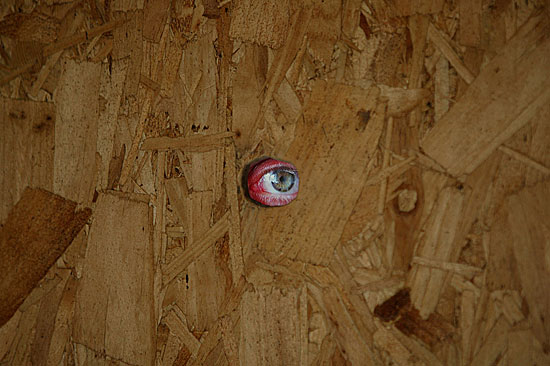
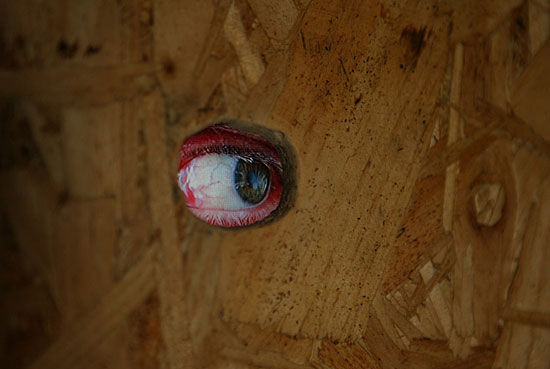
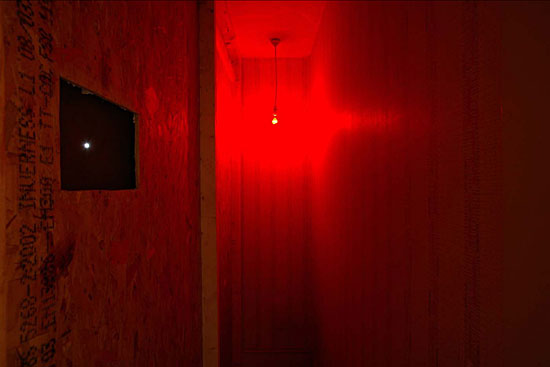

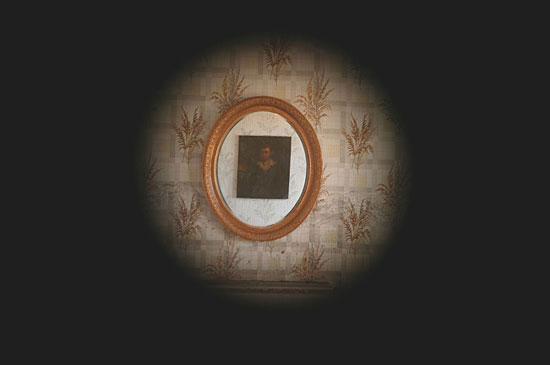
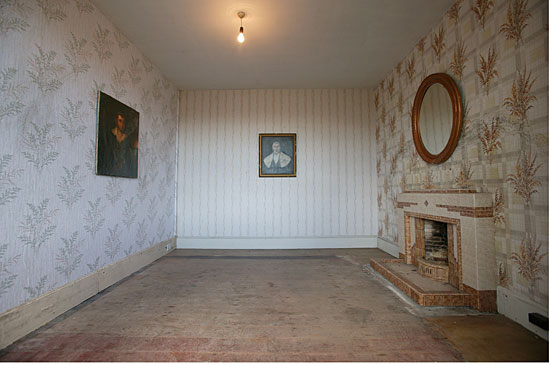
Body-Wall Maple Cottage
2005
In this work a false wall made out of plywood wound its way around an abandoned cottage first blocking the staircase, then creating a false passageway that began at the original door and continued until the front wall of the house itself. This new space created a hybrid space in-between the original house and the new wall and thereby set up a dialectic between past and future with the spectator mediating between the two. The visitors were transformed into performance artists and actors and were made aware, by a small light, of a viewing device through which they were meant to look to see an enclosed domestic space reminiscent of the places of inspection so often used by Sherlock Holmes. The optical pathway for this inspection was a hole cut out of the eye of an old portrait painting that hung on the inside of this simulated domestic space. This opening in the painting was lined up on one hand with a hole in the wall itself and on the other with the viewer’s eyes. Together they created a machinic assemblage that was aligned with a mirror hung directly across the room which reflected the antique painting, mentioned above, and the eye of the viewer that through his or her participation was now part of. The viewer’s eye, as it looked through the painting from behind the wall, now became part of the painting itself. The hidden passageway became an uncanny space in which the fragmented viewer through a transformational process of the experience of becoming an actor in this architectural scenario became a whole body again not as himself but as a painting with all the meanings pertaining to the nature of portraiture itself.
When You Look East You Are Already Looking West (2009-10)


Brainwash 2 (2009)


Silent: A State of Being (2004)


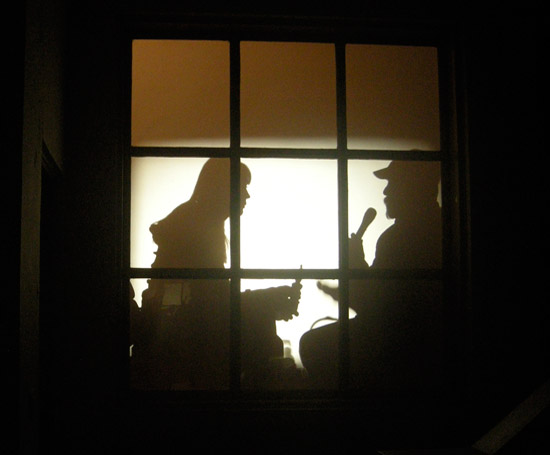
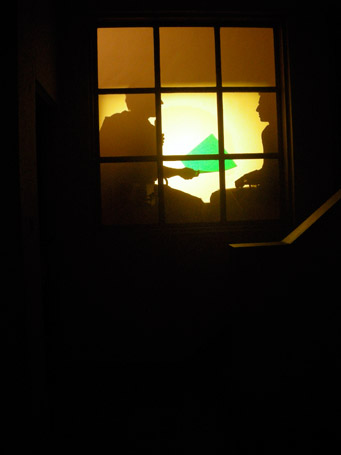
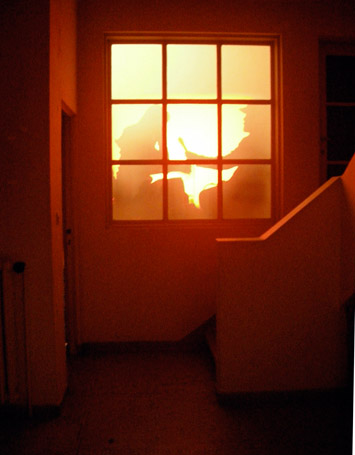
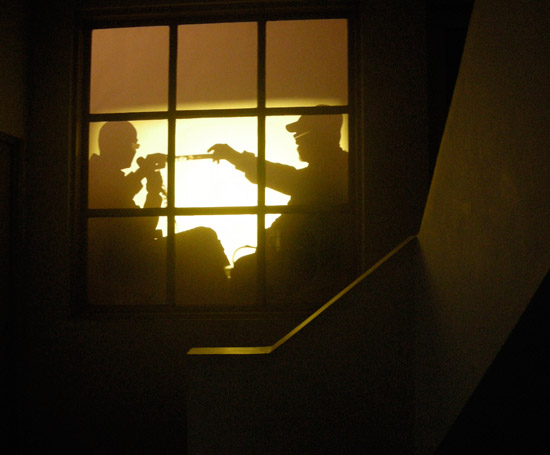
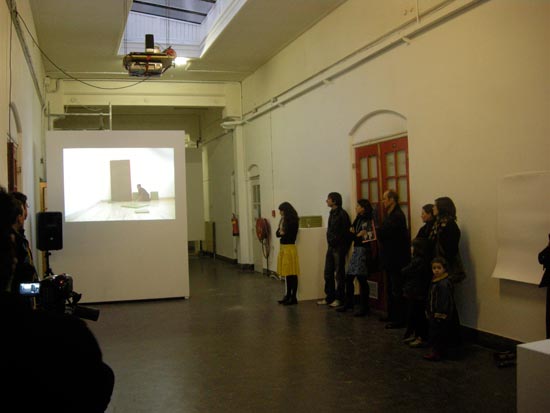
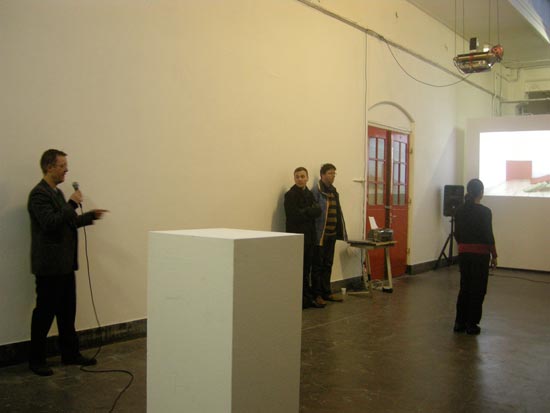
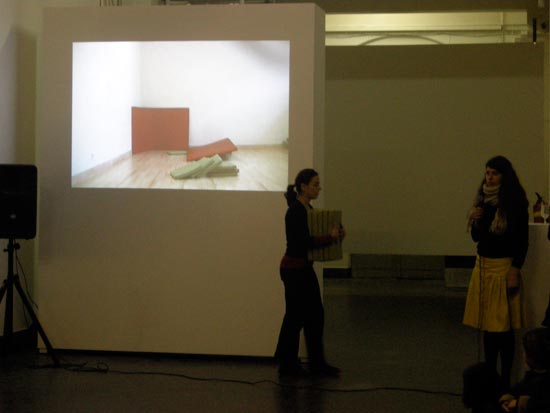
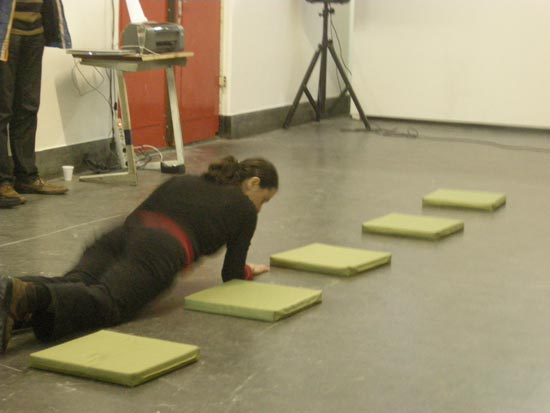
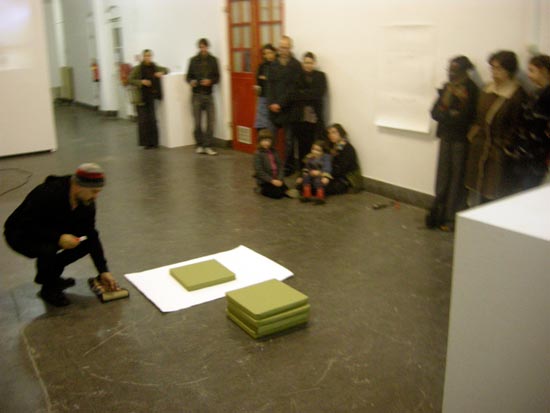
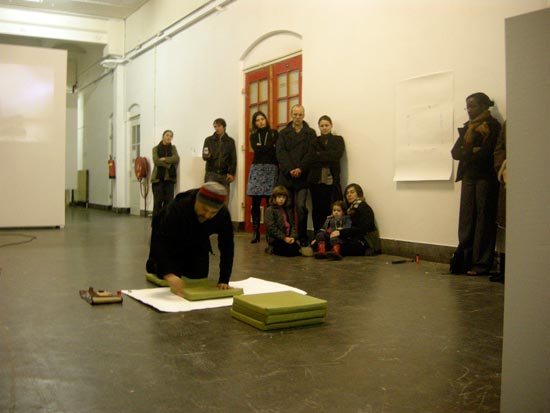
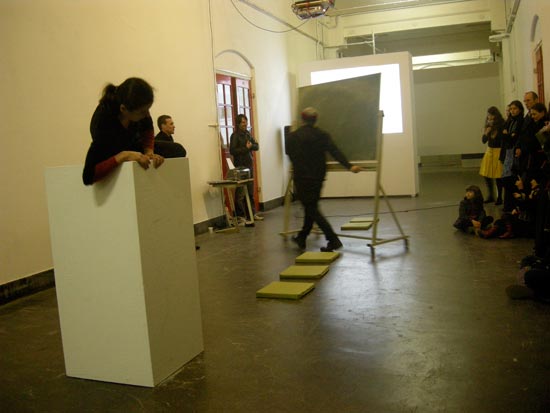
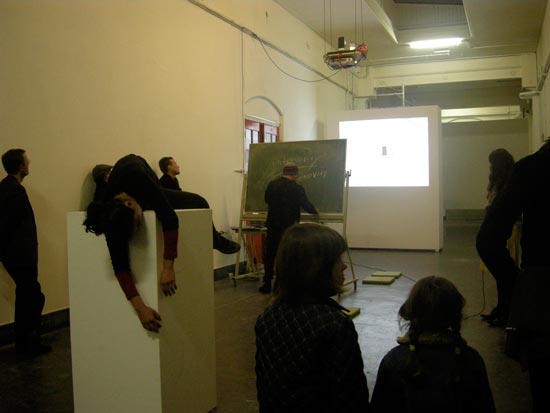
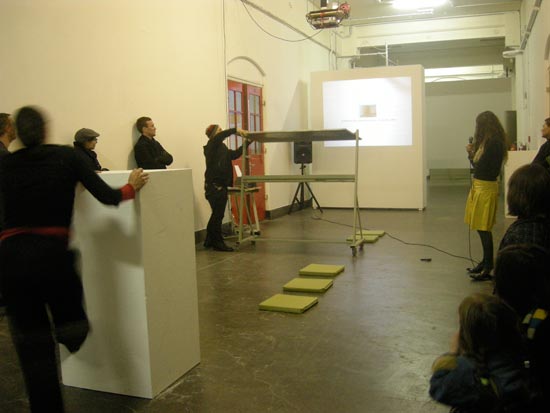
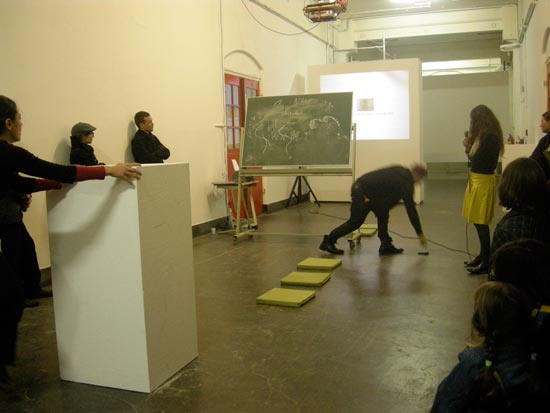
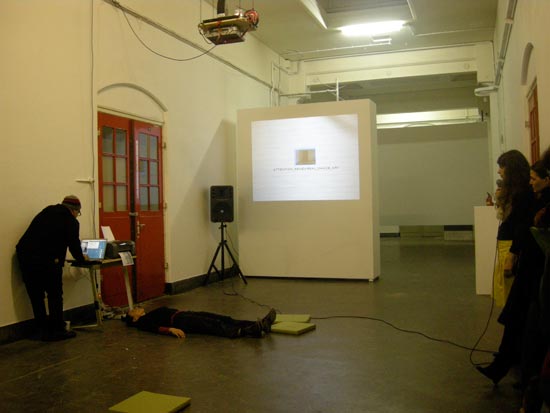
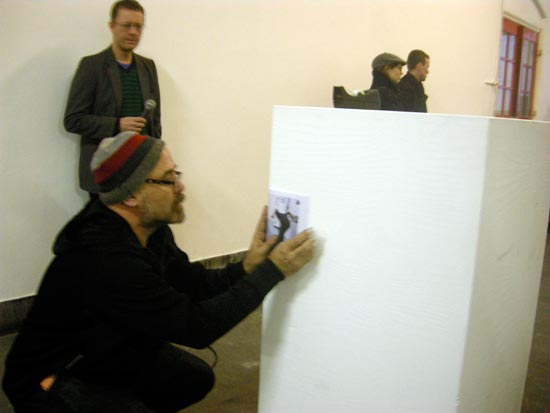
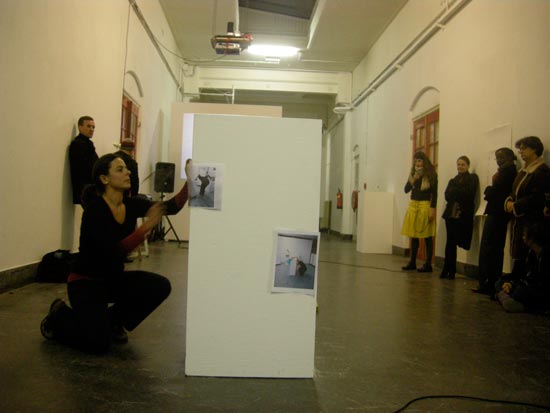

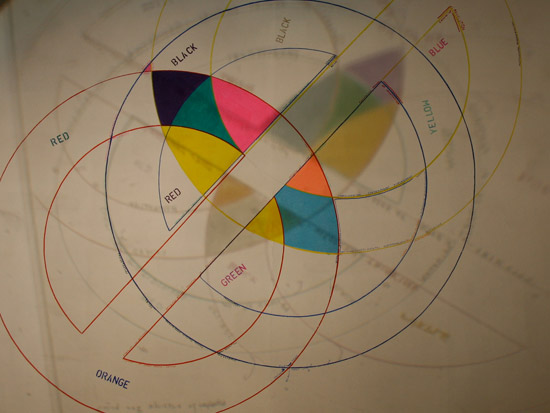
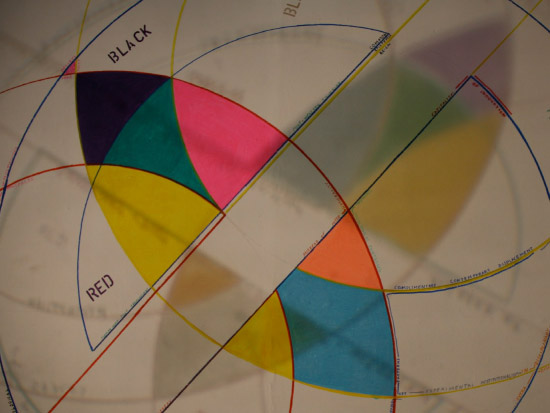
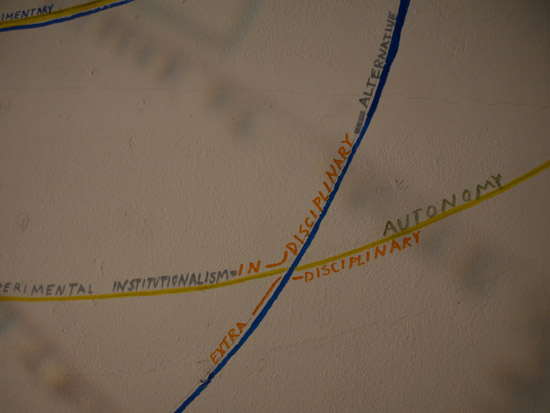
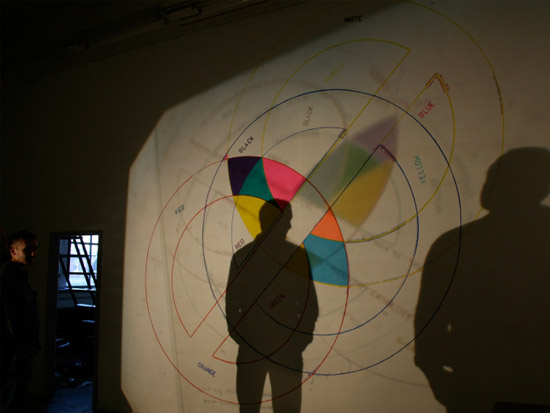
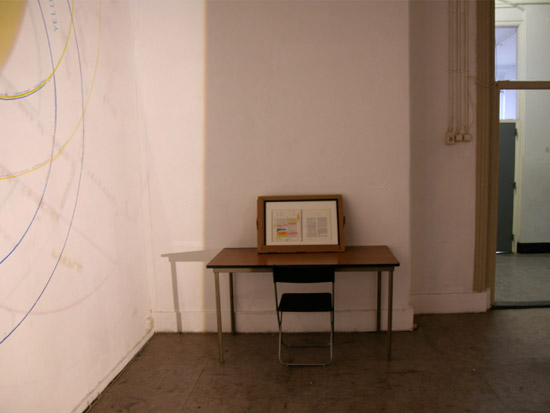
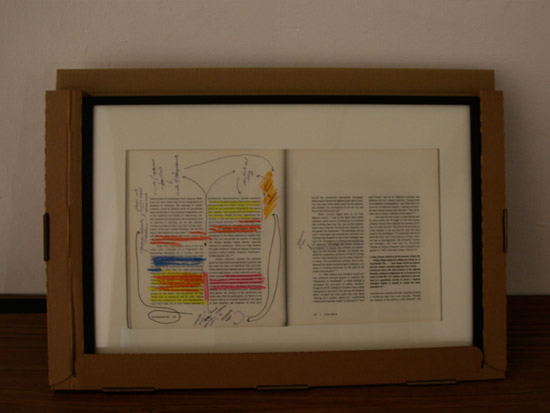
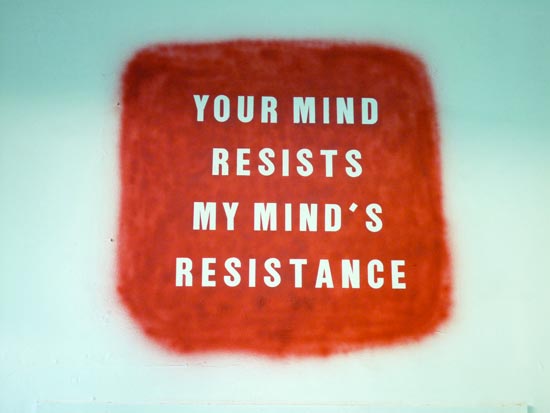
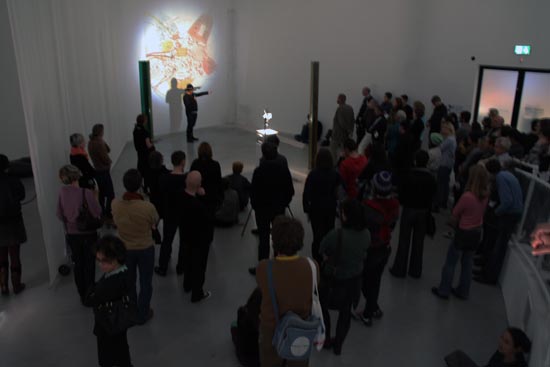
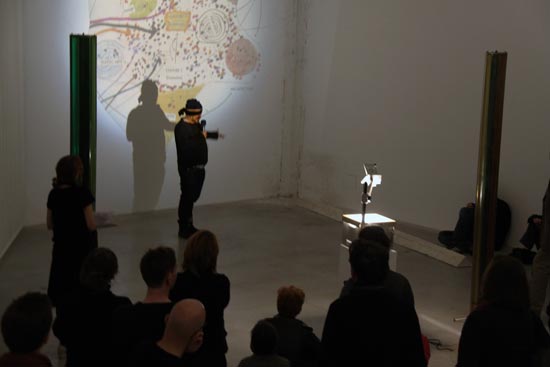
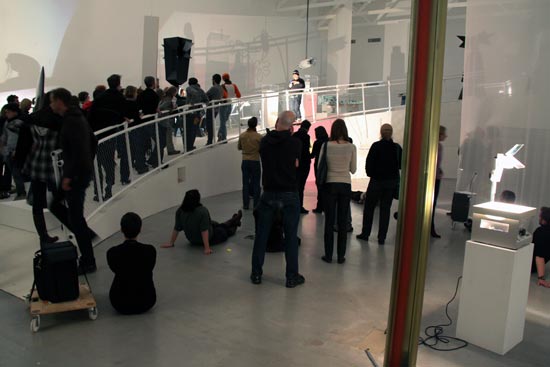
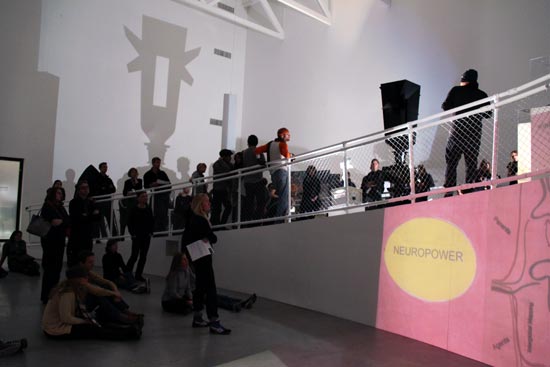
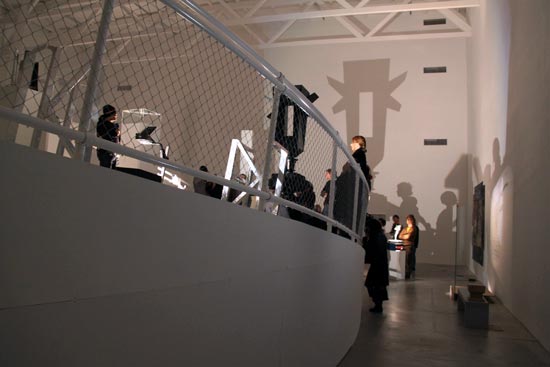
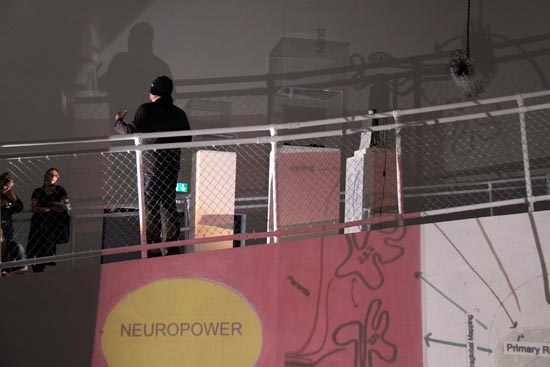
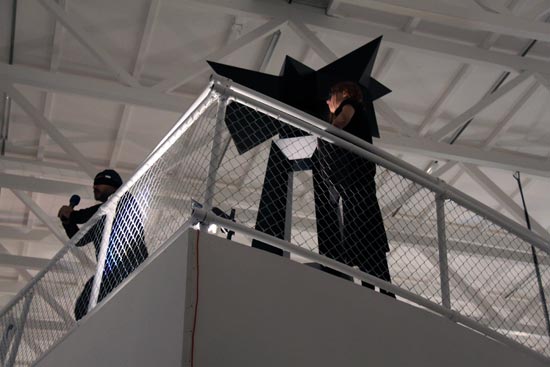
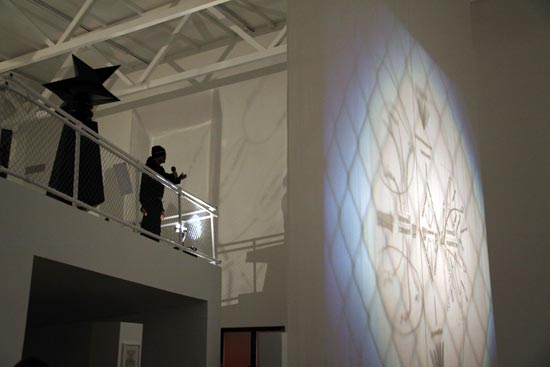
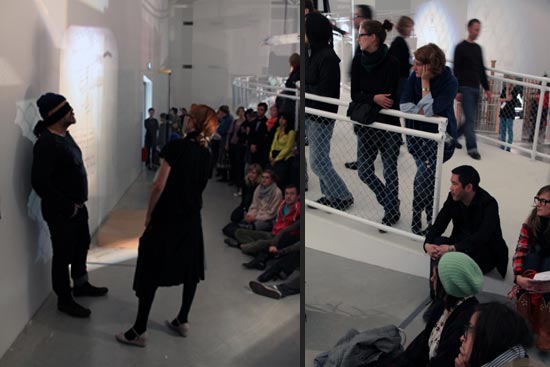
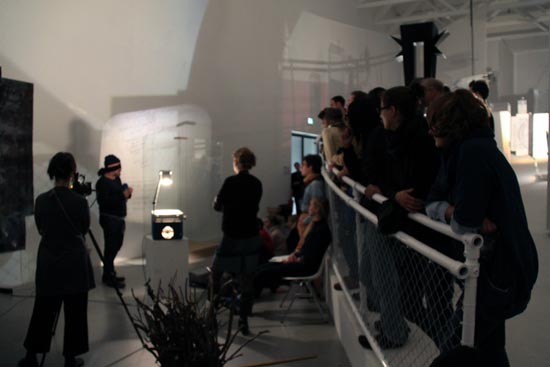






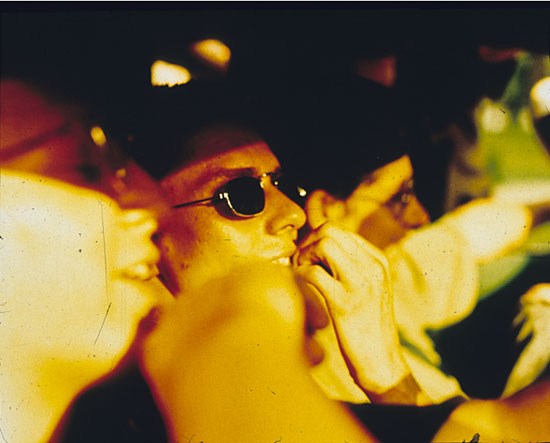





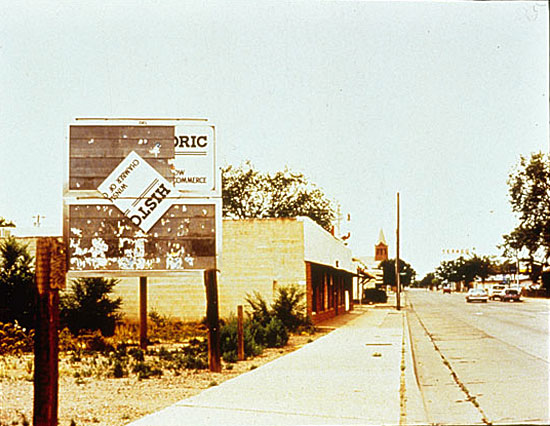





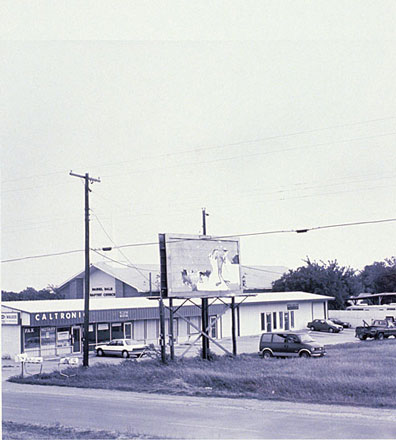


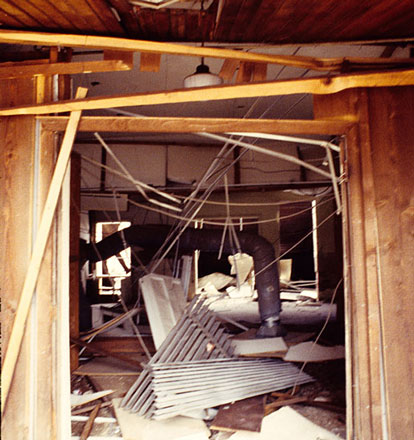


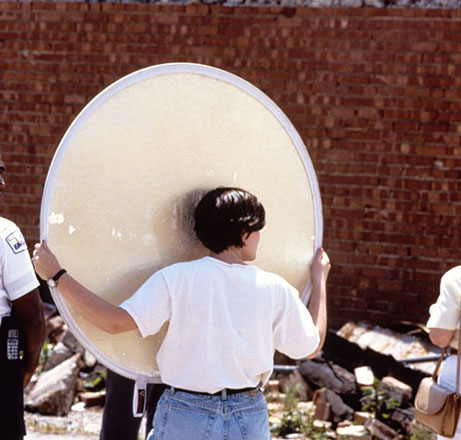


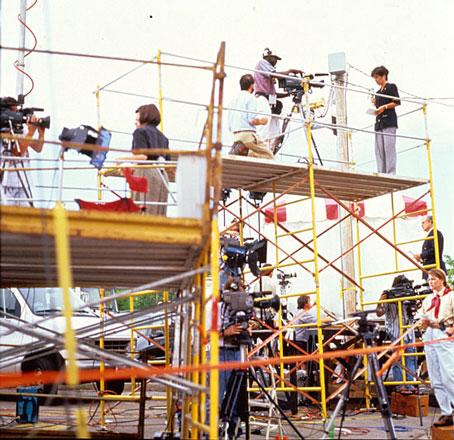











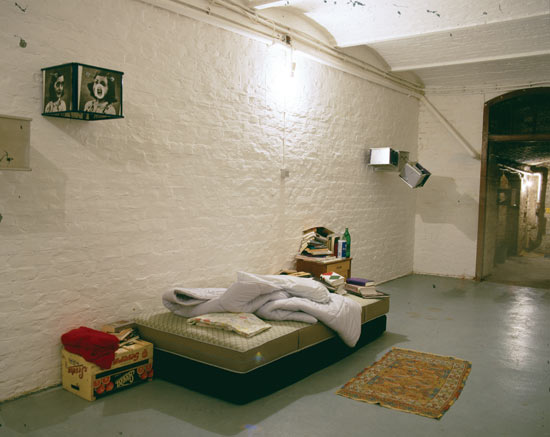


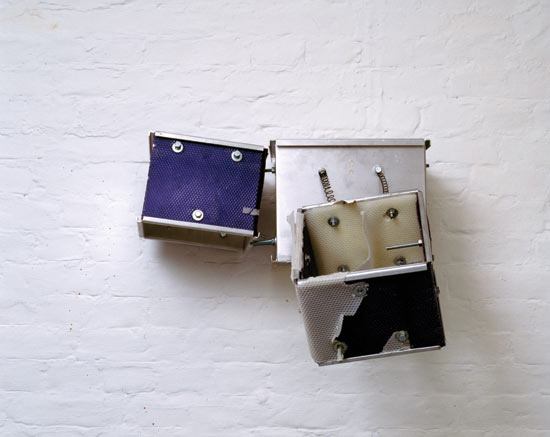
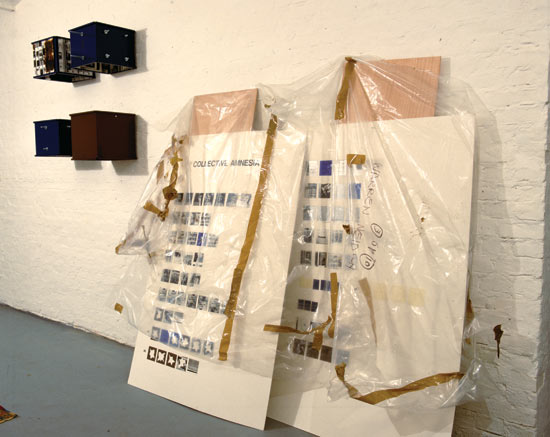







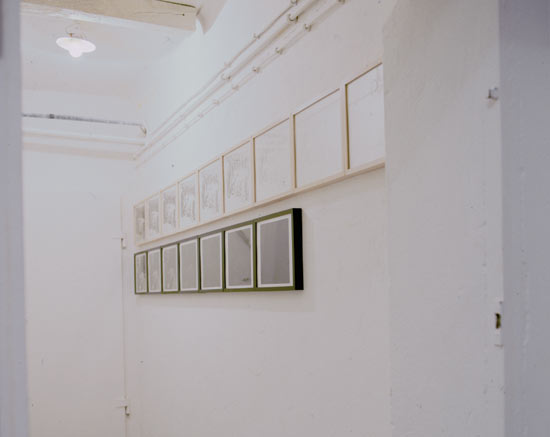


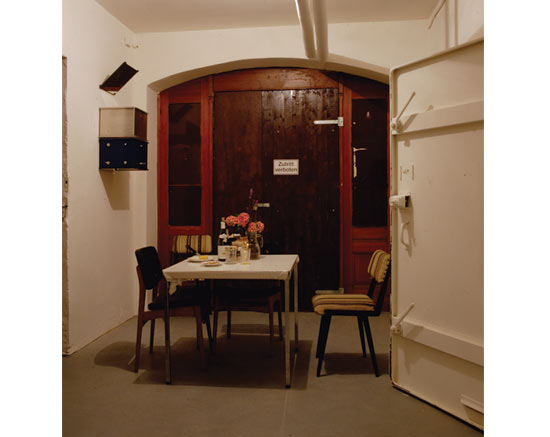

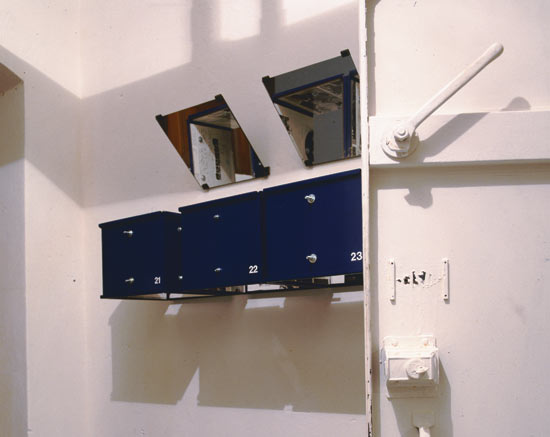
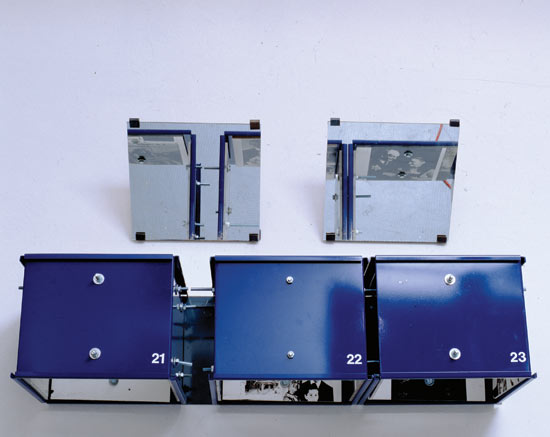


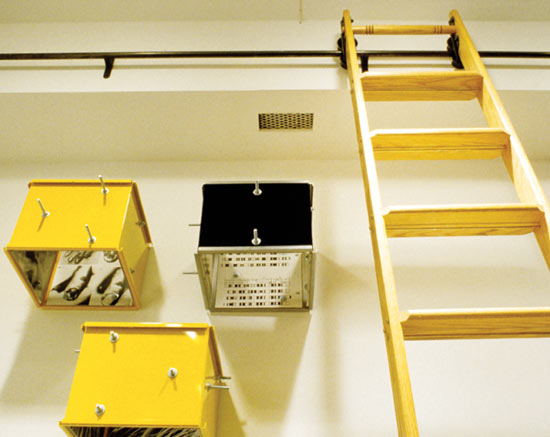
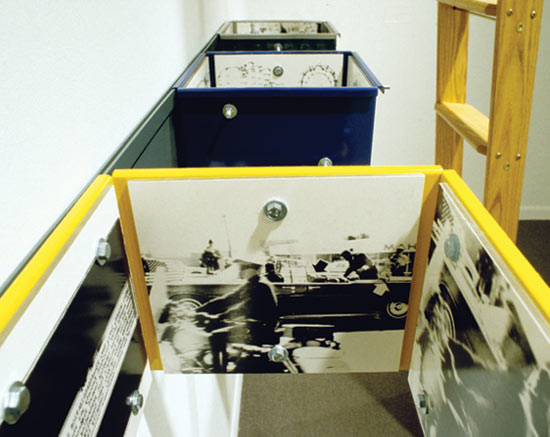
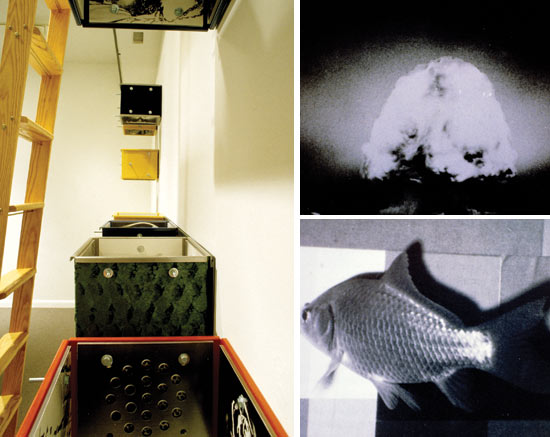
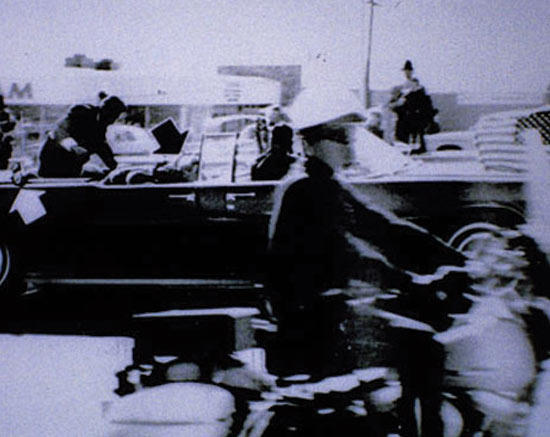
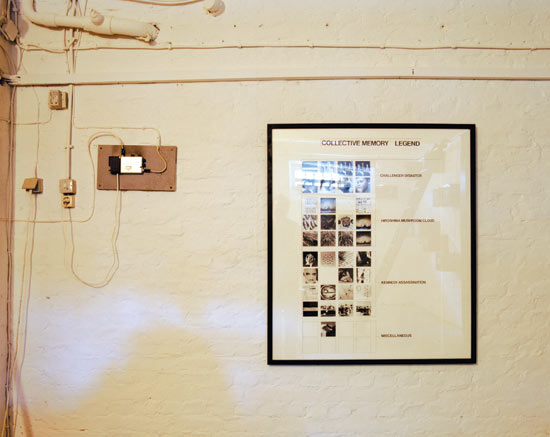
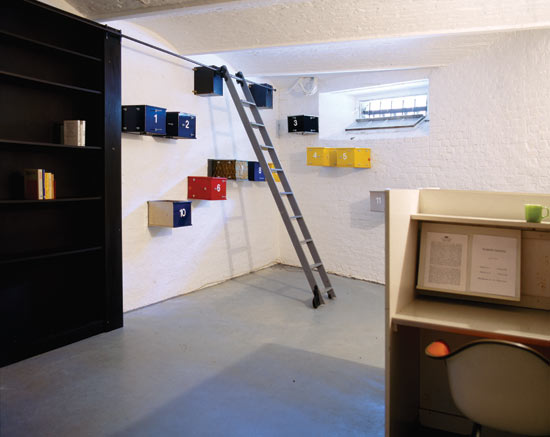
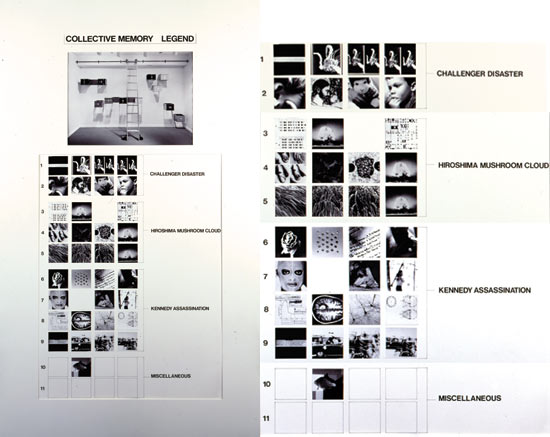
Some Cursory Comments on the Nature of my Diagrammatic Drawing
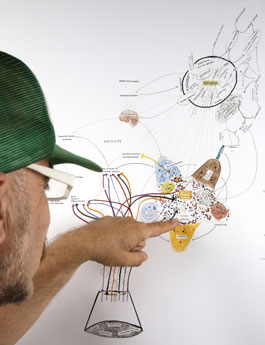
The diagram is indeed a chaos a catastrophe but it is also a germ of order or rhythm. It is a violent chaos in relation to the figurative givens, but it is a germ of rhythm in relation to the new order of the painting. As Bacon says, it “unlocks areas of sensation.
Francis Bacon: The Logic of Sensation, Gilles Deleuze
The diagram or abstract machine is the map of relations between forces, a map of destiny, or intensity, which proceeds by primary non-localizable relation and at every moment passes through every point, or rather in every relation from one point to another.
Foucault, Gilles Deleuze
I approach the Earthling Drawing that is tacked to my wall. It is at some distance now and what I see is a multicolored abstract drawing that covers the paper with lines, marks and points distributed unevenly. Several, separate areas are demarcated like small continents. These parts, of which there are four, have developed over the past 8 years. They have been drawn, overdrawn, redrawn, extended and edited. As such, the drawing is an impermanent condition of a still evolving process! The first part is called The Cultured Brain Drawing and fills the space in the middle right hand section. It looks like an amoeba with pseudo pods. The second part is called The Global Generator and it is funnel shaped and situated at the bottom. The third section is called The Becoming Brain Drawing and is found on the far left. Finally, The Earthling Drawing is found in the upper right hand corner and was the most recent addition.

As I continue my approach I realize that there are words that adorn its’ arabesque forms. I first point and then deliver my finger quite randomly to a location towards the center left center. This initial touch begins a drifting process in which my finger tip is a compass navigating a route or root to other locations and places as a tracing. My finger for instance my finger alights first in The Cultured Brain Drawing on Culture 1 (Extensive Culture). It then moves up along a tracing connecting it to Culture 2 (Intensive Culture). The arrow is bidirectional and connotes that each is symbiotic and contained in the other as nested symbolic gestures (see figure 2).
Intensive Culture (Culture 2) is the product of an ontologic process that emanates from Culture 1 (Extensive Culture) and is defined by a multiplicitous, non-linear, rhizomatic processes, immaterial labor as a virtuoso performance and the conditions of the social brain. It has supplanted its predecessor Culture 1 (Extensive,Culture) defined here as a set of conditions which has been formed according to a different set of coordinates and logics. Ones, which are equally divisible, linear, narrative in which labor concerns the production of a real objects tethered to the actions of the physical body. Each is situated in a diffuse milieu of The Cultured Brain Drawing signified by random colored dots made with the end of a blunt magic markers, which are diffusely distributed throughout. Closer inspection unveils a series of flowing multicolored lines swooping in from the bottom left where after entering the inside of the drawing they seem to fragment.
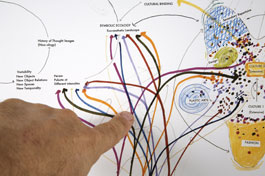
By a reverse tracing, the finger follows the multiple multi-colored curved lines back down towards an upside-down, cone-shaped funnel situated below. I refer to this part of the drawing as The Global Generator. The cone is divided into two parts. The top is the generative source of the colored lines and upon close inspection one can see that they are labeled according to the immaterial relations such as the social, political, historical, economic, psychological and unknown that they designate. Each, in itself, is in constant flux and is caused by the incessant shifting of internal differences which form its structure constituted by, for instance, the logic of the symbolic conditions that give it meaning. Moving the eye along each sinewy strand -in fact the eye has learned to follow the finger- one begins to notice lightly traced eddies and whirlpools that represent feedback and feed-forward circuits that link all the relations together and which through a series of tight junctions, open conduits which allow for the exchange of internalized elements, allowing information to diffuse from one relation to the other, producing differences that need to be adjusted to.
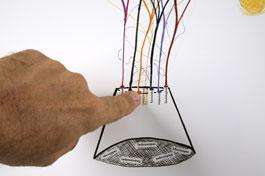
Forming the substructure of the funnel are a series of labels like, Ethnocape and Mediascape that refer to the mutating conditions of culture in the global setting adopted from the work of Arjun Appadurai Modernity at Large: Cultural Dimensions of Globalization. They form the foundation of the cultural shifts from Culture 1 to Culture 2.
I resume my drift and now move my finger again upward and rejoin the The Cultured Brain Drawing. My finger tip, like a vagabond circulates throughout the terrain of the inside, finding shelter under its nested regularities labeled Plastic Arts, Architecture, Technology and The Film Arts. Like the Visual Culture they together help to produce each other, in a condition of flux as they respond to the same immaterial conditions. Each attempts, as best it can, using its own histories, performances, apparatti, techniques and materials to make its own image. An image that is a present and past tense simultaneously. An image of the past, which is reflected in the history of all its past images, as each travels along its own journey of time. How design of jewelry and religious artifacts used in burial rights has changed since the time of the Cro Magna! In the present tense, each is the consummated activity of the immaterial relations that it embodies and that, like a mirror, reflects back to be cogitated by the subject as observer who, witnessing the differences in that ontology, understands the differences inherent also in himself and herself. But, as an assemblage as constitutive elements in the much larger apparatus of visual culture, these separate aesthetic-producing activities together, constitute a non-linear, emerging superstructure that is more than the sum of its parts. This superstructure digresses away from an equilibrium condition; entropy plays havoc on its component parts as well as on itself, it releases latent potentialities, add that defines each epoch. Thus, who have ever imagined that Surrealism would emerge from the Bowels of Impressionism and that the New Figuration of, say, John Currin or Elizabeth Peyton in the early 1990s would have developed from a culture obsessed with conceptualism and abstraction. And, today, the mutating social political historical economic and psychological conditions of, for instance, Post-Fordist Labor in the Age of the Multitude and the Empire constitute art works, built spaces and buildings, films that respond to those mutating conditions producing the works of artists like Liam Gillick or Carey Young and architects like RUR and Zaha Hadid.
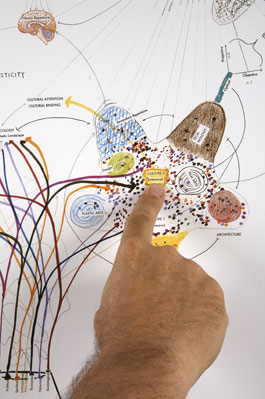
My finger, like a mouse on a computer screen, engages the drawing again now in a random walk through this information map and alights again on Culture 2 and then moves through a portal, into an area called The Secondary Repertoire just above and to its left. The Secondary Repertoire is a condition of the nervous system which results from its reaction to the environment, of which culture plays an important role. As a result of the conditions of intrauterine development and the genetic contribution of your mother and father, the brain, at birth, is made up of elements that are ready to operate in any environment that the baby might find itself. These, you might say, are pre-determined, like the sucking reflex and the beginnings of sight. I might say, however, that this Determined Brain is very underdeveloped compared to, for instance, a baby horse, that at birth can already walk. Nonetheless, there is also a Becoming Brain, one that has a potential to be modified. A brain in which large areas have not yet been organized and that are ready to meet the specific demands, within reason, that it is born into. According to neuroscientist Gerald Edelman, in his book, co-authored with Giulio Tononi, A Universe of Consciousness, the brain is made up of a large population of variable nervous elements some of which can become selected by the conditions of the world that it finds itself in. Neurons -the basic building blocks of the nervous system and neural networks- that are selected, operate more efficiently than those not selected for and, accordingly, will out-compete others for the confined and limited space of the brain. The process of, for instance, neural selectionism, combined with the brain's inherent potential for change, called Neural Plasticity, allows for a sculpting of the brain. Each culture provides a metaphor for that sculpting, whether it is the Figurations of Rodin, the Scatter Art of Barry Le Vay or the cacophonous meanderings of Jason Rhodes that call out to the brain in different ways, intensifying different networks and currents and diminishing others. D.O. Hebbs in his famous book of 1949, The Organization of Behavior, states that "neurons that fire together wire together.” in this context, this adage becomes "Network conditions in the Real-Imaginary-Virtual Interface sculpt Network Conditions in the Brain." These new forms of interconnection reflect the cultural conditions and the immaterial relations, as we already saw, produce it. The mutating conditions of the assemblage of Networks as they are produced by the mutating conditions of culture create new dynamic pathways for thought and the imagination. In fact, each culture produces what Deleuze called 'noo-ology,' the history of the Thought Image through its inflection in the intergenerational conditions of the selected brain and the psychological and philosophical thoughts that emerge.
As we have mentioned already, Culture 2 directly contacts the Secondary Repertoire through a portal cut in the flesh of the diffuse milieu of Cultured Brain Drawings Microscopy. It is connected to the Primary Repertoire from which it emerges. The pleuripotential Primary Repertoire is the brain at birth or shortly before. It is the end point of Develpmental Selection, which we mentioned above, and produces the variable population of neurons that Culture 2 can now act upon. It is a node that indirectly connects the other parts of the drawing; to its upper right the Earthling Drawing and to the left the Becoming Brain. The Earthling Drawing delineate the conditions of the unconscious and the pre-individual, where the new logics of global Capitalism, according to Antonio Negri and Maritzio Lazzarato, are now focused. In the transformation of labour to its current Post-Fordist condition, noo-politics, namely the ensemble of techniques of control exercised on the brain and aimed at memory and attention is the order of the day. Through the 'distribution of sensible', the partage du sensible as Jacques Ranciere has defined it in The Politics of Aesthetics, sovereignty creates a series of laws and dispositions that establishes the modes of perception, that is, the set of perceptual horizons, a system of self-evident facts of perception that delineate what can be heard, said, made and done. Those distributions are very different in an Intensive Culture and in an Extensive Cuture. The order and sequencing of those stimuli, especially as they are generated in built space, have implications for the history of the thought image and the becoming brain. In the present Intensive Global Culture, the expanded role of capital in the generation of the general intellect consortiums of media giants, cognitive neuroscientific research assemblages, the military, advertising firms, polling interests consciously or unconsciously have littered Cultural Visual/Haptic Landscape with very sensational stimuli. Paul Virilio has labeled these processed and engineered stimuli Phatic Stimuli to draw attention to their conditions of Emphasis and Empathy, which are produced to call out to the brain and mind of the multitude. Branding would be an example of such a Phatic Stimuli, especially as they circulate in the real abstract conditions of billions of televisions and computer desktop terminals. In the expanded condition of thousands of these phatic stimuli operating together in immanent assemblages forming intensive networks of phaticity, a simulated ecology of meaning becomes possible. This intensive environment is now what calls out to the brain and preferentially selects neurons and neural nets according to its logic. This is one condition of the Earthling as a new Global Subject in the production of the people of the planet Earth. But there is another story.
In their most Utopian sense artist, architects, designers, writers and cinematographers, just to name a few, utilize there own methods, apparati, histories, spaces, performances to produce another distribution of the sensible, a Redistribution of the Sensible, that competes with that of the aforementioned Institutional Conditions for the attentions and memories of the multitude. This is the real story of the Earthling Drawing. Art as a form of resistance in which the form(s) of the Distributed Sensibility is the conceptual palate through which new forms of imagination with their potential for difference are transfigured.

The diffuse logic of my now unconscious finger searching for the intense psycho-geographic spaces finds itself, through diagonal and lingering gestures, in the cyclic looped Earthling Drawing. Here is where the dynamis of subjectivity is produced; where the pre-individuals of the singularities reside. Embedded in a spinning vortex of energy relations are a history of forms of that resistance to institutional norms, which constitute the homogeneity of the people. Practices like The Paranoid Critical Method of Salvador Dali, the channeling and theater of cruelty of Antonin Artaud, the Ready-made of Duchamp, the Derive of Gilles Debord, the collage of John Heartfield, the automatic writing of Andre Breton which produce new objects, object relations, space, reactions and virtuoso performances. To these practices could be added the Race, Gender and Class-Based practices that have become critically important in the past forty years. Here, the work of Mary Kelly, Andrea Fraser, Felix Gonzales Torres, Fred Wilson and Valie Export come to mind. These new conditions of the distribution of sensibility, now populated by these other objects emanating from quite different conditions, cause perturbations in the Institutional Diagram and produce adjustment of the minds eye as it scans the visual, auditory and haptic landscape in its daily routines. Through the same process of Neural Selectionism and its affect on the primary repertoire new connections are built; an other Cultured Brain. As such, attention and memory, the building blocks of the conscious and unconscious, are undeniably affected as well. As the world of imagination and fantasy creates the internally mediated stimulation of those and other circuits, neural sculpting and the mind will, though various feed-forward and feedback looping, be affected. Sovereignty in the age of controlling the mind at a distance is hip to the contingencies of the possibility of culture as its competitor. The new war on culture and the differences it produces is taking many forms. From the reduction of funding, to the extended power of the market place, to the new interest in the funding of the what are referred to as the cultured industries, Sovereignty is doing all it can to usurp the power of the artist.

The Neurobiopolitics of Global Consciousness
Neuroscientists say that by peering inside your head they can tell whether you identify more strongly with J.K. Rowling's Harry Potter, say, than with J.R.R. Tolkien's Frodo. A beverage company can choose one new juice or soda over another based on which flavour trips the brainís reward circuitry. Itís conceivable that movies and TV programmes will be vetted before their release by brain-imaging companies.1
In their well known study Empire (2000), social theorists Antonio Negri and Michael Hardt elucidate what philosopher Michel Foucault had already made explicit in the last chapter of his The Will To Knowledge (1976): they once again reiterate and delineate, in Section 1:2 of their text, the different and evolutionary consequences of the disciplinary society and the society of control (to use Foucauldian parlance). On the one hand, the disciplinary society is constructed through a dissemination of social command by diffuse networks of ìmachinic assemblages, to borrow a term from the cultural theorist Gilles Deleuze, that regulate each subject's customs, habits and productive practice.2 Extensive culture (characterised by stable Euclidean geometries, the assembly line, arboreal classification systems such as the taxonomic classification systems of Carl Linnaeus) operates upon the subject from the outside, specifically restricting his or her movements and choices along pre-set paths. Disciplinarity fixed individuals within institutions but did not succeed in consuming them completely in the rhythm of productive practices and productive socialisation: it did not reach the point of permeating entirely the consciousness and bodies of individuals3. On the other hand, the society of control operates within the domain of intensive cultural apparati characterised by the Riemannian spaces, rhizomatic logics and folded temporality induced by the multiplicity of flows that characterise our global world post-internet.4
According to Negri and Hardt, this transition from a disciplinary society to the society of control involves the emergence of what they refer to as 'biopower', which regulates social life from within. By contrast, when power becomes entirely biopolitical, the whole social body is comprised by power's machinery and developed in its virtuality. This relationship is open, qualitative, and affective. Society, subsumed within a power that reaches down to the ganglia of the social structure and its processes of development, reacts like a single body. Power is thus expressed as a control that extends throughout the depths of the consciousness and bodies of the population and at the same time across the entirety of social relationsî5.
Since 1987, the field of neuroscience has seen the emergence of Neural Darwinism and Neural Constructivism, powerful new theoretic tools that have profound implications for how biopolitical systems might instantiate themselves in the neurobiological substrate of the individuals that comprise the social body. Utilising these concepts, I would like to explore the possible mechanism and sites through which we might understand the new potential for biopower, which I am now referring to as the neurobiopolitical: the ability to sculpt the physical matter of the brain, and its abstract counterpart, the mind. I will also show how this process ultimately has very significant implications for imagination and creativity.6
Neural Selectionism / Neural Constructivism
Recent research in neuroscience, most notably the pioneering work of neuroscientist Jean Pierre Changeux at the Pasteur Institute in Paris, and the later assemblage and expansion of this work by biologist and Nobel laureate Gerald Edelman in San Diego into what is now referred to as 'Neural Darwinism' or 'Neural Selectionism', has provided new tools with which to understand the important role played by culture in the configuration of the architecture of the central nervous system. This theory, or as it is sometimes called, the 'Theory of Neuronal Group Selection', has three main tenets: developmental selection, experiential selection and reentry. Developmental selection describes the ontogeny of the embryo as an interaction between its genotype and the circumstances of its prenatal environment. Events occurring at the microscopic level, such as cell division, migration, differentiation and plastic modification, create what Edelman refers to as the primary repertoire. This term describes a dense and variable population of neurons with complex branching patterns that create extensive neural connections.7
Experiential selection is defined as the period just prior to birth and continuing throughout life, in which the diverse and variable population of the primary repertoire is pruned and sculpted by the environmental context to which the human being needs to adapt. Most changes, however, take place in the early years and are linked to what is referred to as ëneural plasticityí ñ the ability of neurons and their synapses and dendrites to adapt and change as a result of experience. Most importantly, according to Edelman, Experiential selection does not, like natural selection in evolution, occur as a result of differential reproduction, but rather as a result of differential amplification of certain synaptic populations8. Further, those neurons, neural networks or assemblages of neurons, and their dendritic and synaptic components that are most often and intensely stimulated, will acquire more efficient means of information transmission, thus enabling them to outmanouevre those neurons and neural networks that donít. In other words, as a result of being repeatedly excited by recurrent and repetitive external stimuli, these neurons develop firing patterns that have increased efficiency and specific tuning, and as a result are therefore likely to be favoured over other neurons and networks in future encounters with this stimulus.9
However, neurons and neuronal networks do not fire in isolation; they are part of large complexes that are together called out by complex stimuli. They could be part of abstract assemblages of stimulation, such as a billboard one might find in Times Square in New York or Piccadilly Circus in London, with its flashing lights, smoke rings, video screen, text messages and speaking voice telling you to smoke Camel cigarettes As eminent cognitive psychobiologist D.O. Hebb has so astutely stated, 'Neurons that fire together wire together'. They form greater firing efficiencies collectively, and form other alliances with other networks similarly excited and predisposed.
Reentry, the third part of the neural selectionist triad, allows for the synchronisation of neural events occurring in circumscribed and widely disparate areas of the brain. It plays a role in binding together these networks, some of which are broadly distributed throughout the brain, through its dynamic influences. As a result of this cooperation, even a partial trace of the original stimulus, by exciting a small number of neurons in a section of the complex web of neurons, can excite all the neurons in the network. Sharing of inputs in this manner allows for the repetitive stimulation of the network, which results in greater efficiencies for all the individuals in the whole group. It also gives the network advantages, in the competition for neural space, over other neural groups not thus stimulated.
Those neurons and neuronal groups that are less stimulated either find other targets to connect with, or undergo a mode of cell death called apoptosis: the process by which neurons that fail to find their targets degenerate and then are phagocytised (eaten up or absorbed by other neurons). In simple nervous systems, apoptosis plays a major role in pruning the least-used synaptic connections being selectively destroyed, while the mostused are retained. However, in more complex systems like the cerebral cortex of humans, it plays a minor role. "[I]t appears that apoptosis is a more important factor in simple systems such as the spinal cord motor neurons, where about fifty percent of the neuronal population is wiped out than in more complex systems like the primate cerebral cortex where it occurs in less than twenty percent"10. In these systems, the abundance of potential sites for alternative connectivity in the cerebral cortex may alleviate the need for cell death.
So far, this is a story of pruning and subtraction. It only partly describes the data on brain development and evolution, which shows that the brain mass gets larger instead of smaller with age, and that different parts of the brain grow at different rates. Neural Constructivism sees development as a progression in representational complexity. It appears to involve both selective elimination as well as considerable growth and elaboration.11 Studies by Greenough and Chang12 and Coleman et al13 have found that the degree of correlation between the firing of groups of dendrites in the receiving part of a neuron, rather than simply the presence of activity, was essential for the production of dendritic complexity and growth. What this means is that the secondary repertoire the primary repertoire pruned by experience goes through a dynamic change in which those selected neurons undergo a further transformation. They continue to be stimulated by correlated activity, which may also correspond to correlated relationships in the realimaginary- virtual interface, with other neurons which are coding for similar stimulation complexes; and the connectivities thereby multiply and grow (here I am using the word 'virtual' to refer to virtual reality, not the virtual as described by Deleuze in relation to the actual, in his account of ontological parameters).
Neuralbiodiversity and Cultural Determinism
Culture is in a constant state of transformation as it responds to a changing milieu, determined by the cumulative effect of a multitude of immaterial relations that are each in a state of unrest. Each of these relations mutates within a rapidly evolving context of new possibilities for example, in relation to the speed of information transmission and develops new vocabularies and systems of meaning to accommodate those changes. Then, individually or together with the other changing relations also affected by these mutating conditions, they create new dynamic patterns of flows that impact culture. Sociological conditions, political intrigues and scandals, global economic depressions, conditions of psychological instability, historical reinvention, spiritual revivals all of these operate together to transform the context in which culture operates; and, in some cases, operate together upon culture itself. This flux creates new pressures on the system of culture, producing subsequent instabilities.
These instabilities are the result of noise produced by certain incompatibilities of coded information between the existing cultural system and the new flows of information it attempts to incorporate. To respond to this crisis of assimilation, culture creates new technologies. Here I would like to describe in detail one such technology, the optical; I confine myself to this in the interest of time and clarity, although similar changes are taking place in the auditory, kinesthetic, and tactile sensorial realms as well.
Optical technologies can be divided into two groups. First, projective creative optical technologies, examples of which are the camera obscura, camera lucida, photographic camera, stereo camera, cinema, virtual reality and, most recently, intelligent media. These devices help create the world as a projective interface to be inspected by the organic system of the eye and brain; as such, this eye-brain link produces the plastic mimetic configuration of the noumenal/phenomenal world. As is explained further in the essay, the eye-brain apparatus is a plastic and selected entity in a constant flux between being and becoming, a being and becoming that is co-evolving with the mutating conditions of the world. It is the relation between what I term intensive technologies (discussed later in this essay), and the cultures they attempt to redefine spatially and temporally: redefinitions that lead to new forms of linkages in the tectonic substrate of culture itself. I call these linkages 'cultural bindings'; and it is this binding of cultural artefacts, for instance, that leads to new networks of meaning within that culture. This cultural binding leads to intensely stimulating cultural networks that, as we will see, may sculpt neural networks preferentially (I use the word ìintenseî here to mean a very strong stimulus, as well as one which is non-linear, folded and rhizomatic in its spatial-temporal dimension. This latter quality is what makes such stimuli powerful agents of neural excitation). It is this fundamental relation between cultural and neural networks that defines what I am calling Cultural Determinism.
The evolution of projective optical technologies has for decades inspired artists, designers and architects, who were awed by the new kinds of images and processes that these machines made possible. In her description of 'La Fenêtre en Longueur', a drawing Le Corbusier made at his parents house on Lake Geneva, architectural historian and critic Beatriz Colomina states that the window glass is superimposed on a rhythmic grid that suggests a series of photographs placed next to each other in a row, or perhaps a series of stills from a movie14. This is an instance of photography and cinematography influencing the way the architect, in his desire to respond to these new optical possibilities afforded by cinematic time and space, reinvents the materials of his trade, glass and window, in a way that re-enacts and re-maps the experience of cinema onto the experience of architecture. We will see shortly the implications of this effect on other forms of visual culture, and their summated affect upon the nature of embodiment.
Invented in parallel with these projective technologies are introspective technologies. The word 'introspective' can have psychological meanings related to the investigation of the self, as in looking into oneself or knowing oneself; but in the context of this essay, I am referring to instruments that probe the body in order to understand its own changing anatomical and physiological conditions. Introspective technologies may in the future help us to see at the functional, dynamic, synaptic and neuronal-net level, on which the effect and residue of events in real/imaginary-virtual space over time can be appreciated. This kind of brain mapping is beyond our reach today. However, recent theories that attempt to make sense of the ways the brain works have begun to leave strict hierarchical descriptions in favour of ones that are non-hierarchical.15 For instance, neural complexity in relation to subjectivity is now being studied at the level of collectives of neural circuits that display patterns of emergence of large-scale integration.16
Of the many new devices invented that enable culture to visualise itself, only a few are really relevant; and these, as a result of their widespread use and dissemination, help define and optically describe that culture. Perspective was the best visual analogy with which to describe the sociological, psychological, economic, historical and spiritual conditions of the Renaissance; new media is the best way to depict those same conditions today.17 This is not to say that one excludes the other. In fact, the genealogy of optical instrumentation is a history of one technique subsuming the qualities of its predecessors, followed by a moment of unease in which structural rearrangement leads to a mutation in its form and operation, and then to the invention of a new device that can be adapted more adequately to the conditions at hand. We are reminded of communications theorist Marshall McLuhan's idea of 'remediation', in which the content of any medium is always another medium.18
I suggest here that an analogical process of remediation is occurring in the brain as well. The co-evolutionary phenomenon I have been alluding to is more than simply a
selection of neural tissues: it is an evolution of the processes through and by which they operate. Phylogenetic changes are slow changes, the result of genetic mutations: All the old control systems must remain in place, and the new ones with additional capacities are added on and integrated in such a way as to enhance survival. In biological evolution, genetic mutations produce new cortical areas that are like new control systems in the power plant; while the old areas continue to perform their basic functions necessary for the survival of the animal, just as the older control systems continue to sustain some of the basic functions of the power plant.19
Older systems of the brain form the basic foundations for the new capacities of the organ as it evolves.20 This has been discussed earlier in the essay with regard to the
primary repertoire, which is the end result of millions of years of evolution. Its variability is to a certain extent determined by all the changes recorded in the genotype, and slowly refined by natural selection.21 I refer to this variability as neuralbiodiversity. This condition, hospitable to and augmented by the mechanisms of neural plasticity, enables the rapid changes of experiential selection to take place, as well as those of epigenesis the development of an individual and/or the external environment as a result of interaction between an individualís genes, external environment and internal environment.
These rapid generational changes in context of genetic drift and Baldwinian evolution (which is based on the fact of phenotypic plasticity, the ability of an organism to adapt to its environment during its lifetime, and which emphasises the fact that the sustained behaviour of a species or group can shape the evolution of that species) can become incorporated into the genome. The anthropologist Terrence Deacon delineates this as the mechanism by which we acquired language, and for which a special area of the brain was developed.22 Deacon explores the means by which language evolved as a cultural entity. He sampled a population of humans with a variable innate capacity for the acquisition of language. As language produced real advantages, those whose brains were more receptive to the acquisition process in the end gained a selective sexual advantage, and through their descendants produced a population of what he now calls homo symbolicus. Similarly perhaps, new technology ñ through creating new types of images, sounds, feelings and hapticities with intensive spatial and temporal logics has produced different forms of cultural networks and binding. In the end, using a similar logic to that of Deacon, new forms of humanity could be produced. The new habits we now see in the children of the Egeneration, who appear to have multiple or split attentions, is one example of such affect.
In other words, each new generation has a living brain that has been wired and configured by its own existence within the mutating cultural landscapes in which it lives. These new conditions allow for new kinds of images, new thoughts, new ideas that are transmitted and embedded in cultural forms of representation. As such, the history of this transformed representation forms a kind of cultural memory or cultural heredity, which has its own rules and regulatory patterns of evolution, that are different but symbiotic with Darwinian evolutionary paradigms of selection, subtraction and deletion. It is a system of memory that evolves as the result of the Bergsonian mode of 'creative evolution', which is neither mechanical nor teleological, and does not represent evolution as conditioned by existing forces or by future aims; it is additive, and concerns the ways and means that the constantly transformed context provides a backdrop for the constant re-evaluation and reformulation of cultural ideas. These ideas are alive, but pulsate at different amplitudes and frequencies in the web of cultural meanings, depending on the ratiomatic and proportional distribution of immaterial relations that create that context.23
By ratiomatic, I imply that cultural meanings are virtual and in flux. I am here referring to 'virtual' in the Deleuzian sense of a repository of possible meanings that are made actual by, for instance, the relative opposition between transcendence and immanence, this difference enabling dualistic categories, Cartesian and otherwise, to be maintained. In the context of my argument, virtual implies the set of immaterial social, political, historical, psychological, economic and spiritual relations that create the human subject's overriding context at a particular moment. The inherent virtual meanings are the results of complexes of cultural binding that create nodes of varying intensities in the networks of relations. Some of these nodes are thick and strong, while others are weak and thin. Their overall distribution in the 'plane of immanence' is their ratiomatic identity, and it changes all the time. But subtle neural changes are continuously initiated by the variable conditions of this cultural milieu. Through its capacity to reorient and seek out alternative sites for connectivity, the brain thus sculpted is able to bind and suture itself to contextual peculiarity and difference. This cultured brain can also be properly termed the intensive brain.
In a system of network conditions that are pulsating and immanent, and therefore available only at certain times, what is present at any one moment will reflect the specific combinations of entities that are existent at the time of that reception. However, what is existent is dependent on a specific context in which these networks are embedded, and which is different for each network. Thus, each context creates a ratiomatic flow of immanent cultural meanings. This cultural memory then becomes the framework through which the cultured brain is produced. When each observer dies, those neurological changes that defined his or her experience and relationship to his specific generational moment within visual culture dies as well. Only in very unusual circumstances will these experiences find their way into the genome, as in the example of language. However, that generation's cultural effect is retained in traces within that cultural habitus, awaiting a new generation of brains on which to mould new kinds of neural relations, in the end creating new types of subjectivity. In other words, a kind of cultural somatic mnemotechny is disseminated in forms of literature, visual art, architecture and design. Separately and together, as these practices evolve they create new forms of cultural attention.
Cultural attention delineates the subset of cultural forms and relations that call out to the developing brain, through its use of images, forms of language or social contingencies that in the end are important in the processes of sculpting the brain. It too is evolving, and becoming ever more sophisticated as its forms of spatiality and temporality become linked to ever more sophisticated forms of media. These new forms are beginning to adapt and synchronise themselves to those operating at the level of neural networks. This process is called visual and cognitive ergonomics, and will be addressed later in this essay. At the moment, it is critical to re-emphasise that this development is the result of the coincident effect of the evolution of optical and haptic projective and introspective technologies.
Recently, as a result of digital technologies, there has been a transformation of the conditions of culture itself, which has implications for the history of cultural attention. I am referring to the shift from an extensive to an intensive culture. Its precursors could be first found in earlier non-narrative film practice, exemplified by Soviet director Dziga Vertov's Man With a Movie Camera (1929) and Italian director Luchino Viscontiís Obsession (1943). Film scholar Donato Totaro aptly sums it up: ìIn the time-image, which finds its archetype in the European modernist or art film, characters find themselves in situations where they are unable to act and react in a direct, immediate way, leading to what Deleuze calls a breakdown in the sensory-motor system. The image cut off from sensory-motor links becomes a pure optical and aural image, and one that comes into relation with a virtual image, a mental or mirror image24.
No longer tethered to the restrictions of the body and its narrative context of action and perception, the time-image is free to circulate according to other possible temporalities, some of recursive feedback on the body, producing new potentials and becomings. According to contemporary philosopher Manuel De Landa, the term extensive time may be applied to a flow of time already divided into instants of a given extension or duration, instants which may be counted using any device capable of performing regular sequences of oscillations. These cyclic sequences may be maintained mechanically, as in old clock-works, or through the natural oscillation of atoms, as in newer versions25 Intensive time, however, is characterised by nested sequences of temporality that form complex and multiplicitous relations with each other. A good example is found in the of the genomic regulatory system described by theoretical biologist Stuart Kaufman:
The network, in so far as it is like a computer programme at all, is like a parallel processing network. In such networks, it is necessary to consider the simultaneous activity of all the genes at each moment as well as the temporal progression of their activity patterns. Such progressions constitute the integrated behaviours of the parallel-processing genomic regulatory system.26
Thus, as we learn more and more about the brain and how it works, and as we begin to apply the power of computational technologies to answer some of the questions
concerning its methods, we begin to see that neuro-scientific narratives based on linear modes of explanation are giving way to non-linear descriptions.
The Phylogeny of Projective Optical Technologies
One could hypothesise that the genealogy of optical instrumentation from the Renaissance to the contemporary moment is a story that recounts the history of the changing meanings of time and space. Photography most effectively reinvents and experiments with space, while cinema, building on this spatial practice, added new ways to deal with temporality. It animated and continues to animate space. Through the techniques of analog fast-cut editing, embedding fast-forward and reverse effects into narrative, and silhouetting as a means to illustrate the past, cinema reinvented the interpretation of time. As Hungarian artist and photographer L. Moholy-Nagy remarked with regard to Vertov's The Camera Eye (1924):
The combination of all these elements in their astonishing interchangeability revolutionises the customary visual as well as conceptual processes. It produces a
completely new timing of perception based upon the translation of physical motion into pictorial motion, also the translation of the initial action into an objectively observable process viewed by the acting persons themselves. Though this may appear at first bewildering, one must acknowledge that a new code of space-time perception is in the making.27
This experimentation of cinema with time does not occur in a vacuum, but is part of a network of conditions occurring in other fields similarly affected by concepts and interests involving temporal phenomena. Marcel Proust's À La Recherche du Temps Perdu (In Search of Lost Time), a seven-volume semi-autobiographical novel published between 1913 and 1927, Sigmund Freud's The Interpretation of Dreams (1900), Albert Einstein's Special Theory of Relativity (1905) and his General Theory of Relativity (1915), and Henri Bergson's Matter and Memory (1896) these paradigmatic writings all dealt with different experiences and formulations of time.
The field of new media, as it grew out of cinema and television, created a digital time and space: a space and time that is now folded, intensiveí and rhizomatic. Powerful
information and communication technologies, such as the internet, undermine serial, extensive ideas of time and space. According to information cartographers Martin Dodge and Robert Kitchen, intensive technologies disrupt traditional forms of cultural and social interactions in critical ways: they promote a mode of global culturisation at the expense of local customs and traditions; they facilitate what has been termed incidental outsiderness, meaning that people live in multiple locations; and they create an alternative sense of identity, one that is fluid, mobile and disembodied. Thus, community that had formerly been dictated by factors of presence and place is now formulated on the basis of interests rather than on location28.
But these are not the only effects. In each case, these network relations leak out of the specificity of optical media into design, fashion and architecture; and, in the end, they
radically alter the visual and haptic landscape. Can anyone imagine the folded, wandering, gestural movements of the Guggenheim Bilboa without Computer Assisted Design programmes, or the idea of the rhizome of Gilles Deleuze without the Minitel? The same visual landscape that, as we will see later, will help select the brain and affect identity. Linked together, these technologies create parallel systems of temporality that simultaneously manifest in time and space, like the genetic regulatory system or the model of the brain using the process of reentry, broadly defined as the synchronisation of neural events occurring in circumscribed and widely disparate areas of the brain.
Photographic spatiality, disrupted, linear and non-linear cinematic time and space, and digital, co-extensive time and space are all now folded together through the transductive force of binary code, which is assimilative. Remediation itself cannot be seen as anything but nomadic, non-linear and recursive. One media does not flow directly into another in a linear and positivist way, but is a series of jolts, digressions, regressions, informal mixings and bricolage. The material specificity of modernism has relinquished its hold on the imagination in todayís world of pervasive symbiotic systems characteristic of the postmodern condition. The result is a grand tapestry of time and space that has resulted in new combinatory possibilities and, by extension, new possibilities for thought and creativity. As these nested relations redefine objects and images, they create landscapes of meaning; these visual ensembles are sampled and processed by the intensive brain.
Brain / Mind / World
The complexities under discussion here are precisely defined by philosophers of science Franciso J. Varela and Evan Thompson:
The nervous system, the body and the environment are highly structured dynamical systems, coupled to each other on multiple levels. Because they are so thoroughly enmeshed biologically, ecologically and socially ñ brain, body and environment seem better conceived of as mutually embedding systems than as externally and internally located to produce (via emergence as upwards causation) global organism-environment processes, which in turn may affect (via downward causation) their constituent elements.29
The genealogic relations of optical technologies, both projective and introspective, contain a number of meta-genealogic relations that influence the physical constituents of
the instruments themselves, how they are made, the images they produce, and the effect these have on the brain and mind. I am referring to a number of processes categorised as visual and cognitive ergonomics30. These two terms refer to the way that technology, combining the knowledge of neuroscience and physiological psychology with the advanced application and utilisation capabilities of computing and recent advances in special effects, has created visual images that are more powerful then naturally occurring ones, with more enhanced potential for first calling out, and then selecting, the nervous system.
These processes employ and utilise sophisticated fields of what urbanist and theorist of technology Paul Virilio calls ìphatic signifiersî. The word 'phatic' shares the same root
as 'emphatic' (Gk. emphanein, to exhibit/display): it means something that forces you to look at it. The phatic image a targeted image that forces you to look and holds your attention is not only a pure product of photographic and cinematic focusing. More importantly it is the result of an ever-brighter illumination, of the intensity of its
definition, singling out brighter only specific areas, the context mostly disappearing into a blur.31
I use the expression ìfields of phatic signifiersî to stress that these stimuli are linked up in large conglomerates of stimulation. Think for a moment of ëbrandingí. The brand is only one part of large landscape of interconnected signifiers. Visual and cognitive ergonomics has been instrumental in the production of this ëbrandedí environment. It refers to an evolution of these practices as they develop in the real/virtual interface as well as the world of bodily experience. The dialogue of optical instrumentation, neurophysiologic research and, more recently, advertising and computerised special effects, has impacted the configuration of visual space in which brands are embedded. The visual landscape has become more textual, and thereby more comprehensible, to an intensive brain that has undergone analogous, although idiosyncratic, changes consistent with its own material substance, its convoluted gyri and sulci consisting of millions of neurons, glia and blood vessels. As a result of experiential selection, new types of neuronal configurations leading to new patterns of neuronal discharge have emerged, reflective of this evolving visual space and time.
Phatic stimuli are produced according to the rules of visual and cognitive ergonomics, and as such have greater attention-grabbing qualities than those stimuli not so engineered. The development of these stimuli traces a history of increasing sophistication and simulation between them. This history is punctuated by moments of competition with each other for the brainís attention, followed by moments of cooperation when certain of these stimuli link up to form networks of stimuli, giving them emergent abilities far greater then they had before, in their isolated states. What emerges is an ecology of phatic forms, the human brain being its interface.
The neuro-anatomical and neuro-physiological condition of the living brain reflects its epigenetic experience. Epigenesis involves the processes by which genetically prescribed forms are altered by interaction with their environment, be it pre-, peri- or post-natal. The conditions of the developing brain, just like the conditions of the world, create specific environments that affect populations of neurons in specific ways that have crucial consequences for its neural architecture. That experience, having been recently dominated by the phatically charged, artificially constructed, cultural domains into which it is born, will reflect a condition generated by intensive non-organic fields of stimulation. (As mentioned earlier in this essay, one could make a similar argument for other sensorial domains.) This condition is one in which naturally derived, organic stimuli and signs, such as trees or our own naturally conditioned feelings, have difficulty competing with phatic entities for the mind's attention. The story of Thomas in my essay 'Blow-up: Photography, Cinema and the Brain' is about this problem.32
If one superimposes the effect of global capitalism on this perceptual system, one begins to understand its staggering proportions; for it has the potential of producing and
disseminating these stimuli worldwide, and to sometimes bizarre excess. Just think of the McDonalds brand, or the power of CNN. These highly engineered sign systems are
distributed worldwide with incredible intensity. They have, in fact, become new media objects, according to cultural theorist and sociologist Celia Lury. A key theme in her analysis is the idea that the brand acts in the market like the interface of a computer: it is a mobile, dynamic and responsive framing of communication33. She adds: "Central to the interactivity of the brand are certain practices in marketing which function in an analogous way to programming techniques in both broadcasting and computing. The most significant example is the feedback loop many marketing practices act like feedback loops of a computer programme"34. Products differentiate according to complex open autopoeitic systems self-limiting, self-generating, self-organising, self-maintaining and selfperpetuating (much like the cell) ñ and through practices like marketing mix, with its model of the 4 Ps': product, price, place/distribution and promotion. Consumer surveys probe user desires, needs and wants, and link these to the use of the product as a marketing tool; this data enables the producers to finally create a kind of super-sized, über meta-object, a phatically compelling entity that is constantly becoming as it competes in a field of similarly differentiating meta-objects for the observer's attention.
The brand progresses or emerges in time in a series of loops, an ongoing process of (product) differentiation and (brand) integration. It thus comprises a dynamic sequence or series of loops that entangle the consumer, Lury concludes.35 Brands also form corporative relations with other brands. For instance, the Coca Cola, Disney and Mars
Corporations have joined up to form networks of brands that interconnect both synchronously (they all occupy one space simultaneously and react in a dynamic and nonlinear fashion to create super-sized desire) and diachronously (they link to the history of other advertising campaigns in which, separately or together, they attempt to influence choice, perhaps in the parents of their target group, young children; this represents a kind of internal marketing in which the brand influences new consumers, children, by appealing to the nostalgia of the parent).
Brands are a distinctive form of phatic signifiers, particularly when they are produced with the use of special effects, or when they are embedded as products used in popular
movies. They become attentionally intensified when they are linked up to global campaigns in which they participate in other global phenomena, such as the global flows of money, people, ideas, raw materials; and through which they interact with local food, languages and cultural customs. These emerging properties, as they are expressed in the global context, can compete effectively for the attention of the global brain.
In a brain that has been selected for through the operation of neural Darwinistic and neural constructivist pressures, the spatial configurations of neurons and networks and
their non-linear, dynamic neural signatures manifest as synchronous oscillatory potentials; they reflect the influence of this complex, competing, artificially created network of phatic signifiers that dominate the contemporary visual landscape. Drawing attention to these processes of binding and dispersal, I propose that as the systems of technical/cultural mediation become increasingly more folded, rhizomatic and cognitively ergonomic, they evolve to more closely approximate the conditions of temporal transaction that sculpt the intensive brain.
I would also hypothesise that there exists an envelope of possible formulas of output from the brain, a kind of virtual potential in the Deleuzian sense. As intensive culture evolves into more complex formations, it produces new dispositions that, when selected and coded by the brain, unlock that potential.
The brain is a becoming machine. The paradigms of neural plasticity and neural Darwinism provide the crucial frame for its continual renewal but also perhaps for its
eventual subjugation.
NOTES
1. Melanie Wells. ìIn Search of the Buy Buttonî. In Forbes Magazine (1 September 2003), pp. 62-70.
2. But the first zone of the power centre is always defined by the State apparatus, which is the assemblage, that effectuates the abstract machine of molar overcoding: the second is defined in the molecular fabric immersing this assemblage; the third by the abstract machine of mutation, flows, and quanta. Gilles Deleuze and Felix Guattari, A Thousand Plateaus (Continuum, 1988, New York) p. 227.
3. Michael Hardt and Antonio Negri. Empire (Harvard University Press, 2000, Cambridge).
4. Ibid., p. 23. Power is now exercised through machines that directly organise the brains (in communication systems, information networks, etc.) and bodies (welfare systems, monitored activities) toward a state of autonomous alienation from the sense of life and the desire for creativity.
5. Ibid., p. 24.
6. Ibid., p. 33. The communication industries integrate the imaginary and the symbolic with the biopolitical fabric, not merely putting them at the service of power but actually integrating them into its very functioning.
7. Gerald Edelman. The Remembered Present (Basic Books, 1989, New York), p. 45.
8. Ibid., p. 46.
9. From that process of competitive selection in the primary repertoire of cell groups, which is a process fundamentally based on variability, correlation, and connective re-entry, a secondary repertoire of neuronal groups will emerge. They will form a new representational map. The neuronal groups of this second repertoire, that is, of the newly formed map or network, will subsequently respond better to the individual stimuli that formed it. Further, the network as a whole will recognise those stimuli by responding to them categorically. Thus, by the selective process, the secondary network will have become a more effective representational and classifying device for perception, memory and behavior than the original, primary repertoire of cell groupsî. See Joaquin M. Fuster, Cortex and Mind: Unifying Cognition (Oxford University Press, 2003), p. 38.
10. A central hypothesis underlying remediation and enrichment programmes is that the brain is more malleable during infancy and early childhood than later in life. This malleability leads to an increased capacity for learning, which in turn provides an opportunity for the improvement of cerebral functioning that cannot be reproduced to the same extent or with the same ease later in life. This property of the immature brain is referred to as neural plasticity. See Peter R. Huttenlocher, Neural Plasticity (Harvard
University Press, 2002, Cambridge), p. 53.
11. S.R. Quartz and Terrence J. Sejnowski. The Neural Basis of Cognitive Development: A Constructivist Manifesto. In Behavioral and Brain Sciences 20 (4), pp. 537-96.
12. W.T. Greenough and F.L. Chang. Dendritic Pattern Formation Involves Both Oriented Regression and Oriented Growth in the Barrels of Mouse Somatosensor Cortex. In Brain Research 471, pp. 148-52.
13. P.D. Coleman et al. ìSpatial Sampling by Dendritic Trees in Visual Cortexî. In Brain Research 214, pp. 1-21.
14. Beatriz Colomina. Privacy and Publicity, Modern Architecture as Mass Media (MIT Press, 1998,nCambridge), p. 139.
15. Varela, F.J. et al. The Brainweb: Phase Synchronisation and Large Scale Integration. In Nature Reviews, Neuroscience 2, pp. 229-39 (2001).
16. M. Le van Quyen. Disentangling the Dynamic Core: A Research Programme for Neurodynamics at the Large Scale. In Biological Research 36, pp. 67-88 (2003).
17. Bolter and Guisinís theory of remediation proposes that ìthe history of media is a complex process in which all media, including new media, depend upon older media and are in a constant dialectic with them. Digital media are in the process of representing older media in a whole range of ways, some more direct and transparent than others. At the same time, older media are refashioning themselves by absorbing, repurposing and incorporating digital technologiesî. In (eds.) Lister, Martin et al, New Media: A Critical Introduction (Routledge, 2003, London), p. 55.
18. Ibid., p. 78. So, for McLuhan, the importance of a medium (seen as a bodily extension) is not just a matter of a limb or anatomical system being physically extended (as in the hammer-as-tool sense). It is also a matter of altering the ratio between the range of human senses (sight, hearing, touch, smell), and this has implications for our mental functions (having ideas, perceptions, emotions, experiences, etc.).
19. John Morgan Allman. Evolving Brains (Scientific American Library Series, 1999, New York), p. 41.
20. There are, grossly speaking, two kinds of nervous system organisations that are important to understanding how consciousness evolved The first is the brain stem together with the limbic (hedonic) system, the system concerned with appetite, sexual and consummatory behaviour and evolved defensive behaviour patterns. It is a value system; it is extensively connected to many different body organs, the endocrine system and autonomic nervous systemÖ It will come as no surprise to learn that the circuits in this limbic-brain stem system are often arranged in loops, that they respond relatively slowly (in periods of seconds to months), and do not consist of detailed maps. They have been selected during evolution to match the body, not to match large numbers of unanticipated signals form the outside world. These systems evolved early to take care of bodily functions; they are systems of the interiorî. See Gerald Edelman, Consciousness: The Remembered Present, in (eds.) Sporns, Olof and Giulio Tononi, Selectionism and the Brain (Academic Press, 1994), p. 111.
21. Personal conversation with Gerald Edelman.
22. Selection pressures affecting language must be considered as nested within one another to the extent that language evolution is nested in biological evolution. On the human side of this equation, the processing demands of symbolic reference, symbolic combination and symbolic communication in realtime provide novel selection pressures affecting the brain and vocal tract. As the language-mediated niche (the symbolic cultural environment) became more and more ubiquitous in human prehistory, these selection pressures would have become correspondingly more important and powerful, producing evolutionary changes in these structures in response. On the language side of this equation, the humanderived requirements of learnability, automatisability, and maintaining consistency with the constraints of symbolic reference provide selection pressures that affect language structures. See Terrence Deacon, Multilevel Selection and Language Evolution, in (eds.) Weber, Bruce H. and David Depew, Evolution and
Learning: The Baldwin Effect Reconsidered (MIT Press, 2003, Cambridge).
23. Very different, in our opinion, is the kind of definition which befits the sciences of life. There is no manifestation of life that does not contain, in rudimentary state, either latent or potential the essential characters of most other manifestations. The difference is in the proportions. But this very difference of proportion will suffice to define the group, if we can establish that it was not accidental, and that the group, as it evolves, tends more and more to emphasise these particular characters. In a word, the group must not be defined by the possession of certain characters, but by its tendency to emphasise them. See Henri Bergson, Creative Evolution (Dover Publications Inc., 1911).
24. Donato Totaro.Gilles Deleuze's Bergsonian Film Project. Offscreen, 31 March 1999.
25. Manuel De Landa. Intensive Science and Virtual Philosophy (Continuum, 2002, New York/London).
26. Ibid., p. 58.
27. L. Moholy-Nagy. Vision in Motion (Paul Theobald and Co., 1965, Chicago) p. 280.
28. Martin Dodge and Rob Kitchin. Mapping Cyberspace (Routledge, 2001, New York).
29. See Francisco J. Varela and Evan Thompson, ìNeural Synchrony and the Unity of Mind: The Neurophenomenonological Perspective, in (ed.) Axel Cleeremans, The Unity of Consciousness: Binding, Integration and Dissociation (Oxford University Press, 2003), p. 279.
30. For a detailed analysis of these terms, see Warren Neidich, title essay in Blow-up: Photography, Cinema and the Brain (DAP, 2003), pp. 22-30.
31. Paul Virilio. The Vision Machine (Indiana University Press, 1994, Bloomfield), p. 14.
32. "Blow-Up" is the story of the ìmutated observerî: one whose neural networks have been sculpted by artificial stimuli to the point that he has become what I call cyborg-ised. Thomas, who plays the role of the fashion photographer David Bailey, has two types of memory. One is the result of his own experiences; the other the result of the memories of the photographs he has taken. As the photographs are more phatic, they compete for the brainís neural space more effectively. He loses touch with his own feeling and memory when these are not supplemented by photographic documentation.
33. Celia Lury. Just Do What? The Brand as New Media Object, inaugural address given at Goldsmiths College, London, 2004.
34. Ibid.
35. Ibid.
Pierre Molinier and the Phantom Limb
Fetish
The original definition of the fetish finds its roots/routes in the religious practices of so called "primitive" societies. The fetish was defined as a menagerie of objects connected through their properties as magical charms. In nineteenth century Europe the definition of fetish evolved into anything that was irrationally worshipped.
It was not until the seminal work of Alfred Binet (mostly known for his I.Q. test) that the fetish became linked to sexual practice. “Normal love is the result of complicated fetishism. Pathology begins only at the moment where the love of a detail becomes preponderant.”(3) Kraft-Ebing drew attention to the idea of pathologic erotic fetishism in which the fetish itself becomes the exclusive object of sexual desire, “while instead of coitus strange manipulations of the fetish become the sexual aim.”(4) Today the American Psychiatric Association in its Diagnostic and Statistical Manual defines fetishism as recurrent, intense sexually arousing fantasies, sexual urges or behavior involving the use of non-loving objects, inanimate or animate material which can be hard or soft.(5)
But the subject of fetishism is much more complex than the above definitions would imply, and in order to discuss Pierre Molinier a slight digression to review pertinent literature is needed.
Freud wrote in 1905 that the fetish was an unsuitable substitute for the sexual object that serves to disavow knowledge of the differences between the sexes. (6) Five years later, in "Leonardo Da Vince and Memory of His Childhood", 1910, he reiterated that the fetish is linked to intense castration anxiety in men.(7). Agreeing with Kraft-Ebing he organized the fetish around the notion in which an inanimate object is used in an obligatory and fixed manner in order to attain sexual gratification. The choice of the fetish is a substitute for the absent female phallus that the young boy discovers is lacking in his mother. Thus the pieces of underclothing, i.e., garters, silk stockings, fur, which are so often chosen as a fetish “crystallize the moment of undressing.” For Freud, in 1910, the object of choice is “merely a substitute symbol of the woman’s penis which was once revered and later missed.”(8) “The child becomes fixated on some safer object, which aids in warding off the feared knowledge of the mother’s castrated state.”(9)
A complementary theory to castration anxiety is separation anxiety which is suffered and defended against in childhood.. Through the creation of illusion, and the symbolic gesture of representing the mother through the fetish object, some state of union, or reunion, with the absent mother is preserved. Louise Kaplan notes in Female Perversions: The Temptation of Emma Bovary that “the little boy whose childhood curiosity, fantasies, anxieties and wishes lead him to endow his mother with a substitute penis is constructing only a temporary, elusive fantasy...that the adult fetishist will concretize into a shoe or fur piece... As Freud was the first to insist, the extravagant theories of little boys may be outgrown and forgotten but they are never entirely given up.”(10)
Although Bak, in 1953, states that the “fetish undoes the separation from the mother through clinging to the symbolic substitute.”(11) he understands its fundamental function is still to alleviate castration anxiety. The child caught in the Oedipal triangle fears the father who he fantasizes is the culprit of the misdeed. To maintain his relationship with his mother and dissuade bodily damage he takes the symbolic gesture of the fetish. Chassegunet-Smirgel join these two etiologies with a conception of illusion.(12)
Illusion for Freud is brought about by a defense--that of disavowal of threatened reality. The ego, which Freud described as that part of the psyche that mediates between the intense sexually motivating drives of the id and the socializing function of the superego, is thus split. On one hand, it has a reality function directed to real data and on the other, an illusionary scrim through which reality is filtered and adjusted. Thus the child attempts to maintain the illusion of the phallic mother; a mother that does not require him to fertilize her in order to maintain their social union. The fetish is the symbolic representation of mother as phallus. Mother then can continue her procreative function alone. She thus becomes, in a sense, a parthogenic hermaphrodite.
Parthogenesis being the ability found in certain insects, in which male and female attributes are maintained in one individual, where sexual intercourse is not necessary for procreation. Hermaphrodite describes an individual who maintains the sexual characteristics of both genders, male and female.
It is not a great theoretical jump to formulate a proposition for the “anal sadistic” component that J. Greenacre talks about in her 1979 paper, Fetishism. (13) Here the performance of anal intercourse is a later re-enacted form of earlier unaccomplished/inhibited intercourse.
The fetishist is involved in a self-fulfilling enactment of taking the mother into him physically and psychically. Never having made the concrete distinction between genital types, the fetishist’s illusions of childhood become recontrived as himself-mother. The hermaphrodite tendency thus becomes defined as the stultification of the ontogeny of psychic sexual dimorphism. The fetishist is looped in a virtual memoryscape. We will return to this theme in our discussion of Pierre Molinier, who as a fetish artist is described by Peter Gorson in The Artists Desiring Gaze on Objects of Fetishism: “The transvestite figure of the Shaman, which is one of the themes of Moliniers’ self-portraits, allows the artist to identify with the feminine body image of the woman (after Freud unconsciously that of the mother) with pleasure and without conflict, where in reality he should experience a threat to male, genital narcissism.(14)
Clothes as fetish object
The fetish object, as signifier, has specific characteristics such as smell, touch, color (typically black.) Bornstein, recalling a letter Freud wrote to Abraham, remarks on the centrality of “coprophilic olfactory qualities in shoes and foot fetishes.”(15)
Tough durability of the object is an issue because sometimes they are used harshly. Finally, the object is shaped like a body part, especially those involved in sexual encounters, while often it hides or encloses other parts.
Although many objects function as fetishes; masks, pieces of fur, handcuffs, etc., it is those related to the foot and leg that are most prevalent. Since this discussion centers on Pierre Molinier, and his proclivity for the foot and leg, it’s prudent that we focus on this part of the anatomy. According to Valerie Steele, “shoe fetishism emerged in the eighteenth century.”(16). Quoting Stephen Kern in his book “Anatomy and Destiny,” the high incidence at that time of fetishes involving shoes and stockings “further testifies to the exaggerated eroticism generated by hiding the lower half of the female body.” (17)
The size, and height, of the shoe have erotic bondage-like connotations. A specific kind of shoe, the Chopine, was characterized by an extremely high platform shoe, and was associated with Venetian Courtesans. A quotation from High Heel Magazine will further elucidate the importance of the foot. “The high heel shoe is a symbol of love and also a symbol of aggression. It signifies power, it indicates domination.”(18). A case report of a patient of Havelock Ellis is further elucidative of the role of boots and heels during sexual encounters. “The treading should be inflicted all over the chest, abdomen and groin and lastly the penis which of course is in a violent state of erection--I also enjoy being nearly strangled by a woman’s foot.”(19). Pornographic novels with titles like; Boot Licker, Boot Licking Slave, and Booted Master give a sense of this genre in which boots symbolize a large penis. Finally, as Marilyn Monroe said, “I don’t know who invented the high heel--but all women owe him a lot.”
Pierre Molinier
But what about the fetish objects of Pierre Molinier, cathected as they were with both aesthetic and sexual intent?
We are told, by Peter Gorson, that Molinier paid a great deal of attention to the crafting of, what were referred to as, his “godemiches.” (20) These were made of compressed silk stockings, and then covered with a sheath of homogenous fabric, and a skin of some kind which acted as a preserving agent. They came in many varieties, including one- or two-member sleek art pieces, and were not only employed for anal-masturbation, but also hetero- and homosexual intercourse. Masturbation usually took place in front of a mirror. For this purpose the godemiche was fastened to the heel of a shoe with strings of leather which function both as a kind of hinge, and a foot corset. The dildo was further extended by a hand-made leather-covered wooden high heel, and thus transformed into a real and symbolic phallus (if the high heel substitutes for the penis, then the space between the heel and the sole of the shoe, as well as the shoe’s inside, can be read as vaginal surrogates).
Wayne Baurwaldt in his introductory essay on Pierre Molinier further elaborates upon the godemiche: “These became essential for his staged acts of transformation to the androgynous hermaphrodite.” (21) Black silk stockings, Dior lipsticks, hundreds of high-heeled shoes, custom-made plaster poupées, and black lace, were used to add precision to the idealized image of the androgynous figure. Molinier was aware of the fetishistic quality of his own photographs, and crafted those as obsessively as his other relics. “Molinier fully endorsed the fetishistic function of photography, that is of allowing people to construct their own image for themselves and finding satisfaction through a fantasized object. Painting as well was not immune to his obsessions and he declared that all his erotic works had been painted for his own stimulation:’ In painting I was able to satisfy my leg and nipple fetishism." (22)
But this scopic regime, in which a myriad of visually conducive, organized perceptions would become objects of Molinier’s not-so-discreet desire, was not limited to inanimate objects infused with auratic illusionist constructions. For Molinier was interested in the living participants in his dyadic diachronous stagings: “While a doll can function as a substitute for a woman, there is no movement, no life. This has a certain charm if one is before a beautiful corpse. The doll can, but does not have to become the substitute for a woman.” (23)
Molinier was open to heterosexual women and homosexual men. As a leg fetishist (by his own account) he stated that “the primary interest for the sexual engagement with others is the fetishized leg, not the gender of the respective partner.” (24) In a later quote he says “the pure sexuality of a woman or a man does not arouse me in the least; yet a beautiful leg, a calf will arouse me immeasurably....legs of a woman or a man arouse me equally, so long as they are hairless and dressed in black stockings. I detest body hair and, if you will, even its suggestive nakedness.” (25) As if through a misdirection in, or redirection of the formulation, the body is recontorted into an altereity of positional axis (see Schwartz, Hillel. Torque: The New Kinesthetic of the Twentieth Century, in Incorporations, Zone Books.) (26) The gaze is doubly redirected. First it finds itself in the mirror and constructs a fantasy of the self as other and then its shifts its interest from the locus of the centrally placed genitalia to the marginalized leg or ankle or foot at its periphery. One is reminded of Tina Papoulias (Fetishism): “...the fetish disrupts the (phallic) order by fixing sexuality away from its proper focus of attraction--that is the genitals of the opposite sex and ultimately away from the gendered body altogether. It moves sexuality towards a preoccupation with the fragment, the inanimate....and since the fetish is an object out of place, its power erupts, outside the hierarchy of normality.” (27)
Is Molinier’s versional directiveness, away from the genitalia, and on to the smooth silken leg a desire to move himself further to the margin in order to direct his gaze away from foveation where vision is its most acute, into the rhodopsin fields of the peripheral retina where vision is more about pure light and darkened obscuration? Where shapes metamorphose into illusions through which a delusional discourse can easily be superimposed. Is this marginalization and fragmentation, inherent in Molinier’s fetish practice and art practice, revealed in his choice of collage as the best method with which to express his ideas? (Collage as a cutting up and reconstruction of the image into something other.) As we will see later the leg acting as an abstract signifier de-corporalized, a truly floating signifier, can be re-arranged and collaged within a mental representation or within the boundaries of an art product. This hairless leg forms the perfect partial object or signifier as its genderless status and minimalist form allow it to act in a multiplicity of ways in the construction of the imaginary.
The Phantom Limb
Although the first account of a phantom limb was reported by the famous neurologist S. Mitchell in 1866, it is only recently after the landmark work of Melzack et al., who were able to understand the phenomena in the broader context of neural plasticity, that it has attracted a great deal of attention. (28) In Mitchell’s “The Case of George Dedlou,” the patient lost both his legs as the result of an amputation during the Civil War. Upon awaking the patient felt a severe pain in his left leg, too weak to rub it he hailed an attendant, who explained to him that he had no leg to rub. This story is a fairly common one: pain in a phantom limb is a common complaint among amputees. What is remarkable in these patients is the reality that the phantom limb possesses, especially in the early course of the healing process. Melzack remarks that the patient may try to step off the bed onto a phantom foot, or lift a cup with a phantom hand, a phantom leg bends as it should when a patient attempts to sit. Sometimes however, if the patient had a paralyzed limb before amputation caused by, for instance, a brachial plexus avulsion, or a carcinomatous infiltration (Ramachandran), the patient complains that although he experiences the limb, he cannot voluntarily move it. (29) Sometimes the patient is sure that the limb is stuck in some unusual position and he will even alter his posture or gait so as not to hit the limb when going through a narrow space. Many times patients with phantom limbs experience the pain they suffered in that limb previous to the amputation. A case in point is a patient who had a painful ulcer on his foot prior to amputation.
But the story of the phantom limb does not end there. Until about twenty years ago the scientific community considered the cerebral cortex inert; damage due to stroke, tumor, or trauma, after the age of ten, was considered irreversible. The peripheral nervous system acted somewhat differently: regeneration of traumatized nerves was possible. In 1984 this all changed. Melzack et al. found that two months after amputation of the middle fingers of adult monkeys the area in the cortex corresponding to this particular digit started responding to touch stimuli delivered to adjacent digits.(30) It was as if this area had been taken over by sensory input from the adjacent digits. In 1991 Pons et al. extended the range of this neural plasticity from 1 mm. to 1 cm. when they discovered that the cortical area formerly representing the amputated hand had been taken over by the adjacent cortical region which represents the face. illustrates the homunculus which indeed shows the hand being flanked by the face and arm in the precentral gyrus of the frontal cortex where incoming thalamocortical neurons carrying sensory information synapse.(31) Cells in the hand region now start responding to stimuli applied to the lower face region.
V.S. Ramachandran in his text “Perceptual Plasticity and Freudian Psychology,” reports the case of Patient V.Q., a 17 year-old male whose left arm had been amputated 6 cm. above the elbow. The patient described his phantom limb as being “telescoped,” in that it felt like it was attached just a few centimeters below his stump and was pronated. Using a cotton swab to touch areas far from the amputation line, with the patient’s eyes closed, they found two clusters of points that, when touched, would elicit stimulation in the phantom limb. So specific was this re-representation that a mapping-out of individual digits could be found 7 cm. above the amputation line as well as a remarkably stable field on the face. . Stimulation to other parts of the body, including the neck and the tongue did not elicit those sensations. (32)
As was mentioned in this section’s introduction, phantom limbs move voluntarily. Even patients who have congenitally absent limbs can vividly experience phantom limbs. However, if the patient’s limbs were paralyzed prior to amputation another story unfolds: in these cases the phantom limb remains paralyzed, and assumes a position similar to that of the limb’s position before amputation. This happens because prior to amputation the paralyzed limb signaled the brain, through visual and propioceptive cues, that the arm was unable to move. In the case of the sudden amputee when the subjects tried to move the limb there was no feedback, neither confirming or contradicting the command signals.
These findings led Ramachandran to construct an ingenious set of circumstances to determine if the phantom limb could be taught to move. A virtual reality box was constructed to trick the patient into thinking that his phantom limb was moving. A hinged mirror was placed vertically in front of the patient so that when he saw the reflection of his normal hand it appeared in the place of his absent hand: as if he still had two hands. The patient was then asked to move his normal hand so that its reflection was superimposed on the felt position of the phantom hand. When doing mirror-symmetric movements it appeared as if his phantom limb moved. When patient D.S. (a patient with a brachial avulsion) was subjected to this paradigm, he was surprised to find that indeed his phantom limb did move. “Mind boggling,” he said “my arm is plugged in again,... I can actually feel my arm moving.” (33)
Thus far our attention has been directed to the upper limbs, but is this mislocalization also present as a consequence of lower limb amputation? In 1994 Agliotti et al. were the first to conduct a detailed evaluation of mislocation in the lower limbs. (34) Each of the patients experienced phantom limbs following amputation, sensation varied from pin-pricking to burning. Studies, conducted very much as outlined previously, showed that the mislocation phenomena was prevalent, and a topographic map could be outlined on the upper leg.
An important finding relevant to the discussion of the phantom limb, and foot fetish, is that although direct quantitative evidence from these experiments did not show a re-mapping phenomena in the genital-anal area, qualitative patient verbal accounts did. Agliotti has suggested that the light touch used in this area may not have been substantial enough to elicit a response. Be that as it may, all the patients, based on their oral accounts, confirmed a foundation upon which the re-mapping hypothesis could rest;
Patient 1 reported that both defecation and sexual intercourse elicited tiny, painless, electrical currents sliding down the stump to the phantom limb, which then ran on the lateral side of the foot, and stopped just before reaching the halux.
Patient 2 had evocations of clear sensations on the phantom foot during defecation and sexual intercourse.
Patient 3 experienced sensations during defecation.
In his summary of these findings, and two patients of his own with similar experiences, Ramachandran hypothesizes that this connection between the genitalia as a topographic reference area of re-mapping might have something to do with “the prevalence of foot fetishes and relative scarcity of hand and nose fetishes.”
What is re-mapping, and how does it occur?
Before continuing our discussion a slight regression is necessary in order to delineate certain neurobiologic concepts which will be important here as well as in our final discussion of the relation of the to the phantom limb. Many of the ideas described here can be found in "Remembered Present" by Gerald Edelman in which he constructs a model of Neurobiologic development as the product of a process known as Neural Darwinism. (35) In this brief rendition the theory posits that we are born with an overabundant population of variable neurons which he refers to as the primary repertoire.. The primary repertoir is grossly organized into functional areas such as the visual cortex in which neurons have specific predisposed signal characteristics and stimulus sensitivities some of which are relevant and some of which are not relevant to our species in the specific reality context into which one is born. Through a process of selective amplification of relevant neuronal-synaptic complexes and selective inactivation of unimportant neurons the brains microarchitecture is sculpted. Because objects and the world they "inhabit" are complex they have many synchronous and interactive qualities such as color, shape, motion and form, networks of neurons in the visual cortex are linked together. " Cells that wire together fire together." (36) When these networks are confined to one specific area of the cerebral cortex, defined here as the outer mantle of the brain that contains its neurons, they are called local maps. Local maps, such as those found in the visual cortex linking say motion and form and color can link up quite distant neurons together. Spatial and temporal signatures tie these neurons together through altering their specific firing patterns. Neurobiologists have named these temporal signatures as synchronous firing patterns. When these now synchronized neural networks, in this case local maps, are connected to either qualities characteristic of other parts of the brain like smell, or are linked to value control systems in the primitive limbic brain the networks expand beyond their former local formations to create global maps. I might add that these networks are under the same selective pressures as we saw for individual neurons. Only those significant local networks/ maps and global networks/maps will be selected for and the resulting brain now called the secondary repertoire will reflect those positvie interactions. Global mapping in its basic form conjoins different areas of the brain in a kind of symphony of activity. But so far global mapping is restricted to the autonomous individual operating upon the environment. I am defining this type of global mapping as "intra-global mapping" in order to distinguish it from another variety of global mapping called "inter-global mapping". Intraglobal mapping is primarily the result of a personal and subjective experience of the world. As that subjective experience is embedded in a cultural experience intra-global mappings can also reflect the interaction of the individual in relation to the cultural. For instance what is paid attention to may seem to be based on a subjective feeling for hunger when one is looking for something to eat but the actual choice of food and the way the food is acqired is culturally based. Inter-global mapping describes the way that multiple simultaneous stimulated global maps become synched up between individuals during specific learned group practices that have specific rules some of which are linked to specific spatial loctions and temporal diachronous relations. These experiences are shared as microsynaptic encodings which have similar neurobiologic architectectonic structures and result when groups of individuals grow up in similar spatial. temporal, linguistic, social and cultural environments. As stated before the brain is sculpted by those relevant stimuli it comes in contact with into what Edelman calls the secondary repertoire. (37) Through millions of interactions the resulting brain will the product of all those significant signifiers that it comes in contact with and what is experienced as the real is the result of a binding of all those stimuli into a seamless whole.
In religious ceremonies respondents react to signifiers in a controlled analogous way. Sacred Christian objects like pagan objects organize group behavior and elicit similar responses through their ability to stimulate similar intra-global networks in the participants simultaneously. The ceremony is a series of linked performances which step by step, link one neural network after another. A construction of synchronous pulsating neural networks results. As members in the audience are privy to the specific signifiers and have been trained to respond to them in a similar fashion the result is a kind of shared neurobiologic response. In other words their brains become synched up together. We will later see how the idea of inter-global mapping becomes significant for our understanding of the fetish.
Re-mapping is that phenomena by which neurons in an adjacent area of cortex (although it can also occur in the sub-cortical area) sprout new connections which take over the function of a previously injured or inert area. Re-mapping can also be the result of neurons already existing in that denervated area which are now unmasked. Recently the above two theories have been displaced by evidence "that suggests that temporally correlated activity among many neurons is the crucial force behind map (re)organization. Map movement is believed not to involve migrational movement or growth of neurons per se but rather a spatial shift in their collective activity." (38)
Whatever the mechanism, the effect is the same. The formerly inert-deafferented area is now functional but in a different way. The area to which it responds is different, it now serves areas similar to the areas of the stimulating new nerves which have taken over. The orphaned cortex is adopted into a new family, and it must follow new rules.
The re-mapping seen in patients with the phantom limb is a result of the anatomical construction of the cerebral cortex. The somatosensory cortex, through which all sensory information concerning touch is routed, is located in an area called the post-central cortex. What’s truly fascinating and wonderful about this area, is that it is constructed as an homunculus: a little man. In this homunculus the surface of the body is not represented by square inches of peripheral skin area, but by degree, density, and character of innervation. Thus the face, hand, and foot areas are intensely represented, well beyond what would be expected by physical area alone, but in accordance with their sensitivity to touch, and need for dexterity. As you can see fromm the diagram the face and the foot are huge in comparison to the back and skin covering the stomach.
Perusal of this map also delineates the possible relationship exposed in the phantom limb. The close and adjacent proximity of the face and the upper arm to the hand, and the relationship of the foot to the genital area, should be noted. The re-mapping hypothesis delineates a conception of re-organization in which adjacent neurons take over deafferented adjacent cortical material. Gilbert et al. have divided this re-mapping model into short- and long-term changes.(39) Possible unmasking of silent synapses within minutes of an injury could explain findings reported by Ramachandran of skin areas eliciting phantom sensations one month after upper limb amputations. Long-term changes, as evidenced by the presence of these areas years after the original amputation, could be further elucidated by a sprouting mechanism. Whatever the reason, this work points to the brain’s large-scale ability in areas of neural re-organization. One important question still lingers which may be helpful later in trying to understand both the phantom limb phenomena and the fetish. Why is that only the hand is re-represented on the face and the foot upon the genitalia rather than on the adjacent structures of the nearby trunk in the cas of former and midline structures in the case of the latter. The explanation lies in the way the hand and face/mouth and their associated groups of muscles, joints and nerves are connected as functionally linked coordinated structures during natural activities like feeding and grooming. When normal input is removed one part of the linkage must compensate for the other. (40) Could the same by hypothesized for the foot and genitalia? That the explanation lies in the way the foot and genitalia and their associated muscles, joints and nerves are linked as coordinated systems not so much in the usual physical sense but in the psychic sense. As if over the anatomical material body is an overlay which links these two systems of relations binding them as significantly as real physical relations would. When normal input of one part of the linkage is displaced or absent the other could take over. This work and the previously cited work (using the virtual reality box) in patients with paralyzed phantom limbs justifies another theoretical position as to the etiology of the phantom limb phenomena. The superimposition of the visual antonym upon the formerly absent space of the amputated arm, in which the formerly illusory phantom limb becomes mobilized, speaks to a conceptualization, or body belief system, which is more free-floating, and liquid, than theories of the brain in which hard-circuiting and -wiring are the rule. Through this process of re-mapping the representation of the body is rearranged. The result being a kind of neurobiologic collage. The representation of the hand coming out of the cheek or the simultaneous stimulation of the heel during defecation and micturation resonates from the annals of surrealist manuscripts like the "exquisite corpse."
In its basic formation the unmasking and sprouting hypothesis presents the hardware with which higher consciousness can creatively play, based on particular contextual formations. To summarize, re-mapping occurs both as a structural/material property of the brain, characterized by unmasking/sprouting, but it can also occur as immaterial pure energy as defined through a metastable electrophysiologic flux in the syncitium output, which we call consciousness.
The phantom limb and the fetish
The phantom limb and the fetish occupy the opposite ends of a continuum that posits real, physical relations at one end and immaterial, imaginary relations at the other. The phantom limb phenomena is the result of a reconfiguration of the body image which not only the physical body adjusts to but the psychic body as well. The re-mapping of the vacated cerebral space by the adjacent cortical area representing the face or genitals or the unmasking of previously inhibited neurons and their relations is the response of the body to keep that vacated area active. For the amputated leg is inscribed in a pleuthora of relations beyond its strictly physical role in, for instance, ambulation. This inscription is impressed in the millions of short and long term memories in which that leg is involved. Memory as a continual recatagorization of inputs links memory to the act of revisitation inspired by certain relations in the external objective reality which elicit specific neurobiologic excitations, local and global mappings, whose characteristics are analogous but not exactly the shape and nature of the critical synchronized stimulations that defined it in its original formation.. The leg or arm as they are involved in countless actions and reactions play an important role in the internalized psychic revelatory world of the body. A body in the throws of constant performance and reenactment. Such is the body in our dreams or in the re-enactment characteristic of visualization which athletes utilize before performing. Skaters imagine themselves doing their routine prior to the actual fact and it is through this psychic rehearsal that they perform better. The leg has an immaterial life because it is linked with the rest of the immaterial body through immaterial relations which are tied into the millions of local and global maps by which it is defined both temporally and spatially. The re-mapping hypothesis suggests much more then simply the re-adjustment of the body to the physical fact of its own traumatic loss. It also rehabilitates and stabilizes the bodies psychic life.
Earlier in this essay I traced some of the history of the fetish in order to outline ways that it has been folded into the fabric of society. The fetish flickers between two somewhat compatible states: the first physical the second immaterial. An investigation of its ontogeny bears witness to this condition. From its origins as a religious artifact with magical powers it is transformed into a representation of social relations as in the commodity fetish of Marx and as code in the semiologic discourse of Baudrillard. This duality can also be expressed in terms of the body. For the fetish exists outside the body in physical space and through its representation becomes internalized. But as social code it has the potential for organizing variable psychic energy. Earlier in this essay I outlined the concept of inter-global mapping in which the brains of groups of individuals are synched up together by virtue of the fact that they share learned responses to specific objects which occur during learned rituals. Anyone who has participated in a group meditation has witnessed the rigorous and formulaic methodology by and through which the "congregation" was lead through a series of linked rituals. This formulaic discourse is the result of a transhistorical discourse of such rituals which over time has been modified to create the greatest affect in harmonizing the states of consciousness of its participants. The magic of the fetish emanates from its role in highly stylized ritualistic practice. The fetish objects' presence in these practices link the participants to itself and to the other participants who are experiencing it in a similar way. The phantom limb phenomena recounts the body's attempt to re negotiate its own loss through an internalized re-schematization of its own form. The residual plasticitiy and lability of the central nervous system allows it to circumvent that loss. The phantom limb is about the representation of the physical body and the role that the psychic body plays in its formation. The fetish is about the absence in the psychic body representation of ,as we saw, the female phallus and the fear that castration engenders. It is about a loss that took place in the ontogeny of the psyche and the bodies desire to make up for the loss. The healing takes place from without. The fetish object cathexis around it a series of actions, a performance, in which the object plays a fundamental role in organizing that performance."In quest to represent and possibly embody the ideal/sensual/doubly gendered body; a vast array of relics and fetish items were employed for the camera. The combination of relics and fetish items are shifting constructs of his ideal form." (41) As the brain is constructed by the environment each part of the performance has its Neurobiologic analog. The performance is therefore about a serial linkage of acts that entrain and route psychic energy along prescribed routes creating a kind of internalized map. A map that constructs a psychic representation which makes up for its lack. In the case of the ontogeny of the evolving individual psyche it is a kind of symbolic re-mapping. "The fact that a neural network can switch flexibly among functional states and can reconfigure itself according to current conditions is likely a result of dynamic instabilities in a system whose functioning is depended on interactions among non-lnear processes at cellular synaptic and network levels." (42) This switching which takes place is the result of the fact that different patterns coexist in the same network (multifunctionality). (43) Certainly the percieved trauma of castration could cause a switching of circuits that would circumvent the conscious re-enactment of that trauma and substitute a different pattern in the schemata of ones psychic life. Since the genitala, the site of the psychic trauma, is adjacent to the area of the foot and as we have seen metastable neural circuits are easily remapped onto it, it is quite reasonable to suggest that the foot would now take over and participate in those multifunctional neural nets which were formerly the domain of the genitalia. The symbolic code of other fetish objects like fur and the inside of the heel are similarly connected through their intrinsic relation,either visual or tactile, as facsimiles of the genetalia which are temporally linked through synchrony as global mappings. The power of the initiating event, such as percieved or real trauma creates the increased gain that links these disparities together in an ensemble firing network. The ritualistic practices in which the religous fetish plays apart is just an extrapolation of this practice. Special meanings are inscribed into the surface of special objects which are given special significance through their role in religous ceremonies. A proscribed set of actions which become encoded as a proscribed set of neurobiologic relations can be initiated under the right circumstances. In the individual's case the development of the neurobiologic correlates were a result of chance and circumstance which embed themselves in the body. In the case of ritual the fetish instigates and initiates a series of changes that have been learned and as such are fairly stabile. The patterns are shared both in their perception and in their activation in actions as performance.. Through a series of proscribed and shared acts a mental state is created which is shared by an informed audience. Intra-global mappings become linked up to produce a communal inter-global mapping.
Conclusion
The performance art of Pierre Moinier has opened a door to another kind of investigation. The phantom limb and the fetish are the bodies reaction to physical and psychic trauma and its attempt to heal its affects. Performance plays a fundamental role in creating the neurobiologic context in which this can takes place.
Bibliography
1. Neidich, Warren. “Marcel Duchamp and his Optical Machines,” lecture given at School of Visual Arts, New York, 1994, 1995.
2. Apter, Emily and William Pietz. Fetishism and Cultural Discourse, Cornell University Press, 1993.
3. Steele, Valerie. Fetish/Fashion, Sex, Power, Oxford University Press, 1995.
4. Ibid., Steele, V., 1995.
5. American Psychiatric Association-Diagnostic and Statistical Manual, 1994.
6. Freud, S. Three Essays on the Theory of Sexuality, Standard Edition, 1905.
7. Freud, S. Leonardo Da Vince and Memory of His Childhood, Standard Edition, 1910.
8. Ibid., Freud, S. 1910.
9. Bronstein. The Fetish/Transitional Objects and Illusions, Psychoanalytic Review 79(2), Summer 1992.
10. Kaplan, L.J. The Female Perversions: The Temptation of Emma Bovary, Doubleday, 1991.
11. Bak. Fetishism, Journal of the American Psychoanalytic Association, 1:285-298, 1953.
12. Chasseguet-Smirgel. Creativity and Perversion, W.W. Norton, New York, 1984.
13. Greenacre, J. Fetishism, in Sexual Deviations, edited by Irwin Rosen, Oxford University Press, 1979.
14. Gorson, Peter. The Artists Desiring Gaze on Objects of Fetishism, in Pierre Molinier, Plug in Editions, 1995.
15. Ibid., Bronstein, 1992.
16. Ibid., Steele, V. 1995.
17. Ibid., Steele, V. 1995.
18. Ibid., Steele, V. 1995.
19. Ibid., Steele, V. 1995.
20. Ibid., Gorson, 1995.
21. Baurwaldt, Wayne. Introduction, Pierre Molinier (catalogue), Plug in Editions, 1995.
22. Ibid., Baurwaldt, 1995.
23. Ibid., Gorson, 1995.
24. Ibid., Gorson, 1995.
25. Ibid., Gorson, 1995.
26. Schwartz, Hillel. Torque: The New Kinesthetic of theTwentieth Century, in Incorporations, editors Kwinter and Crary, Zone Books, 1993.
27. Papoulis, Tina. Fetishism, in The Sexual Imagination from Acker to Zola, A Feminist Companion, edited by Harriet Gilbert, London, 1993.
28. Melzack, R. Phantom Limbs, Scientific American, April 1992.
29. Ramachandran, V.S. Phantom Limbs, Neglect Syndromes, Repressed Memories and Freudian Psychology, in Selectionism and the Brain, edited by Olaf Sporns and Guilio Tononi, Academic Press, 1994.
30. Ibid., Melzack, 1992.
31. Pons, T.P. et al. Massive Cortical Reorganization After Sensory Deafferentiation in Adult Males, Science 252, 1992.
32. Ibid., Ramachandran, 1994.
33. Ramachandran, V.S. Touching the Phantom Limb, Nature, Volume 37, 10/12/1995.
34. Agliotti et al. Phantom Lower Limb as a Perceptual Marker of Neural Plasticity in the Mature Human Brain, Proceedings in the Royal Society of London, 1994, 255, 273-278.
35. Edelman, Gerald, Neural Darwinism, Basic Books, 1987.
36. Hebb, D.O., The Organization of Behavior: A Neuropsychologic Theory, Wiley, 1949.
37. Ibid., Edelman, 1987.
38. Kelso, J.A. Scott, Dynamic Patterns, MIT Press, 1995.39. Gilbert, C.D. Rapid Dynamic Changes in Adult Cerebral Cortex, Current Opinion in Neurobiology, 3, 100-103, 1993.
40. Ibid., Kelso, 1995.
41. Ibid., Baurwaldt W., 1995.
42. Ibid., Kelso, 1995.
43. Ibid., Kelso, 1995.
44.. Ibid., Baurwaldt W., 1995.
Visual and Cognitive Ergonomics: Formulating a Model through which Neurobiology and Aesthetics are Linked.
“Style attests to the existence of a physiology...” —Norman Bryson1
“Culture is sculpting the brain—that’s what visual ergonomics is.” —from a conversation with a friend
The word ergonomics comes from the Greek words ergon, to work, and nomos, pertaining to a set of laws. Ergonomics is concerned with designing the most efficient and physically effective interface between humans and their workstations.2 In creating an ergonomic design, the object, system, or environment should be designed according to the physical and mental characteristics of its human users.3 In its early manifestations, ergonomically astute designers limited themselves to the proportions of the musculoskeletal system. Designers have also realized the importance of creating spaces that are ergonomically cued to the senses such as sound and sight (Figure 14). Recently cognitive ergonomics, which takes into account perceptual and cognitive strategies in the design of computer-worker interfaces, has come into being.4
I use “Visual and Cognitive Ergonomics” to describe fundamentally historical processes that are rooted both in neurobiology and aesthetics. They are my terms, or tools, for describing the way objects, their relations, and the spaces they occupy, affect changes in the brain. What is of particular concern is that aesthetics, as a study of principles and codes that affect the way we understand or experience a work of art, must be understood as having an effect on our strategies of seeing (Figure 15). As Norman Bryson puts it: “What the painter does, what the scientist does, is to test…schemata against experimental observation: their production will not be an Essential Copy reflecting the universe in terms of transcendent truth: it will be a provisional and interim improvement on the existing corpus of hypotheses or schemata, improved because it is tested against the world….”5 Bryson then describes how the canvas is more than just a surface upon which the history of a particular art form is displayed. In fact, my argument is that it displays a map of neurobiological visual perception as it develops, in history, over time and place, and that it can be used to make comments on the ontological development of the nervous system. For the canvas and the brain are both in a constant state of mutation as they are configured and reconfigured by a group of immaterial relations such as psychological dispositions, social upheavals, political intrigues as well as historical reformulations, which express themselves simultaneously—although quite differently—in the shape of sculpted marble and the arrangement of the neurons in the neural networks of the brain.
But there is another story that parallels this story of art and the brain, but which has important implications for both—a story that traces an ever more refined and changing instrumentalization and technique with which to visualize and concretize these relations. Some might argue that this history begins with the implementation of the technique of perspectival renderings as they were described in Alberti’s De Pictura and manifested in the canvases of the High Renaissance. Others might begin the story with the camera obscura, tracing a path from it through the nineteenth-century stereoscope and stereopticon cards, zoetrope and phenakistescope, into twentieth-century cinema, landing in the twenty-first century in tele-operated environments and virtual reality (Figure 16). Wherever you locate the beginning of this process, the ontogeny (I deliberately use the biological term here) of such optical devices details a progression from a Euclidian, three-dimensional monocularly-based static “truth” or reality, to one that is binocular and mobile. The devices come to stand in for how we see, or know, the physical world. Michelangelo Antonioni’s Blow Up is a perfect example. The plot involves a fashion photographer, modeled after the sixties London fashion photographer David Bailey, who doubts his own perceptions and memories of a murder he may or may not have witnessed. He relies upon and trusts the photographs he took of the crime scene, rather than his own bodily sensations. These artificial images and the memories they conjure are more real for him than actual sensorial perceptions elicited from “real” objects in the real world. What are the reasons for this and how did this come about? These are the questions I hope to answer with my definitions of visual and cognitive ergonomics—terms that I appropriated from their original contexts of design and architecture into terms used to investigate the ontogeny of “image species.”
Before we go on, I think it necessary to distinguish the terms visual and cognitive ergonomics. Visual and cognitive ergonomics are distinguished in a number of ways. Visual ergonomics developed first and is tethered to early forms of representation such as painting, sculpture, and drawing. It is primarily concerned with the representation of static space. It delineates a process through which natural space is coded to be represented as space on a canvas, and it describes a historical process by which that space becomes palpable and haptic. It is tied to such formulations as early perspectival renderings and to chiaroscuro or claire-obscura as it is also called. It is also tied to a mutating population of observers. That is to say that there are two parallel and dependent processes occurring simultaneously. On one hand there is the genealogy of techniques that render and reformulate space through aesthetic codes, and on the other hand there is a genealogy that describes a more educated viewer who constantly demands more from the image. The demands of that viewer are the result of many concurrent processes that act on society as well as the individual, especially the individual’s perceptual-cognitive system. Those changes are the result of actual changes in the way that the rendering of space, which is itself an instantiation of the changing values of a particular society as expressed in fashion, design, and architecture, reconfigures networked relations in the brain. How this happens will be discussed later but let us mention here that the result of visual ergonomics is a refinement of the techniques of creating images and the images themselves. These refinements are visually ergonomic because they are more tuned to the requirements of the nervous system and are therefore processed by it more efficiently. This efficiency renders those neural networks that perceive it greater efficiency of coding, and they are therefore selected over those neural networks that are less efficient. Visual ergonomics is linked to traditional forms and materials of representation like painting; but because certain ideas of space and its representation discovered in, say, landscape painting, were carried over to photography and later cinema, it also has some relevance to them.
Cognitive ergonomics is a later phenomenon and is involved in delineating dynamic processes. Whereas visual ergonomics was involved in defining space, cognitive ergonomics is involved in describing temporality. I stated earlier that it emerged out of the science of determining the most efficient viewing strategies for worker-computer interfaces. As such it is much more pertinent to recent digital and internet art. In this regard it is involved in determining the process through which information on a computer screen is obtained, and for that it relies on knowledge of how cognitive systems operate. We all know this from working on a computer, for instance using any word program. We can access information in different ways according to different menus that are set up in specific places that lead us to other places where other kinds of information are available. Working on a computer, playing computer games, or interacting in virtual reality are about moving and progressing through different kinds of space over time.
Cognitive ergonomics, as its name implies, takes into account the whole brain and conceptual system, as is necessary when organizing technologies that interface with the entire body and being. What complicates the representation of virtual worlds is the need for an immense database that contains all the objects viewed within the virtual environment, their motions and behavior, within the limited range of computer memory. Even when one takes into account the ability of the brain-mind to fill in so that it is not absolutely necessary to mimic all the stimulation of the real world, the memory size required to store such information is still huge.6 Limitations of database compression techniques and limitations in image retrieval and display create a need for ergonomically sophisticated methods that will maximize the efficiency of the information at hand to create the clearest, i.e., most familiar and therefore “real” display.
Jonathan Crary’s Techniques of the Observer7 and Rosalind Krauss’s The Optical Unconscious8 have much to tell us about how aesthetic systems were influenced by optical devices. Discussing Max Ernst, Krauss recounts the artist’s fascination with the magazine La Nature, in which details of the many optical devices of his day were presented. Later he would use this material in his collage novel A Little Girl Dreams of Taking the Veil, in which his heroine finds herself in the middle of a zoetrope.9 Other authors have alluded to how the camera obscura and the Claude glass were used to aid artists in the representation of nature by producing a stable, miniaturized image.10 In turn Duchamp’s fascination with optical machines and opticality lead him to create his Handmade Stereopticon Slide (1918-1919) and to include his Oculist Witness (1920) in the The Bride Stripped Bare by Her Bachelors, Even (1915-1923; see Figures 9 and 10). In the latter case, the decontextualization of the oculist device from the doctor’s chambers into the lower panel of glass, the bachelor’s section, alluded to the work of art itself as an optical machine through which the world might be reinterpreted. The effect of cinema on the work of Duchamp, specifically Nude Descending a Staircase #1 (1911), as well as on the Futurists is well known. A fascination with cinema as an optical device continues today in Douglas Gordon’s recent piece Double Vision, as well as in my own work Brainwash in which the optokineticnystagmus drum used in the diagnosis of diseases of gaze and balance has an uncanny resemblance to the aforementioned protocinematic devices and “shot/reverse-shot” in which a cinematic convention simultaneously plays opposite roles of visual articulation and disarticulation (Figure 7). Recent works by such artists as Jeremy Blake and Gary Hill elucidate the visual structures found in video games and virtual reality.
Although obvious, we have to remember that all optical devices are constructed with an ideal human viewer in mind. In other words, the image is created by a technology fit for the specifics of human physical and sensorial capabilities (see Figures 13 and 14). A camera, for instance, is made up of lenses in which a series of curved lenses are arranged in a manner to focus the outside world clearly upon the filmic surface. But in most cases the focusing apparatus is linked to the optical properties of the apparatus of the eye. Stereoscopic viewing is the result of the slight difference in the way the outside world is projected upon the retina of each eye. It is this difference, and the normal disparity it causes, that create depth perception. In other words, it is the ability of the human eye to adapt that is engineered into the apparatus so that when the card is moved towards or away from the viewing plane there is an experience of depth perception. In this sense, at the moment of taking a picture or using a stereopticon, mechanical optique and organic optique merge as one. As such they qualify as interdependent visual ergonomic systems. Thus a tacit or real knowledge of optical neurobiology is a prerequisite for the construction of such devices.
At birth, all human brains are endowed with what in neurobiology is called a “primary repertoire.” The primary repertoire is the product of genetically determined processes that construct the microbiological architecture of the brain in utero.11 For instance, the area of the brain that controls movement has a very different architecture than that involved in vision. Even within the area that is important for vision, the so-called occipital cortex, one finds architectural differences and refinements that relate to different functional capabilities such as color, form, and motion detection, to which they are linked. These are named V1, V2, V3, V4, V5, and V6 (Figure 11).12 When viewed, the world is parceled—like putting different kinds and shapes of stones in different boxes—into specific qualities of information which are analyzed according to the cellular domain to which they have been routed. As Semir Zeki states in A Vision of the Brain, “Thus a particular visual object elicits responses in a large number of spatially distributed neurons, each of which responds to a partial aspect of the object.”13 Only later is this information bound together to create the seamless impression we call physical or visual reality. In other words, the genetically delineated architecture of the brain determines the way in which it is instructed and later selected for by specific partialities of objects in the environment: we do not hold onto the memories of every object and every possible orientation of those objects. Instead we remember categories of characteristics, and these separate categories of characteristics become bound together as a result of learned aesthetic relations, influenced by cultural vernaculars, which are superimposed upon them.
The metamorphosis of the primary repertoire into the secondary repertoire is the result of a process by which, metaphorically speaking, the primary repertoire is sculpted into patterns, or “maps,” by the millions of sensations that impose themselves on the developing brain during the post-natal period. Neurons or neuron groups, referred to as maps, i.e., those elements that are repetitively stimulated, develop faster and more efficient firing patterns, giving them a selective advantage over neurons and groups of neurons that are not repetitively stimulated.14 Gradually those neurons which are not stimulated die off, while those that remain continue to recruit other viable neurons, which assist in coding the same stimuli or other stimuli to form novel cell assembly complexes. This complex process provides an explanation for the fact that the human brain, which weighs four hundred grams at birth, expands to four times that weight in its mature form. The secondary repertoire is thus an organization of neural elements, and their connections, created by the specific context into which each individual brain is born. Thus repetitively occurring objects which are organized in real space in specific ways—keeping in mind that how the space is organized might in fact make the objects significant, and this may be aesthetically determined—stimulate their neurobiological counterparts in ways that give those neurons a selective advantage. Multiply these sets of conditions one million times and one has a brain, built by neurobiology but shaped by specific cultural conditions.
In any imperfect system—and most are in fact imperfect—in which there is a transfer of information from one form to another, there is always some loss of information. Such is bound to be the case when one is talking about the way certain patterns of light are coded from radiant energy into the electro-chemical codes that the brain uses. Superimpose on this system the great differences that exist between the topography of the brain, its surface undulations, and twisted inner core—and that of the noumenal and phenomenal world—and one begins to appreciate the immense obstacles nature has had to overcome in order to be represented at all. And it is this process that I call visual and cognitive ergonomics.
At this point, a metaphor may help to illustrate this point. If a photograph is copied over and over again, each time using the copied image as the template, eventually the image will become blurry. There is a sharp decrease in resolution in each successive generation. If instead one were to copy an image file by transferring that image from the computer hard drive to a floppy disc or CD, and then copy that copy on to another disc, the amount of loss of image resolution would be less. Visual and cognitive ergonomics are the tacit processes through which the aesthetic transformation of our perception, and our subsequent cognition of the physical world and its changing nature, affects the way a particular set of stimuli is perceived and cognized. Like the computer example, the amount of resolution loss is minimal in a well-constructed cognitive ergonomic system. In this sense, cognitive ergonomics is simply another factor, along with economic and social factors, which must be considered when discussing the development of artistic practice.
But visual and cognitive ergonomics define a system of relations more sophisticated than these simply materialistic underpinnings. The history of art can be seen as an ever-refined series of ergonomically constructed changes, that may first take place on the surface of the canvas/laboratory and spread out into the world through the contribution of other aesthetic practices such as architecture and design. Such aesthetic practices then cause changes in the way the physicality of the real looks, redesigning, so to speak, the secondary repertoire, resulting in changes in the microbiological structure of the brain. What I am saying is that the seventeenth-century human, bound as he or she is to a set of cultural relations, lives within a visual field that looks and feels much different than the visual field of the late twentieth-century observer. A comparison of the Louvre and Pompidou Center attests to this. As such, the resulting neurobiological configuration that has been organized by the specific spatial and temporal relations of these epochs as they are embedded in their forms of representation may be, or are, quite different. Of course since the morphology of the seventeenth-century visual field and that of the twentieth have certain linkages, as they are connected through a genealogy of changing forms that describes the history of art, those different brains will share commonalities and linkages. The ontogeny of visual apparatus, beautifully elaborated by Jonathan Crary in his Techniques of the Observer, is a tribute to the ingenuity of humanity in its desire to directly visualize these changes.15
At this point I would like to conclude by discussing what in cognitive psychology is called “binding.” Binding is a process whereby certain topographically dislocated neurological excitations become associated with one another, constructing the sense of a seamless consciousness in which everything in our cognitive field becomes connected. For instance, an apple, which is perceived as a whole object, is in fact a group of sensorial partialities that are first distributed to the various parts of the visual cortex concerned with shape, color, and movement, and subsequently reconstituted as an apple. But things become more difficult when this apple is passed from one person to another who eats it and enjoys the taste while recounting the story of the apple eaten by Snow White. Recently it has been theorized that binding of populations of neurons could be achieved by taking into account properties of temporality such as synchronization. As Wolf Singer says in his essay “Coherence as an Organizing Principle of Cortical Functions”:
“The assumption is that [in] the formation of functionally coherent assemblies, the discharges of neurons undergo a specific temporal patterning so that cells participating in the encoding of related contents eventually come to discharge in synchrony. Thus, neurons having joined into an assembly coding, for the same feature or at higher level, for the same perceptual object…would be identifiable as members of the assembly because their responses would contain episodes during which their discharges were synchronous.”16
What allows these disparate areas to discharge together is that they are connected by extensive neural connections that have developed as a result of the formation of the secondary repertoire. Temporal relations that link networked relations in the real world or the real/virtual interface reconfigure networked relations in the brain. Some of these temporal relations are aesthetically driven. In my essays “Blow-up” and “Remapping” I show how cinematic temporal relations such as montage and twenty-four frames per second are embedded in architecture and serve as a template for the developing brain during critical periods. Temporal relations have become invested in installation art and new media, and these have affected all kinds of artists, designers, architects, and filmmakers. As a result our world is invested with these experiments with time, and aesthetics is one set of codes that tether disparate stimuli together around temporal messengers. These constantly evolving spatial and temporal environments configure the secondary repertoire.
“Reentry” is the term for the process whereby neural mappings are linked together and thus communicate. Reentry allows disparate parts of the brain to work together while allowing each component part of the brain to also work independently.17 Each neural map is aware of that which shares connectivity, and adjusts itself accordingly. When such neural maps share the same referent, they become part of a large network of synchronous firings. Oliver Sacks quotes a BBC radio interview with Gerald Edelman in which he says:
“Think, if you had a hundred thousand wires randomly connecting four string quartet players and that, even though they weren’t speaking words, signals were going back and forth in all kinds of hidden ways (as you usually get by subtle nonverbal interactions between the players) that make the whole set of sounds a unified ensemble. That’s how the maps of the brain work by reentry.”18
Edelman is picturing an orchestra without a conductor: one that makes its own music.
Could we conjecture then that binding and the process of reentry which allows it to happen is more than just a neurobiological process binding different areas of the brain, but is also a process that operates in the world of networked relations? That just like the disparate areas of the brain that are tethered together by temporal signatures, disparate fragments in the world are also bound together by spatial and, most importantly, temporal signatures? That aesthetics plays a role in this binding by organizing these fragments according to historical antecedents and stylistic and factographic formulas that are in essence really dancing temporal codes that are causing objects to constantly switch their partners according to specific contexts? Visual ergonomic pressure on space and cognitive ergonomic pressure on time act on binding as well, refining its process to create frictionless information flows between these disparate stimuli. Aesthetics may be a response or a mediator in this process.
Aesthetics is constantly reassembling the partialities that make up the perception of physical objects and their relations. The many examples given already in this discussion attest to this. These partialities are linked together by processes analogous to those we saw at work in the brain. Processes analogous to reentry tie these fragments together into wholes. During the development of the secondary repertoire, linkages are created between these two systems of relations, one inside and one outside. Those relations linked by a temporality that is inconsistent with the innate neurobiological temporality will not be incorporated into neural networks. Those relations with an ergonomically consistent temporality will be inscribed into the secondary repertoire.
And so, as I said at the outset, visual ergonomics is about how culture—manifested in physiological stimuli—sculpts the brain. As such, Norman Bryson’s statement that “Style attests to the existence of a physiology...” is quite neurobiologically correct for an art historian.19
Notes
1. Norman Bryson, Vision and Painting: The Logic of the Gaze, Yale University Press, 1983.
2. R.S. Bridges, Introduction to Ergonomics, McGraw Hill, 1983.
3. Stephen Pheasant, Body Space, Taylor and Francis, 1996.
4. Cognitive Ergonomics and the Human–Computer Interaction, Ed. J. Long and A. Whitefield, Cambridge University Press, 1989.
5. Ibid., Bryson, 1983.
6. Roy S. Kalansky, The Science of Virtual Reality and Virtual Enviroments, Addison Wesley Publishing Company.
7. Jonathan Crary, Techniques of the Observer, MIT Press, 1990.
8. Rosalind Krauss, Optical Unconscious, MIT Press, 1993.
9. Ibid., Krauss, 1993.
10. Geoffrey Batchen, Burning with Desire: The Conception of Photography, MIT Press, 1997.
11. Gerald Edelman, Neural Darwinism, Basic Books, 1987.
12. Semi Zeki, A Vision of the Brain, Blackwell Press, 1993.
13. Ibid., Zeki, 1993.
14. Ibid., Edelman, 1987.
15. Ibid., Crary, 1990.
16. Wolf Singer, “Coherence as an Organizing Principle of Cortical Function,” in Selectionism and the Brain, International Review of Neurobiology, Volume 37, Academic Press, 1994.
17. Gerald Edelman, Remembered Present, Basic Books, 1994.
18. Oliver Sacks, “A Vision of Mind,” in Selectionism and the Brain, International Review of Neurobiology, Volume 37, Academic Press, 1994.
19. Ibid., Bryson.
Cultured Brain
The human brain weighs only about four hundred grams at birth and consists of a population of neurons that are highly variable in terms of their signal characteristics and stimulus specificity. Gerald Edelman has referred to this population of neurons as the “primary repertoire.” He states that it is the product of genetic programming and intrauterine development, and that it consists of neurons that have sensitivities to stimuli that are essential and no longer essential to us.(1) “The neuronal manifestation of expectation or sensitivity appears to be the production of an excess number of synapses, a subset of which will be selectively preserved by experience-generated neural activity. If the normal pattern of experience occurs, a normal pattern of neural organization results, and if an abnormal pattern of experience occurs, an abnormal neural organization pattern will result.” (2) Edelman refers to the establishment of the primary repertoire as “developmental selection” which results in extensive variability in the connection of individual and groups of neurons (Figure 1). As a result of this, developmental groups of spatially contiguous neurons form groups that are not only wired together but fire together. The production of this primary repertoire is followed by a period of “experiential selection.” From birth, the brain is selected for by the specific environment into which it is born. This process, called epigenesis, is responsible, as we will see, for shaping the primary repertoire into the secondary repertoire that is made up of a highly selected set of neurons with specific links to external reality, the reality outside and apart from the body. Those neurons that are repeatedly stimulated over and over again develop enhanced firing capabilities beyond those that are infrequently stimulated. They thus develop a selected advantage. In a population of neurons, those that are repeatedly stimulated will be selected for above and beyond those that are not, and the resulting population of neurons will reflect this condition, being dominated by those that are frequently stimulated. “The concept that there are mechanisms that act to retain those pathways in which patterns of external stimuli induce activity and eliminate potential connections not so activated has been termed functional validation by Jacobson and selective stabilization by Changeux and Danchin.” (3)
For example, in the visual cortex of the brain there are neurons that are sensitive to the color red, and these neurons will fire when they come across the appropriate wavelength combination. The more a neuron fires, the faster its reaction time to that stimulus. Since the color red is omnipresent in the environment, neurons with this signaling characteristic will be continually stimulated and will be selected for from a population of neurons as a result of the their speedier and more efficient firing patterns. The color red exists in a myriad of situation complexes; it colors living and non-living forms, it has emotional and psychological qualities that are culturally defined but are also based on personal experience, and it is therefore coded in the brain in thousands if not millions of what are called neural networks. These networks are assemblages of neurons, each with specific signaling behaviors, which are linked together in order to code complex qualities and entities. “When an axon of cell A is near enough to excite cell B and repeatedly or persistently takes part in firing it, some growth process or metabolic change takes place in one or both cells such that A’s efficiency as one of the cells firing is increased.” (4) Spatial and temporal signatures tie these neurons together through altering, organizing, and synchronizing their specific firing patterns together in ways that address these specified contexts. Neurobiologists have come up with terms like synchrony to address the way that neurons in very different parts of the brain fire together when stimulated by the appropriate object or set of relations resulting from the interaction of those objects. “Detailed studies on anesthetized cats...have revealed that synchronization probability for remote groups of cells is determined both by factors within the brain as well as by the configuration of the stimuli.” (5)
What allows for this synchronization of distant and globally (encompassing the entire brain) relevant maps, allowing them to be bound into circuits capable of temporally coherent maps, is the process of reentry. Although Edelman implies that it is a separate system apart from, but organized around, experiential selection, I consider it part of its process. I believe that the world, especially in the context of new media, is modeled into systems of networked relations that are linked, and that these linkages, through higher and more abstract selective processes, select for reentrant connections in the brain (Figures 2 and 3). In other words, just as neurons and neuron groups are selected for, the relations that exist between them are selected for as well. Reentrant connections in the world reconfigure reentrant connections in the brain. Neural networks are under the same selective pressures that we saw with individual neurons. Those that are stimulated repeatedly will be selected for at the expense of others not so stimulated. Those that are not will undergo apoptosis and cell death. Regression of nerve terminals is thus an integral part of the development of connections in the adult cerebral cortex. “The succession of a phase of synaptic exuberance (in which there is a heavy growth of synaptic connections) by a phase of regression of axonal and dendritic branches thus marks a critical period in the development of the nervous system.” (6) The resulting configuration of the brain will reflect the selective pressures of the outside world. How the history of objects and the environments they participate in affect the design of the sculptured brain will be the content of the next section and will, I hope, lead us to configure a model through which to address the problem of how art can investigate the brain.
An art object is a specialized form, a species of object with its own history and set of practitioners. Its form is shaped by the porous relation that this history shares with the history of other non-art objects that populate the world outside itself, as well as other art objects that share a common genealogy. They are part of a syncitium of relations that include political, social, economic, historical, and psychological factors that define the greater cultural context in which they function. These objects act on one hand as an instantiation of these relations, as each is a product of these changing relations and their mutated summating effect, and on the other hand as instruments that feed back on the system to change it and to make it function better. Anytime you have a system of interacting relations that emerge from different discourses, you are bound to have “translational friction” that occurs as the language and specialized information communicated from one system is interpreted in another. Aesthetic objects act in some instances to reduce this friction; they can provide a surface for smooth and efficient interaction. That being said, each artist, informed as all artists are by a specific training, is made aware of a prescribed and proscribed genealogy of such art objects as they have migrated through the history of their own form. The history of such art objects and their relations function as a system of devices and mechanisms through which an understanding can be reached relative to the political, social, economic, historical, and psychological relations that, as we saw, formed them. This then becomes a model or anti-model through which to create new objects, non-objects such as the immaterial objects of conceptual art, new relations and anti-relations, and new spaces and non-spaces in which those entities live.
The history of painting is one such genealogy. (7) Each successive generation of painters layers upon the practices of its predecessor. Some authors, like Norman Bryson and E. H. Gombrich, claim these changes have implications far beyond the object, since they become a model to comment on the process of visuality itself. (8) Other art works such as installation art and performance have focused on prefigured object relations instead of simply the object. This work is more time based. Just as certain kinds of prerequisite technologies were needed before steel could be produced or the discovery of photography could be made, similar such discoveries in technique and materials needed to be made before time-based and contextually-based artworks could be invented. Cinema and new media are such discoveries, and they would transform the conditions of art forever. In my essays “Blow Up” and “Remapping,” cinema’s effect on architecture and its role in the development of what Paul Virilio calls “phatic” images was reviewed. (9)
I use the expression “centripetal palimpsest” to describe this process through which objects evolve as they pass through constantly evolving social, political, economic, technological, historical, and cultural contexts. Centripetal refers to ever-evolving outward movement like the ripples that form on the surface of an calm pool of water after a stone, thrown into it, breaks its surface. Palimpsest describes the layers that evolve, one on top of another, like the layers of an onion. Although this metaphor is positivistic in its notion of growth and development, it does exclude growth that occurs in opposition, that is inward and is about removal rather than addition. With these flaws in mind I think it can serve as a visually provocative analogy of how the process of change occurs to the art object and its relations, and how these changes then impress themselves on the neural network condition of the brain.
Upon the art object is deposited a kind of silt which the artist—who mediates these external relations through his or her own body, through a process of reified perception and cognition—carefully applies to the object’s surface. The artist’s specialized knowledge has two effects: On the one hand, the artist’s attention is directed and diverted to special surfaces of the object through his or her aforementioned specialized aesthetic training, and it is upon these surfaces, or in opposition to them, that he or she directs changes. On the other hand, the artist’s knowledge of technique allows an understanding of the internal structure and internal forces that hold the object together, and he or she applies the new applications in ways that do and do not disrupt the forces that hold the object together.
The special conditions of the readymade also fit into this model. In this case, the placement of the object in the white cube has a number of effects. First of all, this recontextualization reconfigures the object’s original utilitarian functions into aesthetic ones. Secondly, the new meanings that adhere to it are a function of its relocation into a new historical lineage. Thus Marcel Duchamp’s snow shovel in In Advance of a Broken Arm (1915) is first identified as a snow shovel but then is assessed as a challenge to other sculptural forms displayed in the gallery before and after. Thus it might be compared to something completely different in the past, such as Rodin’s portrait The Sculptor Jules Dalo (1883), or something similar that came after it, like Claus Oldenburg’s Green Beans (1964). In the case of the Rodin, the shovel hung from the ceiling challenges the solid sculpture resting on a pedestal. In the case of the Oldenburg, the readymade is reconventionalized as the found bean is now brought back into traditional sculptural display formats and production.
Architecture is another field in which we witness a history of subtle changes produced on its external morphology within the restraints of technological and structural integrity. It is hard to imagine recent buildings of Frank Gehry, such as Bilbao, without Corbusier and Jeanneret’s Pavillon des Temps Nouveaux or Frank Lloyd Wright’s Guggenheim Museum; but it is just as hard to imagine them without CAD-linked computer-generated drawings and new ways of conforming building materials that have the look of a flowing curtain or folded tissue paper.
But painting, sculpture, and architecture are not the only discourses to be affected by these historical rules. Fashion, design, and typography, to name just a few, are also affected. When one views all these disciplines together, one begins to appreciate the construction of an entire “visual cultural field” which is subject to similar but not exactly the same effects: a syncitium of networked relations that are changing synchronously through their adaptations to the same forces and to themselves.(10) One needs simply to pick up a fashion magazine to see that either the fashion designers are in collusion with each other, or that they are unconsciously responding to the same conditions independently. For instance, today the trends seem to be shifting from the influence of the sixties to that of the eighties. But the similarities do not stop there. One can find the same trends in art, architecture, and design. As many cultural critics, such as Manuel De Landa, have pointed out, those differences have as much to do with how goods were to be distributed, how cities grew and worked together, and even how disease was dealt with, as much as decisions concerning changes in brushstroke, palette, and available materials.(11) All these relations are bound together in a great syncitial organism of being. The human body is also subsumed and embedded in these sets of relations. First of all through the relation of the discourse of vision and anti-vision which has been an integral part of aesthetic philosophy and production in Western Civilization for many centuries.(12) Secondly, in the invention and use of optical technologies with which to visualize the products of culture, such as the stereopticon, photographic camera, zoetrope, cinema, and virtual reality. And thirdly, through the invention of devices to investigate and probe the body, such as the X-ray machine, CT scan, MRI, and FMRI. Fourth and most importantly for this text are the changes that occur in the brain as a result of interaction with culture.
A similar and parallel process of reconfiguration is also taking place in the brain. In the shift from the primary to the secondary repertoire there exists an envelope that limits the reconfiguration of the neuronal-axonal-dendritic population within certain boundaries. The primary repertoire is prefabricated along certain architectonic dispositions that sequester specific functions to specific anatomical sites. For instance, the visual cortex is primary for early processing of visual information; its columnar micro-cellular organization, plus its regional diversification, create areas specific for color and motion. However within those constraints, external stimuli, some of which are aesthetically and culturally configured, can affect the spatial and temporal linkages that form between neural elements. Aesthetic styles affect brushstroke, color, and surface pattern that tether the parts of the work disjunctively along differing paths with different properties, for instance Gestalt properties, which are addressed by the nervous system differently. We all know this when we witness a form emerging from a dot diagram as we connect the numbers with our pencils and random dot patterns emerge into known designs. But even beyond these changes, the genealogy of changes that we previously commented upon in describing the history of the object and its relations could also express itself in a similar genealogy in the brain. Hypothetically speaking, a cybernetic loop of feedback and feedforward relations could link changes in the morphology of the art object to similar changes in the morphology of structural changes in the brain.
It is conceivable that the evolution of the brain as it is reconfigured in the ascent to man is based on waves of changes that took place in the configuration of the brain as a result of being sculpted by concomitant changes of the outside world, which as we know today are culturally configured. This is based on the belief that networked relations in the real world are reconfigured as networked relations in the brain. This does not mean that if you could one day do scanning of neural networks you would see a pattern of connected responses that would mimic those in the real world. But it means that using its own code system of representation, the brain would create a pattern of neural networks that would subsume into its own materiality those network changes that its response is linked to.
This model implies an understanding of brain development that could explain changes in the gross morphology and complexity of the brain in an evolution that is delimited by skull size, shape, and vascular markings on the endocranium. As we witness the evolution of civilization we also witness an evolution in the complexity of networked relations that man creates and gains knowledge of. In other words, as man evolves from a gatherer to a hunter-gather to a sedentary agrarian culture to a city dweller, one is impressed by the amount of information that it is necessary to understand and use. This complexity is subsumed in networked relations that are inscribed in culture and in the environment that links this information together so that it can be used and processed more efficiently (Figure 4). On one hand it allows the culture to operate more smoothly, and as such has direct consequences on the infrastructure of the living settlement or city through the building of roads, bridges, convention centers, and markets, all of which help to facilitate the distribution of goods and information. On the other hand it allows the brain to bind information into bundles that can be perceived and cognized as a whole rather than individual parts. The model of neuronal group selection elucidates ways in which neural networks are selected for by a constantly reconfigured environmental context, which is aesthetically and culturally modified. For our purposes, let’s say that one way or another, the plastic brain is capable of reorganizing itself adaptively in response to the particular novelties encountered in the organism’s environment, and the process by which the brain does this is almost certainly a mechanical process strongly analogous to natural selection. Each generation of humans must “reenact” the interaction between the brain and the environment of its predecessors; because when an individual dies, so too do the neural maps that the individual has spent a good deal of his or her life creating. That is to say that the brain is not equipped at birth with an a priori set of tuned neurons and configured neural networks. With the exception of the face, the brain is set up as a system of fragment detectors. The brain one is born with must wait for its interaction with the world to attain its full functional capacity, which occurs when these bits of information are linked up through temporal signatures, through processes like reentry, to form representations. The superimposition of many of these depictions, one on top of another, form maps which are either local, when they involve a single sense modality, or global, when they link widespread areas of the brain. The complexity of the world is mapped into that neural biological complexity. This could account for the brain’s increased mass as well as the development of cortical structures such as the forebrain to deal with this evolving world.
Culturally configured stylistic changes occurring over time, as we saw in the example of the centripetal palimpsest, remain embedded in the underlying structure of the object and its relation to other objects and the space it occupies. Future generations, upon perceiving and cognizing those same relations, some of which have been subsumed in the interior foundation of it, will undergo similar neurobiological changes as their forefathers, either in a direct or indirect way: directly because the same object may remain unchanged or marginally changed from its original design, and indirectly in the way deeper morphologies which have become internalized—so-called secondary and tertiary structures—may have an effect in the manifestation of its form and thus affect the neural network that it may help to inscribe. Secondary and tertiary structures may exist in the brain coded as temporal algorithmic functions. In this way the genetic load, which each generation must hold and transmit, is diminished. It is no longer necessary to code a priori for any object or any possible object. The world retains a multiplicity of forms, each with their own histories that lie waiting for a cognizing brain to receive their transmissions. They form a repository of cultural genes. I am not talking about memes here, although the term has been used incorrectly to stand for this type of cultural transmission. There is a big difference between a tune that is transmitted through a culture and embedded in the brain, and a history of aesthetic forms created and recreated in a multitude of forms awaiting generation after generation.
So what does all this have to with the development of the brain?
What I am basically saying is that if you accept the initial premise of the selectionist paradigm, that the brain is sculpted by the external reality in which it is embedded, and if you accept that those material relations, as they express themselves in art, architecture, and media culture, are the result of the social, political, economic, and technological relations that interact to produce them, then it is not a difficult leap of faith to accept the position that the neuronal structure—neural networks as they express themselves as local and global mappings—have been indirectly prescribed by those immaterial relations. That is to say that culture, encoded through aesthetic relations, inscribes itself upon the brain. The implications of this statement are, I believe, immense. The “culture war” is no longer simply a discourse of limited importance relegated to a marginalized art world but becomes incorporated—or should I say “incorporalated”—into a more fundamental discussion of forces concerning how culture is reflected in the organization of neurobiological tissue at the microsynaptic level. “Our brain is not the seat of a neuronal cinema that reproduces the world: rather, our perceptions are inscribed on the surface of things, as images amongst images.”(13) As we discussed earlier, the genealogy of the changing morphology of objects and their relations, the “centripetal palimpsest,” results from an ebb and flux of different but repeatedly cultural flows. The changing political, social, economic, and technological relations become inscribed on the surface of objects in the context of deeper tectonic structures, which are themselves the result of rules prescribed by these same relations of earlier times. Only in revolutionary times, like those surrounding the Russian Revolution, are those immaterial relations so different as to necessitate absolutely new forms—like Malevich’s Suprematist Composition: White on White (1918) painting—which may or may not seem to relate directly to the history from which they emerged.
Thus we arrive at what I referred to recently as the “cultured brain.” For the sake of argument, I am looking at, for the most part, that part of the equation that goes from right to left, from culture to its effect on the brain, rather than from left to right, or how the brain affects culture (others have made this argument quite forcefully and I refer those readers to the work of Paul and Patricia Churchland). The growing number of artists from China, South America, the Middle East, and Africa represented in the finest art museums and galleries must impress anyone who has recently visited them.
Art historically I see this trend as an outgrowth of two forces. On the one hand it is the result of what I call the second phase of postmodernism. The first phase challenged modernism’s notion of material specificity with works like those of Rauschenberg and Warhol, in which works of art broke down the barriers that separated painting, photography, film, and sculpture from each other. The second phase challenged modernist barriers that excluded individuals of color, women, and explicitly homosexual art. One of the most significant contributions of the art of the much-maligned eighties was that it created opportunities for these groups to gain a foothold in the art world. This trend would continue into the nineties and manifest itself in an interest in what is now called “global art.” The barriers, which had formerly excluded artists from countries outside the artistic fovea of Western Europe and the United States, are finally coming down. On the other hand, global art erupted from interest in the postcolonial discourse centered around Homi Bhabha and others who have filled the intellectual void left by the fall of Conceptual art.
Viewed from the perspective of the “cultured brain,” the significance of this contribution becomes more important. With the advent of media culture, ideas once locked away in small circles of influence find an expression in generalized culture almost immediately. As one views a Madonna video or a Diesel ad, one is amazed by how much of the visual language is adapted from what is going on at that moment in the galleries or museums. In a recent Diesel ad, a model reenacted Bruce Nauman’s Self-Portrait as a Fountain (1966-67/70). There is no longer any temporal disparity between the art world and the real world. They are porous to each other, with ideas flowing very rapidly back and forth. Ad executives and video producers are obviously looking at art magazines and attending exhibitions; some, like Saatchi, have tremendous art collections. Our world is becoming more and more saturated with these expressions of visual culture as they articulate themselves in what has been referred to as the mediascape. The fundamental motivation that drives these designs is based on a desire to capture the attention of their viewers. Success or failure is based on how many people view a specific campaign and how many are motivated to change their behavior in accordance with its message.
Artists from formerly marginalized cultures are creating works of art that have their roots in different traditions. The genealogy of cultural changes that have become inscribed on and in the objects they produce reflect the nuances of cultural difference. Artists make choices when they make a work of art, and some of these are visual. What the surface looks like, what colors are chosen, and the distance and size relations between objects or between figures on a canvas are the result of decisions that are culturally determined, and they sometimes can be discovered in each artist’s heritage. When these works are displayed in a public forum—such as biennial exhibitions or “Documenta 11” recently held in Kassel, Germany—in which they are contextualized within a specific discourse and are set next to works of art that are more culturally familiar to the viewing audience, these cultural differences become linked to specific aesthetic practices, sometimes in ways that can dilute their specific meaning. However, with the emergence of a political, social, economic, and cultural context in which cultural difference is embraced and which as a result of its new-found status has developed value as an art commodity, the above-mentioned culturally based aesthetic choices become significant and form models which other international artists working in film, music, or advertising first co-opt and then adapt into their own practice. Documenta has stimulated a flow of interest in postcolonial practice, with museums all over the world sponsoring exhibitions with links to this discourse. Using the prestige of this exhibition and the artists who contributed, curators can now convince museum boards to sponsor these types of exhibitions. Since many of these artists are involved, as we saw, with web design and advertising, the aesthetic configuration of the urbanscape, mediascape, and cyberscape will reflect these changes. It is important to add that these producers and art directors are from these former colonial outposts as well, and the aforementioned indirect effect may supplement a more direct affect.
As I have argued in “Visual and Cognitive Ergonomics,” mediated images are configured in ways that make them more attractive to the developing brain. They are more vivid, seductive, and are more easily resolved by the nervous system. They are connected to technologies and apparatus for their distribution and dissemination, and as a result they are selected for over other forms of visual stimulation without these characteristics. I mean selected in two ways: First of all, in the public domain there are networked relations that bind objects, object relations, space, and buildings together. We can all identify Chinatown in New York City when we enter it past Canal Street. Some of us have no difficulty telling modern architecture from postmodern architecture. Mediated images have redefined space and the images and styles that define that space, and have been imbedded onto the surface or skins of buildings that inhabit these spaces. As I suggested earlier, they are engineered with the nervous system in mind, and as such are called “phatic” images that have been constructed to attract attention. In the world of mediated images, these images compete with each other for the mediated spaces of television, billboards, magazine covers, and recently the internet. By building relations with other phatic images, either through design compatibility or dissemination, certain such images develop stronger attracting potentials. They are thus selected for in the context of this now-transformed real/virtual interface. Dissemination in media is now world wide, reaching huge audiences, and works of art on the web are not limited to geographic space and time, but exist simultaneously globally. Second of all, these kinds of images are selected for in the brain. Networked relations in the now real/virtual interface select and reconfigure network relations in the brain. That is to say that these phatic images, as they attract attention better and are disseminated diffusely throughout the visual landscape, recurring over and over again, over and above their naturally occurring organic counterparts, will have a selective advantage for neurons and neural networks that code for them. Phatic images, beyond attracting attention better, have one other advantage: they allow the neuron and neural network to attain maximum coding efficiency faster. This gives those neurons and networks that code for phatic stimuli a greater advantage over those that do not. Thus, in the competition for neural space they will be successful. Just imagine the effect of linked networks of phatic stimuli on the summated activity of the brain. As a result they have tremendous potential to sculpt the brain.
The cynic could be very disturbed by what I am implying. For just as nuclear science and gene therapy simultaneously offer tremendous opportunities and devastating calamities, the theory of the cultured brain contains opposing discourses: on one hand, there is the potential for a global culture with a concomitant sharing of cultural diversity; and on the other hand, there is the possibility of global manipulation and control. The culturally diversified message is now democratized to incorporate strategies that can hail the multiplicity of global subjectivities. The power of that message to tether desire to the object fetish is magnified as a multicultural crystal whose plethora of cut surfaces catch and hold the attention of diverse populations. Implicit in this idea is a kind of neo-colonialism in which territories and natural resources are now substituted for by the regions of the brain and brainpower. The seemingly benign and liberal impulses that drive the art world towards ever greater inclusion of minorities and marginal cultures can also provide a formula though which commodity culture finds increasingly easy egress into the corporeality of the human nervous systems with its machinery for desire.
1. Gerald Edelman, Neural Darwinism, Basic Books, 1985.
2. Ibid., Edelman, 1985.
3. J. P. Changeux and S. Dehaene, “Neural Models of Cognitive Function,” in Brain Development and Cognition, ed. Mark H. Johnson, Blackwell, 1993.
4. Ibid., J. P. Changeux and S. Dehaene, 1993.
5. R. Llinas and D. Pare, “The Brain as a Closed System Modulated by the Senses,” in The Mind-Brain Continuum, ed. R. Llinas and P. Churchland, MIT Press, 1996.
6. Ibid., J. P. Changeux and S. Dehaene, 1993.
7. Norman Bryson, Vision and Painting: The Logic of the Gaze, Yale University Press, 1983.
8. E. H. Gombrich, Art and Illusion, Princeton University Press, 1961.
9. Paul Virilio, The Vision Machine, Indiana University Press, 1994.
10. The whole is greater or at least different from the sum of its parts, and the whole system undergoes changes according to macroscopic rules.
11. Manuel Delanda, A Thousand Years of Non-linear History, Swerve Editions, 1997.
12. Martin Jay, Downcast Eyes, University of California Press, 1993.
13. Gilles Deleuze, Cinema 2, Athlone Press, 1989.
The Power of Art
‘The Bremen German literature conference was highly eventful,’ Roberto Bolaño reports in 2666: ‘Pelletier, backed by Morini and Espinoza, went on the attack like Napoleon at Jena, assaulting the unsuspecting German Archimboldi scholars, and the downed flags of Pohl, Schwarz and Borchmeyer were soon routed to the cafés and taverns of Bremen.’
In reality, few conferences are this dramatic. The fraternal complicities of academic politics create echo chambers more readily then they do intellectual routs. The format is familiar: a couple of superstars assemble their various allies and, in the liveliest cases, work up an exhilarating spectacle from which everyone goes home happy. The audience is flattered with the impression that something radical is happening; the speakers enjoy the prestige that comes with exposure. Seldom, alas, are two opposed networks brought together for combat.
Held last week at the Drawing Center in New York, ‘The Power of Art’ was something different. Also sadly bereft of martial incident, the eccentricity of the programme, which included both the brain scientist Bruce Wexler and imp of perversity Boris Groys, produced something different from another well-rehearsed event. Organized, in the words of John Welchman, by ‘the irrepressible Warren Neidich’, a Berlin-based artist and curator with an apparently unquenchable appetite for cultural theory, the peculiarity of what was to follow was foreshadowed by the chair of the first session, the poet and English professor Meena Alexander, who used the word ‘feast’ three times in her opening remarks, finishing with the phrase ‘marvelously delicious’, before spending eight minutes reading out the various different speakers’ credentials. The latter gesture raised some questions of its own about the power of titles. Perhaps it would be easier if everyone in the cultural sphere simply agreed on a system and began wearing epaulettes?
‘The Power of Art’ derived its title from Art Power, Groys’ 2008 collection of essays. The book argued that art has ‘always strived to capture the most absolute power’ and that the radical pluralism which underpins contemporary art follows naturally from the death of God, which is to say, the death of transcendence. As the Berlin-based painter Alexis Knowlton remarked during her own lecture, the conference also shared its title with a 2006 BBC television series presented by Simon Schama.
Knowlton’s paper was the breeziest and most polemical of the day. Under the title ‘Intention Attention’, she delivered an engaging anti-curator screed, with the enemy figured in the form of ‘the middleman’: a no-talent thematizing schemer comparable to sub-prime mortgage dealers. The middleman, Knowlton claimed, worked to systematically corrupt the purity of artistic intentions in the service of crafting false points of convergence. The talk was as entertaining as it was critically dubious. Accompanying herself with a slide-projector, the high-point arrived when she pulled up a picture of Daniel Birnbaum looking leonine, and called him bad names to much mirth and applause.
If Knowlton was the least recognizable name on the programme, the most recognizable was undoubtedly Groys, who spoke under the title ‘Mass Culture, Phase 2’, and dominated the first session with his nihilist irony. The contemporary situation, he claimed, was ‘exactly the opposite’ to the one theorized by Guy Debord in The Society of the Spectacle (1967). There are no longer any spectators, or even an audience. ‘We are all on stage’, he argued from the stage, as we watched from the audience, and wrote down what he said. Reflecting on the profusion of the blogs and the mysteries of the readership, Groys mused, ‘I am convinced they are being written for God,’ later clarifying, ‘who, of course, is dead.’
Groys spoke third out of four in the morning session, following the Yale professor Laura Wexler’s opening disquisition on ‘Pregnant Pictures’ and her colleague David Joselit’s noble attempt to formulate ‘The Laws of Images’. Completing the set was Jonatan Habib Engqvist’s dramatically-titled ‘Long Live Degenerate Art!’ The quartet then came together for a morning panel, which was too brief to throw any additional light, except for one excellently observed point by Wexler. The embodiment of contemporary ideology, she suggested, is no longer the Althusserian policeman shouting ‘Hey you!’ but the traffic cop, waving cars past a car crash, affectlessly repeating, ‘Move along, nothing to see here.’ Wexler attributed the insight to one of her Yale colleagues but a quick Google search reveals that it seems to have been made by several people independently, including Jacques Ranciere, Paul Helliwell (in the course of attacking Ranciere) and Cai Guo-Qiang.
The American Studies professor Wexler avoided contemporary art topics to criticize the representation of pregnant bodies in the mass media, from Annie Leibovitz’s hugely controversial photograph of the pregnant Demi Moore, published in Vanity Fair in 1991 (vendors outside the permissive Sodom of New York City insisted in sheathing the issue in a protective layer of plastic), to the more recent images of Thomas Beattie - the pregnant man. Wexler claimed that the images of Moore, which depicted the bronzed actress as powerful and in command (glittering diamonds placed across her body, her hands protecting her belly-product), slotted into a neoliberal paradigm of defensive ownership. The Beattie photographs apparently broke with this paradigm, by showing the expectant father/mother proudly displaying his/her swollen stomach without the same sense of protectiveness. I wasn’t wholly convinced by this, but Wexler’s concluding speculative question was well-judged: will the image of a pregnant man change an abortion debate, when that debate rests on men telling women what they can do with their bodies?
While Wexler’s paper was essentially a single-issue concern, Joselit was more ambitious. The chair of the Yale Art History department opened by establishing that he meant the idea of ‘laws’ in the sense of physical laws, like the laws of thermodynamics, rather than moral or legal laws. Talking about placement, source and frequency, and itemizing three laws in particular, Joselit proposed that: images engender, by producing new images and by establishes genres of being; images crystallize as icons; and icons display inertia. His main point of departure was the unregulated documentation of Abu Ghraib; his hero was Thomas Hirschorn and his collage Visions of a New Millennium (2002), which Joselit interpreted as having the Brechtian aim of compelling its viewers to take a position. The main distinction was between ‘governed’ and ‘ungoverned’ images, the latter corresponding to the images which proliferate beyond state control (as with the Abu Ghraib pictures), and the former represented by Hirschorn’s reproduced pictures of viscera.
After the brief panel, and then a break for lunch, Meena Alexander returned and resumed proceedings with an impromptu reading of some of her war poems. She was followed by Knowlton, and then the Swiss curator and doctoral student Susanne Neubauer, who delivered a scholarly disquisition on Channa Horwitz and Paul Thek. John Welchman then brought up the field.
Part of the Thatcher-inspired academic exodus to California in the early ‘80s which drove a raft of Leftist-minded UK art historians (Peter Wollen, Victor Burgin, Laura Mulvey, T.J. Clark) to the American West Coast, Welchman began by revealing that he has known conference organizer Neidich for 30 years. His erudite, jolly paper focussed on the finer points of Paul McCarthy’s ongoing ‘Pirate Project’ (started in 2004) and ended with a dramatic Usual Suspects-like twist, in which McCarthy was revealed to be none other than… Walt Disney: both represent myth-generators par excellence, the former is only the dark side of the latter.
In the aftermath of this bombshell, and a brief cigarette break, Welchman returned to introduce the hybrid third session, which opened with a scholarly talk on the invention of aesthetics by Sven Olov Wallenstein, the prolific Swedish philosopher and translator, and editor of the brilliant geek-philosophy and art journal Site. Wallenstein had arrived in New York armed with copies of the new issue; the cover star was Husserl.
Time constraints prevented Warren Neidich himself for speaking; scheduled to lecture on ‘neuropolitics’ his remarks were restricted to a few brief closing remarks that gestured towards a synthesis, that, under the circumstances, could not be made. Realistically, an additional day, devoted entirely to discussions, would have been needed to digest this sprawling smorgasbord, and that day apparently wasn’t available. Nonetheless, problems were posed and tentative new correspondences established, and on these grounds the conference was undeniably a success.
Following the close of the conference, on a terrace overlooking Manhattan, the conversation turned to darker matters. Groys, a charming egomaniac, discussed how much the deceased Heiner Müller had liked his book Gesamtkunstwerk Stalin (1983) and recalled the experience of staying in Elena Ceauşescu’s bedroom three weeks after she was murdered by a vengeful mob. Meanwhile Wallenstein, under pressure from Engqvist, told Žižek stories. ‘He told me once over dinner,’ the Swede noted, ‘that his single greatest ambition was to write more books than Derrida. He will fail, of course. Derrida wrote, what, 80 books?’ Reflecting on how his own reading habits were changing with age, the philosopher mused that the day was approaching where he would start reading biographies of dead Roman Emperors.
The Rules of Engagement: EXHIBITION
- Warren Neidich -
Exhibition is a temporary (six months) independent art initiative located in a vacant storefront at 211 Elizabeth street in New York. Exhibition offers an experimental and contradictory artistic and curatorial approach. Only a continuous single exhibition will be shown during this six months project. Initiators: Eric Anglès, Nathalie Anglès, Elena Bajo, Warren Neidich and Jakob Schillinger.
Warren Neidich
At Exhibition we have a number of rules—or prescriptions—that establish three levels of chance that envelop each artist intervening in our project. The rules are as follows: first, the artist’s name, written on a small piece of paper, is drawn from a hat in which up to ten names have been included. The artist is then contacted and a meeting is scheduled at the space. After the artist has understood and agreed to a set of overriding conditions upon which the project was founded—for instance, that he or she give up all rights to the work and that the work is not to be sold—the artist is asked to roll dice. Three rolls determine where the artist can operate within the space. The floor plan of the space is uniquely constituted for each invited artist so that, for instance, what was a pie-shaped conformation for one could become a set of concentric circles emanating from the center of the gallery for another. If an artwork already occupies that space, the new artist has the right to move, destroy, change, parasitize or ignore it. These three levels of chance have the effect of making this project, as much as possible, one that is uncurated. Does anyone think that these rules of chance could be instituted and recoded into a set of prescriptive devices mapped into the context of a magazine format? Could we throw the dice here as a way to begin our conversation for Art Lies?
Jakob Schillinger
Reading the statement I’m supposed to respond to (the order of statements predetermined, in fact, by a proverbial roll of the dice), I’m tempted to ask, Who are you speaking to, Warren? Which makes me wonder who I am speaking to right now. My interest in Exhibition is that it does not (at least not primarily) address an abstract audience but instead generates and gives space to concrete relations and interactions. By “addressing an abstract audience” I mean a principle that I see at work not only in the production and showcasing of art but also in practices of everyday life: the reification of activities, the creation of representations that are circulated amongst an abstract audience—the art world or the World Wide Web, in the case of the broadcasting of one’s life via cameras, phones and online services such as Facebook. This public is abstract in the sense that it is mediated to the degree where the medium itself becomes fetishized—becomes the actual address. The medium embodies the idea of a public. This “public,” however, is in my impression not a discursive realm but a market, its principal category being visibility. Its operations are ranking, quantification and statistics, not argument or communicative exchange. Arguably, art (or life, for that matter) is increasingly produced to circulate in this realm, and thus increasingly reduced to its exchange value. Against this tendency, Exhibition shifts the emphasis to what one could call the use value of art—artworks as props for concrete human relations and for communicative exchange. That said, I pass my turn.
Nathalie Anglès
Indeed, how to address the format of the magazine within the context of the invitation that is extended to us, and whether it is relevant within this framework to remain consistent with the process and mechanisms we have established for Exhibition, were my own first thoughts. No conclusive argument was drawn from our numerous discussions on the topic. But these back-and-forth discussions only reinforce my conviction that the most significant part of this project—beyond the material results generated in the space—is the continuous flow of immaterial conversation between organizers, contributors and visitors.
Eric Anglès
Thanks, Warren, for bringing up the dice! I must say that for me they’re definitely something to avoid fetishizing. A look around and it’s pretty clear already that while the dice do guarantee outcomes, they don’t necessarily guarantee exceptionally interesting outcomes. Nor do I find chance mechanisms all that interesting in and of themselves. But that’s precisely the point, isn’t it? The “interesting” is another one of those abstract categories that I think Jakob is talking about. There’s this kind of anxious relief that’s delivered by a common verdict of how wonderfully interesting something is that thwarts the concrete human relation that you are both calling for. And yet, while dice aren’t interesting, they’ve been such a uniquely liberating tool in this process. They free us, if only temporarily, from the pressure of the many irreconcilable interests colliding in this experiment: our individual projects, those we invite, “career” stakes, the expectations of the developers lending us the space, which we might otherwise feel an awkward pressure to internalize. The interests of the editors and readers of Art Lies, which of course we could never manage to anticipate. In the end, these dice are a game of movement, color and laughter that, for a fraction of a second, rip us from the sphere of self-involvement into a present of pure possibility and projection.
Elena Bajo
The other day in our preliminary/tentative conversation, we couldn’t agree on common issues of interest in Exhibition, and we couldn’t agree on a common format to talk about the project. We tried to come up with common questions that would summarize these interests, and we failed again. Then I said very spontaneously: “Our strength is our weakness,” just like that...I think I was referring to the fact that in this project, we are managing to preserve our five individual voices (even if this is a generator of constant conflict) but that we still share a common mechanism by which the project functions. The power and strength of Exhibition is that individuality is preserved. We are against individual voices being lost in favor of the group, but this actually benefits the project. On the other hand, we provide a space free of restrictions (except the structural rules of the game) to be intervened in by artists. The interventions in the space are traces left behind after engaging and questioning the space, the project and us. The fruits of those questions are left in the space. At the same time, the state of the space is such that if I were a visitor who doesn’t know about the project and I came in and looked around, I would not even know what question to ask.
Jakob: Dear friends, I’m still conflicted about this double address, but since I really want to ask you these questions at this point in our correspondence—and since we all agreed on this format for discussion—please insert this: what status would this visitor’s question have? One of the contributing artists was very critical of our project because we’ve established rules that the participating artists have to submit to—because we are exerting power but conceal this fact by referring to “external” laws and the “impartial” dice. What you are describing, Eric, really is an outsourcing of decision (to the dice) and our own submission to this law. (I say law rather than rules, thinking of Warren’s “state of exception.”)
Now, that artist’s critique was that we’re not equals in our relation to this law. What are we? Sovereign? Police? I think this makes up a big part of the project. Aren’t we staging and framing processes that are structurally analogous to political problems of a democracy? I’ve been thinking about art in political terms recently, especially about the sovereign power of the artist and the possibility of a non-sovereign force. (In a talk, Boris Groys theorized the constitutive violence rendered visible in installation art—especially when it stages the democratic processes.) What kind of power is at work in Exhibition? What is the status of the “continuous flow of conversation” with regard to this power? Eric, you often insist that we are not curators but artists. In a conversation with a participating artist, asking what kind of work you do, you said: “You’re in it.” I think this is a crucial statement regarding the status of our conversations. Does that mean that the installation or conversations that are Exhibition are based on a sovereign authorial decision—are subject to the law this decision posits—which eventually need not justify itself? With regard to our discussion the other night about the curator becoming artist—yes, many curators become reflexive of their decisions and no longer claim objectivity. But aren’t they still obliged to justify their decisions rationally, in discourse, while an artist’s decisions can only be rejected as a whole and cannot be subject to discursive negotiation? And if that’s not the case here, what are the implications of Exhibition with regard to this model of the artist, which arguably still structures the field of art? Is this where the agonistic principle that Elena called “our strength [and] weakness” comes in?
Warren: I think that many of these concerns are concretized in another issue that has become a focus of our conversations at Exhibition and has relevance for this conversation in Art Lies: I am speaking about the archive. If Exhibition is a space in which each gesture is an event, ephemeral and in some ways performative, then what form would an archive have here? How would it assemble the myriad of gestures into a narrative or story? These gestures can at times be destructive, parasitic and autocatalytic, leaving works broken, fragmented and hollow vestiges of themselves. How would power relations come into play? Especially in terms of how forms of cultural hegemony influence the conditions of the decision-making processes at work inside the parameters of Exhibition as it functions as a social condition between its initiators. How would that archive therefore be constructed? What texts and images would be included or excluded? How would the history of the space be remembered—and for whom? First, as a series of stories generated by a storyteller sitting in the gallery who through an oral diatribe recounts the history of each work in the larger context of the space in different terms at each recount; a virtuoso performance that has no material basis except in the memories of each visitor. Or, as a series of photographic documents taken at the time of each gesture and then assembled into a book that could then be used as a visual aid to guide visitors who enter the space and want to know what it is they are looking at and need physical evidence to feel secure. Each form has the potential to be affected by different kinds of administrative procedures that must themselves be questioned. Finally, when this experiment closes on the last day of August, what traces will be left for future audiences now transformed into historical readers? Is having a physical archive a complete contradiction to the spirit of the project? Or is it a form of generosity?
Elena: Jakob, I see us as a group of five artists who share a common mechanism of action when we find ourselves within the Exhibition territory, limited to its physical premises. We function as a collective in this project. The fact that today “colIectives” in the art world have become institutionalized tokens that generate the interest of curators and museums looking to demystify the idea of the Modernist individual genius has affected our approach to this way of working, perhaps making us a little too self-conscious of our every intention and action. Perhaps limiting actions to a specific site, which is free of rent, and creating a temporary timeframe of six months and a set of rules in which chance and conversation play a significant role frees us from the dangers of capitalistic assimilation that beset most large cultural institutions that rely on private funding. It is within this set of parameters that other artists are invited to intervene as excess collaborators: as individuals within our collective. The original conversation mentioned earlier, in which the rules of the project are elucidated, is more than an invitation to participate with us in the space. It is an invitation to become part of our collectivity and enjoy our freedom. In this way, the rules of sovereignty incorporated into Exhibition’s procedures are dispersed beyond the original initiators, and our project becomes an experiment in nongovernmental agency. In other words, it functions in accordance with a multitude. And, Warren, the issue of the archive is a delicate and intricate one. Who has the power to tell the story of what really happened? Who has the power to rewrite history, the power to manipulate memories and the power to retell a story? This has been an issue in the history of the world, and perhaps Exhibition is a microcosm in which displays of the micro-politics of that larger condition can be enacted, reflected upon and critiqued.
Eric: A microcosm, indeed...make that an aquarium! What is beyond doubt is the amazing density of heady conceptualizing and self-reflexive musing this echo chamber has been injecting into our daily conversation. Elena, Jakob, Warren, you each bring up the politics of this experiment. I too wonder where that is located. My view is that we should not exaggerate the significance of these funny rules of engagement we’ve cobbled together, either as vectors of “freedom” or of undue “sovereign power” on our part. What is it that has been happening in this room, first and foremost? Social encounters. Honestly, so far I have not found the nature and quality of these encounters to be under the gun of our eccentric little structures—catalyzed, yes, just as they are by the work on the walls and those floppy balloons in the air, but not determined. Every time it’s my turn to sit at the desk, talk to an artist, greet a visitor or sit with the four of you to decide how to proceed, the most urgent and incredibly exacting demand I experience is to make myself open and available to whomever is there before me. Am I listening? Probably not so closely. Am I cutting you off? Likely. How distracted am I by my desire to see my argument carry the day? What am I assuming and presuming? What kinds of crutches am I relying on to get this conversation safely over and done with? To what extent am I projecting myself into an abstract future only to stare right back at my own image from the nonexistent vantage point of the “archive” of an experience that has not yet merited its name? This is an experience I could instead be trying to manufacture in the company of a stranger, at the risk—in the hope—of historical invisibility. This, in a nutshell, is where the politics of this experience lie for me. Those are the pragmatics of any experience, I guess...but this particular site we have constructed has been precipitating—wittingly or not—a bewildering concentration of spontaneous, ethical micro-dramas of this nature. So what might at first glance look like a theater of freedom and constraint, the rehearsal of a tired dialectic between an artist/curator enforcing the law and an artist/Houdini dancing her way out of those shackles, is far more immediately and compellingly an experimental site where each one of us present in this space is made to decide, over and over again, how to face one other.
Diagrams of the Mind
Latin diagramma, figure, from Greek, a figure
worked out by lines, plan, from diagraphein,
to mark out, delineate : dia-, dia- + graphein,
to write; see gerbh- in Indo-European roots.
(The American Heritage Dictionary of the English Language)
I.
In the landscape of contemporary artistic and critical operations, by which we can understand those practices that seem increasingly difficult to separate from theoretical work, as well as those theories that refuse the state of merely abstract reflections on already existing practices, the diagram—a writing or drawing “dia,” ”through,” a schema that is worked out or traversed by lines that are not only physical but also immaterial, lines of flight as well as lines that constitute dead ends and machines of capture—has become an eminently useful concept. From visual arts to architecture, from philosophy to theories of organization, the diagram has escaped the condition of something merely graphic, a representation of a set of relations established elsewhere, and has become more akin to an instrument of thinking, or even something that engenders thought itself.1 In Warren Neidich’s “Diagrammatic drawings” we find a distinct take on this theme, a way to use the diagrammatic mode of thinking in order to connect areas of research, discourse, and practice, which in the contemporary division of labor between on the one hand the sciences, on the other hand the humanities and the arts, seem destined to either remain deaf to each other, or produce the fantasy of asymmetrical reductions and appropriations. Bringing together concepts from neurology and the life sciences, political philosophy and aesthetic theory, theories of immaterial labor and post-Fordist production, Neidich creates a maze of concepts and connections that may at first sight seem bewildering, and even more so since he explores them not just as theoretical concepts, each located within their particular sphere, but as physical and corporeal zones that we can and indeed do inhabit, and that we traverse in the most minute of our everyday activities. But in doing so, he suggests that the transversal activity of the artist is a highly productive way of transgressing such limits, not in order to simply undo them— which most often means that one domain overtakes the other—but to produce certain resonances and encounters, captures and assemblages that extract a power from each domain in order to project it into a new sphere. Philosophy, science, and art, Deleuze and Guattari claim in the final collaborative work What is philosophy?, each have their distinct properties and procedures—philosophy constructs concepts, science establishes functions, and art tears perceptions and affections away from the subject in order to elevate them into “percepts” and “affects,” composites that have their own temporality and a proper way of “conserving” experiences in a virtual state—they are parallel activities none of which is inferior or superior to the others. But as three distinct modes of approaching “chaos,” they also extract things from each other, they discover zones of indistinction, and it may be the task of all three to reflect—in a way that at a certain moment must suspend the securities and professional assurances of each—on such unforeseeable encounters. It is to such encounters that the practice of “diagrammatic drawing” may be related, in marking limits, thresholds, and breaks, but also establishing connections and allowing remote areas to communicate; it delves into a peculiar potential of the diagram that has attracted the attention not only of practitioners within the visual arts, but also philosophers and social scientists.
II
The word “diagram” seems indeed to have entered current thinking about art, architecture, and the visual/spatial arts through then influence of Deleuze, and particularly his book on Foucault (although the concept had already been used extensively both by Deleuze himself and in his collaborative work with Guattari, as we will see),2 which picked up and extended a few seemingly off-hand remarks in Foucault’s Discipline and Punish, which describe the relations of power in Bentham’s plan for a Panopticon prison as a “diagram.” In his analysis of the carceral and disciplinary techniques of the late 18th century, Foucault stresses that we should not see the diagram as a merely geometrical entity, and thus as connected to any particular form of architectural or spatial shape, but as a more abstract way of ordering, a “type of location of bodies in space, of distribution of individuals in relation to one another, of hierarchical organization, of disposition of centers and channels of power, of definition of the instruments and modes of intervention of power, which can be implemented in hospitals, workshops, schools, prisons.”3 Or, formulated in the terminology that Deleuze and Guattari had already developed, the diagram can be understood as an “abstract machine” out of which relations of power emerge, and which is capable of assuming many different physical morphologies: it is the very condition of possibility of a stable physical order, but also that which envelops every order with a “becoming” of forces, a dimension of the virtual that makes all stable forms susceptible to change and disruption.
In the specific case of Bentham, the essential feature of the Panopticon diagram is its capacity to exert a maximal influence over a population by the minimal use of physical force, or, more precisely, to situate the prisoner within a permanent visibility that renders the application of power automatic. The Panopticon does this by transferring the active force to an “object” that thereby becomes individualized and “subjectivized” as the bearer of responsibility and locus of agency, which also means that the subject becomes endowed with a certain freedom. This is why Bentham can suggest that the Panopticon’s outcome is a global increase in freedom and prosperity for all individuals: it invigorates economy, perfects health, and diffuses happiness throughout the body politic by installing a reflexive capacity in its subjects that renders them more productive.
Deleuze picks up on this—probably incidental—use of the term “diagram” in Foucault, and wittily connects it to a probably just as incidental use of the word “monogram” in Kant’s Critique of Pure Reason. The Kantian monogram is used to characterize the temporal schema projected by the imagination— ”an art concealed in the depths of the human soul, whose real modes of activity nature is hardly likely ever to allow us to discover, and to open to our gaze,” Kant says—that ensures the passage from intelligibility to sensibility, or more precisely, from the categories of the understanding to the manifold of intuition. In this sense, the schema is not simply an empirical image, but, Kant proposes, “a product and, as it were monogram, of pure a priori imagination,” and as such it is that “through which and in accordance with which images themselves first become possible.”4
If the Kantian monogram is the purveyor of a certain unity of knowledge, the Foucauldian diagram (at least as developed by Deleuze) is rather what makes possible a manifold of practices, but also, through linking these practices together, that which transforms the fleeting and ephemeral events of discourse into stable “archives.” Power can be understood as a diagram that moulds and formalizes matters (the visible and the sayable, light and language, the two pure “Elements” of knowledge that Deleuze perceives as the Foucauldian sequels to reason and sensibility in Kant), and Deleuze likens it to a “cartography” coextensive with the social field, a mapping of those forces that traverse it, hold it together, but also provide it with a mobility and possibilities of reversals and disruptions. “A diagram is a map, or rather several superimposed maps,” he writes,5 the “the map of relations between forces, a map of destiny, or intensity, which […] acts as a non-unifying immanent cause which is coextensive with the whole social field. The abstract machine is like the cause of the concrete assemblages that execute its relations; and these relations take place 'not above' but within the very tissue of the assemblages they produce.”6 If this machine, like Kantian schematism, can be said to be “blind”, it is precisely in the sense that it is what makes us see and talk. Power is always actualized as a form (knowledge as structured into archives of light and language), otherwise it would remain in a pure virtual state, but inversely there would be know stable forms of knowledge unless they were immersed in relations of power. But if there is a mutual imbrication and “capture” between knowledge and power, this does not mean that they can be reduced to each other (a frequent misreading of Foucault is that he would say that knowledge is nothing but power)—in fact they remain irreducible to such an extent that they only communicate via a “non-place” or “disjunction,” Deleuze suggests, which is why no assemblage of knowledge and power ever remains stable, but only exists in relation to those singularities that it attempts to capture and formalize.
Understood in this way, the diagram always has two sides. On the one hand, it integrates singular points by binding them in a curve or form in general; on the other hand it is an “emission” of singularities, and as such it is connected to a more profound Outside (le Dehors), a chaos or an “abstract hurricane” out of which it emerges through “draws” (tirages). This connection to the outside it what makes the diagram akin to philosophical thought, Deleuze suggests, which is why the act of thinking in itself constitutes an act of resistance: it is open to a formless future, to those virtual forces of becoming that constitute the “double” of history, but in this it is also and always a perilous act, with the risk of plunging us into mere chaos and death. Here, Deleuze notes, there is an encounter between Foucault and Heidegger, in that they both determine the possibility of thought through a fundamental relation to an Outside that is an un-grounding, that dispossesses consciousness.7
This aspect of formlessness and chaos is in fact reminiscent of an earlier use of the concept of the diagram in Deleuze, in book on Francis Bacon, Logique de la sensation. The reading of Bacon’s diagram prefigures the analysis of Foucault, but also points in a slightly different, although perhaps eventually complementary, direction. The context is the painter’s resistance to photography: the ubiquity of the photographic image in contemporary culture, Bacon says, tends to fill the canvas with clichés and readymade forms. This means to reduce “sensation”—which is what Bacon attempts to capture, in a quest for a “logic” that (at least in Deleuze’s reading) leads him to an incessant and critical dialog with phenomenology and with Cézanne—to one singular level, and renders invisible those intensities and transformation that produce violent differences and spasms, sudden drops and increases in energy.8 The problem for Bacon is thus never the empty canvas, as in the drama of reduction to flatness in modernist painting that had developed on the basis of Clement Greenberg’s theories, where the reduction to the materiality of the support and the act of inscribing marks leads us from late modernist monochromes back to Mallarmé’s pristine sheet of white paper that both calls upon and rejects the act of inscription. But neither is the issue to get “into” the painting—as in the opposite existential rhetoric of Harold Rosenberg, whose idea of “action” emphasized the other side of Abstract Expressionism, the self-creation of artist and artwork in the same ambivalent movement of expression. The painter, Deleuze says, is already inside, and fundamentally so against his will, because of the world of clichés, and the question he faces is rather how he, at a certain moment before painting, can get out of it. The strategy that Bacon adapts for attaining such a distance is to reintroduce a moment of chance in opposition to the merely “probable” (before we start to paint it is probable that we will reach certain forms, given what we have set as a task, for instance to paint a portrait), a chance that operates through the distribution of singular marks and allows the energy of the “figural” to erupt at a level situated below the form or the figurative.9
Bacon’s technique is to use such randomly produced marks and stains of color in order to disfigure the alltoo probable figure based on resemblance and representation, and Deleuze suggests that this should be seen as a “diagram,” or a freely produced schema of possibilities that makes the initial and familiar form deviate from itself. The term appears occasionally in Bacon’s conversations with David Sylvester (which are Deleuze’s primary source), but its strategic importance seems to be an invention of Deleuze. The diagram is a “catastrophe” of the canvas, Deleuze proposes, in the etymological sense of an “overturning,” an event that violently disrupts forms: “It is as if one would suddenly introduce a Sahara, a Sahara-zone, into the head; is if one introduced a rhinoceros skin, seen through a microscope.”10 These marks are non-signifying traits, attacks, or random inscriptions, and understood in terms of the diagram their task is to introduce new possibilities— indeed a chaos of sorts, but also the beginning of a “rhythm” that allows the painting to integrate, hysterically, its own catastrophe, as Deleuze puts it. The painter passes through a catastrophe in his use of the diagram, but in the process of retrieving the form, he discovers the Figure, liberated from the confines both of abstraction, where the hand is subordinated to a higher signification and an “optical” order governed by binary or digital codes (with Mondrian as the paradigm case), and from the temptation to allow the diagram as such to take over, which produces the opposite descent into a purely manual space (with Pollock as the paradigm case). Bacon’s path— which should obviously be seen not in terms of any aesthetic or artistic superiority, but simply as his own path, where he discovers a “logic of sensation” peculiar to his work: Deleuze always stresses that great artists are incomparable—is to preserve and enhance the tension between form and disfiguration, instead of transcending it in either direction.
This, Deleuze suggests, is why Bacon and those that follow his path focus on color, as an intensity that acts directly on the nervous system. It is also why line and drawing in a particular and restricted sense. i.e., as disegno opposed to colore within the system set up by the Renaissance theorists, can be understood is secondary to color as intensity, and the reason for Deleuze’s emphasis on the primacy of the haptic over the optical. This distinction, with roots in Alois Riegl and Wilhelm Worringer, is however here given a new twist that eventually overcomes the division between the terms. The haptic is all about proximity, the fusion of painter, object, and spectator in an “aformal” element—which for Deleuze must be distinguished from the “informal” in postwar French abstraction (to which much of his rhetoric may seem close, at least if viewed from a more “normal” artcritical perspective)—that introduces a Sahara of continual variations: to paint Sahara, nothing but Sahara, even in a single apple… The optical would on the other hand entail the emphasis on the distance in figure-ground relations, the introduction of narrative content and a whole space of representation. But if opticality traditionally asserts a priority of the line, then Deleuze, drawing freely on Worringer’s Abstraktion und Einfühlung, finally discovers another type of line that no longer connects pre-existing points in a system of coordinates, but becomes a nomadic force that generates the points rather then joining them within an already given grid (which is one of the ways in which Deleuze describes the difference between a “smooth” and a “striated” space, in the vocabulary he borrows from Pierre Boulez). An instance of this he also finds in Klee, whose Schöpferische Konfession contains the famous phrase that Deleuze cites on many occasions, and which here too guides the aesthetic of force developed in the particular reading of Bacon: “art does not render the visible, art renders visible” (“Kunst gibt nicht das Sichtbare wieder, sondern macht sichtbar”).11 The eye and the hand, the optical and the manual, are then finally superseded in a third element, to which Deleuze points in the concluding paragraph, where he speaks of ”the formation of a third eye, a haptic eye, a haptic vision of the eye, a new type of clarity. It is as if the duality between the tactile and the optical had been visually transcended in the direction of a haptic function that emerges from the diagram.”12 Color and line can finally not be opposed, since they are part of one and the same event, one and the same logic of sensation.
If the Foucauldian diagram has to do with the formation of archives of knowledge, and as it were constitutes the differential element of force into which practices and discourses are located, but also points in the direction of an act of thought, a “Fiat” that exceeds both knowledge and action, the Baconian diagram can perhaps be taken as a particular version, a local practice, whose condition of possibility however resides in the general, “aformal” dimension in which it always plunges.
And finally, if we were to lead both of these versions of the diagram back to their common root, we should go back to the most general presentation of the term in A Thousand Plateaus. In the fifth plateau, ”587 B.C.— A.D. 70: On Several Regimes of Signs,” it appears to be a particular aspect of the “abstract machine”, and here we get a series of definitions, the most succinct of which is perhaps that the diagram is that which has “neither substance nor form, neither content nor expression,” and “retains the most deterritorialized content and the most deterritorialized expression, in order to conjugate them.”13 Understood in this way, this diagrammatic and/or abstract machine “does not function to represent, even something real, but rather constructs a real that is yet to come, a new type of reality. Thus when it constitutes points of creation or potentiality it does not stand outside history but is instead always ‘prior to’ history. Everything escapes, everything creates — never alone, but through an abstract machine that produces continuums of intensity, effects conjunctions of deterritorialization, and extracts expressions and contents” (p. 157). But in traversing the different “plateaus,” we also encounter many other instances of diagrams, related but surely not identical: the “short-term memory” of the ”rhizome or diagram type” opposed to a ”long-term memory” that is ”arborescent and centralized” (p. 17); the abstract machine which ”cuts across all stratifications, develops alone and in its own right on the plane of consistency whose diagram it constitutes” (p. 62); a Foucauldian use which inverts the terms, and defines the diagram as ”a single abstract machine for the prison and the school and the barracks and the hospital and the factory” (p. 74); “the abstract Machine, or abstract Machines, insofar as they construct that body [without organs] or draw that plane or “diagram” what occurs (lines of flight, or absolute deterritorializations)”; a “true abstract machine [that] pertains to an assemblage in its entirety” and which is ”defined as the diagram of that assemblage” (p. 101; cf. 110f); a diagram that is opposed to a stratified semiotics, although ”even an asignifying diagram harbors knots of coincidence just waiting to form virtual centers of signifiance and points of subjectification” (p. 153); the list could go on. A close analysis of the minute shifts in terminology throughout the book, or any precise distinction between diagram and machine, would however probably lead us astray and simply create a kind of pseudoclarity: the terminologies of Deleuze (and Guattari) remain in constant flux where old terms are picked up in new constellations in which their significance is enriched, and what we should attempt to catch, is rather something like a tension or a movement toward a certain experience of thought, and not a precise definition that would immobilize the movement.
III
How can we make use of this manifold of possible diagrams, which in itself seems to be diagrammed, or The following quotes from this book are given with page reference in the text. traversed by a kind of diagrammatic movement? Warren Neidich’s drawings, multicolored abstract schemas containing large subsections connected by multiple passages and sometimes minute connections, have gone through various stages, from the physical to the immaterial. As an ongoing mapping of our cultural condition, they are necessarily interminable, and even called upon to exist in terms of various supports and framing. Connecting continents with names like the Cultured Brain, the Global Generator, the Becoming Brain Drawing, and finally the Earthling Drawing, they resuscitate some of the humor of the variously named parts in Duchamp’s Large Glass, but perhaps even more the infernal logic of Öyvind Fahlström’s attempts from the later period of his work to produce flow-charts, for instance in the form of Monopoly games, which would map the world of capital and politics. The world system is both a paranoid machine revolving around the law of a Symbolic order (the flag, the nation, the president, the phallus, the great Signifier…) that constantly reproduces binary forms, closed segments, discontinuous architectural and organizational fragments, as well as a schizoid undoing of the machine—the other side of the diagram, which makes all the segments resonate, opens transversal communications, and shows us that a system is defined more by its leakages and lines of flights than by its hard and “segmented” order.14
The diagram has its pedagogical dimensions, it is an index or a “showing,” which is why the act of pointing, the indexical movement, is an integral part of the artist’s strategy to lead us into the diagram. From a random point of departure—all introductions to the labyrinth are of equal value, just as every exit is an entrance and every entrance an exit—we are lead onwards into an encyclopedia, which takes us from the “extensive” to the “intensive,” from a space that contains the world, to ideas of the world, to techniques for altering both of them, and finally to modes of resistance to such transformations.
Much of Neidich’s work takes its departure from the idea of “noology” and “noo-politics,” as this has been developed by for instance Maurizio Lazzarato, but he extends and radicalizes it into his own idea of “neuropower.”15 Moving from the theory of cognitive capitalism to neuropower, Neidich invites us to reflect on the way in which images, brands, and various visual technologies impact directly on our brain, bypassing the censorships and reflective mechanisms of consciousness, but also on what kind of “image of thought” that this makes possible, not just as a passive causal effect, but as an active and constructive response. In a wider context, the visual arts, architecture, advertising, and media in general can be seen as part of the same process, whereby our minds are “sculpted” in order attain new levels of action and reaction. The neural interface—and we should remember that the science of neurology is precisely contemporary with cinema, which is surely not coincidental: the most powerful image technology for the re-visioning of the outer world is intertwined with the tool for investigating the substructure of our inner mental space—has become a site of conflict, even of political struggle, at a level which extends below that of human subjectivity and integrates consciousness in a process of transformation which is neither nature nor culture. Neuropower, as Neidich understands it, would inscribe itself on the most fundamental level of mental life, where our most basic affects and ideas are organized, where memory, fantasy, and intelligence emerge, and where a certain “neural plasticity” is at work.16
To such a process one might react differently—from the rejection that any artistic engagement in a domain such as “neural plasticity” no doubt provokes within a traditional humanist culture, to the complete immersion one encounters in the contemporary neo-Futurist techno-culture. Warren Neidich’s way into this universe seems to be a kind of reflective fascination, combining both a theoretical desire to conceptualize and a profound physical attraction. For better or worse, we are inside a violent mutation of our sensorium, and there is no way back to a theory of subjectivity and experience that would remain untouched by it.
The question that his work poses is a crucial one: what position do the visual arts occupy, indeed what position can they at all occupy, in this vast transformation, which concerns not only images as we normally apprehend them through media or in institutionalized spaces of art, but in fact extend into the sphere of what used to be called the unconscious, the articulation of life and consciousness on a pre-subjective level, and even into the basic biological features of living beings? Should art and artists attempt to provide pockets of resistance, residual modes of experience that yet remain to be colonized by technology; should they inversely intensify these processes, perhaps in the sense of the “nihilism” earlier encountered by Nietzsche, and show us that the death of the supersensuous world opens up a world of perspectivism ruled neither by God nor Man, but by chance and necessity; or must they be content with simply recording and reflecting on a process whose determining factors are located elsewhere, in the flows of Capital itself, which then would appear as the successor of God and Nature, as the great Other to which we all must subject, both in the sense of mere subjection and the active response of becoming-subject?
The option suggested by Warren Neidich’s work seems to be that there must be some other way to enter into this process—or better, since we are ineluctably part of it, to inhabit it, with body and mind alike—to steer it into the direction of a possible General Intelligence. Here he draws on ideas that have been developed by Paolo Virno in his analysis of post-Fordist labor as subjectivity and the development of a new “virtuosity.”17 The idea of inhabiting, although doing so in a more thoughtful and reflective way, perhaps indicates that the model of resistance and dialectical negation is no longer directly useful here (although I think it would be premature to simply abandon it). Since late modernist theory, the capacity of the work of art to open up a space freedom has predominantly been understood in terms of its interiorization of the formal contradictions of society, whereby it would create a reflective distance towards the real. Today, the rethinking of critical theory that has been underway at least since the 1970s and posthumous publications of Adorno’s Aesthetic Theory, to some seems to necessitate a dismantling of the very idea of resistance and the critical, which in many cases (for instance, in the ideas of the “postcritical,” the “operative,” and the “instrumental” in recent architectural discourse) appears to border on sheer acquiescence and subjection to the forces that be, although dressed up in a vocabulary of networks and intelligent production. Beyond such alternatives, the proposal of these diagrammatic drawings, as well as of those diverse theoretical models that they engage, must be understood in terms of a mutation into some other stance, based neither on rejection or affirmation, but on the possibility to release a different potential inside the forces of Capital.
Warren Neidich’s diagrams insert themselves in this complex and still highly indeterminate mutation of Capital and its concomitant modes of perception, experience, and action in an active fashion, and their suggestion seems to be a demand that we should not only think more intensely and question our own propositions, and that we should not be afraid to discard inherited ideas of what constitutes mind, subjectivity, and experience, even the “human” as such, but that this rethinking as such is already an act of resistance, albeit in a new way, and that it invites us to conceive of artistic work as a tool for thinking that goes beyond the institutional framework of art and artist alike. The “redistribution of the sensible,” of which Jacques Rancière speaks, and to which Neidich refers in several of his texts, must in this perspective be understood as transcending the sphere of art as well as politics, since it eventually affects the very fabric of life, the underlying substructures of the mind. The political challenges of such a redistribution are of course formidable: how should we conceive of an ethics or a politics, how should we account for the formation of a possible ethical or political agency, when the “multitude” that it must organize and integrate—without reducing it into the all-too classical form of a subject, individual or collective—extends beyond what we normally circumscribe by the use of our inherited humanist categories?
In asking such questions, and doing so within a horizon of certain optimism, Warren Neidich shares the utopian convictions of many of today’s radical political thinkers, which call upon he “virtuosity” inherent in “immaterial labor,” or the potentials that are set free by the advent of “Cognitive Capitalism.” Whether this is a radical shift, or a mirage produced by the inexorable logic of Capital itself, as many of those who uphold the ethos of the traditional Left have argued, remains to be seen. Suffice it to say that whatever it is that is happening to us, it releases a certain transformative energy that needs to be cultivated, and that plunging into chaos may be a risk that we may need to take.
Warren Neidich’s diagrammatic drawings are schemas for thinking, ways of connecting parts of our culture and history which for those entrenched in the average curricula of academic thought appear as hermetically sealed off from each other. Charting new and even non-existent territories—for to think, write, and create, as Deleuze and Guattari says, has to do with mapping and measuring territories, and above all those that do not yet exist—they incite us to trace new connections, although without providing any definite answer to what the outcome will be. The artist points his finger and leads us into the diagram; it is up to us to perform the rest.
Notes:
1 The division between mere representation and the capacity to engender thought was of course never clearcut, and the current extended use of the idea of the diagram may be seen as an actualization of possibilities that were there from the start, in the first Greek experiments with representation through graphs and letters. For a fascinating study of this topic, which traces the role of the—today no longer extant—diagrams in the texts of Greek mathematics, see Reviel Netz, The Shaping of Deduction in Greek Mathematics (Cambridge: Cambridge University Press, 1999), esp. chap. 1, ”The lettered diagram.”
2 Gilles Deleuze, Foucault, trans. Seán Hand (Minneapolis: University of Minnesota Press, 1988). Following Deleuze’s book, the diagram has been used extensively in architectural theory; among the first to do so was Greg Lynn in a discussion of the work of Ben van Berkel, “Forms of Expression: The Proto-Functional Potential of Diagrams in Architectural Design,” El Croquis 72, 1995. For an survey of recent uses, see the contributions in Any 23, “Diagram Work” (1998).
3 Michel Foucault, Discipline and Punish, trans. Alan Sheridan (London: Penguin, 1991), 205.
4 Critique of Pure Reason, trans. Norman Kemp-Smith (London: MacMillan, 1929), A 142/B 181. Further on, in the section on the Architectonic of Pure Reason, Kant makes use of the schema as a way to formulate the structural and not simply aggregative unity of reason, and distinguishes between a schema whose unification is “empirical” and only yields “technical unity,” and one “which originates from an idea [and] serves as the basis of architectonic unity, that which we call science, whose schema contains the outline (monogramma) and the division of the whole into members in conformity with the idea” (A 833/B 861).
5 Deleuze, Foucault, 44.
6 Ibid., 37.
7 A further and final encounter would be located at the level of the necessary return from such an Outside, where a relative and precarious interiority must be constituted, if death and dispersal is not to have the final word. In Deleuze and Foucault, but to a certain extent also in Heidegger, this return is made through the figure of the fold, although each of them determines this in a different way. For a discussion of the idea of folding in this respect, see my Essays, Lectures (Stockholm: Axl Books, 2007), 150ff.
8 The reading of Bacon is in fact one of the places where Deleuze engages in one of his most productive debates with phenomenology, although it is only rarely named in the text. For a discussion, see Alain Beaulieu, Deleuze et la phénoménologie (Mons: Les Editions Sils Maria, 2004), 160-169.
9 The idea of the ”figural” is derived from Jean-François Lyotard’s early work Discours, figure (Paris: Klincksieck, 1971), where Lyotard attempts to combine, but finally also transgress, phenomenology and psychoanalysis. Lyotard would later abandon these theories, and their potential for articulating a theory of the visual arts has remained strangely uncharted. Together will Daniel Birnbaum I hope to be able to explore these issues further in a coming book; a brief sketch of the argument can be found in our essay “Thinking Philosophy, Spatially: Jean-François Lyotard’s ‘Les Immatériaux’ and the Philosophy of the Exhibition,” in J. Backstein, D. Birnbaum, and S.-O. Wallenstein (eds.): Thinking Worlds: The Moscow Conference on Philosophy, Politics, and Art (New York and Berlin: Sternberg Press, 2008).
10 Francis Bacon: Logique de la sensation (Paris: Éditions de la Différence, 1981), 65. Bacon himself refers to his fascination with the texture of rhinoceros skin in the interviews with Sylvester. The idea of “Sahara” is also the organizing idea in one of the best monographs on Deleuze’s aesthetics, Mireille Buydens, Sahara: L’esthétique de Gilles Deleuze (Paris: Vrin, 1990).
11 Cf. Paul Klee, ”Schöpferische Konfession”, in Schriften. Rezensionen und Aufsätze (Cologne: Dumont Verlag 1976), 118-122. On the idea of line in Klee, cf. Deleuze, The Fold, trans. Tom Conley (Minneapolis: University of Minnesota Press, 1993), chap. 2.
12 Logique de la sensation, 103.
13 A Thousand Plateaus: Capitalism and Schizophrenia, trans. Brian Massumi (Minneapolis: University of Minnesota Press, 1987), 156.
14 This too is of course one of the great themes of Deleuze and Guattari’s work, from the 1975 book on Kafka, through A Thousand Plateaus and onwards. For a discussion on segments vs. lines of flight, cf. in particular plateau 9, ”Micropolitics and segmentarity.” I have attempted to develop this theme in relation Fahlström’s idea of games in “Every Way in is a Way out,” together with Erik van der Heeg, in Öyvind Fahlström, exh. cat. (Valencia: IVAM Centre Julio Gonzalez, 1992).
15 Here I draw on a manuscript by the artist, forthcoming in Atlantique in spring 2008. Many works and reflections that address these issues can be found in Neidich’s earlier book Blow-Up: Photography, Cinema and the Brain (New York: DAP, 2003). Deleuze and Guattari develops the idea of “noology” particularly in What is philosophy?, but then theme is announced already in works from the late 1960s, for instance The Logic of Sense and Difference and Repetition. For Maurizio Lazzarato’s idea of “noology” as a “second bios” relating to the brain, cf. for instance La politica dell’evento (Cosenza: Rubbittino, 2004), and Les Révolutions du capitalisme (Paris: Empêcheurs de penser en rond, 2004). For a discussion of these themes, as they have been developed by Lazzarato, Paolo Virno, and a whole series of thinkers and activist in the Italian “post-workerist” (postoperaista) movement, see the translations and introductory essays in SubStance, #112. Vol. 36, no. 1, 2007. For a discussion of the related idea of “autonomy” in relation to Italian architectural debates, se Pier Vittorio Aureli, The Project of Autonomy, The: Politics and Architecture Within and Against Capitalism (New York: Princeton Architectural Press, 2008)
16 Here too there is decisive inspiration from the work of Deleuze, particularly the two books on movement and time in cinema. Cinema, Deleuze argues, does not accommodate itself to pre-conceived theories of perception and synthesis, such as phenomenology and psychoanalysis, it traces and establishes new connections in the brain itself, and this is why it always has a close connection to philosophy. In producing new space-times, cinema forces us to once more ask Heidegger’s question ”what is called thinking/what calls upon us to think?” (”Was heisst Denken?”), not as a resistance to technology, or even as an attempt to think the “unthought essence” of technology, but as a way to intensify the possibility of expanding thought on the basis of the most recent image technologies, which obviously have developed a long way since Deleuze’s two books were first published in 1983 and 1985. For a recent discussion of image, time, and perception in relation to post-Fordist capitalism, see also Maurizio Lazzarato, Videofilosofia. La percezione del tempo nel postfordismo (Rome: Manifesto Libri, 1997).
17 See for instance his A Grammar of the Multitude (Los Angeles: Semiotext(e), 2004).
Neuropower Up
1. Introduction
Warren Neidich’s work as an artist, writer, educator, and theorist explores the potential of Neuroaesthetics, a field he began to formulate in the mid-1990s, as a paradigm capable of describing the complex conditions of the ‘now’—a moment in which global technological networks and novel potentialities for subjectivity are coming into greater focus and correlation to each other. As knowledge becomes ever more commodified, and labor increasingly immaterial, our notions of art, work, and politics call for a ‘redistribution of the sensible.’ Theorist Jacques Rancière described ‘the distribution of the sensible’ as “…the system of division and boundaries that define, among other things, what is visible and audible within a particular aestheticopolitical regime.”1 However, the condition of ‘immaterial labor’ itself (work as potential, not yet objectified, constituting labor as subjectivity) insinuates a high level of mutability, adaptability, and contingency that characterizes current cultural production, giving rise to new forms of intellectual coherence.
Neidich’s decades-long project seeks to discern these simultaneous transformations, occurring in a seemingly endless and indiscernible feedback loop state, which impact both the cultural, social, and political realms and the networks of the brain, due to our distinctive neural plasticity. He has noted: “…the combination of new social definitions, the disembodied kinesthetic logics they engender, and the response in the fields of artistic and architectural production, for example, of ‘trying to keep up’ with these new compulsions brought about by revolutionary technologies, redefine our cultural context and call out to the brain’s inherent dynamic architecture.”2 Historically, Neidich cites the transition that occurred at the turn of the last century as one of analog (extensive) to digital (intensive) culture, but also, taking cues from Fredric Jameson’s Postmodernism, or, The Cultural Logic of Late Capitalism, acknowledges that the subject formed by “the space of high modernism” lagged a bit behind, and did not previously possess the “perceptual equipment to match this new hyperspace,” imagined long before its current full-blown actualization.3 It seems a new equivalence is at hand, and the ‘now’ is about ‘becoming.’
2. Power Up
Power Up is a phrase I first heard when Julie Ault, founding member of the New York art collective Group Material (1979–1996), organized an exhibition for the Wadsworth Athenaeum in Hartford, CT, entitled Power Up: Sister Corita and Donald Moffett, Interlocking (1997). This was the first time I became consciously aware of Corita’s work (which I had often seen in the form of public works—a painting on a natural gas tank along the Southeast Expressway in Dorchester, MA, and her 1985 Love stamp for the US postal service). This pairing of two artists separated by generation but joined by their integration of popular culture, graphics, and art for the purpose of addressing social change, highlights the cultural affinities of the 60s and 90s, perhaps illuminating the critical junctures that preceded, and at which we arrived, roughly following each of these decades. Corita’s use of the words “Power Up” in a 1965 serigraph, like many of her pop graphic slogans, utilized the vernacular of the day to motivate political action (the phrase was borrowed from a gasoline ad and paired with text concerning hunger and class disparity by poet and peace activist Daniel Berrigan). Moffett’s work as an artist, cofounder of the design firm Bureau, and member of the collective Gran Fury, utilized various advertising strategies to bring messages concerning HIV/AIDS to largescale public audiences. Although aesthetically different, both Corita and Moffett used the apparatuses, materials, and production skills of their day to reach audiences defined by specific perceptual habits, to instruct and disclose the conditions of power and their biopolitical import.
A borrowing between aesthetics and politics is perhaps characteristic of these two particular decades, the 60s and 90s. In observing movements that preceded each of them, it is interesting to note that certain prior developments also called for a more extensive engagement, reflected in the cultural realm. In this context, the field of culture can be understood as a viscous medium that supports political, social, economic, historical, and spiritual languages, and allows for a certain degree of interactivity. As such, these languages form an amalgam of shifting concepts and conditions in which we are immersed. The 60s and 90s are reflective of preceding compositions, but display important shifts. Like the conditions of ‘the image of thought’ to be discussed later, these shifts represent the projection of circumstances imagined by artists, for example, echoing the historical transition, which began in the late 19th century, from an ‘extensive’ culture with its linear, hierarchical characteristics, to a non-linear, rhizomatic ‘intensive’ culture. This transition makes possible the elaboration of display tactics—the opportunity to imagine and create slogans and iconography representative of this new space.
Looking at the micropolitical events that shaped the characteristics of many waves of Modernism (Constructivism, Impressionism, Cubism, Abstract Expressionism, Pop Art, etc.) mitigates their repetition as eternal return (in which Color Field painting, for example, simulates early Constructivist painting) and instead suggests the actions of the avant-garde are instituted upon the nature of subjectivity itself. In his discussion of postwar American and Latin American art of the 1950s, art historian Benjamin Buchloh explains: “These practices appear no longer to originate in the cultural matrix of the nationstate, or in the fictions of national identity as their ultimate social anchoring ground. […] Their ‘international style,’ by contrast, seems to have shifted (perhaps already starting with Abstract Expressionism) toward a model of cultural production that is ultimately grounded in the economic structures of advanced global corporate capitalism that have definitively left those conditions of traditional identity formation behind.”4 Neidich elaborates that the conditions and contextual frameworks of the classic avant-garde and that of the neo-avant-garde are entirely different, making primary and secondary iterations unique. In his words, there is no reason to account for the eternal return as degenerate. His project as a whole points to the fact that this is not only a cultural and philosophical argument, but a neurobiological one as well.
“The avant-garde can never be understood in terms of reductive, empirical material paradigms because the nature of the avantgarde itself is always about the sublime conditions of the work of art, which are always beyond the recognition facilities the perceiving subject has on hand. As such, the avant-garde is essentially a future-oriented paradigm of what is not obvious in the deep substrate of meaning, what is ‘yet to become’ in the vast milieu of significance. Culture as it was in its social dreams, and as it will be in its future prognostication, constantly unwraps the possibilities that lay inherent in the history of the species itself, collaged as it is upon the matrix of evolving memory as it is positioned in artworks, buildings, urban and virtual spaces.”5
While acknowledging the seemingly forward-looking nature of prior aesthetic movements (for example, abstraction in the 50s), an engagement with overt political realities was similarly absent in the 50s and in postmodernism of the 80s. For once again, in looking slightly backward and slightly forward, postmodern theory, in an attempt to level such categories as aesthetics and politics altogether, also may have missed the point. As Neidich has noted: “Perhaps the initial reception of […] avant-garde excess proclaims a misrecognition; [further] postmodernism’s misunderstanding of this misrecognition, in its attempt to understand the work of art in an expanded cultural and social field, led to its demise as a condition of social change.”6
In his 1982 lecture, “Postmodernism and Consumer Society,” Fredric Jameson defined postmodernism as a “periodizing concept” that is characterized by “the erosion of the older distinction between high culture and so-called mass or popular culture,” and “whose function is to correlate the emergence of new formal features in culture with the emergence of a new type of social life and a new economic order—what is often euphemistically called modernization, postindustrial or consumer society, the society of the media or the spectacle, or multinational capitalism.”7 In addition to the rejection of prior modernist values and forms that sought to embody truth, originality, and universality, he goes on to outline key features of postmodernism such as pastiche, mimicry, schizophrenia, and their reflection of a fragmented sense of space and time, characteristic of the postmodern moment. Doubt is cast, as well, in Jameson’s figuration of the individual postmodern subject: “[I]n the classic age of competitive capitalism, in the heyday of the nuclear family and the emergence of the bourgeoisie as the hegemonic social class, there was such a thing as individualism, as individual subjects. But today, in the age of corporate capitalism, […] of bureaucracies in business as well as in the state, […] that older bourgeois individual subject no longer exists.” He notes a poststructuralist position would add, “…not only is the bourgeois individual subject a thing of the past, it is also a myth; it never really existed in the first place; there have never been autonomous subjects of that type.”8
Jean-François Lyotard in his essay “What Is Postmodernism?” argues that postmodernism is merely and already “a part of the modern,” caught in a dialectical process whereby “…in an amazing acceleration, the generations precipitate themselves.”9 This conflation is perhaps aptly demonstrated in the contradictory conservatism of the art world of the 1980s, characterized by an increasing over-valuation of media attention and the aggrandizement of wealth, which precipitated an elitism that postmodernism (and Pop Art before it) initially sought to remedy. Jameson ended his landmark lecture with a question: “We have seen that there is a way in which postmodernism replicates and reproduces—reinforces—the logic of consumer capitalism; the more significant question is whether there is also a way in which it resists that logic.”10 To this question, Neidich’s work may propose: Neuropower Up.
3. Political Art of the Sixties was About Delineation, Political Art Today is About Differentiation
One of Neidich’s recent drawings, Political Art of the Sixties was About Delineation, Political Art today is About Differentiation (2008), originally existed as a drawing on paper, constituting the left margin of a larger wall drawing of the same name, initially installed at IASPIS Studio in Stockholm. The right margin was fitted with a white neon sign that read: “If it looks like art it probably isn’t.” Later, the drawing resurfaced in a projected installation at Onomatopee in Eindhoven under the rubric, Lost Between the Extensivity/Intensivity Exchange. Here, the larger handmade drawing was fragmented into a series of smaller drawings, photocopied on clear plastic, and distributed onto a number of overhead projectors dispersed throughout the space. Some of the drawings projected onto the walls of the space, others onto participants wearing white shirts, and some onto the white surfaces of pedestals borrowed from galleries and museums. Given the relative obsolescence of the equipment used (the overhead projector) and its institutional style, paired with the educational directness of a diagrammatic method of drawing, this immaterial mapping spelled out a complex historical transition. On the one hand, its initial inspiration was the psychogeographic mappings of the Situationists, and on the other, “the dynamic qualities of the signals of the brain during thinking, like a mental map, in which the present is recategorized in relationship to multiple memory maps distributed throughout the brain.”11 Further, this combination of equipment and image elicited the relative speed with which we shift from past to present, also reminding the viewer that this knowledge is cumulative, as the past is not replaced or obliterated, but rather becomes folded into an understanding of the present.
Political Art of the Sixties… seeks to outline the implicit power relations that surrounded artistic production in the 60s, against which practitioners of conceptual art and institutional critique, for example, sought to delineate their work, as if they could somehow operate from outside this sphere of relations. However, as Andrea Fraser has recently noted, “Moving from a substantive understanding of ‘the institution’ as specific places, organizations, and individuals to a conception of it as a social field, the question of what is inside and what is outside becomes much more complex.”12 This question of inside/outside has consistently beleaguered modernism, because it is undermined by the very dialectic of extensivity/intensivity prompted by modernist thought. Dan Graham, in his “My Works for Magazine Pages: ‘A History of Conceptual Art’,” cites his early experience, in the mid-60s, as manager of the John Daniels Gallery in midtown New York, and his exposure to a group of artists, including Sol Lewitt, Donald Judd, and Robert Smithson, but particularly Dan Flavin, as instigation for his subsequent interest in “the possibility of dematerialized, noncommodified art forms and a more politically engaged role for the artist.”13 He noted: “The fall after the gallery failed, I began experimenting with art works that could be read as a reaction against the gallery experience, but also as a response to contradictions I discerned among gallery artists. While American Pop Art of the early 1960s referred to the surrounding media world of cultural information as a framework, Minimalist art works of the midto- late 1960s seemed to refer to the gallery interior cube as the ultimate contextual frame of reference or support for the work.”14
However, these frameworks could not long maintain the structural transparency necessary to distinguish critical artworks within an economy that consistently sought to assimilate them, giving them value within the very structures they sought to critique. Perhaps due to the fact that Graham “…seems to have acknowledged that their original radicality in questioning the role of the artwork in its social context had been given up and that minimal works had been restored easily into the commodity status acquiring exchange value inasmuch as they gave up their context-bound idea of use value…”15 he instead adopted a form that made “no claim for itself as ‘Art’,” selecting the “informational frame” of the magazine.16 But information itself is the currency of intensive culture. Intensive culture is characterized by nonequivalence and difference. Whereas extensive culture produces the commodity as a form of equivalence, intensive culture is described best by the idea of the brand: “Products no longer circulate as identical objects, already fixed, static and discrete, determined by the intentions of their producers. Instead, cultural entities spin out of the control of their makers: in their circulation they move and change through transposition and translation, transformation and transmogrification. […] In global culture industry, products move as much through accident as through design, as much by virtue of their unintended consequences as through planned design or intention.”17
Following in a long tradition that spans the disciplines of art, architecture, philosophy, linguistics, and science, Neidich has chosen the intensive logics of the diagram, a format laden as much with information as it is with shape, color, and line, to aid in the production of ideas. Like the pages of a journal, Neidich’s drawings, mappings, and diagrams resist easy categorization within a given field, and can recall a range of references from Jacques Lacan’s “Schema L” (1955) to Warhol’s “Dance Diagram” (1962). Deploying this format toward future-oriented action reflective of the current cultural moment, Neidich points out in Political Art Today… “[art] must address the homogenizing effect on culture of Neo-liberal Global Capitalism, which through the creative industries, art market, branding, and advertising has created a crisis in the production of difference and variation. Art must resist this homogenizing condition. […] Art is a condition of the future and must await parallel and commensurate changes in the social, psychological, spiritual, economic, and historical fabric before it can obtain full meaning.”18
4. Diagram as Thread or, Conceptual Art as Neurobiological Praxis and its Antecedents
My engagement with Neidich’s project began around 1997, as a newly appointed curator at Thread Waxing Space, New York. In taking this job, I inherited a rather large box of unsolicited exhibition proposals to review. Known for exhibition projects that favored curatorial experimentation in an alternative, large-scale context, Thread Waxing Space’s stash of proposals read like an archive of reiterations of what had come to be considered “pathetic art,” a term made distinct by curator Ralph Rugoff in the early 90s. As art critic Irving Sandler noted:
“Art of the end of the 1980s took three diverse directions. The first extended available twentieth-century styles in personal ways, disregarding social issues. The second—which commanded the most art-world attention—dealt directly with newly urgent social problems, and the third was aptly labeled abject or pathetic art. […] Ralph Rugoff wrote, […] ‘Bereft of irony’s protective distance, pathetic art invites you to identify with the artist as someone [not] in control of his or her culture…. […] Pathetic art knows it doesn’t have the strength; its position of articulation is already disabled and impaired….’ Rugoff concluded that pathetic art was a reflection of a society and a culture that were dysfunctional and out-of-gas and whose future did not seem to offer any improvement.”19
Perhaps it was its optimism, or the marked difference between the strains of pathetic art and the sense of intellectual agency attributed by Neidich to artists and works, that drew me to his weirdly uncomplicated proposal, entitled Conceptual Art as Neurobiological Praxis. It also could have been the visual material included—not necessarily that of the artists in the exhibition—but diagrams roughly drawn by Neidich, illustrating neologisms drawn from concepts of neurobiology as they might correspond with historical and contemporary art. The exhibition was divided into three parts, according to the diagram: the Retinal-Cortical Axis (visual processing); the Word-Image Dialectic; and Global Chaosmosis (a term invented by Neidich referring to the operations of the entire brain, derived from both Gilles Deleuze’s notions of chaosmosis and the rhizome, and Gerald Edelman and Jean-Pierre Changeux’s ‘global mapping’ in relation to the development of the brain as it is shaped by experience). This category is the foundation of Neidich’s more recent arguments concerning the ways in which intensive culture sculpts the brain.
The diagrams and proposal posited that conceptual art was/is not “a linear practice [but instead] emerges in the context of many streams of art practice including Lettrism and Situationism; philosophy including Structuralism and Phenomenology; Infomatics like Cybernetics; psychological discourses like psychoanalysis; as well as Marxism and political activism of the late 60s.”20 In retrospect, Conceptual Art as Neurobiological Praxis seems to envision the advance of prior iterations of immaterial labor, including conceptual art, as inseparable from current understandings of art and its relationship to popular culture, media, politics—and the significance, for new generations of artists, of historical predecessors who imagined this hybrid state. As Neidich noted in relation to the exhibition project: “For it is within this complexity [of folded structures] that other forms and other meanings hibernate, latent, remaining in a state of hypothermia and very slow metabolism, waiting for the proper set of conditions in which to emerge and once again ‘become,’ only slightly changed, especially in regard to interpretation. […] Some would argue that an explanation of this phenomena can be found in the way that the social, political, historical, psychological, economic conditions of the late 90s and early 21st century share important qualities with those of the late 60s and early 70s, such that certain works [which have gained renewed interest] express key insights common to both eras.”21
5. From Hybrid Dialectic to Dynamic Collage
Neidich has recently directed me to his videos as a fundamental framework for all his work, “slipping into the spaces between the lines as if they were an architectural edifice by Cedric Price,”22 an architect driven by the goal of nurturing change. His goal was “enabling people to think the unthinkable. Through projects, drawings, and teaching, Price (1934-2003) overturned the notion of what architecture is by suggesting radical ideas of what it might be.”23 Coincidentally, at the time of our initial meeting, I was involved in an exhibition project concerning architecture of the 60s, Research Architecture: Selections from the FRAC Orleans Collection (co-curated with Philippe Barriere and Bill Menking, organized by Thread Waxing Space in conjunction with Pratt Institute and the University of Kansas). The exhibition project was based on the premise that an engagement with the imaginations of the past, during moments when technological advances render increasingly tangible the theoretical experiments of prior generations, is reflected in contemporary practices—another aspect of catching up with a future imagined in the past.
Research Architecture posited that against the repressive forces concretized in institutional architecture of the 60s, for example, futurisms of the past and the visionary authors who imagined them existed—with or without the actual technological means to realize their dreams. The availability of tools that enable the rendering of widespread hallucinatory spectacle, global communications, etc., across real space and time doesn't necessarily make them better, or more real, than the speculative projects of the 60s by Archigram, Utopie Group, Superstudio, or Buckminster Fuller. These artists and groups integrated themes from popular culture and politics within radical intellectual frameworks to expand the fields of art and architecture, mainly through works made of paper and cardboard, and unaided by computers.
These predominantly ephemeral histories of utopian art and architecture run parallel to the still-persistent inheritance of modern rationalist methodologies—outlining that there were other, less tangible, societal dreams at play. Not always explicitly oppositional (although hostage-taking did occur at conferences involving Utopie, Archigram, Superstudio, and Archizoom), these projects were oriented toward a different future than the one we typically experience today, and they achieved this alien status by challenging the accepted links between artistic forms and representation—seeking, instead, to demystify the objects of art and architecture.
"Basically [Utopie] attempted to transcend architecture itself, as they transcended urban planning itself, like the Situationists could scrap the university milieu itself…. Everyone found himself at ground zero of the destruction of his own discipline. There was a kind of dissolution by excess on which everyone could agree. […] Within the framework of Utopie—and that's what Utopie was, too—we were searching for an intellectual center of gravity from where we could branch out to all the other disciplines."24
The potential for catching up from lag times, and the complex processes of recuperating from cyclical approaches toward perceived annihilation of prior understandings, are precisely what gave Conceptual Art as Neurobiological Praxis its unusual optimism. Rather than the failure or death of previous movements, Neidich’s thesis pointed to the ways in which these repositories of knowledge and action fuel the present, as they are folded into any potential that art, architecture, etc. may still possess as productive forces. This potential, shared by a newly conceived ‘multitude,’ could be described as the neurobiological sublime: “The lack of register between new and old forms of spaces and the lack of computability of a mind adapted to the conditions of the architectural past produce a new form of the unconscious and uncanny.”25 In his discussion of the ‘multitude,’ philosopher Paolo Virno also addresses the ‘uncanny’ as a key element:
“Thus, there is nothing more shared and more common, and in a certain sense more public, than the feeling of ‘not feeling at home.’ No one is less isolated than the person who feels the fearful pressure of the indefinite world. […] ‘[N]ot feeling at home’ is in fact a distinctive trait of the concept of the multitude, while the separation of the ‘inside’ and the ‘outside’ […] is what earmarked the […] idea of people. […] The multitude […] is united by the risk which derives from ‘not feeling at home,’ from being exposed omnilaterally to the world.”26
Accelerated circumstances, a lack of register between old and new, and an uncanny sense of the obsolescence of the present (such as Walter Benjamin’s arcades—already replaced by department stores) were, perhaps, all foreshadowed in the landmark essay, “The Work of Art in the Age of Mechanical Reproduction,” in which new technological conditions of reproduction or “post-production” were received with optimism. For Benjamin, the mediums of photography and film promised a democratized, participatory audience, necessarily operating in “an immense and unexpected field of action.”27 The significance of cinema and early cinematic devices in Neidich’s work has taken various forms, including his video investigations such as Brainwash (1999), in which audience and actor view the turning of a black and white striped drum. Neidich’s interest in this instrument emanates from its twofold purpose, as both an early cinematic zoetrope and a diagnostic neurological tool. On one hand, it is a device used by artists to create another kind of reality, and on the other, it is a device used by doctors to document and diagnose conditions of the brain. The video presents these two functions, with their distinct histories—one presumably subjective and the other objective—as inseparable. He has noted in relation to this work: “The body is part of the world and that world is to a certain extent formed by new technologies. These new technologies, especially as they affect time and space, affect the production of subjectivity. […] The drum represents the effect of a new sublime condition brought about by cinema in the early 20th century; a condition that is related to the perceptual and cognitive systems of time and space.”28 Marcel Duchamp, fascinated by the congruencies of art, cinema, technology and science, exemplifies the link between transgressive artistic gestures and the positivistic advance of technology, moving toward a reorientation of the conditions of knowledge. Neidich’s work emphasizes, as well, that art can and does investigate areas most notably relegated to science, like perception, and arrives at radically alternative paradigms.
In his discussion of Gilles Deleuze’s concepts of cinematic time, philosopher John Rajchman makes reference to Duchamp’s cinema books as a means to introduce a “new psycho-mechanics, a new way of affecting our nervous systems. […] At the heart of Deleuze’s analysis of cinematic images and their dispositifs, we find the problem of a determination of a time no longer defined by succession (past, present, future); of a space no longer defined by simultaneity (distinct elements in closed or framed space); and of a permanence no longer based in eternity (instead given as form of a complex variation).”29 By overlapping creative technologies with those of a scientific nature, Neidich proposed a new assemblage, which he refers to as ‘hybrid dialectic,’ a new strain of the history of thought based on a novel set of perceptual conditions. In his video works Kiss (2000), 360 degrees (2000), and Taos, Pueblo, Looping (2000), which all involve pointing with a cane designed for the visually impaired, Neidich’s investigation is based on infirmity and disability. He chooses medical instruments used to diagnose maladjusted perceptual systems in order to conduct artistic research in direct opposition to modernist requirements of perfect coordinates. Similarly, more recent works attempt to combine overlapping subjectivities, reminiscent of cinematic consciousness.
Neidich’s Earthling series of photographs and videos of improvised performances by amateur actors taking place in cafes (2006) makes reference to the role of media (newspapers, magazines) in “producing new subjectivities in the context of evolving global identities.”30 After collecting an archive of images sampled from newsstands, café tables, etc., around the world for about a year, Neidich began to frequent cafes, asking strangers if they would perform in his work. When someone agreed, he or she was given a choice from the collection of magazines and newspapers Neidich carried with him. Each had an image of the face of a notable person and a headline. Neidich then measured the size of the participant’s eye or the distance between the eyes, in order to match holes cut out of the magazine or newspaper image—aligning the optical axis of the actor with that of the image on the page. The actor then improvised a performance, looking from behind the newspaper or magazine as if it were a mask. The photographs and videos that resulted are called ‘dynamic collages,’ drawing attention to the fact that the inanimate newspaper was superimposed upon a living human being. Although sharing similar intentions with, for example, the political collages of John Heartfield or Hannah Hoch, Neidich’s political images and videos look very different. Like Corita and Moffett previously mentioned, these artists have used similar methodologies to describe extremely different times.
The photographs and videos that comprise Earthling, like other serialized projects by Neidich, insinuate the connections between “the history of apparatus, the history of the images they create, the history of the ‘thought image’ which results, as a way of the mind making sense of the new landscape of images that make up visual culture. That history has become condensed in the new logics of global media in which the nation state has been replaced by global culture and the apparatus to administer those new conditions has changed as well.”31 If postmodern thought rendered impossible any sense of progress or transgressive individual agency, signaling a form of ‘apocalyptic pessimism’ described in Jameson’s conclusion as symptomatic of late capitalism, and thematized as a disappearance of history, perhaps it was best exemplified by the news: “One is tempted to say that the very function of the news media is to relegate such recent historical experiences as rapidly as possible into the past. The informational function of the media would thus be to help us forget, to serve as the very agents and mechanisms for our historical amnesia.”32
In Neidich’s once again somewhat optimistic figuration, the postmodern aesthetic of ahistoricism seems almost old-fashioned, and nothing is forgotten. If news images are the lens through which we understand the world and our place in it, amidst today’s maelstrom of information— images streaming past us, disappearing as quickly as they appear—a major transformation must be occurring. With Earthling, Neidich expands upon the ‘hybrid dialectic,’ with “the objective dispositif of the newspaper now directly linked to the organic body mind in a collaged interface.”33
“By collapsing the historical dimensions of time—recollection of time past and projection of the future—into an empty play of euphoric instants, post-modernism runs the risk of eclipsing the potential of human experience for liberation. It risks cultivating the ecstasy of self-annihilation by precluding the possibility of self-expression. And it risks abandoning the emancipatory practice of imagining alternative horizons of existence (remembered or anticipated) by renouncing the legitimacy of narrative coherence or identity. […] The danger stalking the post-modern labyrinth is nothingness. The empty tomb. The paralyzing fear that there is nothing after postmodernism.” 34
6. Neuropower
Perhaps it is in Neidich’s diagrammatic drawings that novel possibilities for the subject most freely float. Outlining in-depth studies, new orders, rhizomatic processes, “the diagram is indeed a chaos, a catastrophe, but it is also a germ of order or rhythm.”35 It is here that branching histories and concepts of art, work, and politics play into mappings that suggest expansive potentialities, tracing past intellectual actions with arrows pointing to a future. As Neidich notes: “This goes to the very heart of Neuropower, as the site of control has now moved into the very brain centers that form our goal-directed habits and that influence the decisions we make before we even encounter the streaming conditions of the world that, in the end, we sample according to these internally generated conditions.”36
In his forward to Paolo Virno’s A Grammar of the Multitude, Sylvère Lotringer describes the important historical context from which the ideas of abstract intelligence and immaterial labor were born, in Italian ‘workerism’ (operaismo) or the Autonomia movement of the 70s. Linking labor, politics, and intellect, Autonomia sought, through researched activism, pirate radio, and direct actions, to develop alternative theories concerning the self-organization of labor. They articulated a diverse series of experiences based on a fundamental refusal of labor in the traditional sense. A sharp assessment of capitalist society, its powers, and its protagonists, Autonomia outlined new forms of communication and knowledge beyond the social relations dictated by waged labor. Based particularly on the conditions of factory workers, workerism maintained that workers’ knowledge of the productive cycle resulted in the possibility to stop, to sabotage, to withdraw. Further, the absence of work becomes a time of communication, exchange, and social knowledge. Their theories grew away from the traditional Marxist notion of ‘the people,’ with its implication of a separation between inside/outside, and instead viewed the expanded field of social intelligence as the new labor force.
“The multitude is a new category in political thought. […] It is, Virno suggests, open to plural experiences and searching for nonrepresentative political forms, but ‘calmly and realistically,’ not from a marginal position. In a sense the multitude would finally fulfill Autonomia’s motto—‘the margins at the center’— through its active participation in socialized knowledge. […] Everything has become ‘performative.’ Virno brilliantly develops here his major thesis, an analogy between virtuosity (art, work, speech) and politics. They all are political because they all need an audience, a publicly organized space, which Marx calls ‘social cooperation,’ and a common language in which to communicate. And they all are performance because they find in themselves, and not in any end product, their own fulfillment.”37
In Neidich’s performative lecture, Some cursory comments on the nature of my diagrammatic drawing, (first presented in the studio at IASPIS in which his wall drawings were made in 2008), the artist is blindfolded. With the aid of an assistant, Neidich is spun around, but left facing one of the walls. Pointing, he walks toward the wall and lands on a word at random, which the assistant calls out. Turning toward the audience, Neidich then recites from memory all of the interwoven connections, definitions, and significations mapped out in the drawing for the duration of about one hour and a half. As Peggy Phelan has noted: “Performance’s only life is in the present.
Performance cannot be saved, recorded, documented, or otherwise participate in the circulation of representations of representations: once it does so, it becomes something other than performance. To the degree that performance attempts to enter the economy of reproduction it betrays and lessens the promise of its own ontology. Performance’s being, like the ontology of subjectivity proposed here, becomes itself through disappearance.”38
Much like Autonomia’s notion of immaterial labor, Phelan’s concept of performance as non-reproductive insinuates a new form of subjectivity, liberated from the “machinery of reproductive representation necessary to the circulation of capital. […] Without a copy, live performance […] disappears into memory, into the realm of invisibility and the unconscious where it eludes regulation and control.”39 Neidich’s project takes these ideas into the area of Neuropower, which he defines as the means through which a constantly transforming cultural milieu sculpts the differences inherent in the nascent neurobiological potential of the brain, a process mostly occurring right after birth, but also continuing throughout life. “Neural Plasticity’s potential as a field of differences can be molded according to the new conditions of post-Fordist deregulation, acting upon the conditions of the matter of the brain itself. I would like to suggest that this reconfiguration is actually the site of performative gestures, the non-reproductive labor of communicative virtuosos.”40
Perhaps it is only when we move from the individual to the audience that these two theoretical frameworks, Phelan’s concept of performance and Virno’s notion of the virtuoso, merge. As a population of singularities, the audience of the multitude is a heterogeneous sampling machine. As such, the summated condition of an unstable fluid social mind, the resultant of the combined dispositions of its individual members, is the true site of action of the virtuoso performance, which is now about the stabilization of anarchic dispositions in moments of synchronous appreciation. This, for Neidich, is the true condition of intensive culture that now acts to synchronize thought and consciousness. It is only in the last century with the emergence of intensive culture, computer and Internet technology, social networks and social orders, and the production of the multitude that new forms of biopower and administrative techniques have emerged.
7. Conclusion, Redistribution of the Sensible
If the now is about becoming, then the artist’s task is “…concerned with aesthetic acts as configurations of experience that create new modes of sense perception and induce novel forms of political subjectivity.”41 Neidich’s work, perhaps, reinforces the fact that artists have always created their own distributions of the sensible. Taking this as its curatorial subject, Neidich’s recent exhibition project, The Re-distribution of the Sensible (Gallery Magus Muller, Berlin, 2007), reminiscent of Michael Hardt and Tony Negri’s ‘society of control,’ deals with the issue of sovereignty: “Sovereignty, utilizing the methods of the global marketplace with the help of scientific research on perception and cognition, has conspired in creating complex networks of attention, which allow for the manufacture of explicit ‘connectedness’ that today defines the distribution of the sensible. […] These networks form a hegemonic cultural syntax, which is inscribed on society as a whole, producing new forms of subjectivity and, in the case of a world tuned into global media, a bounded multitude.”42 Artists, as well, utilizing their own historical referents, materials, processes, and performances, create “complex assemblages that together compete with institutional arrangements for the attention of the mind.”43 Again, this work is optimistic, concerned with an imagined future, not destined to be a repetition of the past.
“[T]he essence of politics consists in interrupting the distribution of the sensible by supplementing it with those who have no part in the perceptual coordinates of the community, thereby modifying the very aesthetic-political field of possibility. […] Those who have no name, who remain invisible and inaudible, can only penetrate the police order via a mode of subjectivization that transforms the aesthetic coordinates of the community by implementing the universal presupposition of politics: we are all equal. Democracy itself is defined by these intermittent acts of political subjectivization that reconfigure the communal distribution of the sensible.”44
This is central to the argument of Neidich’s Neuropower. In the end, the brain and its collaborator, the mind, are the products of a multiplicity of culturally formed congruencies to which they are coupled. On one extreme is the institutional understanding that produces ‘people’ as a homogenous entity, easily controlled and manipulated within the confines of the historic nation state. On the other extreme are the conditions of aesthetic production itself, which produces another distribution according to its own rules, manufactured by alternative methods. Both extremes and all that falls in between function to form the conditions of the brain/mind interface. The power of art operates through this redistribution of the sensible, in spite of the institutional tendency to co-opt. Redistributed sensibilities, produced by aesthetically driven systems, sculpt new forms of neural networks, attempting to make sense of a newly configured distribution. Potentials locked in older configurations are released. This newly organized neural substrate, as it is modeled upon the new conditions of culture itself, creates new possibilities for creativity and imagination, elaborating new forms of the image of thought.
Notes:
1 Gabriel Rockhill, “Translator’s Introduction: Jacques Rancière’s Politics of Perception,” Jacques Rancière, The Politics of Aesthetics, The Distribution of the Sensible, (London: Continuum, 2004): 1.
2 Warren Neidich, “Neuropower,” draft of essay to be published in Atlantica (forthcoming 2009).
3 Fredric Jameson, “Culture,” Postmodernism, or The Cultural Logic of Late Capitalism, (Durham, North Carolina: Duke University Press, 1991): 38-39.
4 Benjamin H. D. Buchloh, Neo-Avantgarde and Culture Industry; Essays on European and American Art from 1955-1975, (Cambridge, MA and London: October Books, MIT Press)
5 Warren Neidich, correspondence with the author, January 2009.
6 Warren Neidich, “Political Art of the Sixties was About Delineation, Political Art today is About Delineation,” artist’s description, 2008.
7 Fredric Jameson, “Postmodernism and Consumer Society,” The Anti-Aesthetic: Essays on Postmodern Culture, ed. Hal Foster (Seattle: Bay Press, 1983): 112-113.
8 Jameson: 115. 9 Jean-François Lyotard, “What Is Postmodernism?” Art and Its Significance: An Anthology of Aesthetic Theory, ed. Stephen David Ross, (Albany: State University of New York Press, 1994): 561-64.
9 Jean-François Lyotard, “What Is Postmodernism?” Art and Its Significance: An Anthology of Aesthetic Theory, ed. Stephen David Ross, (Albany: State University of New York Press, 1994): 561-64.
10 Jameson, “Postmodernism and Consumer Society”: 125.
11 Warren Neidich, email correspondence with the author, 2008.
12 Andrea Fraser, “From the Critique of Institutions to an Institution of Critique,” Artforum, September 2005: 281.
13 Brian Wallis, “Dan Graham’s History Lessons,” Rock My Religion 1965-1990, eds. Brian Wallis and Dan Graham, (Cambridge, Massachusetts: The MIT Press, 1994): viii.
14 Dan Graham, “My Works for Magazine Pages: ‘A History of Conceptual Art’,” Rock My Religion 1965-1990: xviii.
15 B.H.D. Buchloh, “Moments of History in the work of Dan Graham,” Dan Graham Articles, (Eindhoven: Van Abbemuseum, 1978): 75.
16 Dan Graham cited in Buchloh: 73.
17 Scott Lash and Celia Lury, “Introduction: Theory-Some Signposts,” Global Culture Industry: The Mediation of Things, (Cambridge: Polity Press, 2007): 4-5.
18 Neidich, “Political Art of the Sixties was About Delineation, Political Art today is About Delineation.”
19 Irving Sandler, “Into the 1990s,” Art of the Postmodern Era: From the Late 1960s to the Early 1990s, (Westview Press, 1996): 547-548.
20 Warren Neidich, “Conceptual Art as Neurobiological Praxis,” The Alternative to What? Thread Waxing Space and the 90s, (Foundation 20 21 and Participant Inc, forthcoming).
21 Neidich, “Conceptual Art as Neurobiological Praxis.”
22 Neidich, email correspondence with the author, 2008.
23 Cedric Price, Architect (1934-2003), Design Museum, London, website, designmuseum.org.
24 Jean-Louis Violeau quoting Jean Baudrillard in, "Utopie: In Acts," The Inflatable Moment: Pneumatics and Protest in '68 (Princeton Architectural Press and the Architectural League of New York, 1999): 53.
25 Neidich, “Neuropower.”
26 Paolo Virno, “Beyond the coupling of the terms fear/anguish,” A Grammar of the Multitude, (Los Angeles and New York: Semiotext[e], 2004): 34.
27 Walter Benjamin, “The Work of Art in the Age of Mechanical Reproduction,” Illuminations, ed. Hannah Arendt, trans. Harry Zohn (New York: Schocken Books, 1968): 236.
28 Warren Neidich, Brainwash, project description, 1999.
29 John Rajchman, “Deleuze’s Time or How the Cinematic Changes Our Idea of Art,” Art and the Moving Image, A Critical Reader, ed. Tanya Leighton (Tate Publishing and Afterall, 2008): 310.
30 Warren Neidich, Earthling, project description, 2006.
31 Neidich, Earthling.
32 Jameson: 125.
33 Neidich, Earthling.
34 Richard Kearney, “The Crisis of the Post-modern Image,” Modern French Philosophy, ed. A. Philips-Griffiths (Cambridge: Cambridge University Press, 1987): 120.
35 Gilles Deleuze, “The Diagram,” Francis Bacon: The Logic of Sensation (Minneapolis: University of Minnesota Press, 2003): 83.
36 Neidich, Neuropower.
37 Sylvère Lotringer, “Foreword: We, the Multitude,” in Paolo Virno, A Grammar of the Multitude (Los Angeles and New York: Semiotext[e], 2004): 13.
38 Peggy Phelan, “The ontology of performance: representation without reproduction, Unmarked, the politics of performance (London and New York: Routledge, 1993): 146.
39 Phelan: 148-149.
40 Neidich, “Neuropower.”
41 Jacques Rancière, “Foreword,” The Politics of Aesthetics: 9.
42 The Re-distribution of the Sensible, press release, Gallery Magus Muller, Berlin, 2007.
43 The Re-distribution of the Sensible 44 Rockhill, “Translator’s Introduction: Jacques Rancière’s Politics of Perception,”: 3.
Artforum Summer 2008 Review
Warren Neidich's recent solo show in Berlin, "Each Rainbow Must Retain the Chromatic Signature, it...," comprised a triad of painting, sculpture, and installation that playfully pointed out the conditions of perceptions and the way it can manipulated and controlled. The exhibition included “Rainbow Brushes,” 2007-2008, a series of nine oversize paintbrushes that each feature a different sequence of colors, all taken from famous paintings throughout European art history. Neidich places the matching pigment on a piece of paper laid flat on the ground, then pulls a brush through, leaving traces of color on the bristles like an afterimage. After Peter Paul Rubens 1636, 2007, is based on the rainbow found in Ruben's 1636 painting Rainbow Landscape. Filled with browns and vibrant turquoise, the brush's colors are quite different from those of the typical rainbow. According to the laws of optics, a rainbow consists of colors that follow one another in a fixed order. Neidich, on the other hand, presented a wide range of variations on this order drawn from various epochs of art history, so that the changing cultural and empirical conditions they represent are "made visible" in retrospect.
Neidich went on to challenge the viewer with concentration exercises that begin where Jasper Johns leaves off: In Red-White-Blue, 2007-2008, three canvases each display the name of a color, written in neon tubing whose hues contradict the names that they are spelling out: Green neon read WHITE, red neon BLUE, and the blue neon RED. The work alludes to the Stroop test for attention deficit disorder, perhaps leading us to wonder how bad it is if, confronted with this contradictory perceptual information, we read and even perceive the blue as red for a good two seconds: too long? The last work on display was Infinite Regress, 2008, a large pavilion with automatic sliding glass doors that are each tinted a primary color. The movement of the visitors cause these colored panes to overlap, forming secondary mixtures of violet, green, and orange.
Plato noted with disapproval that artists tent to favor appearance over essence. Pliny, too, considered illusion one art's defining characteristics. According to his famous account of the contest between two Greek painters of the fifth century BC, Zeuxis painted grapes so realistic that birds flew up to peck at them, but Parrhasos outdid his opponent with a picture of a curtain. Zeuxis impatiently demanded that Parrhasois pull back the curtain to show him the picture-Zeuxis has fooled the birds, but Parrhasios fooled Zeuxis. Descartes's distrust of sensory perception prompted him to find certainty in thought alone. Since ancient times, thinkers have viewed art as inferior to rational knowledge, but Nietzsche inverted the hierarchy: Knowledge itself is an illusion, he argued, and art acknowledges its own illusory nature.
Neidich's playfulness in approaching visual "apparatuses" gives the viewer an active role in producing the illusion. These pieces lead the viewer to test out the different positions in the room; is is in these interstices of self-observance that the show's power emerged. Neidich works his way through various forms in which our senses are manipulated and culturally coded, challenging us to rethink our ideas about color in art.
Art and Resistance
Il lavoro di Warren Neidich si situa all'incrocio di ambiti diversi: l'arte, la biologia e le neuroscienze. l"installazione al neon Resistance is futile/Resistance is fertile, posta sul tetto della Kunsthalle di Graz e realizzata per l'esposizione 'Protections', curata da Adam Budak e Christine Peters, é un esempio che ci mostra come la sua opera sia rivolta alla construzione di uno spazio critico in grado di produrre une riflessione sui meccanismi della societá contemporanea. Il suo lavoro si pone la questione se l'arte oggi possa essere uno strumento di resistenza a una realtá contemporanea in cui ogni idea di sperimentazione appare bloccata. La grande questione di fondo é: "L'arte, oggi, é ancora un campo sperimentale oppure é soltano la produzione di oggetti per un settore specialistico?". Secondo l'artista, l'arte puó infatti produrre nuove forme di connessione nell'ambito delle arti visive che generano un pensiero critico.
The work of Warren Neidich lies at the crossroads between different fields: art, biology, and neuroscience. The neon installation Resistance is futile/Resistance is fertile, placed on the roof of the Kunsthalle in Graz and made for the exhibition "Protections", curated by Adam Budak and Christine Peters, is an example of the way in which his work attempts to construct a critical space that makes us reflect on the mechanisms of contemporary society. His work examines how art today can be an instrument of resistance to a contemporary reality in which every experiemental idea seems to be blocked. The underlying question is thus: "Is art today still an experiemental field or is it just about producing objects for a specialist sector?" According to the artist, art can actually produce new forms of connection in the field of visual arts that generate critical thought.
Sweet Dreams: Contemporary Art and Complicity
New Aestheticism and Media Culture
Warren Neidich's photographs comment on media events. They expose the way experience is mediated through the complex apparatus of contemporary culture industries. In addition, they engage self-consciously with the history of photographic precepts that come from fine art, conceptual, and documentary traditions. These images argue for a formal dialogue with culture and art history and for a new aestheticism as a basis on which to discuss the relation of fine art images to mainstream culture. But the only way to understand the assertion of a "new" aestheticism is to place it in the context of older precedents. In Neidich's case, that requires attention to the specifics of photographic traditions as well as to the features of engagement and affirmation that position his work within artistic practices in the 1990s and 2000s
Neidich sees his work in a postmodern frame, following the historical lineage laid out by Hal Foster and others.[63] That sequence describes a first wave of postmodernism that broke with high modernism's focus on formal properties of media, a second wave that occurred with the theoretically inspired work of the 1980s, and a third, more recent, wave in which the artist functions as cultural critic or "anthropologist."[64] Neidich sees himself in this final role. But is this accurate? The cultural critic posited by Foster retains the distanced stance of modern and postmodern aesthetic negativity. However, Neidich's work suggest a complicity-not so much with the values of mainstream culture and the entertainment and media industries as instead with the enjoyment these provide. Such observations return us to question the way a new formalism raises issues of reflective engagement through its manifestations. This apparent contradiction between an attitude of critical disjunction and one of positive interaction with mass culture is sustained in Neidich's work. His visual approach argues for a subjectivity that distances itself from mainstream values and provides a point of view rooted in the real and mythic idea of individual artistic perspective. But he also makes use of the complicit pleasure that saturates media production values. The powerfully present tension between these two elements (disjunction and engagement) in Neidich's photographs foregrounds visual form as aesthetic argument in contemporary art. This extends the arguments I'm making for sculptural work, painting, hybrid media artifacts, installation and video work, and digital art and the way these work out an admitted, self-conscious relation to the culture industry through similar reinvestments in aesthetics.
Center stage in the discussion of aesthetics in the last few years was an argument put forth ardently by Dave Hickey. At the beginning of the 1990s, Hickey's pronouncement that "beauty" was to be the overriding concern of the decade resonated through an art world that took up his charge with varied agendas. To the visually starved, theory-weary audiences for whom the 1980s had been a decade of mixed difficulties, the very idea of "beauty" was a welcome, if insidious, relief. The critically overdetermined new conceptualisms of Barbara Kruger, Sherrie Levine, Richard Prince, and other artists had prepared the ground for this backlash. Receptivity to Hickey's notion was accompanied with a certain smugness and satisfaction at seeing the theory cart overturned in the name of something reassuringly old-fashioned and familiar.
But the very familiarity of the term "beauty" belied the complexity of concepts-and art political agendas-that it concealed. For whose beauty were we to take as the standard? Whose aesthetic investment was to be used as a measure against which new forms might be assessed? In The Invisible Dragon, Hickey dismissed this question are irrelevant, intent as he was on resurrecting the potency of visual persuasion.[65] Hickey succeeded by elegant argument. He made comparisons, for example, between images by Mapplethorpe and Caravaggio, using the seductive idea of a regime of aesthetic submission that carries sexual as well as artistic overtones. By selecting such canonical and highly aesthetic works to demonstrate the power of images to engage the viewer in a ritual surrounding the "arrested moment" enacted therein, Hickey was able to campaign for the salvific capacity of "beauty" to resurrect the old notion of the "transcendent" value of fine art. Beauty was not an index to circumstances of cultural production, in Hickey's argument, but a way out of context in the name of aesthetic form. A clever approach to theory-bashing. Hickey's work undercut political correctness through indirect means, never mentioning identity politics agendas but sidestepping them entirely with a retro-conservative position that appealed by appearing to be above the fray of art world culture wars. The aesthetic sensibility that Hickey prescribes is strictly formalist, a stripped-bare closing of the circle of art into itself as a field of reference.
But the aestheticism that we find in Neidich is quite at odds with the "beauty" promoted by Hickey. Neidich's aestheticism can't be cast into an old-fahioned formalism. His is not a retro-gesture, a claim to ideal beauty through the purity of form or out of history through a transcendent image. In this regard he joins those artists of recent years for whom formal properties have become again an invested instrument of communicative efficacy. I would hesitate to cast all of 1980s postmodernism into a completely unaesthetic category, through the "anti-aesthtic" announced in Hal Foster's anthology of that title of 1983 indicates the attitudes of new York-style postmodernism that were birthed under its shadow.[66] Emphatically true, however, is that in the critical climate of the 1980s and culminating in debates around the 1993 Biennial, appreciation was never articulated as a formally based enterprise, this supporting the sense that artists' work led with issues and ideas rather than through a materially based rhetoric.
A substantive change occurred through the course of the 1990s. Formal values were given a serious charge to carry meaning through the capacity of material to communication semiotically and sensually. The new aestheticism is a formalism informed by conceptual art, critical theory, identity politics, and the satifactions of studio practice in dialogue with media culture. In other words, this is not revival of modernist formalism with its belief in the inherent properties or purity of media. Neidich's work exemplifies the hybrid integration of these once utterly distinct, even antithetical lineages, an integration that prevails across the broader field of art production in recent years.
Placing Neidich properly within the history of contemporary art required a sketch of photographic practice fraught with historically charged concerns, each of which has its own relation to aesthetic properties. The Camp O.J. series produced at the end of his cross-country, Kerouac-inspired, mythically heroic journey (accordingly to the narrative supplied by the artist), is composed of large-scale color images of the media camp struck up around the O.J. Simpson trial (fig. 21).[67] The title of the series alludes to the central reason for the existence of the site and it appurtenances, but nothing in the images refers to the trial or its issues in any significant way. This could be a media encampment for a presidential race, a royal wedding, or any of the other incidents that are daily fodder for the broadcast industry. Since the mediation apparatus, not the event, is Neidich's subject, this is part of the point, O.J. is very far off camera in the series, which makes sense.
21 Warren Neidich, Vanishing Point, part of the series Camp O.J., 2000, photograph.
The thematic obliqueness is matched in formal characteristics of the photographs whose aesthetic precepts violate the standard conventions of fine photography. Such systematic violations are very old news, of course. The lack of focal emphasis, absence of hierarchical distinctions, fragmentation of the scene, use of framing that is neither snapshot incidental nor fine art fetishized, disregard for the protocols of photographic production with no absolutely clear undermining of them, a sense of the documentary impulse but without any statement of principles or editorial position-the list of traits could go on. But they are used in Neidich's situation with a very self-conscious sense of their history (and their cognitive effect- Neidich's interest in vision and brain function is a developed part of his approach to image production).[68] Yes, he seems to be saying, all of this has been done and will be done. In doing it himself he is not claiming invention or transgressive violation of the terms of aesthetics. Rather, he acknowledges that since those transgressions are now part of the stock-in-trade of photographic practice, they are themselves highly coded aesthetic gestures. From the moment of its invention in the early nineteenth century, fine art photography's bid to "art" status depended on the elaboration of a set of legitimizing aesthetic conventions (a capacity to demonstrate its formal and expressive values). But the history of photography since its acceptance as fine art in the twentieth century was characterized by the same kind of medium-specific self-consciousness that occupied other "modern" art. The elaborate taking apart of these conventions derives from a dialogue within that tradition of the "composed" versus the "found." Just as the fate of narrative within high modernism improves in the postmodern condition, so the implied narratives of Neidich's images engage the combined character of found and contrived work. Their allegiance to the "found" gives them their documentary credentials. Their engaged contrivance allows them to self-consciously play with the frames and devices of postmodern artifice, made conspicuously, visibly, present. Even the use of the fish-eye lens, with its distorting gaze, calls attention to the fact that these are contrived photographs, not mere "documents" pretending to transparent record.
Many of Neidich's apparently anti-aesthetic features can be traced to conceptual art, which gave photography another kind of legitimacy as "document" of the "immaterial" acts and objects central to its rhetoric. The aesthetic force of conceptual art art, its striking distinction between idea and artifact, became the basis on which fine art could presumably eliminate production values. The emphasis on "non-aesthtic" properties gave conceptual photography distinction. Three decades later, this position has been reintegrated with the suite of production tools available to an artist.[69] The necessity for an anti-aesthetic is not as stringently defended-or defensible-within the current cultural climate. We are weary of the empty, unconstructed image that pretends not to care about its visual appearance. Neidich's images contain that disregard as a posture, seeming not to give in to the requirements of careful composition or traditional aesthetics-but at the same they make every effort to fascinate through visual means.
The editorial point of view in these images demonstrates Neidich's participation in mediated culture. Neidich doesn't position himself outside or above the life that he observes. His depiction of persons, for instance, the newscaster, camera crews, other technical and editorial members of media teams, is clearly without malice of grotesquerie. Neidich is not cynical, but he is critically concerned with how media fascination is produced. At the same time, he is careful to make use of those principles to attract and keep his viewers' attention. A photograph of a woman broadcaster, preparing herself for the camera, shows her at the moment of taking on the persona she projects through media. Her body is awkward, almost not her own. Her costume is vivid, mall-bright, and her face and hair perfectly cosmeticized to read into the technological feed. Yet she is vitally present as an individual person whose is to perform a role. Her presence splits between self and image, between embodied consciousness of the role she performs and the role itself, hanging on her like her outfit, and yet, less separable from her than those professionally coded clothes. A certain tragic tone attaches to this image, and the mood casts its pall through the series as a whole, showing that the process of producing "fascination" is a complex activity of sleights and feints and duplicities performed with earnestness and distance, professionalism and ironic recognition in active, simultaneous contradiction.
Neidich cannot be simply pigeonholed within a single historical tradition, which also speaks to the contemporary condition of his aestheticism as a new formation rather than as a retorgressive gesture. His work makes use of the full history of effects, in a highly self-conscious manner, producing in the viewer an awarenss of critical concerns as well as perceptual ones, all through properties of the images. For instance, the obvious "unconstructedness" of these images, the fragmented, ordered-disordered, apparently uncomposed and yet elaborately selected, produces a visual field that has to be pierced back together through a combination of looking and reading. Legible but not immediately apparent, the structured bits have a random "life captured unawares" aspect that is actually as artificially constructed as any tableau vivant.[70] The prints are saturated, rich with embedded color. But for all their large scale, they are not fetishized, deep-focus detailed works, and they flaunt their allegiance to a fast-moving, on-the-fly, journalistic mode with a deliberate disregard for either fine art quality or documentary craft. Taken in sum, the aesthetic characteristics of these photos are a series of sidesteps that jump off and away from quite recognizable points of tradition.
The notion of laying bare any device whatsoever carries with it the echoes of early twentieth-century avant-garde practices whose earnest naiveté was suffused with belief in the possibility of revealing the mechanisms of illusion in order to raise political consciousness through aesthetic means. The current condition of media saturation, of image glut and visual overstimulation, denies us the luxury of such easy critical operations. We cannot simply "take part" an image, any image, or work of art to show that its conceits are merely a means of deception. The structures of engagement are too complex in current (or indeed, in any) culture. The means of elaborate production involve us through already internalized spectacular experience. We are so inhabited by the images of media life and so complicit with their fascination that taking them apart would serve very little function. How does one undo the image according to which the very terms of self and culture are constructed? An impossible task, like perceiving oneself as whole from within the embodied mind. We are fully interpolated subjects. The deconstruction of the spectacle in many ways just reinforces our subjective and complicated relation to its many layered, interlocking systems. In it, and of it, we are mediated creatures in our early millennial lives. Neidich's images show this, claiming along the way in his particular vocabulary of scientific, neurobiological critical parlance, that this is a feature of the cultured brain in its specific historical moment. Rather than ignore the potency of mediation, Neidich intends to engage its affirmative capacity, its ability to seduce us through consumable sensation.
Thus the avant-garde, with its resolutely critical stance and distancing mechanisms of image production and execution, is only a residual specter as it appears in Neidich's lens. This is a quoted avant-garde, a citation and reference, not a living, pulsing presence in real form. As a quotation, it marks our distance from the historical moment of its appearance on the artistic stage and to give us purchase on the distance from that point of origin. Neidich's rhetoric embraces Foster's reinvented version of the avant-garde artist, that savvy cultural critic. But the addictive capacity of media productions translates into his own visual work. A fascination in looking at the process of production permeates his photographs, and through the production values they embody are far from those of mainstream media, they are antithetical to it. Quite the contrary, if Neidich quotes the avant-garde and its stance of critical interrogation, he also quotes and participants in the look of trendy publications who photographs are produced for entertainment value within the mainstream zones of spectacular consumption. The glitz and celebritization, the exploitative voyeurism and journalistic assertion into realm usually left invisible, unrecorded, are all present. Neidich is playing paparazzi freelancer, professional with bulbs flashing and an entrepreneurial instinct, seeking out events on which to feed his appetite for anything that can be transformed into a photograph for sale. The images are not "life taken unawares" but rather life made aware in order to participate in the world of media and mediated images. Living to be image, the media subjects of Camp O.J. are well suited to such an approach.
Neidich's Camp O.J. series also shows us the world in which "image" is always being produced and put into circulation, but the angle through which Neidich looks at that world inflects his images with a gratification that wasn't allowed within the postmodern photographic photographic canon. Neidich knows that his images are framed by the voyeuristic obsessions that the media produced and fostered around the O.J. incident. By not showing the chief protagonists of the tale and focusing instead on the mediating structures through which the event of the trail is produced for spectacular consumption, Neidich participates obliquely in the same system that he is slightly to the side of. These images could be (and have been) published in a photo-essay in a mainstream lifestyle magazine. They could be-and are-also shown in galleries and museums. In this era of fine art fashion, the slick products of Richard Avedon have claimed space on the museum and gallery walls. The glamour industry's inroads into the citadel of fine art may stir protests in certain quarters, but Neidich doesn't shy away from this compromise. His "art" production, occurs in a variety of site. This distinguishes him from those photographers who do commercial work as a "day job" but preserve their "own" creativity for fine art. His work also moves away from the affectless stance of canonical postmodernism (Levine, Prince, Kruger) emblematic of the "already produced" image-in-circulation sensibility. Like these postmodern artists, Neidich clearly has a sense of mission. Art have something to do, something it can do, and that only it can do. What has changed is that his mission may not longer be fulfilled by opposition. Quite the contrary. The most subversive act that fine art can currently perform may well be to show its own complicity with mainstream culture.
Fine art photographs provide a specifically aesthetic form of mediation. To do this, of course, they be aesthetic objects. They demonstrate that subjective affectivity can be inscribed within an image. By showing that possibility they appear to preserve the last vestige of a romantic sensibility in which the artist is the line voice, the individual talent. After all, Neidich chose that quintessential late-romantic on-the-road outsider Jack Kerouac as his mythologized model. Doesn't that put Neidich right back into the stereotype of the artist-hero, alienated in his own individualism?
Yes and no. Neidich's series positions itself not simply in relation to fine art but also in relation to media and the experience of existence mediate through images. The struggle the fine artist faces is to find a formal vocabulary through which to be distinct from mass culture while competing with it. How does one engage the viewer outside of mass media while acknowledging the fully colonized condition of the imagery? Perhaps very simply, by making artifacts our of that experience, ephemeral testimonials to its having passed through us. Contemporary existence is fully mediated, and through all the systems described by critical opponents of the culture industry. Fine art imagery, such as Neidich's, occupies only only a tiny, rarified endangered zone in visual culture. Any functionality that attends to such imagery, besides the immediate insight to the viewer, comes through the set-aside to-be-seen aspect of its identity-as it does here-show us something. That it shows us the backstage of the culture industry is hardly a surprise. what else there to deconstruct? To interrogate? To take apart and put before and audience? These gestures are not simply an imitation of the visual culture production system, they are also part of the culture's self-conscious reflection upon itself.
Mediation as a social process is crucial to the artist's work, an object of fascination not only as an image, but as a process of image production. Media trump fine, they overwhelm it. The aesthetic force of these images is not what they depict, but their demonstration of the way mediation can itself be captured as an image and then cast back into the culture as a momentarily reflective frame. These photographs affirm the seductions of the mass-produced imagery and spectacle. The aesthetic of tine art if not "other" than that of mainstream culture but exists as a space within it.
63. In a panel discussion about his work Camp O.J. held at Bayly Museum at the University of Virginia, November 2000.
64. Hal Foster, The Return of the Real (Cambridge, MA: MIT Press, 1996), especially "The Artist as Ethnographer," 171-204.
65. Dave Hickey, The Invisible Dragon: Four Essays on Beauty (Los Angeles: Art Issues Press, 1995), 35.
66. Hal Foster, The Anti-Aesthetic: Essays on Postmodern Culture (Port Townsend: Bay Press, 1983); Ann Goldstein and Mary Jane Jacob, A Forest of Signs: Art in the Crisis of Representation, ed. Catherine Gudis (Cambridge: MIT Press, 1989).
67. Warren Neidich, Camp O.J., intro. by Stephen Margulies, essays by David Hunt and Charles Stainback (Charlottesville: The Museum, 2000).
68. Warren Neidich, Blow-Up: Photography, Cinema and the Brain (NY: Distributed Art Publishers, 2003).
69. Lucy Souter's dissertation addresses this relation in detail, comparing the work of fine art photographers and conceptual art photography and assessing their formal and idealogical connections within shared lineages/traditions and shared contemporary concerns. See Souter, "The Visual Idea: Photography in Conceptual Art" (Ph.D diss., Yale University, 2001).
70. The phrase is, of course, from Soviet filmmaker Dziga Vertov. See Annette Michelson, ed., Kino Eye: The Writings of Dziga Vertov, trans. Kevin O'Brien (Berkeley: University of California Press, 1994).
Introduction: Earthling
Speaking of his embroideries of the map of the world in which each nation's territory is filled in with the design of its own flag, the ITalian artist Alighiero e Boetti remarked "I did nothing for this work, chose nothing myself, in the sense that; the world is shaped as it is, I did not draw it; the flags are what they are, I did not design them. In short, I created absolutely nothing." A strategic removal of the artist's subjectivity would allow the work to be flooded by information about that world that, in it, can take legible form: this is the new form of realism offered by the art of the past four decades, and Warren Neidich exploits it to the full in this photographs and videos of his new Earthling series.
Looking at the photographs, nothing could be simpler: the focus in each one is on a newspaper or magazine with a face on its cover. It is being held wide open so as to hide the face of its reader-except that one or both eyes have been cut out of the image, revealing another eye, a living gaze, that of the "reader" who is somehow really a spy. Everything in the photograph somehow exists to frame this gaze. But everything in the photograph somehow really is, almost, everything. The images are far more layered than one might at first notice, and the fact that there a good many images in this series, all employing the same basic framework, helps us to see that this is the case. First of all, there the newspaper or magazine itself-the front page or cover, and often a good bit of the back page of back cover as well. Here already is, usually, a tremendous amount of topical information, a sort of time capsule, with the cover portrait of a notable figure from the worlds of politics and entertainment, various headlines, and often on the back an advertisement, a representation of the world of commerce that is the motor for all that occupies the front, the face of the publication. This universal motor is compatible with a multiplicity of languages, design styles, topics, and political perspectives.
Beyond this flat space of the printed page, there is the always more or less visible space in which the reading that not a reading but rather a spying takes place. Often somewhat out of focus, the setting we glimpse in these pictures is always similar but always different. It may indoors or outdoors, dark or bright, but it is always a public place of consumption, or rather what (a the risk of sounding pedantic) might be called a public-private-public space: the kind of place where one might, in the presence of other people (in public) lose oneself in reading without being bothered (maintaining one's privacy)_so as to turn one's attention to the reported events of the day (public events). To all this, visible of course in the photograph as well as the videos, the latter add a whole further layer of information conveyed through ambient noise and conversation.
In this space, one can permit oneself to become abstract from one's surroundings. The coffee just arrives, it is served, there is not need to get up and make it; the presence of others created an atmosphere of conviviality in which one need not participate; the news transforms the world into somewhat a distant spectacle in which politics degenerates into entertainment and entertainment takes on its political-what Louis Althusser might have called interpellative-function. In a surprisingly way, it is the space of Cubist still-life (in which newspapers were, of course, a recurrent feature) with it multiplicity of semiotic levels among which signs are constantly being displaced, a space of quotidian paradox.
But then what is this eye, what is this gaze, that pierces the plane and meets my own in ways that may be sly, fierce, sinister, or sheepish as the case may be but which is almost always funny? What is its function? What or who is it spying on? It is tempting to answer: it's spying on me. And yet that doesn't seem quite right-it established complicity with the viewer too easily for the viewer to be its object as well. If anything, though the eye might be anyone's, the gaze that meets me in these pictures seems to be something like my own, only endowed with a surprising ability to violate topology and discern from behind the surface of things. It is not the truth breaking through the spectacle but it is the desire for truth that intersects the spectacle at an impossible angle. And when I say this gaze is mine, I understand that it can never be mine alone, for it forms when shared with the one that meets me in these curious images.
Interview with Charles Gere
Charles Gere: Though the idea of Neuroaesthetics first appears in your work discussions about 1995 but you were a practicing artist sometime before that. So why did this idea begin to appear in your work?
Warren Neidich: Prior to 1995-1996 I had been doing work more about cultural discourse and visual culture. I had been done this project called American History Reinvented, which concerned the nature of the photographic document as it was linked to the historical archive. I reinvented that archive by creating my own parallel one in which actors dressed in period costumes reenacted scenes from five different periods of American History and these images were modeled on ones I had researched in the archive. However in my new versions a reversal of power dynamics occurred as people of color stood in for Caucasian counterparts in position of power and ownership.
This work came to an end in 1995- 1996 after I created a work concerning the media at the OJ Simpson’s trials. I was able to gain access to media encampment that was set up alongside the courthouse during the trial, and I photographed the media making, producing the fiction that contextualized the cultural historical psychological social fictions that surrounded OJ Simpson’s trials. I photographed it like I would the backstage happenings at a rock and roll concert. I felt that this whole idea between the validity of the photograph and the veracity of photographic document the relationship between the media and how the photograph is produced, the material that is produced and its production value and how it is then visualized and perceived and how in the case of OJ the whole equation becomes completely reversed in the sense that now reality looked like fiction rather than producing fiction that looked like reality. You see what I mean I didn’t need to make the fictions I made in American History Reinvented or like other artists like Jeff Wall, because that fiction was already part of what we now imagine as reality. That in fact that our memories and the images of our thoughts had been colonized by these composite fictionalized happenings and it was necessary to take another approach one that involved where the events were being incorporated in the body as brain and mind.
That somehow I needed to trace the roots of the relationship between fiction and non-fiction back to the body itself. What was available to me at the time of this work in terms of laying out the path through which I could investigate these issues were psychoanalytical paradigms, which had emerged in Surrealism and in Feminist Practices of the late seventies, or Phenomenological-based theories concerned with the body as the non-physical representation of embodiments from the sixties. OJ is a very psychological piece, although it investigated many other aspects of visual culture represented by this event as well, especially in the way I photographed it and the materials I used to print and produce it. It is photographed with a super wide-angle lens that created uncanny and warped spatial arrangements. It was also about this idea of a kind of collective memory of the unconscious in a kind of historical sense because OJ was yet another mediated ‘American Super Event’, a kind of Blockbuster event that we all shared together. We swooned when he appeared on the camera; we were appalled by the bloodstained gloves; we were mesmerized by the car chase at the beginning of the episode. But we were also affected by the way that the media constructed the story. It was a kind of weekday afternoon version of the soap opera ‘As The World Turns’ with the same kind of episodes and intrigues.
At about the same time as I was doing this project my concerns were going through a transition, and I started to embrace my interest in neuroscience and began to think about ways that I might be able to bring some of its ideas in an abstract way into my art work. So I wanted to go from this idea of psychodynamic drama as it was played out in this unconscious to an exploration of what was going on in the brain. In other words I wanted to start to look at the relationship between mind and matter in a different way. I also felt that this investigation would be away for me to bring the two parts of myself together. I was an artist and I had been a Physician and this seemed a way to consolidate the two, while at the same time allowing me as an artist to bring a specialized knowledge to my practice, which in turn might result in encoding that knowledge for others in the art world interested in similar things.
I had up to this time kept my past as a physician somewhat secret because I did not see its relevance to my work and I also thought it just confused people when I told them what I did. Then I decided that the only way to investigate this mind and brain dichotomy in relationship to media and techniques was to embrace my past as a doctor because it was both a specialist knowledge and something to which I was very connected to, and also was something very much about me and very personal and I wanted my work to be about my life and my experiences. I had always thought that one of the important things about being an artist is to bring specialized knowledge from other fields into the artistic domain. I began think of ways that neuroscientific ideas could become a way of understanding the conditions of culture and be an inspiration for art practice.
This is, to say the least, a difficult thing to do, primarily because, although there were antecedents in film theory and some art works of the fifties and sixties like the early work of Richard Hamilton, Bridget Riley and Stan Brakhage, which had generated a large amount of literature, no one had in the contemporary sense had attempted to create a language connecting aesthetics and neuroscience taking into account all the many new ideas and methodologies that had occurred in the past thirty years, and which I thought had real importance for making art, works of art, artists, and audiences.
I created the word Neuroaesthetics around 1995 and gave the first lectures about it at the School of Visual Arts in the program developed by Charles Traub. I actually didn’t start producing Neuroaesthetic work until 1997 it was like a two-year period time between when I was able to think about it philosophically and intellectually and actually was able to start making a few works about it. I realized that where before neuroscience was about matter and brain Neuroaesthetics was a way to understand it in terms of mind and ideas. Ultimately Neuroaesthetics is a means or a process through which the ideas of mind and brain can be connected in a dynamic way. Neuroaesthetics can perhaps be understood in the Duchampian sense. It is the way that Neuroscience is a readymade, which is recontextualized out from its original context as a scientific based paradigm into one that is aesthetically based. Science being rigid, rigourous and crystalike and static while art practice is about becoming and is dynamic, rhizomatic, unformed and multiplicitous. Art is about creative evolution and the development of ideas, beauty and the sublime can also be ideas, and when Neuroscience is placed in the White Cube it becomes part of a very different discourse and genealogy. Just like the winerack removed from its utilitarian domain and placed into the domain of sculpture where its objectness is changed into process you can do the same thing with a field of knowledge. Ideas like objects can be neutral and utilitarian and this is especially true of science in general and are subject to the same contextual dynamics of the aesthetic field. What is especially relevant for neuro science is that in its special case many of the issues explored by artists like color, memory, forms, spatial relationships etc. are explored by them as well. Although they use different techniques to do so when it is now seen in the light of the aesthetic field the match-ups provide bridges for the flows of information between the two. So that is the way it happened.
CG: Besides being a working artist for some fifteen years and are now in fact the visiting artist at Goldsmiths College, London you were also a trained and practiced as a doctor as well as studying neuroscience on the way.
WN: Yes I did. I directly studied neurosciences, or physiological psychology as it was called, for four years as an undergraduate in college and also I did a year of research in neuroscience at California Institute of Technology in the Laboratory of Roger Sperry. Also, in my residency in Ophthalmology I studied Neuro-Ophthalmology as part of my training, a three months in-depth study of all kind of problems that have to do with the eye and the brain.
CG: What is interesting is that you are not an artist who engages science at a superficial level (what I call the magpie level) but at a far deeper level and this I think clearly comes out of your background as a practicing scientist. I think we would be interesting to talk a little about what Neuroaesthetics relates to recent developments in neuroscience.
WN: Well, I always say that there are really two fields simultaneous fields which are emerging and that are going on right now, both of which are called Neuroaesthetics, and which are equally are important. But I think they are coming out from different kinds of approaches and producing different kinds of information.
What I call Neuroaesthetics is where you foreground the cultural, historical, psychological, economical, social relations that actually produce a piece of work. A piece of art is an instantiation of a group of immaterial relations which it concretizes within its own structure within its own objectness, and there is also work that is non-objective as well in art and that is a very special condition, but, whether it is an object a non-object, or its about relational aesthetics, or its about the relationship between objects or its about the history of those objects, or its about the spaces those objects occupy, it is still, whatever it is in its final manifestation, a representation or a concretization of its historical, social, political economical conditions that actually formed it. You cannot strip those things away from the artwork without changing the artwork fundamentally.
The way an artwork is created is through creative evolution, it is about addition; no idea in art is ever destroyed; it always is there waiting to become again, like the work of Robert Smithson for example. He is very fashionable right now, but nobody has really talked about him in 30 years, so there are certain conditions that there are occurring right now that are either similar to the conditions that happened during the late 60’s or early 70’s that are concretizing themselves, so that now people can look anew at Smithson’s work, or there were aspects of implicit relationships in Smithson’s work that never came out before, or were never developed at the moment of the work’s existence, but the conditions that are now happening create a condition that these other aspects of the work are now made explicit. Also there is the condition of the observer who has changed as well to now be able to perceive and comprehend this work differently. So Neuroaesthetics takes these three mutating conditions that inform the work of art into consideration and looks at the way these mutating conditions affect the brain as well.
CG: Do you mean by becoming visible?
WN: Yes, because the observer is changing as well. The same conditions that changed the artwork are also changing the observer through neuro-selective processes and, some people would say, through constructive processes.
Aesthetic Neuro-Biology on the other hand takes the art object from its place within the cultural field, takes it out of that field and puts it into a laboratory, thereby stripping it bare of all of these conditions which produced it, and acts as if it is some kind of static object and then applies a set of conditions that are very different than the conditions that made it. So instead of remaining fluid and dynamic, the artwork becomes caught in a crystallized lattice of scientific fact.
CG: What you suggest in your recent book, Blow-up: Photography, Cinema and the Brain, is that the brain itself is made and makes the world in which it operates, through its actual plasticity. Can you talk a little about that.
WN: When I was writing the book people would constantly ask me Why did you write the book? I tell them that I had to write it I didn’t have a choice.
CG: Why?
WN: I wrote it because it came out of me but also it was a reaction to people constantly commenting on my work, saying things such as ‘your work is strongly influenced by phenomenology and the work of Maurice Merleau Ponty. Which it was, but that for me was a historical note and just the beginning. Or people might say ‘you know your work looks like late 60’s work or early 70’s work’. They would say ‘your work like that of Bridget Riley’. All these artists are great, however I had realized that I was dealing with a paradigm shift and that I was aware of this paradigm shift because of my special training in neuro-ophthalmology and Neuroscience and also because of my close relationship to some of the leading artists of my day, the artists that worked with me as an artist or curator or who I was in contact with like Rirkrit Tiravanija, Moriko Mori and Douglas Gordon.
For instance I ran two artist-run spaces in the nineties. The first was called Virtual Space and the second was called The Spot Art Foundation. Spot Art Foundation was around for two and half years. Its main objective was to investigate how the alternative space operated within the context of the gallery dominant art world market driven system of New York City. Much of the work show was self-reflexive being about the alternative space itself. For instance we built a warped wall along the long dimension of the space to talk about the need to get away from the idea of neutral space. An artist lived underneath the gallery for a month and artists did projects on the voice activated telephone greeting for the gallery. So I was very aware of the dominant and emerging discourses of my time. Also I was very aware of a very cutting edge neuroscience discourse as well because I was constantly reading books and papers about the most recent advances, which most artists were not aware of, because the information was not being made available to them. So I wrote the book because I had to I had realized that it was a paradigm shift and that I was part of that….
CG: So both of things were developing separately, but were operating in a similar way, and you were a point where they converged.
WN: That’s it. I was seeing all of this. I was part of it.
CG: You see a direct co-relation between some contemporary art practice that is happening now, rather than twenty or thirty years ago, and some of the ways neuroscience is theorizing about our relationship with the world.
WN: Right.
CG: And this is an important aspect of your thinking.
WN: Artists were picking up on it.
CG: Artists were picking it up because they always do.
WN: There was nobody there to really put it in to a kind of new context. … To really understand it and to put it into some kind of language that was relevant to today. All the artists, we’ve been talking about and some who we have not been, like Carsten Holler and Olafur Eliasson, have been kind of categorized as coming out of a phenomenological discourse, which in some cases is true and is or course very important. Or perhaps their work is close to an autopoietic discourse, such as that of Francisco Varela, which is also incredibly important, and it was true that these artists during that time were very much affected by such ideas, and there are still artists that are interested, just like artists today who are doing work about modernism. Similarly there are architects today who still interested in modernism and there architects who are doing computer-generated work and dealing with blob architecture, or dealing with intelligent buildings. They coexist simultaneously. Another way to look at this is to say without the Louvre there could not be a Pompidou Center and without the Pompidou Center there could not be a Bilbao.
There are always these kinds of relationships. But I am calling for another interpretation as well, which proposes that these artists like myself are being affected implicitly or explicitly by the same kinds of knowledge as the information that helped Deleuze and Guattari create their theories of Choasophy, Rhizomatic thought and Nomadism. As with philosophy new paradigms are necessary to understand this new kind of artwork. Especially since art creates its own sensations and thoughts which require new material and immaterial representations to understand and appreciate.
CG: It seems to me that the difference between what people like Richard Hamilton and Bridget Riley and Donald Judd were doing and what you are doing, is that their paradigm is phenomologically and psychoanalytically inflected, whereas is yours is where material neurology comes into play, the actual materiality of our evolutionary relationship with the world around us.
WN: Yes and no. I think that it’s definitely an important part of what I am doing but whereas they are dealing with ideas of conceptual art, perception, phenomenology, embodiment, objecthood and issues like that, I am foregrounding ideas like plasticity, sampling, variability, population dynamics, neuroselectionism, and creative evolution and using them to encode a new dimension of aesthetic discourse. I am folding this new energy and contemporaneity, especially in the sense of reformulating the ‘desire machine’ of the new observer, into a context that is evolving in art production today.
CG: All essentially neurological ideas.
WN: Again yes and no. I am talking about the way new kinds of idea are evolving out the relation of between mind and brain through the processes of how each is produced. I am interested in production and apparatus and techne as they commingle and co-evolve in parallel processes through Creative and Darwinian evolutionary paradigms. This is not Conceptual Art or Neo-conceptual Art. It is just art making and using the new means of production to that end. Artist have always done this and there is no need to foreground the technology. In my work you never see the technology it is invisible and sublime but at deeper levels it is always there deforming the work of art. The idea of ‘creative evolution’ comes out of Bergson, but it plays an important role in my aesthetic paradigm and was extremely prescient. What I am trying to do is to find a new language in terms of how the mind and the brain are connected. I am trying to create a new paradigm for mind and brain and using art works to do it. What I am saying is that creative evolution is creating a multiplicity of heterogenous, highly variable objects, that is to say…
CG: In the brain?
WN: Hold on, I am going to get to that. First the mind, using creative evolution, creates a new whole bunch of objects and new combinations of objects as for instance in ‘dj culture’. You have this global sonic archive, to use a term I got from Kudwo Eshun, and then you have these DJs who are sampling, who are scratching, who are creating different kinds of sounds, and VJs, who are creating new kinds of visual-acoustic sounds. The same thing is going on in the visual arts, because a lot of artists today are actually using DJs’ methodologies in their artwork. But instead of directly sampling the sound archive they are going on line and accessing the Internet. Then what happens is that these new kinds of acoustic or visual objects scatter themselves into visual culture and they change visual culture; they change what the visual culture’s objects look like; they change the relationships between objects and they change the architecture in which these new objects and relations live, and, don’t forget, they change the reactions against these relations.
Look at Bilbao, for instance, which is in response to a kind of computer-generated program called CAD. Now what happens is then the brain that you are born with what Gerald Edelman based on the work of Hebb and Changeux calls the ‘primary repertoire, which is made up of a highly variable population of neurons, which is the result of the genetic combination of the DNA of the sperm and egg, and of the events that have taken place during development. Every one of us is born with a unique ‘fingerprint’ of the organization of the brain within certain limitations. After all we are all of the same species. According to the Theory of Neuronal Group Selection this highly variable nervous system is sculpted and pruned like the branches of a tree by the environment with which we interact, and culture is an important component of that environment, as it affects what we pay attention to and what is important for us. Those neurons, which are competing for stimulation, that are stimulated repetitively by stimuli in the real/imaginary/virtual world most often develop faster and with more efficient firing and wiring capacities, which in the end allow them to be selected for above and beyond those other neurons not so stimulated.
In the same way that the different types of relationships that exist between objects and signifiers allow them to form networks of relationships in the world, groups of neurons called nets may be selected together. Just as some objects, words and relations are part of more than one type of meaning relationship and participate, for instance, in multiple narratives, some neurons or groups of neurons participate in a multiplicity of network relations which in the end gives them even more selective advantage as a result of being stimulated in many different conditions and as result of this kind of co-operativity, which Edelman calls degenerative, may have selective value as well. I hope you see where I am going.
Because it is the mutating, dynamic and changing world that sculpts this brain according to these Darwinistic principles and as the world changes so to does the neurobiological architecture. New network relations in the world select for new network relations in the brain. Therefore the mind utilizes creative evolution paradigms, at least according to this model, while the brain and its materiality is shaped by Darwinian principles. That does not mean they are different. They are all part of one system that includes the world. Creative Evolution creates new objects which are sampled by a different population of neurons in the brain which are thereby selected for. This new neurobiologic architecture as it is based on different kinds of neural connectivity between the sensorial primary areas of the brain and the more abstract areas allows for new kinds of thought based on these new forms of connectivity to occur in the imagination. Creative evolution feeding off this imagination creates more new objects and the spiral goes on ad infinitum. For simplicity sake I have explained them separately but they are all one system. In my opinion there is no mind-brain dialectic, or for that matter no mind brain(body) problem.
CG: Are the neurons constantly changing? Physically changing?
WN: Yes I believe so. I believe for instance, the seventeenth century brain is very different from the twentieth century brain.
CG: Different?
WN: It can’t be proved. Unfortunately the technology does not yet exist that has the capability to look at this kind of structure. There is some controversy about this idea. But there is new data emerging, which seems to show such differences. But it is still far from definite. However most neuroscientist I have been speaking with agree with this idea. Also one has the kind of evidence that exists anecdotally. For instance a child of nine who has been seeing TV and working on the computer has no problem reading Wired Magazine with its specifically internet-style graphic design and layout, whereas the child’s grandfather does. This does not mean that a certain percentage of the grandfathers couldn’t learn it but a great proportion of them could not. I believe this discrepancy is due to different configurations, both spatial and temporal, of the two very different kinds of observers. There is something different about the Internet world and the world that preceded it. Sociologically this opens up all kinds of issues as one begins to understand the problems which might occur in communication if in fact the different agents were wired up in different ways.
CG: Is it also a question of speed?
WN: Yes, it is about the relationship between extensive culture and intensive culture that we live in a time of folding and heterogeneity and multiplicity and rhizomatic time and I think things are getting hooked up in very diverse ways. The plasticity of the brain is therefore organized differently because these intensive relationships create other kinds of groupings of sensations and meta-sensations, gestalts and so forth, which are perceived ensemble and all together.
CG: Is the brain changing? Are the changes inheritable? Or does the brain begin as a tabula rasa?
WN: That’s a difficult set of questions. These changes are generally not inherited because these changes occur during the lifetime of that individual and only in extreme situations, where the animal has a natural propensity that results in a selective sexual advantage in which that proclivity has selective value and is passed on. Acquired characteristics are not normally passed on that is, of course, the difference between Lamarckian and Mendelian inheritance. The sculpting I was talking about perishes with the host. What you are born with is a pre-wired architecture which is in some instances already synched up to certain unchanging and stable conditions of the world, plus generalized qualities of the neural tissue itself, like plasticity and mutability, interspecies variability and synchronicity, which are processes which help the brain adapt to varied sets of circumstances as well as being functional characteristics of neuronal systems themselves.
For instance gap junctions, tiny communications that exist between neurons, may be important for synchronicity. You are born with them they are part of the anatomy of the neuron. But other examples like you inherit linkups between your senses and the cortical systems where these sensations are processes, you inherit basic categories of sensory processors based on specific architectural configurations like that which is found in the visual cortex for processing color, shape and movement might be significant.
Recent research in the somatosensory cortex is finding similar parcellization, which may be a condition of all sensory cortices. It may be an a priori condition of the nervous system. You are inheriting specific hierarchial arrangements of processing from the most concrete to the most abstract, such as one finds in the posterior cortex between primary perceptual areas and different layers of association cortex or in the opposite direction in the processing of movement from the most abstract to the most concrete. What I am emphasizing, and I am trying not to be too technical, is that, for the most part, you are inheriting building blocks or fragment detectors, like edge , color, motion and form detectors (maybe what Joaquin Fuster calls cognits) that can be assembled according to the world one finds oneself in. There are exceptions like the fusiform cortex for face recognition where the whole face is represented. There are certain areas that are so important for the young (and now I am anthropomorphizing) that you are born with the ability to recognize faces and probably your mother’s or your parents’ faces.
But beyond these exceptions for the most part there is this condition of fragmentation. What are the implications of this idea of the partial whole or as neurologists call it parcellization. When you look at the outside world you think you are seeing a seamless world but in fact you are seeing fragments and parcels, the color is processed in one area, the form in another and motion in another part of the visual cortex. Certain monkeys have seventeen different areas that process the visual stimulus in different ways in parallel and then these different areas become sutured together by a process called binding, which binds the fragments together. This takes place beyond the primary visual areas in the association cortices. These building blocks may occur at the most basic and the most abstract levels, in other words higher categories of thought may have their own kinds and forms of building blocks but in the latter it may be harder to identify where there are isotropic counterparts in the world.
There is no one to relationship between what is perceived and its representation. The direct coding is elusive. You may inherit all of these potentialities. How they get hooked up is about experience and sculpting. Depending on what world you need to adapt to, you put the building blocks together differently. That is why I am emphasizing the question of time now. Although time itself may in the future found to be parceled it still has the ability to be morphed and new types of temporality are beginning to function because of the artistic experiments occurring in cinema and new media where it has become non-linear or the narrative time becomes cut up and reorganized into some thing non-narrative, and because these have been designed by the human brain then it may be that these new temporalities reconfigure the way the world appears and it may also affect the way the brain codes for it.
CG: This sounds almost Kantian.
WN: Yes it is similar to Kant except, it is the a priori relations are building blocks that create the possibilities for an a posteriori brain. The a priori brain is sculpted by selective processes in my model (and I am indebted to Scott Lash at Goldsmiths College for expanding my understanding of the work of Manuel Delanda) into the a posteriori brain, which is no longer the Cartesian brain of an extensive world but the Riemian/Deleuzian brain of an intensive world.
CG: There has to be something that we inherit.
WN: Yes, basic building blocks and processes, but every world is different and if we knew what we were going to see and our brains were already wired up to see that specific world, then it will be very hard to change the world beyond the senses we are born with to appreciate it. We would be trapped by a kind of stasis instead of being open to the multiplicity of possibility of the dynamic. But of course the extensive is remediated in the intensive and both systems are coextensive with themselves and with the brain creating new possibilities for the mind. That is the point, because in the end I am calling for a new way to look at the mind and its products thoughts, ideas, imaginings, dreams and nightmares.
CG: So you are saying that we inherit enough to cohere the world but in different circumstances different worlds are brought together.
WN: Exactly and our brains are able to make sense of very different worlds within the boundaries of very specific sensorial possibilities, which makes sense. It also will mean you don’t have to have that much genetic code to do it, you don’t have to code for every object that we might see or every situation we might experience. All we need is to code for processes that help us put the building blocks that make world picture together whatever the conditions might be within certain bounds. Obviously if there was no light within the visual spectrum we would be unable to see. That is what I mean about limits. Our senses are tuned to living on the Earth to the extent that human beings have long roamed the surface of this planet. You just have to put things together.
CG: That makes a lot of sense. It allows for the evolutionary traits to perform in very different circumstances. You can live in varied environmental contexts and to be able to respond very quickly in an open way.
WN: Exactly, the person ‘becomes’. We are constantly becoming. But the thing is that when you die your nervous systems dies with you. Everything that you have learned dies with you. What is going on is that you have cultural memory. Cultural memory is really where the genetics of culture takes place. Let’s take architecture as an example, because, as I said before, the Bilbao wouldn’t have happened without the Pompidou Center, and the Pompidou Center would not have happened without the Louvre, because of the technological advances, and because of each one of those represents a different kind of historical, political, social, economic and psychological condition that was preponderant at that particular time; plus the history of technics itself which allow these kinds of different structures to be built. Cultural memory is a history of the genealogy of different conditions of creativity and the history of their creative, visual auditory and technical resolutions.
Artists, Architects, Designers, Writers, Cinematographers and Musicians/Composers all have participated in this genealogy as each has reflected upon their particular discourses and through acting as a kind of membrane between themselves and the changing conventions have added or subtracted to that genealogy. Like the rings of a tree the history of these changes represent a kind of cultural memory that the brain and mind reflect upon and are sculpted by. Notice I put mind in this case first. The brain is different than it was in the seventeenth century because the conditions of cultural memory of are different. But the twenty-first century remediates the seventeenth century brain and one can say this for the mind as well.
CG: So you don’t need a meme.
WN: No I am not into memes.
CG: Nor am I. I think that memes are a very poor conception. Although what I think is interesting is that the idea of the meme can emerge because the brain and mind have been configured in certain ways by cultural history. The meme itself is a kind of cultural object.
WN: Yes it is a cultural object. A meme can be because the brain has been already configured in a certain way. It doesn’t change anything and it doesn’t cause anything.
CG: I want to take the discussion in a different direction. If we bring in technics we imply their use by humans rather than animals, in a sense, because the history of technics implies human phenomena rather than animal phenomena.
WN: We do know certain chimps use sticks for eating termites.
CG: Yes, but that is not inherited. The origin of technics is quite complex. But to express my understanding in a rather simplistic way, when an animal uses tools it still remains largely an instinctual act. What humans do is to enable their tools to be inherited. That is the difference between humans and animals. Humans can inherit what humans before them did and understand it and adopt it. So if the human brain is different in different periods, could the same be said for a horse brain?
WN: That is an interesting question. But the answer is no, Of course not. It is not inherited. It is not connected to the social political and economic and historical relations. The horse and for instance the elephant are born with a predetermined anatomical form which is to be already perfectly suited for a predetermined ecologic system that it is to become coextensive with. It assumes that the environment will be their. The animal is born with the tools it will need to survive in specific contexts.
CG: Much of what you say reminds me of the work of the French philosopher Bernard Stiegler, particularly the way in which he analyses the relation between the brain, the world and technics.
WN: The brain makes the world and it is made by the world of which technics is part. It is a cycle it is a real, cybernetic cycle, and as such is very complicated and full of feedback and feed-forward loops.
CG: So the objects we are surrounded by actually determine the neuronal arrangements in our brain?
WN: Right but they are always changing, the conditions that create them are mutating, they are responding to those mutating conditions and they are mutating themselves.
CG: Physically mutating?
WN: This is what I was trying to say before. There are no technologies right now that can allow us to see these changes explicitly and in fact there are some people who are even questioning the results of brain scans themselves because of the large degree of error caused by the machines themselves. The technologies of neuro-imaging are still comparatively primitive. However these ideas are in agreement with most of what neurobiologists and neuroscientists think is happening and I might add concurs with the discussions happening at the borders of sociology, psychology, and philosophy. Even if those conditions existed they would be difficult to see because, as I said before, they may be dynamic temporal codes or signatures that are linking up spatial static relations. However we are leaning more and more about neural plasticity in the last few years and the brain is much more mutable then we ever imagined.
CG: But in theory what you are saying makes sense. Brains are mutable. So where does all this lead. What are the political or social consequences that arise out of these ideas and discoveries, particularly in relation to globalised, mediated capitalism and, above all, what is the role of the artist?
WN: I think that there are some interesting political consequences of this because I think that basically that this idea of neuro selection can also lead us into an alternative way to view the political sociological consequences of global capitalism and, in particular, you can look at its methodologies. One first needs to look at what is called phaticity, from Paul Virilio, meaning something that is emphatic, so you have to pay attention. This idea of phaticity is the idea of that these are artificial stimulants, stimulations that are constructed to make us pay attention to them. If you look at history of special effects or the history of advertising you’ll see how the images have changed and the use of special effects become more and more complicated more effective and more and more what Jonathan Crary calls obscene.
So that in a sense the brain has to pay attention to them, it captures our attention. Attention is one of the most fundamental ways in which groups of neurons and neuronal networks are configured, and it is a way to stimulate them over and over and over again. These as you remember are the fundamental conditions that allow for neurons to be selected for.
CG: Are you saying therefore that because they are more complex we need greater and greater stimulation for the phatic effect to take place.
WN: If you take for example the special affects used to make movies such as star wars and matrix you can see what I am talking about. The observer or movie viewer has an insatiable hunger for better and better special effects. Your expectations constantly increase. What originally was overwhelming and exciting on the first viewing of Star Wars becomes commonplace on repeated viewing. The next blockbuster must be better, more expensive, have better special effects. To the degree that these effects require more complex machines with greater computing power the answer may be yes. Anyway to continue the argument Hollywood knows this is as well, you need more and more phaticity to capture your attention.
But these images are not just occurring in the movie theaters. There is a confluence between technology and physiological psychology, now that brain imaging and computer graphics create ever more attention grabbing stimuli that are even marketed to different age groups according to not only their commodity needs but to a specialized aesthetics which is incorporated in the branding of the product being sold. Sophisticated computer graphics are tethered to advertisements for video games and blue jeans. These types of images are being made for billboards, computer screens, magazine images and so on. They are occurring over and over again in our visual culture. Global Capitalism allows these images to be distributed worldwide. They’re happening everywhere you look. So we have a perfect set up for a Neural Darwinistic Paradigm. We have artificial stimuli that have been designed to capture our attention which have been disseminated worldwide, appearing over and over again throughout visual culture. One other point is that there is an actual competition going on between the phatic stimuli themselves to capture our attention. They also compete with other such phatic stimuli to become ever more cognitively ergonomic. This is a term I began using in 1996 to describe stimuli that were no longer adjusted to the sensorium but were directly designed for how the brain itself processed information.
As such over time they become incredibly sophisticated. This has another strange component as it relates to the body and the notion of embodiment. This has implications for neural selectionism and especially for ideas of memory and the body. In the end these phatic stimuli compete for the minds attention more effectively then naturally occurring stimuli because they have been designed so well. Soon they overtake the neural space of the brain because they outcompete the naturally occurring stimuli for the brain attention.
CG: What happens in the end?
WN: In the end what happens is that these phatic stimuli competes more effectively than naturally occurring stimuli so in the end in our brain and all its memory will be somewhat artificial. These phatic stimuli have one other advantage. They are all connected to each other. The icons or brands they represent are no longer about an object or product but instead about relations. It is their relationships that now become engineered and the effect is on the network relations in the brain which link up lower brainstem areas of desire to those of the higher cortical areas concerned with perception and action. These are all organized in a certain way together. They develop linkages to each other in the world and when they are processed they become parts of many memory networks any one of which can cause the stimulation of the others. This is what Gerald Edelman calls ‘degeneracy’, which is an unfortunate terminology for obvious reasons.
Thus phatic memories and their relational components set up a system of artificial and highly phatic memory networks which can compete effectively for neural space. They are a ‘super-memory-system’ which can out compete through their neural efficiency quality all other competing systems of stimuli, including those of the natural world which we were once so much a part of. So in a way you are creating what I am now calling Cyborg Mnemotechny, through a process of ‘cerebral mnemonic cyborization’ , based on networks of artificial stimuli that have outcompeted naturally-occurring counterparts for the limited neural space. This was the theme of the essay “Blow-up: Photography, Cinema and the Brain in the book by the same title. If you multiply this over and over again you understand why you need more and more of this kind of stimulation, it is linked up to desire remember, and now it is no longer about the icon/brand but now it is about the branding relationship, and about the network of relationships not the brands how they are acting together to coopt networks in the brain.
CG: They are also communities in themselves.
WN: They are communities themselves and they stimulate neural networks. These very same network relations in the real/world/imaginary/ virtual interface as I refer to it now (and these can be natural or culturally determined) create or construct or select for networks relations in the brain.
CG: What is the role of the artist in all of this?
WN: It is always about variability and deformation. Today people believe the avant-garde is dead, and there is a partial truth to this because we are, because of this artificial network of relations right now that we are all responding to, we are no longer sampling individually anymore. This is the problem. These neurosystems are no longer sampling individualistically anymore. We are all sampling similar phatic networks that are now becoming hard-wired into the brain, so we are becoming more and more similar.
The artist, because of his or her unique role in this system as arbiter of difference or because of ‘unique’ circumstances of their lives and perhaps because of a unique education with another or alternative systems of signs and meaning, for example the world of painting, sculpture, film, video , performance and installation just to name a few, views the world from along side it and produces work according to principles of creative evolution. However even artists are affected by the homogeneity and the mass of clichés that are now present. However there is another side to these new technologies, as I was thinking the other day. I was clicking the television remote control, and I thought that, even though the sponsors of these shows want us to see their commercials and the directors who are imbedded within the studio system want us to view a specific narrative, I can resist it all.
I can click on thirteen different channels to create my own individual non-narrative film. Or one can now use DVD machines to view films in a multiplicity of ways. What people are doing in effect is to create their own movies according to their own individual needs. Through the deformation of the hegemonic practice they can break down and disrupt these public sanctioned relations to create their own freedom. Difference, variability and heterogeneity can then emerge. Another example is the use of mobile phones to expose the horrors and autrocities occurring in the Abu Ghraib prison. There are tons of examples like this.
CG: Which links up to your notion of DJ culture. In a sense what this is going towards is that the role of the artist becomes not so much creating but more about finding ways of combining, extending global signs we now have. What the artist is does is finding ways of reconfiguring those in such a way that will go against the grain against the global capitalisms world of consumers.
WN: I think that is very true. Artists such as Richard Prince in the 80’s were dealing with this idea of you no longer have to look to nature for stimulation and images for your artworks and instead simply look to the history of cinema itself. The whole idea of the relation of cinema and art if you look at this incredible new field and new ontology of art which is coming out of cinema whether you look at Cindy Sherman or Douglas Gordon or Fiona Banner or Stan Douglas, there are thousands of-shows about film in art. Peter Lewis just told me recently about a show he was in about B movies.
CG: There have been a lot of such shows in the last 10 or so years.
WN: In the last 10 or 15 years, because people realized that the cinematic and now the new-media environment is as important as the natural world for finding things and images to work with to find ideas to work with. Nicholas Bourriaud has branded a new genre of art as ‘post-production’ and even includes remaking art works or reinstalling art works of the past as new works of art. Like, for instance, ‘In The Belly of Anarchitect’ by Pierre Huyghe, Rirkrit Tiravanija, and Pamela M Lee, which was a remade Gordon Matta-Clarke piece recently shown in Frankfurt. Artists are like DJs remixing their own history.
CG: You might go so far as to say that our media world has become our natural world.
WN: I would say that the mediated world is our world.
CG: There is no nature?
WN: In my latest essay called ‘Controlling Consciousness: Methodologies of –Resistance’, which is being printed as part of the First Visual Culture Symposium in Spain, I analysed the film The Matrix. I love science fiction and science fiction films. The Matrix is a computerized consciousness, a kind of machine consciousness, but one that is completely designed for connecting to the specific neurobiological and neuropharmacological architecture of the brain. It is like the co-evolving relation between an orchid and a wasp, a kind of chiastic evolution. When Neo takes that pill that Morpheus offers him (I always forget if it’s the blue or the red pill) it alters his neurochemistry and disrupts the link between the machinic consciousness and his own. The pill alters the relationship between the cooperative neural chemical systems of his brain, altering the cognitive ergonomic relations between man and machine and therefore allowing him to see the real. Now there is a slippage and he can see the world as it is; a post apocalyptic dystopia. ‘Welcome to the Desert of the Real’ as Slavoj Szizek would put it (though for different reasons).
CG: Neo is a kind of artist.
WN: ‘He’ is the artist.
CG: Because the world that the matrix produces is really that of globalised capital. This is a world that is based on an acceptance of what reality presents and a concomitant reluctance to transgress or critique its illusion. Which is what Neo does and his cohorts do is to refuse it. And this is what artists supposedly do. Refuse that kind of world but now maybe artists are no longer working on the side of capital they are working inside of capital?
WN: Maybe we do. Artists have been co-opted as well. Perhaps it is because the new tools they are using like Photoshop, computers, printers require an acceptance of capitalism as the only way they can now make their work. Although there are artists like the Critical Art Ensemble and Nathalie Bookchin who are utilizing these types of media to create acts of transgression. Again there is a whole lot of artists doing this so it is not so simple.
CG: But look at artists like Cindy Sherman or Douglas Gordon. They work within the sign system but they in the end transgress it.
WN: Douglas Gordon definitely does. But then there are artists who have gone back to the handmade like Thomas Hirschhorn, who is making truly transgressive work that does in fact engage in resistance. Painting in a weird way can be seen this way as well.
CG: Getting back to the artist, they are playing a role in the options the brains are offered.
WN: The genes, no matter what is out there, are always going to produce incredible variation at this point, and who knows what the future will be. However at this point we have the full potentiality of what the neurons can become, what the neuro-networks can become. They have ingrained in them this ability of heterogeneity and the ability respond to heterogeneity so there is always that possibility and that is the real resistance, the real resistance is to allow that to become, that variability and those differences to become. That is really creative evolution.
CG: That is what Bergson is talking about and what you want to bring into your theoretical framework.
WN: I am trying to develop an idea about mind and brain in which the processes are linked into an open autopoetic system of relations. I am trying to solve the mind brain problem posed by Bergson and Darwin, in terms of creative evolution and to Darwinian evolution respectively.
CG: With the artist as the kind of embodied membrane, through which these processes are mediated, assembled, reconfigured and ultimately find expression in a new variability of production. They change the world and in change our brains. This is opposite to a Neo-Darwinian approach promulgated by Dawkins among others, which is predicated on a limited space of possibility. That is not what Bergson was talking about. He was saying there is always the radically new.
WN: I think the idea of Neo-Darwinism works really well when you talk about matter or brain, but when you talk about mind, what is interesting about creative evolution is that it is an additive process, not a Darwinian substractive process, which is and can be instrumental in the creation of new species but it is a kind of negative process, sculpting; it removes and it selects. Creative evolution is about addition and what Bergson is really saying is that nothing is ever lost, everything that has ever been thought still exists, and it can reappear any other time depending on the conditions existing at a particular time. No idea is ever lost. Let’s take the example of Smithson I mentioned before. It is not that Smithson went away. He is forgotten temporarily, but he hasn’t been destroyed, or pruned or negated, as Darwinian Evolution would have us believe. He is there he is just pulsing at a lower frequency in the world as an implicit relation, and what happens is there are other kinds of connections or networks which appear that connect back to him in the past and allow him to pulsate at higher and stronger frequency again, because these other networks, which his work informs or is informed by share similar networks and thus reinvigorate his cultural memory. Thus Smithson’s condition of implicitness is turned into explicitness. He erupts out of an implicit art historicity into one that is now explicit and which operates with different rules then those which created the original context of his work when it first appeared and but which is now invigorates it in the context of the conscious language of artists working today.
CG: There is a kind of temporal thrust in Darwinian Evolution which suggests an ongoing process. But this in some ways seems to go against this notion. Time is directionless and always omnipresent.
WN: There is no time. In Darwinian evolution there is this idea of progress or non-progress. A direction of evolution. However time is also not linear, the past and present are always happening simultaneously. As Bergson says the past is eating away at the present, through durée or duration. So there is another conception of time in creative evolution. Creative evolution needs mind and Darwinian evolution needs matter, brain.
CG: So they don’t contradict each other but rather present two types…
WN: Yes, they work together and form an autopoietic system of relations. The other thing that is interesting is Noology. This is an idea I first heard from reading John Rajchman on Deleuze. I want to talk about noology as the history of thought images, because one of the things that creative evolution does is produce a new culture of images. This process allows for the invention of new images, these images become selected for and become accounted for in biological neuro-physiological ways. For instance if you close your eyes you can bring them up in the minds eye. These new thought images, these new images of our imagination, and there is a history f these images, so if you are in the seventeenth century and you were thinking in the images of your day they will be very different than the kind of images, which you can see if you close your eyes, from those of a twenty first century observer. I would argue that these thought images go beyond the simple objects and images in memory but are also related to the way they are arranged and connected. I am not saying for everybody but generally speaking. And this new kind of history of thought images allow a new kinds of combinations of complex conglomerate images for which complex narrative stories and non-narrative conjunctions can be formulated. In the end these lead to in the artists hands new kinds of films and new kinds of paintings and sculptures and buildings.
CG: The interesting thing is that the images don’t go away. They are still there.
WN: Yes they are still there.
CG: They have been interiorized.
WN: That is why I talk about creative evolution. You don’t nee the meme you have cultural evolution. It is embedded. It is in the object.
CG: this sounds remarkably like Bernard Steiglers concept of Epiphylogenetic memory in Technics and Time, which is materialized, extruded, and exteriorized memory, which is a far better model than Dawkin’s mystical notion of the ‘meme’.
WN: However the meme only exists because of cultural evolution and the way it inscribes itself into the brain creating a brain environment a neurobiological architectonic environment that the meme can insinuate itself in as a kind of messenger with imitative and cyclic qualities.
CG: if it is possible is go back to this idea that we talked about before that you call plasticity, especially in relation to your ideas expounded in your text in Blow Up about the French artist and fetishist Pierre Molinier. It seems to quite controversial since what it seems to be engaging in a friendly critical way with psychoanalysis. You take an idea of the fetish and remake it and rethink it in neurobiological terms.
WN: Sure. First of all that was not my idea, that was the idea of V.J. Ramachandran, the Neuroscientist working in San Diego. For those who may read this and do not know about his argument maybe I should explain it simply. Basically what he and others found was that when you lose a limb the area of the brain that would normally sense the now missing arm or leg is no longer. The entire body is represented in the brain as a map. That map is called a homunculus. The picture of the homunculus is very odd in that the body is represented by its degree of sensitivity. That is to say that the tongue is very large and the back is hardly represented at all. The other characteristic of the homunculus is the arrangement of the body representation. So it turns out that the face is next to the hand and arm and the genitalia is close to the leg and heal. When you lose a limb in about thirty percent of people the limb lingers as a phantom. The individual feels the non-existent limb.
What can also happen is a phenomenon called remapping. The area of the arm and hand is remapped on the adjacent area of the face. In fact you can stimulate the face and feel tingling in the non-existent arm The same can happen on the heal and leg which is remapped onto the area of the genitalia. People who manifest this phenomenon can feel the limb when they are micturating and fornicating. Ramachandran expressed the possibility that this could be related to common connection between the heal and the foot fetish and that a psychological remapping could be taking place. There has been a lot of substantiation of this work.
However I believe I utilize it in a way that he would never consider. I wrote this text with the notion of taking the idea of the fetish from its normal habitat of psychoanalytic discourse and seeing if I could apply a neuro-aesthetic paradigm to it. In a way it looks at the way of embodiment can be re-realized. By looking at the kinds of immateriality the fetish and the phantom leg engender I think you see two sides. The fetish is after all a substitute for the phallus. The fetish is a kind of immaterial ideation of the materiality, perhaps a symbolic reconfiguration of the fear of castration. Then taking the idea of the phantom leg, the missing leg as a kind of physicality of the immaterial then you have the immateriality of the physical and the physicality of the immaterial. But rather then dwelling on this which anyone who wants to read an in depth can read it in the chapter called ‘Pierre Molinier and the Phantom Limb’.
Recently I have been thinking about the way artists use psychoanalytic paradigms. For instance Surrealists such as André Breton or Man Ray as well as the recent interest in Post-Lacanian psychoanalytical feminist work in the 1970’s such as that of Mary Kelly and how these works then populate the visual and auditory cultural landscape. These works of art allow psychoanalysis to populate the visual auditory culture and they become the variable objects and relations that are important for the reconfiguration and sculpting of the selective brain. So it is interesting that in Freud’s time he makes explicit or conscious certain historical, social, psychological, economic and spiritual relations that were affecting the body, for instance in hysteria and dreaming, and culture, and ideas concerning eros and thanatos, which were floating around at the time and he gives them a conscious expression so that we have been able to talk and discuss them in the open. Then the artist affected in some way by these ideas code them into aesthetic paradigms and reconfigure the symbolic relations of the words into more abstracted and physical instantiations in the form of fashion, design, painting, sculpture which then populates the visual culture in the form, because mass media was just merging in a big way in the 30’s and 40’s, as was advertising as it was found on the kiosk and in newspapers and newsreels. Later it becomes billboards and TV advertisements. So that now they are being taken and transformed into phatic stimuli which are sculpting the brain.
CG: Thus psychoanalysis finds its way via the objects, The object becomes the means by which psychoanalysis affects our brain.
WN: What is interesting is that what I think is interesting is that the psychoanalytically-derived objects, psychoanalytically-derived fashion, the psychoanalytically-derived architecture, the psychoanalytically-derived visual culture is sculpting primitive areas of the brain that are associated with affect, such as the hippocampus, the enterorhinal cortex and the hypothalamus. These areas of the brain that are associated with emotion, feelings thirst, hunger, desire and at the same time make network relations with higher cortical areas like the frontal cortex where planning and abstract types of thinking is taking place. What is interesting for me now it is the role in creating fast global networks between the areas of emotion in the brain and the areas of more abstract thinking in the brain and actually sculpting these areas simultaneously, because I believe that the paleaocortex, which is the old cortex where these emotions are being processed uses a different kind of system of coding and therefore is sculpted by phaticity differently than the neo-cortex is. Even if psychoanalysis is not as important to artists today as it has been, it is still embedded in cultural memory. It is remediated by those forms of cultural expression that follow it and is remediated in the brain as well.
CG: Before we finish I want to ask one more question.What is the ethical dimension in your work? What would be the ethical possibilities of, in the sense of global capitalism?
WN: It makes us aware for instance of what is going on in the world today For instance, there are two things, two things I would say, First of all I hope it makes us aware of what people in third world countries are so freaked out about. Because they realized the power of these phatic images they realized that their culture is under attack. They also realize that they must be more vigilant about their own symbols.
CG: So they realize their cultures are under attack at this level.
WN: at this level whether they understand it explicitly or implicitly it is there, they feel it they feel the power of these images They feel the power of these images they feel it and they feel the way they can disrupt consciousness. This is remember layered upon a history and memory of colonialism which subjected them to subjugation of another type but which is still fresh in their minds. Has imperialism, in which foreign interests lay hold of lands and raw materials been substituted for by Global Capitalism using the technologies of mass media to engage and control the varied topology of the gyri and sulci that make up the brain. I don’t know the answer but maybe we should at least consider the possibility.
CG: …and they are aware of this.
WN: Yes in some way. Ideas now have strange and unforeseen powers.
The Neural Interface
It does not often happen that one encounters a set of texts and artworks that propose a different and wholly original paradigm for thinking through cultural history and the philosophy of the human subject. But that is exactly the challenge and the pleasure offered by the essays and images by Warren Neidich that are collected here: a sui generis landscape in which even familiar monuments from the history of art, architecture, philosophy, and aesthetics appear strange and disorienting, because the angle of approach that is taken toward them is so unexpected. This is still a work in progress, with many questions yet to be answered and areas calling for further investigation—but the overall conceptual architecture here is already complete in its general outline; and it taps into speeds of connection and association vivid and compelling enough to push thinking in quite new directions.
The appearance of familiarity can turn out to be deceptive. In certain respects, Neidich revisits territory familiar from phenomenology, with its opening move of suspicion concerning the givenness and independence of the reality that appears outside the self. As in the phenomenological reduction, there is an inaugurating suspension of certainty—we cannot begin thinking we know the nature and limits of “self” and “world,” since the meaning of these terms is precisely the matter that is to be investigated. And as in phenomenology, the emergence of the world within human consciousness is the result of a cooperation between self and world in which both self and world co-inhabit and mutually constitute each other, through a perpetual crossingover or chiasmus where the world “out there” is in fact built by consciousness “in here,” but by an embodied consciousness, a mind that is also a part of material reality, part of the world itself.
Yet in its classic forms, phenomenology always had recourse to a level of primary security in the way it conceived of the body that experientially inhabits the world. The basic, common sense orientations of the object world remain intact—the centralized subject of experience inhabiting its own lived horizon, equipped with sensations that build up a habitat of recognizable objects and circumstances, whose solidity and substantiality are real and dependable. Neidich’s allegiance to cognitive neuroscience undoes this elemental security of the body and of things, since the picture of being that it ¹ begins with is so radically fragmented and de-realized. What appear to the senses as “apple,” “table,” or “hand” are, in this perspective, so mirage-like and apparitional that even the most primitive ontological securities are undermined.
Central to what Neidich takes from neuroscience is the distinction between the primary repertoire—the enormous and variable nervous system with which human beings are endowed at birth—and the secondary repertoire, the pathways of connection that are built up through interaction between the brain and the outside world. Certain complexes of neurons are coded to respond to stimuli for color, others for shape, for weight, for texture, for movement, with each complex occupying its own region of the brain. When neurons are stimulated at the same time by converging inputs, a configuration is formed that, if repeated often enough, will stabilize as “apple,” “table,” or “hand.” The effect of there being an entity or object is not, then, the result of a real thing imprinting itself on the senses, like a seal imprinting itself on wax. Rather, the thingness of the thing is a matter of timing, of networks that are “tethered (or synchronized) through temporal “signatures” that bind all these disparate inputs (such as color, shape, weight, texture, movement, and so forth) “in an experienced seamless whole.” Perhaps the key word here is “seamless”: the apple appears seamless, yet the reduction carried out by neuroscience—which in this respect seems far more radical, counterintuitive, and disquieting than the classic phenomenological reduction—unravels that seamlessness, unbinding the security of a prior object world into the groundlessness of neurons firing in sequence. The solidity of things vaporizes into flashes of synaptic energy leaping from axon to neuron. The level at which the real is understood to operate is no longer that of the object but the neuron, and at this molecular, morcelized level no things as such appear, only fragmentary attributes, surges of brain activity within which no things as yet exist, merely quanta of electrochemical energy discharging along columns and limbs of cortical tissue.
Cognitive neuroscience is hardly the first discipline to have questioned the security of ontological categories. Indeed, the demonstration of a fundamental groundlessness of being has been a hallmark of modern Western philosophy, a permeating vertigo that runs though the writings of Heidegger, Sartre, Wittgenstein, Derrida, and Lacan. To that extent, Neidich’s anti-realism does not in itself constitute an unfamiliar position. What is striking, however, is that the appeal to neuroscience closes off access to the key term by means of which these different visions of groundlessness have tended, historically, to restabilize themselves: namely, the signifier. The effort of the “linguistic turn” in philosophy lies in transforming questions asked of Being into questions asked of language. In the later philosophy of Wittgenstein, for example, “the limits of my ³ language are the limits of my world.” Which is to say that the language with which consciousness thinks does not picture or represent the world directly; rather, language itself is the primary reality, and attempts to establish the existence of a world outside the linguistic are invalid or meaningless. What holds the world together, then, is the coherence of the rules by which language operates, the “language games” that particular communities bring into being in their construction of a shared, coherent reality. Similarly in Derrida, nothing stands outside the signifier in the position of signified: a word does not derive its meaning from outside the system of language, for instance from an intention or thought that language reflects or reiterates, or from a referent—a thing in the world—that language names. Rather, meaning is the effect of movement from one signifier to the next, in a circulation that is “groundless” in that it rests (as in Wittgenstein) on nothing outside the circuit of language itself. And again in Lacan, the Symbolic order is a system that does not rest on a prior reality but rather marks a fundamental break from reality, in which the signifier is hollowed out by the absence of the thing it names: the Symbolic order exists in opposition to the Real, and can never adequately represent or embody a Real that is understood to lie outside all symbolic conventions.
Each of these accounts of being and representation is in its own way as anti-realist as the account that Neidich takes from neuroscience: that is, all are committed to a radical, counter-intuitive and disquieting understanding of consciousness as being never in direct communication, in terms of mental contents, with the reality that surrounds it. Yet, as our new century advances, it becomes increasingly evident that despite this shared thematic of groundlessness that runs throughout linguistic philosophy—the insistence that what we take to be reality is only a construction, without foundation in an absolute—what resecures the subject’s place in the world is the primacy of the signifier, and the shared semiotic conventions that anchor the subject in the world, giving the world its solidity, coherence, and substantiality. The radicalism of neuroscience consists in its bracketing out the signifier as the force that binds the world together: what makes the apple is not the signifier “apple” (though this, too, may play an important role in the process of reality-building), but rather the simultaneous firing of axons and neurons within cellular and organic life. The level of the ground of being, or of the real, shifts from the signifier to the neural configuration, the orchestration of myriad plays of lightning across the ramifying branches of the brain.
From this shift to a cortical or neural model of subjectivity follow a number of consequences that can be taken as distinct advantages which the “neural turn” possesses over the broad family of accounts of the real that are based on the primacy of the signifier. The first is the resolution of a classic difficulty faced by poststructuralist 4 thought in relation to the breadth of experience that it is able to describe; for by concentrating on the signifier as the basic unit of description, the analysis commits itself to an intensely cognitive point of view. Feeling, emotion, intuition, sensation—the creatural life of the body and of embodied experience—tend to fall away, their place taken by an essentially clerical outlook that centers on the written text. The signifier rules over a set of terms whose functions are primarily textual in scope: the analysis of ordinary language (Wittgenstein); of the circulation of meaning within the literary text (deconstructive criticism); of the disruptions of the symbolic order that indicate the advent of unconscious fear and desire in the analysand’s speech or in the discourse of the work of art (psychoanalysis). While the family of terms that owe their allegiance to the signifier—text, discourse, code, meaning—is brilliantly adept at dealing with questions of signification, it encounters a notable limit when the area that it seeks to understand exceeds the sphere of textual meaning. Though semiotics is often at pains to point out that the signifier belongs to the sensory order, it is difficult to modulate the term so as to include the full range of sensuous and emotional experience, the affective, the physical, and the kinesthetic. Yet, as Neidich’s essays indicate, the pathways of association and combination that constitute the “secondary repertoire” are immensely variable in their range of operation: their configurations pass not only through the discursive arena in which semiotics specializes, but sensory memory, affective resonance, and habits of touch and movement that belong to the motor and kinesthetic regions of the body’s experience of the world.
Consider, for example, the kind of analysis of material culture that George Kubler postulated in his classic work, The Shape of Time (Yale University Press, 1962). The ways in which an artifact evolves within material culture certainly concern the world of symbolic meaning, and yet the form that is assumed by cultural artifacts is arrived at through a host of other factors. Such typical objects as tools and vessels are shaped by the availability of particular materials within a region, by cost, by ease of manufacture, by the practical function they are to perform, by the artisanal traditions that are passed on from generation to generation, by the habits of the hand and eye—the whole nexus of bodily predispositions—that are called upon when the maker sets out to fashion the object, and by the user to use it. The shape of such familiar and unassuming objects as tables, chairs, plates, bowls, jugs, and knives evolves slowly: within each culture, one form gradually assumes priority because it balances the multitude of factors that shape it over centuries—it performs the task well, it feels “right” for the job. While each artifact may carry a meaning or meanings that belong to the order of cultural symbols, the artifact cannot be derived from these alone. It comes into being through the interaction of a welter of factors that lie beyond the symbolic register. The familiar objects that 5 surround us in daily life are known to us not only as meanings but through sensuous and kinesthetic handling, the suite of bodily actions that is brought into play whenever we make use of them. Their constellation maps together a vast array of neural “signatures” from the myriad registers of experience within which the object appears, only some of which concern the cognitive work of the signifier.
The cultural space that Neidich’s writings portray is much more rooted in the subject’s sensory, kinesthetic, emotional, and gestural experience than in the essentially textual space described in poststructuralist thought, where the key issues are representation, code, and meaning. The brain’s cortical operations involve constant revision and remapping, the “pruning” and elimination of pathways that fall out of use, and the strengthening of those pathways which by a process of natural selection come to dominate and grow in speed and efficiency. The subject here is essentially a creature of habit and habitat, of sensory-motor repetitions. The time of cultural production is accordingly defined not as the instant when the signifier releases its singular meaning, but rather the long, longitudinal history of practical and habitual activity that lies behind and within it.
Crucial to Neidich’s narrative is that, in modernity, the technologies that have evolved in the sphere of visual communication have come to operate on the subject with particular vehemence, not only in the realm of meaning but in their determining influence on the primary habits and dispositions of experience. Since the nineteenth century, Western visual technology has developed by modeling itself with closer and closer accuracy, Neidich argues, on the patterns of association and combination with which the subject constructs its surrounding world: photography, cinema, television, the internet—each of these technologies is driven by an ergonomic agenda that aims to maximize efficiency and eliminate waste (the same ergonomic drive that is present, according to neuroscience, in the development of the brain itself). Technology intervenes within the primary reality of experience—which is no longer, of course, the reality of the signifier but the configurations of the neural body. As the forces of spectacle gain ever wider currency in a rapidly globalizing world, those cultural forms that emerge as dominant, in the competition for structuring the pathways of consciousness, will annex and colonize more and more of the subject’s interior life, worldwide. As Neidich puts it, “the culturally diversified message is now democratized to incorporate strategies that can hail the multiplicity of global subjectivities….[in] a kind of neo-colonialism in which territories and natural resources are now substituted by the regions of the brain and brainpower.” 6
In some ways this is a familiar narrative—the warp drive into hyper-reality, into a cyborg space of accelerating and predatory mega-icons or “phatic signifiers” whose ability to capture and mesmerize the cultural subject seems to be pruning away the vestiges of an earlier, less heated era before virtuality supplanted the real. To readers of Paul Virilio, Fredric Jameson, Guy Debord or William Gibson’s Neuromancer, this is meat and drink—yet it is important to notice the distinctive cast of Neidich’s thought when his writings deal with visual technology and cyberspace. His is certainly a story of a fall from grace. The idea that the order of simulation is beginning to usurp the place of the real and “to walk all by itself” is signaled several times over in the essays gathered here. In the first era of cinema, when the image was still tethered to the sensory-motor habits of the pre-modern, film followed the same logic of linear and causal sequencing that prevailed in the world of habitual practicality. But at a certain point (Neidich, like Deleuze, dates it to the emergence of the post-1945 European avant-garde) the cinematic image breaks free of the body, launching into new constellations of image-space and image-time that are no longer constructed around—or held back by—the traditional rhythms of bodily experience. Similarly in architecture, in the course of the twentieth century the new image technologies of cinema and television gradually invade the stable order of the built environment, absorbing buildings into the generalized image-stream and image-flow and turning the architectural surface into a skin or screen subject to the montage of the virtual image. Or, in a different register of Neidich’s writing, consider the case of the phantom limb, in which the classical, sculptural image of the body (Leonardo, Michelangelo) gives way to the image of the “homunculus,” a labile, mutable body whose organs and limbs drastically differ from the image received from the past, a body where the currents of desire—especially in the case of Pierre Molinier—rewire and reorder the body’s surfaces into new combinations and bizarre juxtapositions (the hand as a subset of the face, a foot whose sensations are adjacent to the anus, and so forth).
All of these narrative moments turn on a loss of the natural body, a body harmonious within the integrity of its classical outline, and its mutation into a cyborg state, part flesh and part machine. As in the movie The Matrix (Warner Brothers, 1999), the subject is bound to a manipulated cyber-spectacle whose powers of persuasion no longer operate (as in modernity) at the level of ideology or belief, but at the far more primal and insidious level of neural and cortical life, as communal hallucination. It might even seem that The Matrix portrays, in the idiom of cinema, the same essential world-picture as Neidich’s writings and artwork, where the terrain on which culture now operates is the landscape of the brain itself, at the level of its synaptic firing. 7 And yet the comparison with The Matrix would, I think, be misleading. The Matrix centers on the power of the virtual to transfix and immobilize the subject of culture—and the capacity of truth (Keanu Reeves) to break the hallucinatory spell. It is a Sleeping Beauty story, of waking out of narcotic slumber into the “true” picture of things, the horrific hive of incubation and delusion within which post-humanity slumbers. But Neidich’s narrative is structured around the exactly opposite hypothesis, the nonavailability of this consoling moment of disillusion in which the real finally conquers the virtual. For in the fundamental description of the brain’s activity that Neidich draws from neuroscience, the distinction between the real and the virtual cannot be drawn at the level of ontology. The apple, the table, and the hand are at the same time real (we see and feel them) and virtual (assembled from synchronized signatures or fragments). The Matrix maintains a much less sophisticated, almost fundamentalist distinction between the real (good) and the virtual (bad): fans of the movie will know that scenes set in the Matrix are tinged slightly green, while scenes in the real world are tinged blue. The entire effort of The Matrix lies in sustaining a real/virtual dichotomy that neuroscience brackets out. Despite superficial similarities, The Matrix—like the apocalyptic visions of takeover by simulation in writers like Virilio and Baudrillard—depends on a Manichean separation between the natural and the simulated that Neidich, and neuroscience, render archaic in their opening moves.
If in Neidich the subject of postmodern culture is conflicted, this is not because of estrangement from nature but rather is the result of existing between technological regimes. In Antonioni’s Blow Up, the protagonist is torn between the picture of reality that comes from ordinary sensory-motor experience and the competing version of reality that is established by photography. What is emphasized in Neidich’s commentary on the film is the unevenness of cultural development, the clash between residual and emergent, rather than the triumph of one consistent visual-technological regime (such as the Matrix). Neidich’s portrayal of history is non-teleological, in the same way that Darwin is non-teleological: what drives the evolution of subjectivity is conflict between competing systems, in a field of force that is full of reversals, switchbacks, unexpected mutations, and strange singularities. Though the coercive forces in culture may possess extraordinary means to colonize and manipulate the neural interior of the subject, they also face the extraordinary resistance that comes from the subject’s sheer variability, its rapid adaptation and ability to mobilize alternative and resistant patterns of realitybuilding. 8
This is where the arts, in Neidich’s view, are able to perform essential cultural work. Neidich’s understanding of cinema, for example, attributes to the avant-garde powers of resistance, reinvention, and cultural mobilization that are rarely found in discussions of visual aesthetics. In the traditional accounts of the avant-garde that were forged during the era of modernism, avant-garde art tends to be portrayed as significant yet marginal, operating in a separate aesthetic domain away from the central motivating forces of society located in the spheres of economics, politics, and technology. But if the central arena of cultural development is the “neural interface,” those art forms that are able to directly access the inner activity of the brain have the potential to create new configurations of image, space, and time, to forge new pathways within the mind/world nexus, that can challenge dominant forms of cultural expression on their own ground. Avant-garde cinema is no longer at the periphery of culture, offering a merely different set of visual conventions or styles: it is able to rewire perception itself, and to offer cultural subjects patterns of experience that block and oppose the standardized repetitions of the “phatic signifiers” that seek to impose their regime on consciousness. There emerges a new and powerful conception of art as a force for radical social and cultural change, since the territory on which it operates is no longer at the edge of the social field but at the very center of cultural activity, within the “sculpted brain” itself. For the brain with which humanity is endowed is so superabundant in its primary repertoire, so amorphous and changeable, that no single regime can be adequate to govern or standardize such complexity. In the older, archaic picture of the coercion of the cultural subject (Marx, Freud, technological determinism) it was assumed that the subject could be mapped, interpellated, and manipulated—that the subject of ideology could be made uniform and acquiescent. Neidich presents a different conception of freedom, in which the subject of culture has the ability to remap itself, rewire itself, and assume forms so creative and protean that it will always outrun the forces that seek to limit its plasticity. In a sense, the image of the body that is sketched here is invulnerable and indestructible—even trauma and amputation cannot irreversibly damage the neural body, since its basic plasticity allows it to regroup and reorganize its pathways of association and combination into new, unforeseen morphologies. Though the “homunculus” may lack the harmony and grace of the classical image of man, its capacities for shape-shifting and self-transformation give it a new range of powers.
Notes:
1. This essay was published in Blow-up: Photography, Cinema and the Brain, Essays by Warren Neidich, with an introduction by Norman Bryson, D.A.P. and the University of California, Riverside, USA, 2003.
Warren Neidich at the Laguna Art Museum
Warren Neidich at the Laguna Art Museum
In Art In America, February 2002 by Sarah Valdez
In 1995, Warren Neidich made a geeky/neo-hippyish literary pilgrimage across the country, following the route of the character Sal in Jack Kerouac’s On The Road. The unexpected pot of gold at the end of his cross-country journey, in southern California, was the media brouhaha surrounding the O.J.Simpson trial.
Performing Observations: Recent Work by Warren Neidich
Performing Observations. Recent work by Warren Neidich
September 1999 by Regine Basha
Warren Neidich’s new performative video works emerge out of an ongoing project which has taken various forms over the past few years in photography and in curatorial pursuits.

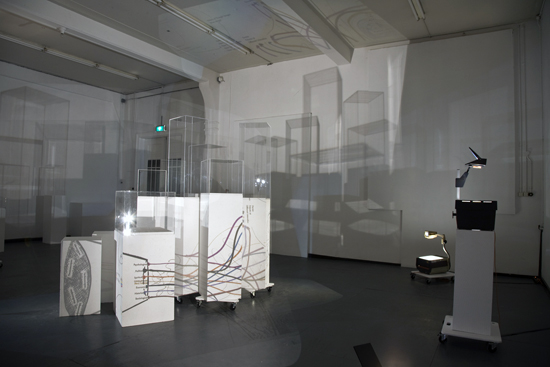


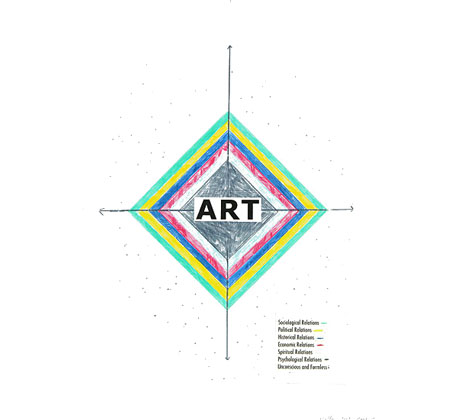





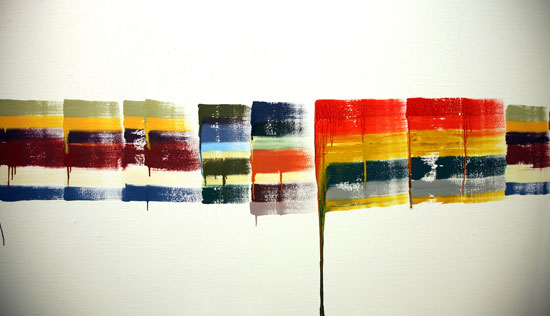


Blow-up: Photography, Cinema and the Brain
“I am proposing the notion that we are here in the presence of something like a mutation in built space itself. My implication is that we ourselves, the human subjects who happen into this new space, have not kept pace with that evolution: there has been a mutation in the object unaccompanied as yet by any equivalent mutation in the subject. We do not yet possess the perceptual equipment to match this new hyperspace, as I will call it, in part because our perceptual habits were formed in that older kind of space I have called the space of high modernism……The newer architecture therefore-like other cultural products I have evoked in the proceeding remarks-stands as something like an imperative to grow new organs, to expand our sensorium”. Fredric Jameson, Postmodernism or, The Cultural Logic of Late Capitalism, page 38. (1)
“In postwar film he (Deleuze) sees a “lived brain,” which works by “irrational” connections, prior to mental states…….beyond the “objectivized” brain, art as well as philosophy might create multiple new paths or synapses, not already given-new connections.” John Rajchman, The Deleuze Connections, page 11. (2)
INTRODUCTION: “Blow up: Photography, Cinema and the Brain” is the story of the construction of the late twentieth century observer. First of all it describes the multiple and connected genealogies of an ever more refined subjective and projective optical apparatus beginning with the camera obscura and evolving into its' most recent manifestation the virtual reality and computer games. This history defines an increasingly accurate optical image that can be mechanically visualized, reproduced and distributed. As we will see in more detail lateer each culture as it exists in its’ own time and place is defined by a hegemony of interrelating and networking immaterial relations such as sociologic connectedness, unconscious psychological reasons, economic forces and political intrigues that bind it’s members together act to define it. By accurate I mean optical systems that make visual those unseen immaterial relations giving them an optical form that can be analyzed and appreciated by the culture that invented them. The phrase genealogical structures, refers to the separate and intertwined evolutions of these subjective optical instruments between themselves, as one technological milestone creates a foundation for the next, and the parallel set of inventions that act investigate the body itself, like the X-RAY, CAT SCAN and MRI, which through their probing unveil the natural conditions of the body necessary for perception and cognition in the first place. Later on we will add one more element to this equation. The brain and the its’ neural-synaptic structure which we will see are active and passive participants in this process. Culture is in a constant state of transformation as it responds to a constantly mutating milieu determined by the above mentioned relations in a constant state of flux. The transformation of culture induces pressures to produce new kinds of technologies to make it operate more smoothly and coherently. Each of these technologies whether it is the steam engine or the computer are on one hand the product of an evolving social, historical, political, psychological milieu and on the other generate new forces which require the invention of new tools to push it further along forward. One direct outgrowth of the creation of these newly invented culturally derived devices are the optical technologies. Many new devices are invented that allow culture to visualize itself but only a few are really relevant and these, as a result of their widespread use and dissemination, help define and optically describe that culture. Such is the case of photography and cinema. But their effect is not limited to simply its lineage as a device in a history of such devices. These optical inventions feedback on culture itself changing its' face in the context of this new view of itself as well as feed-backing on the brain through their effect on networked relations in the real world and the brain's response to them. It is this latter concern that forms the heart of this discussion. I will show how these new technologies and there effects are imbedded in culture at large and how through a process called Neuronal Group Selection they act to change the way the neural networks of the brain may be organized and reconfigured. I hope to show how photography, cinema and most recently virtual reality have redefined the cultural context from one defined by stasis into one defined by dynamism: a dynamic state in which space and time relations are redefined. It is this dynamic image, which adapts itself ever more adequately to the neuro-anatomic and neuro-physiologic specificities of brain function, such as oscillatory potentials on the one hand and reentry on the other. These terms will be defined in greater detail later. What is essential to appreciate here is that early cinema and later avant-garde cinema created a new temporal dimension which through culture could be disseminated. Its power to communicate was not only found in its projective qualities that allowed hundreds if not thousands of people to appreciate it together but was found in the ease with which those individuals could perceive and cognate it. (3) Culture provided a device or apparatus by which this newly reconfigured temporality could be imbedded and artists were its emissaries. As the twentieth century emerged out of the nineteenth century more and more artists became aware of this new temporality and began to imbed its original awkwardness into their work. In literature there was Proust and Mallerme. Proust brought new meaning to reconfiguring the past and Mallerme reconstructed the devices of the poetic voice to give richness to the meter of the internal voice. In painting there was Marcel Duchamp with “Nude Descending a Staircase #2” and “Sad Young Man on a Train,1911” in which the temporality discovered in the pre-cinematic photographs of Muybridge and Etienne Jules Marey where visible in painting. Others followed such as Frantisek Kupka with his “Organization of Graphic Motifs, 1912-1913” and Giacomo Balla with his “Girl Running on a Balcony1912” In architecture Le Corbusier reinvents the “porte-fenetre” into the “fenetre en longuer”. Beatriz Colomina writes “This rethinking of culture through a systematic reappropriation of photography transforms the fundamental sense of space in Le Corbusier’s work. The transformation is most evident in his thinking of the window. After all, the window like the photograph is first of all a frame. The frame of Le Corbusier’s window, like his photographs of the Parthenon, upsets the classical viewer’s expectations, precisely because it cuts something out of the view. (4) Later she alludes directly to the filmmaker Dziga Vertov in her description of the experience of seeing through these windows. “ to an unfixed, never reified image, to a sequence (of photographic images) without direction, moving backward and forward according to the mechanism or the movement of the figure”. The viewer is moving in a cinematic space. As a result of the reinvention of space/time coordinates as they became manifest in this new art, language and architecture, just to name of few, the world in which the spectator or observer moved and lived became changed. The implications of this will be one of the subtext of this essay. It is my opinion that it is this fundamental change in built space that has specific implications for the developing brain. In fact as these new time based relations become configured in the physical world they become remapped into the way neural networks are configured, their spatial relations, and how they operate and communicate to each other through these temporal relations. Whether these temporal and spatial qualities exist as a strategy of the brain already and are simply stamped on the physical world or whether the brain we are born with has infinite potentialities which are unmasked or invented as a result of the new possibilities opened up to it by the changing world that it confronts is one question I hope to address as well.
Whatever the case the cinematic/virtual image, is an image that by its very nature calls to brain in a more direct way. (5) Its structure and its reflectance, I am limiting this discussion to visual images although this argument is pertinent for acoustic, gustatory, kinesthetic, and somesthetic perceptions as well, attract attention in superior ways then images emerging from for instance, nature, because they have been engineered with the human nervous system in mind. I will refer to these images later as phatic after Paul Virilio and the process of their formation as visual ergonomics keeping in mind that they belong to a larger process that I refer to as cognitive ergonomics. “The phatic image-a targeted image that forces you to look and holds your attention-is not only a pure product of photographic and cinematic focusing. More importantly it is the result of an ever-brighter illumination, of the intensity of its definition, singling out only specific areas, the context mostly disappearing into a blur.” (6) As such these artificially contrived images compete more effectively for neural space then their natural or organic counterparts and as such build sets of neural relationships or neural networks that are in a sense artificial. The story of “Blow up” is the story of how these artificial neural networks play a role in the construction of what is real for Thomas, the main character of the film, and how they cause conflicts with those formed through more organic relations. I will use the metaphor of memory to build my analysis and suggest that Thomas has two competing memory systems one gleaned through his normal natural encounters with, for instance, his eyes and ears and another sifted through his photographic prosthesis. In the end it is the informational conflicts that arise through the superimposition of these two systems that cause the conflicts of person that in the end lead to his schizo-affective break down at the end of the film.
This essay is structured in a very different way then most. I have decided to use the structure of avant-garde cinema itself with its weaving and back and forth movements, its switchbacks, and it concretions of action and inaction as a way of presenting this material. The reading of this essay is more like a spiral with the reader consistently returning to previous nodes of inquiry. However not only does this format a kind of memory but in each reactivation and recatagorization of the site the reader understands somewhat better and in more detail the subject matter. In a recent film “Momento” the director uses the device of editing the film to illustrate the main characters loss of short-term memory. Through the “foregrounding” of this technique the audience experiences the frustration and disorder of this disability as if it was their own. I use a similar methodology to explore the non-narrative structure as a better means with which to involve the reader as an active participant in constructing a theory with which to understand the brain.
Intoxicated Sight
When Thomas, the photographer fashioned after David Bailey in Michelangelo Antonioni's “Blow Up” (1966), follows Vanessa Redgrave's gaze into the bushes to discover her accomplice in murder, it marks a rupture between concurrent and mutually exclusive discourses. On the one hand, the apparatus of the eye-brain axis, constructed upon the premise of sensation and reaction. On the other hand, the camera as machine is a mechanical apparatus constructed to extend the range of the body but is not itself “of” the body.
Thomas's sojourn in the park is originally motivated by sheer pleasure. His first inclination is to point his lens at nature in full bloom. His distraction by the tryst of the older man and younger woman comes as the result of an obsessed gaze that hunts out and is called by its own nature, voyeurism. As machine, the apparatus of the camera is constructed as a keyhole that frames the world as a window through which a distanced observer may relish in the secret scene of the bedroom, or in this case, two apparently intoxicated lovers involved in a "secret" liaison. The camera makes the photographer invisible; he is but its organic extension hiding behind it. The performance of photographing, this linking of an organic humanity to the apparatus/machine is not without cost: it results in the momentary loss of self. Thomas is unaware of what is actually going on around him. “Jacques-Henri Lartigue, who called his camera his memory’s eye, abandoned focusing altogether, knowing without looking what his Leica would see, even when holding it at arm’s length, the camera becoming a substitute for both eye and body movements at once.” (7)
He is intoxicated by the process of freeze-framing the world. (8) It is later, back in his studio as he hangs his pictures to dry, that he discovers what "really" happened. Only after a series of "blow ups," in which the apparatus of the camera, its’ partner the enlarger and photochemical laboratory, are used do the secrets which lay hidden in the pictorial space emerge. One is reminded of Walter Benjamin’s comments in "A Short History of Photography". "Photography reveals in this material the physiognomic aspects of visual worlds which dwell in the smallest things, meaningful yet covert enough to find a hiding place in waking dreams, but which, enlarged and capable of formulation, make the difference between technology and magic visible as a thoroughly historical variable." (9) These secret relations exist in and between the parts of an image. They not only define its spatial coordinates, foreground and back round, in-focus and out of focus but its temporal relations as well. Walter Benjamin called these temporal relations, as they existed in photographs and cinema, now-time and “caesura” and their elision and dislocations as space-crossed- time, in which time becomes space and space becomes time. These implicit relations, a term we will return to later in discussing certain processes of the brain, help define the way the photograph is read and therefore understood and they must be uncovered from the image’s unconscious and teased away from some of its own ancillary, distorting conditions. Conditions that are the result of a genealogy of relations imposed from the cultural context that over time may actually act to distort its meanings.
Taxonomy of Phyletic and Episodic Memory
Each photograph functions simultaneously in a multiplicity of memory systems that are permeable to each other and effect specific meanings depending on a system of valences and weights. First it is connected to the collective history of images of which it is part and which we will refer to as phyletic photographic memory, for instance the history of photography. Phyletic photographic memory is further divided into a number of genealogical systems based on semantic and stylistic relations. Some examples are the history of journalistic or fashion photography, the photographs contained in the Library of Congress and those that have been collected in artistic institutions such as the Museum of Modern Art. The advent of cinema and its progeny the “movie still” has recently contributed an intriguing component of phyletic memory. Recent photographic practice, such as the works of Cindy Sherman, Gregory Crewdson, and Jeff Wall with its appetite for staging and remixing has made borrowing the sets and stages of film history into a genre all its own. These images and the photographs that have derived from them are well know to the photographic community and form a type long term memory network system which the aspiring photographer must address consciously and unconsciously during the act of photographing. How many of us know young aspiring photographers whose early work describes a process of historic stylistic mimesis in which different styles of great photographers are at first appropriated before the germination of an individual style can take place. The second broad category of photographic memory is called “episodic photographic memory” and it relates to the personal history of the producers own photographic production. For each photographer creates his/her own archive which acts as a kind of parallel memory to the one formed in his or her normal development of relations with the real world. In recent years the work of photographers such as Nan Goldin, drawing on the style of “cinema verite”, have collapsed the idea of episodic photographic memory into phyletic photographic memory by making there most personal experience the subject of their work. Phyletic memory and episodic memory are terms also used in cognitive neuroscience. The former is defined by those genetically engineered spatial and temporal neuronal relations we are as a species are born with and the latter term is defined by how the effects of experience modify these primary” relations. We will see how this parallel photographically derived episodic memory competes with Thomas’s memory as it has been formed through his body’s interaction with the real world and in the end displaces it. Later in the essay when I introduce the terms visual and cognitive ergonomics, we will begin to understand the process by which this displacement by engineered mediated memories takes place. For now let us simply say that they are sexier or as Jonathan Crary says, “obscene” and attract our attention more. (10) It is this attraction that ultimately leads, I will argue, to a system of neural relations, both spatial and temporal, called neural networks that are configured by artificial stimuli. I call these networks by the acronym APSN that stands for “articulated phatic similated neural" networks. As media and cyber culture determine more and more of the world with which we have contact, as we spend more and more of our time interacting with man made artifice such as billboards, television, computer screens and computer games more and more of our neural connections and the memories that they help code will be organized around these artificial relations.
Returning to the photographer, he or she constructs his/her own system of symbolic relations and meanings that “contextualizes” each new image. For episodic photographic memory embraces both synchronic and diachronic, syntagmatic and paradigmatic relations. In other words each image relates to the image that just preceded it as well as those images made years before. Each image has meaning in the narrative that the photographer is constructing for himself or herself as well as being related to a history of photographic cultural production. For in the end photography is the act of constructing subjectivity for him/herself and for the members of culture at large. The world hails the artist and the artist finds himself/herself in the anatomy of the world. The photographer and cinematographer create and have a conversation with the world and the product of that discussion is the artwork the totality of which is known as a body of work. The episodic archive of photographs and film are the physical instantiation of what makes the artist. Hidden in the interstitial structure of those images are unconscious and implicit relations. The artist looks into that same space and looks beyond the cliches and instead sews together “discursive regularities” bound together by the synthesis of his or her peculiar self. It is these regularities that the artist can see what for others is impossible to see. In this sense the artist and the community of artists, as they have studied the same history of visual relations and have experienced ensemble the constant reinvention of the objective world in which they live, create another system of relations which in some cases are the antithesis of those of the mainstream. Together they propel another type of vision into the future, one which one day may possibly be understood as conventional. These images are found in the border zones interstitial and minority spaces. “If art, or “the will to art,” supposes a people that is missing, that is yet to come, it is because there arises in a peculiar condition the condition in which something new may arise. For novelty in this case is not to be confused with known or visible fashions and the manner in which they are manipulated and promote, but on the contrary, is something we do not or cannot yet see is happening to us…” (11) This tendency to go outside convention in order to deterritorilize new information seems contrary to the visual/cognitive erogonomic paradigm that underlies some of this argument. But the tendency to transform these indeterminate spaces through art is part of a process that I will show is extremely important to the nervous system. Through introducing entropy and increased variability new combinations of sensations and perceptions become possible some of which by chance increase the efficiency with which the brain can code the information of the world. For as I will explain shortly the brain one is born with consists of an overly abundant nervous system in regard to the number and sensitivity of the population its’ neural elements. Gerald Edelman calls this the “primary repertoire”. (12) This primary repertoire is sculpted and pruned by the world that the individual is born into, what I am now calling the real/virtual interface. The real/virtual interface is a laboratory where new combinations of objects and relations are in constant flux as part of shifting experimental paradigms. In the end these experiments, which remember are the result of the shifting and changing social, political, economic, psychological, cultural, historical and aesthetic relations create new objects and relations which then are inscribed in novel networks and network systems. The infinitely variable nervous system is well suited to a variable cultural landscape, the upheavals it creates and the changing visual landscape it dictates. We will see this to be an important impulse of avant-garde cinema as well the avant-garde in general.
Just as the photographer is essential for directing the gaze and aligning the camera along an assumed axis towards that in the "real" which has hailed him/her, he/she is also essential for discovering in the pictorial surface of the photograph other clues to the nature of the image and what it represents. In the transition between the three-dimensional world and its transcription into a two-dimensional surface, changes occur in its representation as photograph which begin to give us clues as to how another kind of coding and transformation, that occurring in the nervous system will occur. On the most superficial level the image is still and frozen. The leaves of trees no longer rustle in the wind, the running figure is frozen mid-step and the sun remains forever behind a silhouetted cloud. Of course photographers using long exposure, stroboscopic methods, camera movement and multiple images have attempted to incorporate a sense of time into its static surface. Some of these methods would find there way into making films. However for the most part the photograph is about spatial relations. The coding of temporality will have to wait for the invention of cinema. But even its spatial relations are subject to interrogation. Through use of focal length and aperture setting that space can become contrived and distorted through manipulations of depth of field. Culturally the problem becomes even more complex when we look at the history of cultural memory as it is delineated in the photographic archive. Although this is not the treatise of this text I think it has important implications for the way that memory is stored and retrieved.
If we believe Peter Gallassi that problems of representation that were found in landscape painting were fast forwarded into early photographic activity which was directed towards imaging nature, one might be able to say the same of history painting. (13) That is to say that the way photography represented history found its schema in the constructed spatial relations of history painting going back to the Renaissance. We are also aware of photography’s role in the representation of history and the construction of a believable grand historical pictorial narrative. This shift from the hand of the painter to the technological photographic apparatus was fraught with difficulties caused by the apparatus of the camera itself. The investigation of which has both plagued and inspired photographers since. Thus, as alluded to earlier, issues such as parallax, depth of field and film speed have affected the way the archive looks and what type of pictures, especially early on, were even possible. For example only moving people and objects coming toward the camera were possible to photographers using very slow lenses and films. Individuals photographed at this time appear stern and stiff because the subject was required to be still for up to four seconds and many times had their neck supported by a brace that attached to the chair in which they sat. But beyond this technological problem there were cultural biases that played a role in what and who were photographed; biases that affected the look and reading of this memory system as much as the technology itself. For the eye of the photographer as it scans the visual terrain and is tuned towards a plethora of possible images selects from that vast array images that tell a story that is culturally biased. It is well known that photography represented the history of bourgeois society, as did painting before, leaving the poor and disenfranchised forgotten. Beyond the actual taking of the photographs there were issues of how the photographs were stored and archived. It is reasonable to assume that the rich and powerful had the means to take care of these images and they therefore would last through time and remain as examples of how people lived and dressed. In reading all the photographs available from that period a high percentage of those that remain will be of those bourgeois cultures thus skewing any interpretation of how people may have lived at that time. Post-modernist photography, which is more interested in investigating apparatus and unveiling its’ form and method of production than its modernist counterpart, has been acutely aware of these problems and has exposed the nature of historical truth as it is manifest in the photograph and how it can be corrupted. Alain Jaubert systematically investigates the methodology of this corruption in his seminal book, “Le Commissariat aux Archives, Les Photo Qui Falsifient L’histoire”. Using a variety of techniques from retouching, cropping, pasting and erasing archivists were able to change the way history was appreciated through the photograph. For instance in many instances the image of Trotsky was removed by these various techniques in order to substantiate Stalin’s claim as the rightful heir to Lenin. (14) This tendency is further informed by Eduardo Cadava “The flood or blizzard of photographs “betrays an indifference toward what the things mean” and thereby reveals the historical blinding or amnesia at the heart of photographic “technicalization”. Substituting for the object and its history, the image represents a trait of the world that it at the same time withdraws from the field of perception. The event that gives the age of technological reproducibility its signature is the event of this withdrawal from sense.” (15)
Crucial to this analysis is that what is represented and thus what makes up history, as we know it through images, is an archive of images that is the result of a construction of a world that can be photographed and yields snapshots. The world takes on a photographic face. This same analysis can be used to look at cinema as well. As we saw first in the films of Leni Reifenstahl such as “Olympia” and the media’s presentation of the O.J. Simpson Trials. “Blow up” is about a discovery and unveiling of that corruption while at the same time a total acquiescence to it. When Thomas is wandering about the park snapping photographs he becomes caught in the phenomenological moment of ecstatic seeing in which his body is elided with the scene of which he is a part. He is unconscious and unaware of the murder that has taken place directly in front of him. His desire has become imbedded in a creative process in which formal rules dictate the direction his camera/eye moves, the amount of space each frame dictates, the position of certain objects in that space and the relations they have to other objects in that shared space. These learned strategies of seeing are imbedded in certain patterns of behavior that control the body such as the tilt of the head, the position of the hands and fingers on the shutter release and focusing ring and even the distribution of muscle tone which controls even his posture. For photographers these postures are imbedded in the actual act of taking a photograph and like walking, breathing, and speaking over time become unconscious. As such they become part of the photograph themselves as that posture in some ways determines the space and orientation of the image. Gary Winogrand’s, “London.c.1967”, “New York.n.d.” and “New York,1962” are just a few examples that come to mind which are examples models of how bodily disposition becomes an unconscious signifier in photographic meaning while at the same time debunking certain predetermined academic postures. Superimposed on culturally derived methods of seeing, such as culturally derived ideas of closeness, harmony and palate, these motor as opposed to sensory adaptations become automatic. In the moment of the act of photographing these learned patterns act to enhance the ability to see, snap photographs and shoot fast while at the same time inhibiting full awareness. They direct the gaze as well as configuring composition. As such they are imbedded in the resulting photograph. It is only through an engaged act of staring and visually searching, in some cases resorting to visual aids like the magnifying glass Thomas uses to inspect his photographs in his studio, that those conventions of seeing, which initially direct the gaze into spaces of knowing but which eventually lead it into lacunae of disinformation, can be overcome.
Avant-garde cinema and the brain
“Blow-up”, as its’ photographic title implies, is part of a much larger impulse of 1960’s avant-garde cinema to connect cinema to its proto-cinematic roots, the motion studies of Etienne-Jules Marey and Edward Muybridge and the single long takes of the earlier Lumiere Brothers' films. Andy Warhol's "Empire" subverts the Hollywood narrative film genre by presenting a single image with slight variations for the entire film. Yoko Ono's "Buttocks" harkens back to Muybridge motion studies. The processes of mechanical reproduction, both his use of the camera and the enlarger, and collage, his reassembly of the images on the studio wall, that define Thomas's investigation of the "real," are a regression of the cinema to its ancestral derivations in photography of the late nineteenth century. The evolving scene of the murder is deconstructed into a set of motion studies as the serial nature of the event is broken down into single shots. Film is montaged, speaking only about photographic montage and not cinematic, into the photo-still and through this process, the true nature of reality unfolds. It is this process of montage, that links avant-garde cinema to the brain. The act of selecting specific examples from the whole host of images, or decoupage, running before our eyes during the cinematic spectacle and their later diegetic reconstruction, is metonymic for a similar process occurring as we witness the spectacle of the "real/virtual interface" and vice versa.
Take a moment to conjure up memories from your childhood. From the almost infinite number of images and their relations construct a story with the faces of friends. Change the locations with these friends. Imagine them today. The story that these memories conjure ,as they are projected upon the immaterial screen in your minds eye and viewed, are a product of ones’ desires, needs, and identity at the particular moment of its’ imagining. A non-narrative, avant-garde film is set up to do the same thing. The stream of images that flow in front of the audience are constructed in such a way that the audience is able to “create” a variety of narratives from the same information. The most extreme cases of this kind of film can be found in Stan Brackage’s, “Dog Star Man” or the early films of Maya Deren and Alexander Hammid such as “Meshes of the Afternoon”. Each person creates their own story from the flow of fragmented images embedded in fractured plots that erupt and fly upon the film screen in a free and unencumbered way. The fragmented nature of these bits and pieces allows them to be bound and collaged together in a myriad of ways creating innumerable plots and stories; stories that have as much to do with cultural context and ideological climate as they do with character development and plot analysis.
This process of selection/montage is reminiscent of Loius Althuser's concept of "interpellation" in which ideology constitutes concrete individuals as subjects: ideology hails its subjects (16) That an ideology is adopted by those that it resonates for and is reified, it becomes part of their body. The immaterial visual landscape that is projected upon the screen is one that, as mentioned above, is full of ideological, cultural and aesthetic determinations. Together they form networks of signifiers that are defined by these determinations in space and time. But cinematic time and space or the experience of cinematic time and space is very different from that which the body responds and is bound to in its normal relations with its experience. These differences are even more pronounced when we compare linear time found in most narrative Hollywood films and that of non-linear time found in its avant-garde non-narrative counterparts. In linear time the story or narrative follows a time line with beginning, middle and end. The film moves seamlessly across the screen in front of a passive audience. In non-narrative film time can be manipulated as an apparatus of cinematic production. The plot rides on its feedback and feed forward disruptions and the audience consciously or unconsciously builds the story from these temporal fragments. Recent Hollywood hybrids like “American Beauty” and “Memento” combine both strategies in their attempt to mimic those relations of the real/virtual interface. This is extremely important for two reasons which later on will be further elucidated. First of all these experiments in time that define avant-garde cinema are mimetic of temporal relations already present in culture and society at large and are responsible for its increased density and complexity. They are endemic to the internet and the way, for instance in hypertext, meaning is piggy-backed onto the same bits of space and time. The very fact that Hollywood has adapted these strategies is in itself an indication of how prevalent these strategies are and how important they are to the viewing audience who now considers them normal rather than odd and cognitively challenging. Secondly these experiments with the application of temporal strategies of non-narrative film have created new paradigms upon which new temporal formations can be described that later will have implications for information systems and for what I call “visual and cognitive ergonomics. As we will see in our description of “Blow-up” more and more cinematic time and now virtual time is being embedded in the “real” as it becomes transformed into the real/virtual interface. The implications for the body are enormous. For the developing brain adapts to these new space-time relations as neurons and neural networks within an existent variable population compete for this newly coded information. Those neurons and networks which most easily can adapt to these newly configured space-time continuum of the real/virtual interface will survive and undergo what J.P. Changeux has called “exuberant growth”. (17) Those neurons and networks whose electrochemical potentials are at odds with these new relations will undergo apoptosis or cell death. (18) In the end the brain undergoes a kind of transformation or mutation in which a new kind of subject or observer is created. I refer to this newly sculpted brain as the “cinematic brain” and the person who is the carrier of such a brain “The Mutated Observer”. This cinematic brain has important implications for our understanding of “Blow-up”. Thomas’s dilemma in this film is a product of a schism or rift between his "cinematic" and "real "brain.
Recent post-structuralist discourse has redefined the role of the audience in constructing meaning from the disparate signals introduced by the cinematic experience. Authors like Jean-Pierre Oudart and Stephen Heath introduced the notion of the “suture” to describe the way the spectator is connected to the representations flowing across the screen of cinema. (19) That non-narrative film introduces fragmented objects, signs and temporal relations into its basic structure to be easily assembled and disassembled makes it easier for the audience to perform similar acts of assemblage and dis-assemblage. The film can then contain a multiplicity of narrative structures simultaneously which act in parallel. Different groups, for instance those constituted by individuals with different cultural background or personal histories, can coexist within the same audience and may construct separate stories from the same film. On the other hand there may be points in the film in which these different audiences may agree. These can be become nodal points around which a consensus concerning the overall meaning of the film can be constructed while still being consistent with a personal reading. Different nodes can participate in the same narrative and the same node can participate in different narratives. Each context slightly alters each nodes meaning as it is shaded and colored by the differing stories it is embedded in. Later on in this discussion we will see how this multiple narrative structure, parallel dimension, fragmented nature and nodal construction have important implications for theories concerning the development and construction of the neuronal structure of the brain. For instance Edelman has called neural networks that participate in multiple larger networks degenerate. (20) For clarity sake, because the section on the brain needs a great deal of introductory information, I would like to continue with this basic discussion of cinema.
Scopic Regimes of Modernity
The meaning that cinema has for us is to some extent related by its close relation to reality. (21) Film is filled with objects with which we are familiar. Their meaning to us and their constructed relationship to each other mimic those relations with which we are already familiar in our daily lives. But the meaning those objects have and their relations are determined by static and changing aesthetic, cultural, social and psychological forces which, for instance, control how those objects are made and used or their spatial arrangement in a room. Marcel Duchamps use of the urinal, wine rack and shovel are a testament to the way that the meaning of neutral objects change and are transformed through simply re-positioning of them from their original context as utilitarian objects into one in which they are appreciated as sculptural art objects. Objects that are bound by very different social, aesthetic, psychological and economic histories and as such are appreciated in the context of a history specific to that kind of object. Duchamp’s, signed R. Mutt, “Fountain”,1917 is therefore embedded in a history of sculpture that begins with early man’s use of figurative fetish objects in religious ceremonies, continues with Michealangelo’s, “David”, followed by Robert Smithson’s, “Spiral Jetty”, 1970 and today exemplified by Gabriel Orozco’s “ET4. LA DS” 1993 (transformed Citroen). Although these other sculptures do not emerge from the same conceptual framework as "Fountain, 1917" they nonetheless help define what Duchamp's three-dimensional object is and what it is not in terms of a history of sculptural objects displayed in a gallery or museum. But spatial and temporal relations have a separate history as well and like there object counterpart these relations are affected by the political, social, psychological, historical, economic and aesthetic relations, just to name a few, in which they are embedded. Therefore space and time can be seen as devices just like our visual apparatti and the way space and time operate can be viewed as an indices of cultural change. In fact each culture and generation invents spatial and temporal constructs that are specific for the changing needs they confront. These constructs become folded over one another rather than simply superseding each other, one displacing the next in a linear progression. This is especially true of what Martin Jay calls the “scopic regimes of modernity” in which a succession of context dependent notions of space developed throughout history become collaged together combining to create our contemporary notion of space. “For as Jacqueline Rose has recently reminded us, “ our previous history is not the petrified block of a single visual space since, looked at obliquely, it can always be seen to contain its momemt of unease. In fact, may there possibly be several such moments, which can be discerned, if often in repressed form, in the modern era? If so, the scopic regime of modernity may be understood as a contested terrain, rather than a harmoniously integrated complex of visual theories and practices.” (22) So what are these different scopic regimes of modernity and how do they configure a context driven space? What role has cinema and new media played in reconfiguring space and time and how have these affected the construction of the twentieth century observer of which Thomas is a prime example. These are some of the questions I would like to now address.
The first scopic regime of modernity alluded to by Martin Jay is Cartesian Perspectivalism which is a combination of the Renaissance notion of perspective developed by the artist Brunelleschi and written about by Alberti and Descartes’ idea that visual representations are projected upon a screen in the brain and rationalized by the mind. The basis of this idea came from a desire to code the three-dimensional world onto the two-dimensional surface of the painted canvas to be appreciated as a three dimensional picture. It required an unemotional, privileged, monadic eye that was in league with scientific accounts of the world. Objects existed in spaces fixed by specific x, y and z coordinates that were defined by connected opposing five sided triangles whose apices touched the fovea of the observer’s retina and the paintings vanishing point. This space created a stage where various narrative structures could and did unfold. I will later argue that it is this Southern tradition of the Cartesian Perspectival window that forms the basis for the Hollywood narrative film whereas avant-garde film is more in synch with the Northern tradition of art of the grid that evolved in the low countries of Holland and Belgium in the seventeenth century. “ Like the microscopist of the seventeenth century-Leeuwenhoech -Dutch art savors the discrete particularity of visual experience and resists the temptation to allegorize or typologize what it sees, a temptation to which she claims Southern Art readily succumbs.” (23) Unlike its predecessor it elevates the art of description over narrative and assumes the existence of objects prior to the observer’s position in front of the canvas. The Northern tradition, sometimes allegorically described by the term Baconian Empericism, redefines space and time relations as finite and infinite simultaneously in opposition to its Cartesian counterpart. Finite in the sense that objects and space could be described and infinite because there was no limits to those spaces and the objects that inhabited them. In its grid it reinvents time and space relations that are essential to changing notions of the limits of space and time itself. For the Dutch realized, sometimes unconsciously, that different worlds existed simultaneously in the optics of the microscope and in the endless horizon of the sea. Whether drawing the minute world of the space of a cell or redefining the endless space of the sea as a map they understood that space and time went beyond the space of their rendering, continuing forever. When it was time for the painter to stand in front of the canvas these same strategies found their way into his/her “recodings” of the landscape and still life. The grid was an invention and a tool like perspective to represent a world that was now understood differently and thus needed to be represented differently. It is no wonder that this art of describing would predate the invention of photography. “….the art of describing also anticipates the visual experience produced by the nineteenth-century invention of photography. Both share a number of salient features “fragmentariness, arbitrary frames, the immediacy that the first practitioners expressed by claiming that the photograph gave nature the power to reproduce itself directly unaided by man.” (24)This sentence could end “unaided by man” over and over and over again. This is, as we will see when we follow the trajectory of the work from Etienne-Jules Marey and Eadweard Muybridge to Andy Warhol and Yoko Ono , a kind of fundamental dictum of minimalism and experimental film. The grid forms a theoretical framework in the early sixties where the strategies of artistic production can be played out. The third schema or model to influence modern vision is that of the Baroque which participates more like an anti-model. Here the geometricalized spaces of perspective and the grid are eschewed for one likened to a mirror that is unreadable, opaque, distorted and out of focus. It moves the viewer out of visual discourse altogether and replaces it with a tactile or haptic quality. The body, which was dethroned by Cartesian Perspecivalism, here makes a startling comeback with the return of a sublime eroticism.
The final two models that I would like to discuss are assembled from these first three but extend their arguments. They are Warped space and Mutated Space. Warped space has recently been championed by Anthony Vidler in his book that carries the title “Warped Space: Art, Architecture and Anxiety in Modern Culture”. Warped space is the result of, on the one hand, the role of the psyche in the perception of and creation of space and on the other the role of the artist projecting his or his discourse on architecture from without. For the purpose of this text I would like to focus on the former. The psychic space is in some ways an adaptation of Kant’s notion of the sublime space except here the body's anxiety has been transferred to the audacious space of the piazza and its subjective feeling of agoraphobia from the supersensible response to mountain peaks. “Astonishment that borders on terror, the dread and the holy awe which seizes the observer at the sight of mountain peaks rearing themselves to heaven, deep chasms and streams raging therein…. In the safety in which we know ourselves to be, is not actual fear but only an attempt to feel fear by the aid of the imagination, that we may feel the might of this faculty in combining with the mind’s response the mental movement thereby excited” (25) The sublime is a condition of reflective judgment and not a characteristic of the object itself. Kant goes further in his analysis of the sublime and links it to the estimation of the magnitude of things by apprehension and comprehension. He posits that the mind in its apprehension of a thing breaks down that object into identifiable parcels or quanta and reconstructs the object of regard in the mind by binding these quanta together into a larger whole. The problem comes when the estimation of magnitude is beyond the mind’s ability to hold the sensation long enough to attach the forthcoming sensation to it. “For when apprehension has gone so far that the partial representations of sensuous intuition at first apprehended begin to vanish in the imagination, while this ever proceeds to the apprehension of others, then it loses as much on the one side as it gains on the other, and in comprehension these is a maximum beyond which it can not go.” (26)Inherent in this notion of the sublime is the concept of “beyondness” which for Kant like Vidler concerns the limits of the body to negotiate space. A space which architecture, as it embeds itself into the “landscape” of the city, first configures according to the bodies perceptual abilities and then challenges its psychic stability. Warped space is the product of interlaced historical strategies of spatial and temporal configuration of the new metropolis or Grossstadt which are linked to specific psychopathologies. Agoraphobia, the fear of open space, hysteria, physical illness that is defined by symptoms incommensurate with anatomical possibilities, vagabondage and ambulatory automatism a kind of amnesia for traversed space and severe distraction, the direct result of the destruction of the space of judgment or reflection by the assault of rapid communication and technological invention where, according to Benjamin, “space was for rent” were all caused by the new perceptual challenges imposed by the new urban environment. It is this last psychopathology that has the most relevance for our discussion of the constructed new observer of the twentieth century and the cinematic brain. I would like to argue that the cluster of psychopathologic states here described resulted from the transformation of built space that photography and cinema incurred through its production in architecture. “ that modern architecture becomes modern not simply by using glass, steel or reinforced concrete….but precisely by engaging with the new mechanical equipment of the mass media, photography, film, advertising, publicity publications and so on.” (28) This modernism created new spatial/temporal conditions which required a neuro-perceptual apparatus that was adequate to their challenging reconfiguration of spatial temporal contingencies. “In modern cinema images cease to conform to tonal rhythms-spectacular moments give way to the most banal ones…without a sense of rational logic. In the end the cinema trips into an ambiguity so overwhelming that the imaginary and real become indiscernible…every perception is an hallucination”(29) It is my opinion that these mental conditions were the result of an inadequacy of the neuro-perceptual system, configured according to the spatial and temporal conscriptions developed in the late eighteenth and early nineteenth century, to deal with challenges that a new condition of time and space exploding out of Realism, captured by photography, redefined by cinema and imbedded into a new urban mediascape would impose.
Mutated space is a term that has been used in various contexts and in fact has even substituted for the term “warped space”. (30) I would like to use it here to signify a specific mental condition of space/time relations as they become coded for in the brain. Mutated space is a specific architectectonic condition of the neurobiologic substrate which is the resultant condition of a brain that attempts to code for the ever evolving conditions of what we now appreciate as the real/virtual interface. (31) I have already alluded to some of the theories of Edelman and Changeux concerning the way that culture inscribes itself on the brain in the transformation of what they refer to as the primary repertoire into the secondary repertoire and I will have to ask for the readers continued patience for a full explanation of these neurobiologic theories. Suffice it to say that whereas warped space and its psychic correlates are the result of reaching the limitations of the brain’s ability to deal with the changes of the "grossstadt", mutated space is the result of the brain’s innate changeability. This flexibility to adapt to new environmental cues is the result of a kind of neural plasticity in which a highly variable, the firing specificities of the neural population are widely distributed over many kinds of sensory stimuli, and overpopulated nervous system is pruned, so to speak, through a process of cell death and exuberant production. (32) The constantly evolving environment is the result of a multiplicity of immaterial relations, such as psychological forces, sociologic cues, economic stimuli, technologic adaptations, and aesthetic styles, that interact together on and though the material world of objects and their relations and the virtual world of televised images, billboards, cinematic images, computer screens and computer games. The history of objects, their relations and the spaces they occupy as well as the history of their virtual counterparts act to write a type of cultural memory. Each entity is the resultant of a multiplicity of vectors. On one hand each has its own historical antecedents and on the other each is adapted to a particular contemporary context. The computer screen was adapted from a television screen that was adapted from the movie screen that was adapted from a painting and so on. These specific and separate evolutionary systems have an interacting counterpart as well. Each come together at sites of interaction called nodes in which for instance technologies developed for one machine can be adapted to be used in another. In this way these memory systems develop and change together and as they do they cause a domino effect throughout the whole system. It is this evolving systemof relations that the brain must adapt to. The mutated brain is the term used to express the constantly evolving system of interacting neural networks that are the result of this evolving world. The next section will deal with a specific kind of interaction that resulted from the development of cinema but is relevant for new media as well.
Cinearchitectonicneuro-synaptologics
“Deleuze describes the brain as a relatively undifferentiated mass in which circuits aren’t there to begin with; for this reason, (c)reating new circuits in art means creating them in the brain too. The cinema does more than create circuits, through, because, like a brain, it consists in a complexity of images, imbricated and folded into so many lobes, connected by so many more circuits. While cinema can simply reiterate the facile circuits of the brain, appealing to arbitrary violence and feeble eroticism, it can also jump those old grooves, emancipating us from the typical image-rhythms….opening us t a though that stands outside subjectivity…” (33)
Cinearchitectonicneuro-synaptologics (CAN) is a term that describes a process by and through which photographic, cinematic and now virtual space, their formal spatial and temporal properties, become first imbedded in architectural forms and discourse and then inscribed upon the brain. Through their connection to photons of light photography, cinema and the visual components of virtual space share with the eye-brain axis a common currency. In the case of photography and cinema light emanating from the objects of the cameras regard are captured by the apparatus of the lenticular system and focused upon a specialized membrane, the film emulsion, where a specific photochemical reaction takes place. The history of photography and film has in essence has been a continual readjustment and reinvention of these components in a process of frequent adaptation. The requirements that an evolving time-space relationship in which the need for faster and faster lens systems, lenses that had larger apertures to capture the light without compromising optical quality caused by chromatic and lenticular aberrations, faster films with greater sensitivities, new cameras which could capture the essence of movement itself and finally ever more refined strategies to capture the attention of an audience with an ever increasing appetite for visual sensation and an ever increasing threshold of believability. In the case of the eye-brain axis the stimulation of specially evolved light processors in the retina, a thin transparent membrane that covers the spherical back of the eye, which communicate and transmit information along a specified route called the anterior and posterior visual pathways to the far posterior aspect of the brain called the visual cortex. ( Figure 3 )What connects these systems is that each is tethered to the electro-magnetic qualities of light. That the history of the neuro-physiology of vision, the invention of devices to research light and the history of the invention of photography, proto-cinematic devices and cinematic technologies occurred together and were linked to each other is, I believe, no accident. (34) That these devices as they captured the attention of an eager public would find themselves embedded in other aesthetic practices that also investigated vision such as painting, fashion and architecture is no surprise. Artists like Georges Seurat, Frantisek Kupka, Jacques Villon, Marcel Duchamp, Carlo Carra, and Giocomo Balla all created works of art that were photographically and cinematically inspired. It was only natural that these strategies, experimented with upon the two dimensional plane of the canvas would find there way into architectural practice as it was conceived, built, photographed and disseminated. It would find an immaterial basis like the light that first bathed and reflected its surface and later would become a kind of metaphor or analogy for built space itself in the work of John Hejduk and LeCorbusier. (35)
In the next chapter I will make the point that these relations as they are immaterial and therefore act invisibly are made visible by specific optical technologies. These technological devices like the camera obscura, the camera lucida, the photographic and cinematic camera and today information and communication technologies ( ICT) (Figure 4 )are in fact each societies response to these invisible relations and their desire to make them visible. It is the complex interaction of these immaterial relations that produces special technologic requirements that necessitate refinements of older apparatti or the production of brand new ones. A similar story can be told for the conceptions of time and space. They function to redefine a special set of circumstances in which they are imbedded and they produce a context in which the constantly mutating relations, previously described above, can mix and interact . New conceptions of time and space create a context in which specific sets of ideas, which had been previously disproportionate with each other, are now able to align themselves to form new concepts which in turn generate the need for new instrumentations to record them. The Theory of Relativity, The Heisenberg Uncertainty Principle and The Schroedinger Wave Equation disrupted then known facts about time and space and would have to wait many years for new technologies and instrumentation to prove their pronounced validity. These kinds of discoveries generate new complexes of information that require new definitions of time and space. This process is not always as linear as I have described it here. Many times there are fits and starts, switchbacks even bushwhacks, if I may use such a metaphor, in which information which appeared inconsequential is now seen as significant and new bits of information are transformational and revolutionary as to turn everything upside down. Such is the case for our recent history of optical technologies of which photography, film and cyberculture form an integral part. From the simple devices for the creation of pleasure for which all these instruments were originally invented these instruments, like a lightening flash, became influential in the generation of new ideas about space and time that would influence Marcel Duchamp’s “Nude Descending a Staircase” 1917 and Albert Eistein’s Theory of Relativity. These changes would first take place in the spaces accorded to them by the image, frame or screen followed by their indirect affect on visual culture in the public space of billboards and giant video screens and finally by the impact they have had on the skin of architecture, fashion, and design. In the end I will argue that the new strategies of configuring time and space that are experimented with locally in each specific media and its later transcription into the broader spaces of visual culture are part of a much larger tendency in which information, and its processing, becomes more dense: that the curved dimensions of space and time can be packed with ever more and more information by incessant folding and plication. (36) I will define this process as visual and cognitive ergonomics. The overall affect of this process is in the end on the brain itself and the way it codes information. I will hypothesize a bi-directional process in which these new experiments with time and space become in(cor)porated into the way neurons and neural networks at a local, for instance the visual cortex, and global level, in which the areas of the whole brain are involved, become organized and interact. These neural networks are configured according to networks of relations that occur first in the visual landscape and are formed from interconnected signifiers. Evolving networked relations in the real world configure evolving networked relations in the brain. For instance primitive man hunting for game might put together animal tracts, the smell of fresh urine, and animal fur tethered to a broken branch as evidence that what he is searching for is nearby. In the modern world these signifiers can vary from groups of objects that have purposely arranged to produce specific meanings, like furniture arranged on a stage in a play, or they can be simply groups of texts consolidated together on a billboard advertisement. When these signifiers are constructed in such away, in the boardrooms of advertising companies and the laboratories of perceptual psychologists, that they “capture” our attention they become phatic signifiers. Paul Virilio calls this a “process of message intensification” and defines a phatic image in the following way. “The phatic image-targeted image that forces you to look and holds your attention-is not only a pure product of photographic and cinematic focusing. More importantly it is the result of an ever-brighter illumination, of the intensity of its definition, singling out brighter only specific areas, the context mostly disappearing into a blur.”(37)
As we live in a world in which the visual landscape is a clutter of these phatic signifiers competing for our attention. I say competing because within the ever-developing field of phatic signifiers new types of signifiers are always being developed. Simply look at the special affects used in Sci-fi movies of the fifties and compare them to those used in the Star Wars Trilogy or witness the effect of the change in movies with advent of Technicolor. What captured our imagination then seems funny and primitive. But special affects are not limited to the movie theater they are happening everywhere constructed images are being formed, located and distributed globally. The devices of cinema, the stage, lighting, cameras, editing machines, special computer programs like after-affects, are being used in television, advertising, and news bureaus. Just as we witness an evolving genealogy of cinematic devices and concepts of the representation of space so to is there a genealogy of specialized devices of special effects to intensify the sensorial and perceptual effect. Ever more sophisticated and intense phatic signifiers are being produced and they are pushing out there more unsophisticated progenitors from the visual landscape in a process similar to natural selection accept the real selection is taking place in the brain as these stimuli compete for the brain’s and its’ neuronal attention. The field of significant signifiers becomes the field of phatic signifiers. Within these fields relations grow which link phatic signifiers together. For instance the use of movie stars to sell products has recently become very popular, the appropriation of movies to structure television programs and vice versa are some examples of the networking of these signifiers in to grand schemata of signification. The visual landscape becomes a network or field of phatic signifiers. This network, as it is composed of elements that developed together in synch and erupted out of the same desire to create an ever more refined and intense image and the end product of selectionist forces that prune off its detritus and excess, is a very efficient system of relations. As they are technologically based and have been created out of the same linguistic surface, in the case of digital technology the binary system, their efficiency translates into a more competent use of space and time. We know this is true as we are witness to the invention of smaller and smaller microprocessors to run smaller and smaller computing devices which have more and more computing power. This in the end has lead to more and more complex abilities and has allowed to society to investigate more and more complex entities including newer concepts of time and space like black holes. (38) These networked relations as they have evolved in the world become the stencils upon which the networks of the brain are modeled. Their complexity and efficiency find their counterpart in a selected neuro-biologic apparatus. As a result technologic apparatti, space and time apparatti and neuro-biologic apparatti all develop in tandem and themselves create a complex set of relations. A little later I will show how these artificial phatic signifiers compete for the neural space of memory with non-artificial stumuli. I will build an argument around the development of a mutated observer of the twentieth-century, of which Thomas is a good example, on a hypothesis that these phatic signifiers are “selected” for by brain above and beyond their non-artificial “real” counterparts and are thus remembered easier and more intensely and in the competition for limited neural space become its master. Before I develop my argument further I would like to step back a little to discuss a fundamental hypothesis and somewhat still controversial theoretical framework of neurobiology called “Neural Darwinism” or “Neural Selectionism.”
Neural Selectionism and Culture
Gerald Edelman in "Remembered Present" building on the theories of Hebb and Pierre Changeux, constructs a concept of cerebral development and cognition based on the Theory of Neuronal Group Selection. (39) This theory posits that we are born with an overabundant population of neurons that he refers to as the primary repertoire. (40) Through a process of amplification of sensitized neurons and pruning of non-essential ones the brains' micro-architecture, the structure of the connections of the units of nervous system referred to as neurons, which can be visualized with a microscope, is sculpted by relevant inputs. The primary repertoire is the result of genetic influences that describe a blueprint in space and time that is followed by millions of migrating neurons during development. A “secondary repertoire” is formed after conception as the result of an interaction between the world that person is born into, which is in flux and can change from one generation to the next, and the neurons and connections of the primary repertoire. Those neurons that develop enhanced firing patterns do to inputs of groups of sensations generated from objects, their signifiers and the spatial and temporal relations that exist between them are selected for over and above those that are not similarly stimulated. These selected neurons are amplified because they are stimulated by these relevant inputs over and over again. Remember that objects as conglomerates of individual sensations share with other objects similar sensations. Therefore the same neuron that codes for that fragment of the object can be stimulated by the same sensation from a multitude of objects that share that attribute. Those neurons that are not stimulated undergo a process called apoptosis and die off. “ The concept that there are mechanisms that act to retain those pathways in which patterns of external stimuli induce activity and eliminated potential connections not so activated has been termed functional validation by Jacobson and selective stabilization by Changeux and Danchin.” (41) The resulting population of neurons reflects these interactions and is dominated by those that are frequently stimulated. These sources of stimuli are woven over and over again into the network of relations that exist in the world apart from the body. In the case of vision, visual objects, their signs and relations have many synchronous and interactive qualities such as color, shape, motion, and form. The history of painting, photography and cinema is characterized by an investigation of these qualities and their representation and non-representation. But it turns out that the visual cortex of the brain, which sits in the far posterior aspect of the brain, consists of multiple functionally specialized areas with which to receive these inputs. They are called V1, V2, V3, V4, V5. V1 and V2 mostly send information to the other areas. V1 is called the cortical retina because a topographic map of the retina can be recreated on it. Without getting too deeply involved with an explanation of the neurophysiology suffice it to say that each area has a particular function such that V4 is responsible for color vision and V5 for motion. But we know that objects and their relations share many of these qualities simultaneously. An apple is red, it has a specific shape that we recognize as apple, it is stationary unless given a push and it exists in a physical milieu that gives it a context. One neuron cannot code for all this information and a network of neurons is required. According to Hebb neurons that fire together wire together. As a result of simultaneously coding for all this information together a neural network is formed. When a network is confined to one area of the brain it is called a local map. Local maps like the ones for the visual cortex also exist for the senses of hearing, taste, and touch. Many times however the visual characteristics of an object are connected to other sensory qualities such as smell and sound and emotional qualities like love and pain that are perceived by other parts of the brain. Many times visual sensations will necessitate a response of the whole body and musculature. In this case a sensory-motor loop will be instigated defined by specific neural networks that connect the posterior part of the brain, where information for sensation is located, to the more anterior aspects where action is cognated. This sensory motor loop as we will see will be very important when we discuss classic and modern cinema in relation to movement and time images In these cases the networks expand beyond the restricted domains of a particular sensory system to create what are referred as global maps. Local and global maps are under the same selective pressures as the neurons that form them. Just like neurons neural networks are amplified if they are repetitively stimulated. This may result from the same inciting stimuli or it can result from a networks participation in larger networks in which they play a role. The apple, of our previous example, can play many different roles in many different scenarios that take part in the real world as well as those which are included in memories and obsessive fantasies. In the end the brain, its neurons, synaptic connections, and neural networks are sculpted by the inputs it encounters after birth. The question then becomes what if these inputs are artificially constructed rather then real or organic. What happens when these artificial stimuli are engineered to be more sensational and intense because they have been created with the brain in mind. What happens when fields of phatic supersignifiers manufactured with social, political and psychological intent compete in the space of the world for the brains attention. I will try to answer some of these questions a little later.
Eye-vision, Camera Vision
The act of photographing as an act of will is the repetition and invocation of a number of Neurobiological events coordinating the desire/value in seeing with the act of shooting. Thomas's body movements, which have been mentioned previously in the literature on temporal discussions of "Blow Up", are a kind of improvisational performance in search of the perfect angle he attempts to discover an alignment that brings a harmony between his subjective phenomenological self and the machine/camera. This performance stems from his desire to find the perfect balance between the optical axis of the camera with the optical axis of his eye. It is the non-resolution of these two opposing factors that lies at the heart of the conflict and disjunction of "Blow Up." For Thomas is in many ways the quintessential twentieth century observer. The latest model in the creation of a subjectivity that begins in the chamber of the camera obscura matures through the elided space of the stereoviewer, and reaches a sort of apogee with the experience of cinema and today new media. The central problem explored by this film concerns the problem of the postmodern observer, an observer in whom fiction and reality are interchangeable in the construction of the observing subject. The misalignment of the phenomenological body and the apparatus of the camera is for Thomas a problem of misalignment of how and by what means he identifies "himself". This "disjunctive subjectivity" is the result of a steady reconfiguration of the observer and the associated substitution, the acceptance and finally dependency of the simulacrum as real. The technological shifts that marked changes in the representation as defined by the camera obscura, the stereo viewer and the phenakistascope marked shifts in the viewer /observer relation to reality and his/her willingness to allow these projections to substitute as real facts in the construction of consciousness and memory. “Blow Up: Photography, Cinema and the Brain” is an essay which analyzes the reasons and affects of this misappropriation of the simulacra of cinematic projection on the construction of long term memory and its consequence for the construction of subjectivity.
The invention of film was a logical result of technological advances and the matrix of sociological and cultural facts that surrounded and enveloped it. The carnate observer of the nineteenth century becomes the disincarnate body alone in the passivity of watching, which is so characteristic of the cinematic observer. Jonathan Crary, although focusing on the seventeenth, eighteenth, and nineteenth century observer is aware of certain implications in his predictions for the twentieth century: "The formalization and diffusion of computer-generated imagery heralds the ubiquitous implantation of fabricated visual "spaces" radically different from the mimetic capacities of film, photography, and television... Computer-aided design, synthetic holography, flight simulators, computer animation, virtual environment helmets,.are only a few of the techniques that are relocating vision to a plane severed from a human observer." (42) This prediction is predicated upon an analysis of both a non-linear and linear trans-historical journey of ever more refined technologies in the context of a mutating observer. (43) Non-linear in the sense that the development of these technologies is a history of stops and starts and of erasures and refinements. “ At each level different non-linear dynamics take place, with their own multiple equilibriums and bifurcations between alternative stable states.” (44) It is a history that in its becoming is the result of a multiplicity of histories, cultural, psychological, aesthetic, biologic that develop tangentially and in parallel and are later implicitly conjoined. Much like non-narrative avant-garde film that history is a collage of and fitting together of disparate images and events that together define the character of that historical being. What we know as linear history is the result of an editing process that comes after the fact in an attempt to create a unified narrative and as a result a unified audience of observers who see and appreciate the same thing. As we will begin to appreciate as this essay unfolds it is the power of this narrative cinematic experience especially its affect on phyletic and episodic memory as it creates a unified audience of observers at the most basic level of the neural network. That in fact the mutations in built space that were alluded to in the first quote of this text by Jamison are in fact going on all the time. What Jamison is saying is that sometimes the changes in space and the objects that inhabit that space are ahead of the body's ability to change in relation to them. For the spaces created by one generation of artists architects, city planners and fashion designers must many times await the transformed neurobiogic substrate of the next generation of observers in order to appreciate them. In the present situation the modernist object, space and sense of time have sculpted, through the process of neuroselectionism we spoke of earlier, the neurosynaptic structure of the modernist observer. Post-modern objects, space and time have not yet conspired to construct a population of observers who have the neurobiologic apparatus to understand them.
Any population is made up of a heterogeneous mixture of observers defined by the degree to which their neurobiologic architecture has been configured by specific cultural models instantiated in specific object time/space relations that are constantly shifting. Jamison’s model of the technologic sublime can be somewhat reconfigured using this model. For here what is sublime is defined by what is beyond the brains ability to understand and configure not because it is enormous, or huge, or scarry and not because we can not imagine the interior mechanism of its working but because the configuration of neural networks has been sewn together by another set of cultural circumstances which have configured the objects and spaces of what we all consider is the real world. The neurobiologic sublime is then defined as those object, object and space/time relations that are beyond the brains ability to understand and appreciate and in the presence of which we are helpless. Jamison's post-modern object or space/time relations is thus sublime when a specific modernist subject observes it. Gilles Deleuze expresses it differently as this quote from Gregory Flaxman’s book The Brain is the Screen points out. “Deleuze often refers to Spinoza’s remarkable claim that we do not know what a body can do and it is precisely in this context that we can understand this sense of the unexplored potential, for the brain and body have been reduced to a neuro-network deflecting images from perceptions into actions, a regulated system of feedback that Bergson calls “sensory motor schema such as the rudiments of a dogmatic image of thought Deleuze identifies with Hollywood Cinema.(45) These thoughts are very significant in relation to “Blow Up” because on one hand they allude to a system of imaginary relations that create an imaginary or cinematic neurobiologic substrate and on the other hand they help us diagnose the modern schizophrenic observer. An observer who is the result of the mismatch of two independent long term memory systems which randomly substitute for the other and in the process disrupt perception. Whether we look at Thomas who disappears at the end of “Blow Up or Robert Michel in Julio Cortazar’s “ Las babas del diablo” , who looks at the sky though the image of a rectangle tacked to his ceiling, we are witnessing the effect of the fracture between these two non-congruent systems of memory and as a consequence the systems of representation they have coded for. The how and why of this process of mental destabilization is one of the subtexts of this essay and I think has something to do with the evolution of the construction of the perfect ergonomic object. When I say object I am talking about two parallel discourses that have evolved in tandem. On one hand the material object that has weight, perpetrates a force, can be authenticated by all the senses together, it can be touched, seen, tasted, heard and positioned according to the axis of the body. A camera would fit this description. On the other hand the image as it has evolved from the painting, lithography, photography, film and now virtual reality. For the purposes of this essay I would like to confine myself to that of the image and that of cinema most particularly. Cinema seen in this context becomes a stage in the process of the construction of the perfect ergonomic object. But what makes cinema so intriguing is that if we follow its genesis we must admit that one of the most important factors in this genealogy is how film deals with space and time. It is these new constructs of time and space that allow for a multiplicity of rearrangements of the real/virtual interface especially in fields like architecture, fashion, design, and art as well as city planning, social praxis, scientific research and political entanglements. Thus it is the experiments in time and space within the cinematic field that become folded and deranged as they are appropriated by other discourses that open up new possibilities and alignments for the information in those fields. New connections are built through the new possibilities of continuity. Thus a reverberation is felt along the entire network of disciplines that make up the plane of knowledge as the time/ space waveform travels throughout its volume.
Defining cinematic time and space
Deleuze divides cinematic history between two poles that are defined by classic cinema at one extreme and modern cinema at the other. What differentiates these two is how they deal with space and time not in the real world but as mental processes. How they in fact are linked to cognitive processes of the brain. Classic cinema is narrative cinema or the action film that has made Hollywood famous. As it description implies it is about a story. It is a sequence of events that are linked together with a beginning middle and end. An appreciating audience follows the lineage of these framed events together as one mass being. For Deleuze what defines the narrative or classic cinema is it relation to what he calls the sensory-motor loop. He proposes that every sensation is followed by a response or action. Visual perception is linked to muscular contractions and this is the quality of the movement image a term he borrows from Bergson, who he says never appreciated the time-image, his later designation, because the technology to make these kinds of films was not yet in existence. Deleuze defines the chronological demarcation line where there is a disruption in the chronology of the history of film as 1945 with Visconti’s film “Obsession”. (46) This work of art would change film forever. As a result of the destruction of the social and cultural fabric of Europe due to World War 2 a new kind of film came into being most characteristically defined by Italian Neo-Realism but later followed by the French Nouvelle Vague and to which avant-garde cinematic practice of the sixties was closely linked. In describing De Sica’s “Umberto D” he says “We run in fact into the principle of indeterminability, of indiscernability: we no longer know what is imaginary or real, physical or mental, in the situation, not because they are confused, but because we do not have to know and there is no longer even a place from which to ask. It is as if the real and the imaginary were running after each other, around a point of indiscernability” (47) Inherent in this description is one of the hallmarks of Deleuze’s description of modern cinema the interpenetration of the objective and the subjective to the denunciation and simultaneous reification of both in the creation of the purely imaginary. There is an indiscernible blending and this seamless dissolution is the result of what he characterizes as the breakdown of the sensory-motor schema and the creation of the time-image in modern cinema. Time images which activate modernist cinema are differentiated from movement image which are the hallmark of classic cinema by there disconnection of time from space. Time becomes independent of space because the temporal continuity of the reaction time of the body as it responds to a stimulus in the sensory-motor schema is broken. When time and space are split off from the normal linkages that connect events time and space are reconfigured under the abstract notion of “any-space-whatever.” Sonsigns and opsigns are the neologistic inventions he creates to delineate these differences. Both are the result of the creation of a meta cinema and a meta language with which to read and understand it. Sonsigns are pure aural sensations untethered to the physical body as are opsigns their visual counterpart. Images freed from the body can dance and wander no longer adhering to tonal rhythms “spectacular moments give way to the most banal ones without a sense of rational logic…..In the end the cinema trips into an ambiguity so overwhelming that the imaginary and real become indiscernible.” (48) What in the end distinguishes modern and classical cinema concerns the way modern cinema disconnects one from external physical reality and attempts to bridge the gap thereby created on a different level. “The real difference between classical and modern cinema is not that the latter lacks any global integrity. Rather, in classical cinema the gap is filled in by physical action within a plot, whereas in modern cinema it is filled in by different mental operations, which require the spectator’s active intellectual participation.” (49) One more point needs to clarified concerning Deleuze and film which will be helpful in our later analysis of Blow-up. Deleuze makes another distinction in his taxonomy of film history as he takes his idea of modern and classic cinema one step further and distinguishes between organic and crystalline cinema. He builds this other level of distinction through his idea of a crystal image of which opsigns are slivers. A crystal images is the point of indiscernability when there is a “coalescence of the actual image and the virtual image, the image with two sides, actual and virtual at the same time.” (50) The crystalline regime is made up of these kinds of images and is distinguished from its ontologic counterpart called organic cinema, from which it emerges in three ways. First crystalline regime evokes images as descriptions without there normal linkages to a motor event that would usually follow. Second the crystalline regime confounds the relation between the real and the imaginary and instead invokes the terms actual and virtual. Finally it develops narration out of anomalies, irregularities, and false continuity rather than the field of forces, oppositions and tensions that normally characterize the organic regime.
But these new definitions of time and space that were invented through cinema were not developed in a vacuum, as they were influenced in changes in the appreciation of time and space that were occurring concurrently in the fields of physics, mathematics, psychoanalysis and literature just to name a few. What is more cinematic ideas of time and space spilled over and leaked on to other related aesthetic discourses such as fashion, design, advertising, architecture, painting, sculpture, performance and theater. In the end the changes that we have just seen occurring in the cinematic field in the evolution from classic cinema to modern cinema are reverberating in these other fields as well. Take for instance the Le Corbousier’s, “La Fenetre de Longuer” the horizontal window that he fashioned after the camera shutter inspired by Dziga Vertov’s Kino Eye. Here the traditional vertical window of classic architecture is exchanged for a slice of a horizontal picture framing. No longer constrained by the linear sense of time in which the body stands like a monad to view the sky, the horizon and the earth the horizontal window a fractured almost digital experience where the viewer can walk back and forth in front of its aperture in order to experience an “anyplace any where” in “anytime”. As more of these cinematic time/places populate the visual field they will come to impact more and more the cognating population of viewers. Could the distraction that Vidler talks about in his Warped Space be in fact the result of a rearrangement of the pattern of neural networks in the brain corrupted, so to speak, by these temporal spatial relations. Could a conflict occur in the brain between two kinds of spatial and temporal neurobiologic configurations which disrupt attention leading to such conditions as Attention Deficit Disorder and Alzheimer’s Disease. Is Thomas’s condition, if I may call it that, one of temporal/spatial agnosia leading to a diagnosis mistakenly labeled as Schizophrenia. Or are we in fact prisoners of a process that in the end will give us superior intellect and allow us to multitask with great proficiency and remember things using superior strategies but for the moment makes us seem incompetent. This would seem somewhat at odds to my earlier discussion of cognitive and visual ergonomics. However understood as a process what one uncovers is that the progression towards the perfect object is a path not easily navigated.
The Conspecific Visual Niche
We share nature with all kinds of species. We know from ecology that each species survives because they have adapted themselves to a specific niche which decreases their competition for food and habitat with other species. Each niche is also made up of a set of visual signifiers, as well as auditory, olfactory and somaesthetic ones. I would like to limit my discussion here to those visual cues as it simplifies the argument and is more relevant to the visual arts which is the thesis of this essay. Each species niche is defined by a system of visual cues. For instance the cardinal's beak is shaped to crack open a certain size and textured seed which it can then eat. When building a nest it looks for certain types of materials and a specific habitat in which to build it. It uses visual cues when protecting its habitat and when looking for a mate. All together this assembly of visual information creates a visual map of the world for the cardinal. More importantly those visual cues are imbedded in the construction of the cardinals ecological niche, a conspecific ecologic niche because it is shared by all cardinals, and creates what I would like to refer as a "conspecific visual niche". This conspecific visual niche is the assemblage or web of visual signifiers that make up the cardinal’s visual universe and are an essential feature of his adaptation. Nature is made up of many species each with their own conspecific visual niches. Man is one of them and in a remote time his conspecific visual niche was woven into the great picture of nature. Nature is thus a tapestry of visual niches of which the domain of the human being is simply one of many circumscribed entities. Of course there are visual cues that are not uniquely conspecific and are shared by more than one species. For instance man can eat seeds and fruit that are eaten by other species. Many things can be shared because they possess multiple levels of meaning such as a flower, which is pollen to a bee is a beautiful and romantic thing for a human. Human beings have created and adapted to a "stratigraphic hierarchy" of visual relations which we are calling naturescape, urbanscape, mediascape, and cyberscape. As their names imply each refer to a specific set of signifiers. Naturescape as the name implies is the all the visual signifiers that are naturally occurring to which man must adapt. Urbanscape refers to the set of circumstances that are organized around the city that accommodate a population of individuals living and working together their roads, buildings and sewer systems. Mediascape refers to network of signifiers produced by society which are communicated through cinema, television and advertising. Cyberscape is defined as a whole host of informational technologies of which the world wide web is one. As we move from naturescape to urbanscape to mediascape to cyberscape what we see is the construction of a more rarefied and refined conspecific human visual niche. We share nature with the animal kingdom but very few animals including the smartest primates can surf the internet. Pigeons can adapt themselves to a building but unless they are specifically trained they have difficulty avoiding large glass windows. And this brings up another interesting fact. That as we move up along this axis of this ever more refined system of relations towards specifically human information systems we also find that vision becomes woven into a set of technologies that extend these perceptual capabilities while at the same time further refining their information content.. For example the differences seen between the seventeenth-century observer and a twentieth-century are the resultant of this process. The ontogeny of technological apparatus and its assemblage into systems of visuality, how they are linked to neuroperceptual processes, marks the maturation of a system of visual relations that defines an “ever more” refined conspecific visual landscape; one that is contrived and constructed for the idiosyncrasies of the human visual apparatus and that has been invented with the human visual processing apparatus in mind. These technological devices, invented in the scientific laboratory and originally limited to the context of parlor games, mapped out a seductive visual space that hailed and roused a waiting nervous system. "Although 'set to work' may sound inappropriate in a discussion of optical devices, the apparently passive observer of the stereoscope and phenakistiscope, by virtue of specific physiological capacities, was in fact made into a producer of forms of verisimilitude. And what the observer produced again and again, was the effortless transformation of the dreary parallel images is far less important than the inexhaustible routine of moving from one card to the next and producing the same effect, repeatedly, mechanically. And each time, the mass-produced and monotonous cards are transubstantiated into a compulsory and seductive vision of the "real." (52) The artificially induced seductivity of the stereoscope which Crary suggests is similar to a Rieman space would later be conflated and enlarged in cinema as the sole observer was replaced by an audience and signifiers became supersignifiers. As audiences became used to the cinematic experience and acclimated, as a result of suspended belief, to the idea of substituting the real with the imaginary, the distinctions that separated the two also began to fade. This is the point where we meet Thomas. A product of the construction of a twentieth century observer, he can no longer discern the real and the imaginary which leads to what Roger Callois has termed "legendary psychasthenia." (53) In this context, this term references Thomas's elision not with nature, but with the mediated context of supersignifiers that is compounded by his job as a photographer and his close relation to the product of his labor, the photograph. He has two disjointed forms of memory, one that is a function of his real life experiences, and the other that the physical archive based on his own production of photographic images. "Blow up" is about the process of Thomas's disconnection from reality and his own body as the vividness of the seductive landscape of the "constructed imaginary" is preferred over the real.
Avant-Garde Cinema as a self-reflexive exposure of self
"The often unacknowledged aspiration of the American avant-garde film has been the cinematic reproduction of the human mind." (54)
Avant-garde film, as a reaction to narrative film, is usually based upon strategies of interpretation and the unpacking of meaning. Narrative film, with its discourse linked to the spectators' perceptual and cognitive inclinations and habits, is the one most often adopted by Hollywood and is closely aligned to Deleuze’s category of classic film (55) Avant-garde film has instead linked itself to what Stan Brakhage calls "a naive vision," one that is outside the code-based models of understanding adopted by narrative film where meaning is constructed and inferred from a display of random and novel visual stimuli and as such is closely linked with Deleuze’s category of modern cinema(56). Narrative film is made of a series of images that are linked by certain culturally non-specific viewing conventions and techniques, such as shot-reverse shot, fades and bleeds, which remain hidden in the body of the film. Avant-garde film, on the other hand, investigates and displays the nature of the process of production in order to expose the film as a film rather than reality. We see the scratches in the film surface and unedited, raw footage. We meet the sound engineer and interview the director, thus demystifying the process of cinematic creation. We see the cuts and edits as abrupt changes of vision and scene. We see remnants of avant-garde cinema today in the work of Dogma who use little or non-studio lighting and use video cameras of poor quality in which we can see the grain of the film. Recently Memento a film about the loss of short-term memory used the editing technique itself to express and define what it was like to experience memory loss. Again we are reminded of Deleuze who suggests that the self-reflexive film is an important quality of what he calls the “Crystalline Schema”. The audience experienced an analogous process as the sequence of cuts and visual jumps allowed them to feel as if they to were part of that experience. It is precisely through this process of the deconstruction of narrative conceits that the nature of cinematic experience shifts away from the director/creator and towards a cinema of audience. It is in the cinema of audience that we can fully understand avant-garde cinema and the cognitive praxis that identifies it. This argument is strangely reminiscent of the post-structuralist argument of the nature of the experience of cinema in which the screen is acting somewhat analogously to a Lacanian mirror.(57) Each viewer brings to the theater a different set of culturally informed values through which to monitor this visual experience. No longer bound by a constricted narrative with a finite meaning in a finite context, avant-garde cinema allows for a differential scanning of the filmic sensations, such that each viewer constructs an idiosyncratic meaning from a unique disparate set of stimuli emanating form the screen. Fred Camper, in "The End to Avant-Garde Film," states it succinctly. "Avant-garde film addresses each viewer as a unique individual, speaks to him in isolation from the crowd, invites him to perceive the film according to his own particular experience and perception, to see it differently from the way the viewer seated next to him would." (58) But the extent of this difference and individuality is limited to a certain context, a certain transhistorical discourse which has been built around avant-garde cinema. For the semiologic discourse of avant-garde cinema is not arbitrary. Rather, a cult of signification has been created in a radical context within the confines of an assortment of aesthetic signifiers. Avant-garde cinema developed with the micro-cultural context of Minimalism. "In fact, we can think of Structural film as the avant-garde's minimal strain of film making, equivalent to minimalism in painting and sculpture. And viewers who are familiar with the concerns of the visual arts during this period can make sense of minimal films like Eureka with strategies similar to those viewers use to make sense of minimal art."(59) The signifiers of avant-garde cinema are part of a network of signifiers and their aesthetic relations are bound together by, in this case, a Structuralist/Minimalist field. But the importance of avant-garde cinema as a model for cognition goes further than simply an edifice with which to define individual creativity and construct subjectivity. As we saw with our example of Memento it can in fact represent cognition itself. This is important of “Blow Up” which although having some characteristics of narrative film is a non-narrative one as well. Avant-garde cinema with its techniques of flashback, multiple and parallel complex narrative structure and close-up mimic many strategies used by the mind and the brain. In fact the minds ability to use remembering in telling a story, to focus on one cello player in a symphonic orchestral performance and to concentrate on one individual in a crowd are closer to techniques one finds in avant-garde cinema and non-narrative especially as it grew out of sixties cinema. Avant-garde cinema’s expansion into cybernetic sculpture, Les Levine’s, “Contact: A Cybernetic Sculpture”, Frank Gillette “Wipe Cycle”, kinetic light images such as Jackie Cassen and Rudi Stern’s “Circles” and mutimedia-projection pieces like those of Stan VanDerBeeks attest to this radical position of interacting directly with the brain. “Blow Up” use of flashback is in the form of the flash-return in which Thomas returns over and over to the same place in the real to revisit the events of his initial experience in his memory. These self-reflexive paradigms realized here in cinema like flash back, montage and telescoping find their analogous structures in the cultural backdrop in general and in architecture specifically for instance in the transparent architecture of John Haydek. As such they create strategies that become imbedded in inscribed structures and cognitive strategies of information flow in the brain like feedback and feedforward neural networks, parallel processing and remapping to be discussed shortly. Thomas use of the magnifying glass to inspect the photographs and his use of the camera and enlarging device to investigate his own photographs is a metaphor for “Blow Up” as cinema in investigating the nature of the new observer of cinematic experience and memory. In this way this film is truly avant-garde.
Aesthetics and the visual landscape
The visual landscape is an historical stage in which objects and their ideological counterparts are arranged. Aesthetics has two “modus operandi.” Firstly, it constructs what is outside the brain into packages of information that can be understood rapidly and efficiently. It does so by creating and recreating networks which can be appreciated ensemble and whose assemblage is dictated by the proclivities of the neuro-biologic apparatus. That is to say that the connections between objects, their relations and the spaces they occupy are arranged spatially and temporally according to the prescribed architectonic arrangements of neural networks in the brain. The history of aesthetics is partly an unconscious dialogue between the evolving neuro-biologic structures and the mutating cultural/visual landscape. In this way aesthetics can be seen to be "ergonomically" activating. Aesthetics constructs and organizes the visual landscape according to prescribed rules that are tuned to specific abilities of the human nervous system, allowing it to respond with greater efficiency. As we have already seen the nervous system has been sculpted by certain political, historical, psychological and social relations that form homologous interdigitated ensembles of coherent meaning. Aesthetic production being as it is an output of that inscribed neurobiologic structure will reflect that condition. Thereafter that very production will provide the scaffolding for the next neural cultural inscription. Another reading of the history of art is its’ long term effect of reordering objects, space and time according to the rules of visual and cognitive ergonomics; rules that define an ontogeny of interactions between the evolution of those objects and spaces and the evolution of the nervous system. Secondly, it creates variability in the visual landscape. New forms are constantly emerging as artists reconsider known forms in new contexts as well as creating new objects. As we will see later, this idea of a "variable discourse" is fundamental to the developing brain and forms one of the linkages to the reception of avant-garde cinema. The visual landscape especially as it becomes encoded into the cinematic field is the product of historical debates as to what deserves attention; culture and ideology can be critical. We have just emerged from a period in which ideology played a fundamental role in its construction and we have now entered into a time in which issues of gender and race are playing even greater roles in constituting what receives attention. Notice the plethora of shows in which artists from African, Asian and Middle Eastern countries are contributing. This is more than just a fad but is rather a result of the globalization of art and the desire to expand the vocabulary of the aesthetic formation away from its historical Western-European dogmatic past. It is through the historical discourse of aesthetics and its sub-discourses of architecture, urban planning, landscape architecture, advertising and media (including MTV) that culture and ideology affect the visual landscape.
Visual and Cognitive ergonomics
"Man sets up the world toward himself and delivers Nature over to himself...........Where nature is not satisfactory to man's representation, he reframes or redisposes it. Man produces new things that are lacking to him. ..............The Open becomes an object and is thus twisted around toward the human being." (60)
"This initial paradox cannot but produce others. Visible and mobile my body is a thing among things; it is caught in the fabric of the world and its cohesion is that of a thing. But because it moves itself and sees, it holds things in a circle around itself. Things are an annex or prolongation of itself." (61)
But what is cognitive or visual ergonomics? The word ergonomics comes from the Greek words ergon, to work, and nomos, pertaining to a set of laws. Ergonomics is concerned with designing the most efficient and physically effective interface between humans and their workstations. In creating an ergonomic design, the object, system, or environment should be designed according to the physical and mental characteristics of its human users. (62) In its early manifestations ergonomically astute designers limited themselves to the proportions of the musculoskeletal system. Designers have also realized the importance of crafting spaces that are ergonomically designed for the senses such as sound and sight. And recently cognitive ergonomics, which takes into account perceptual and cognitive strategies in the design of computer-worker interfaces, has come to be investigated. For the purposes of this discussion I would like to make the following distinctions. Although cognitive ergonomics evolved from visual ergonomics it is differentiated from it. Visual ergonomics is a term that defines a composite of strategies through which nature is represented in the non-plastic art and is reformed and organized according to implicit and explicit knowledge of neural processing whereas cognitive ergonomics relates to the way that artificial information is reconfigured for the process of cognition occurring in the brain. Because as we have seen previously persistent strategies of representation found in painting and drawing continue to be important in newer strategies such as photography, cinema and new media visual ergonomics continues to operate presently along side cognitive ergonomics many time serving as its foundation and at others serving as its schemata. Cognitive ergonomics is especially important in the creation of virtual reality programs as the need for information parsimony is the greatest. In the desire to create a sense of real space virtually with the extant technology now at hand it is more important than ever to know the specific proclivities of the nervous system so that programs can use the limited technology to the greatest effect conserving weight and space in these applications. As cinema exists midway between these newer applications and early aesthetic forms and only recently been joined to new media applications I would like to continue to use the term visual ergonomics in the following discussion keeping the above discussion in mind.
Networks and the Brain
Before going on with this explanation I think it is necessary to reveal some more contemporary issues of neuroscience. ( I have been trying to expose the reader slowly to this material in specific contexts to maximize understanding)) An intricate web of genetically engineered, synchronous and diachronous events controls the in utero development of the fetal brain. Through DNA instructed timed encoded directives (the process of heterochrony) neural development proceeds in an orderly fashion resulting in what is referred to as the primary repertoire, a degenerative and variable nervous system at birth. (63) 'Degenerative' in this context means that there is a vast and varied population of nervous cells (neurons) with a multiplicity of possible ranges for stimulation. This has two major consequences; more then one combination of neuronal groups or networks can lead to an specific output and a single group can participate in more than one kind of signal functioning. “ a conceptual network ( a neural network coding for an abstract thought) would be a large network involving broad areas of unimodal and polymodal association cortex. Because it would include many parts of many networks with common connections it would be not only by widely connected but also robust.” (64) Variable refers to the fact that this genetically proscribed nervous system is the result of a genetic assembly of structural components which themselves are the result of selective changes occurring over the history of that species. “Evolution suggests that these sense organs specify internal states that reflect past experiences of our ancestral history. Once we are born these ancestral circuits ( comprising the inherited functional architecture of the brain, are further enriched by our experience as individuals.” (65). That genetic code and the primary repertoire it has designed contains many vestigial remnants of evolutionary experimentation that are no longer significant for the modern human. Thus neurons that code for a prehensile tail used by our primate ancestors is no longer relevant to the life of a modern human. We no longer hang or swing from branches in the trees. Yet at birth neurons that could code for the perceptual and motor perceptions that are connected to the tail hypothetically could be present. A variable nervous system is primed to adapt to any number of environmental conditions that it could hypothetically confront within certain limits. Those limitations are the result of two kinds of developments. On the one hand there are limits of the neurophysiologic and neuroanatomic systems themselves. Sensory systems for instance are limited as to what they can respond to. On the other side of the equation there are limitations as to what is possible to be created given the possible technologies available. The history of early man is a testament to this fact. The level of sophistication in tool making limited the kind of stone tools that could be constructed with a kind of revolution taking place between 0.3 and 0.12 myr BP when they learned to obtain a flakes of flint from designated cores of stone called the Levallois Technique. (66) The fact, for instance, that the appearance of objects have evolved over time and that cities look different because the architectural styles of the buildings have changed does not mean that we will not recognize them. Of course we know that we do. Perhaps as we have already discussed our perceptions of the same object may change with time but in general we recognize a fork as a fork. I think that this fact has important implications on how the brain is set up.
As was noted before the visual cortex is divided up into regions which code for specific kinds of information like color, form and movement. Vision requires first a parcellization of visual information and the distribution of these individual qualities to their respective areas for analysis before they are undergo another level of divergence to association areas for further analysis before undergoing binding. For instance spatial coding is done in the parietal lobe especially area PG whereas object recognition accomplished down stream in the temporal cortex including prestriate and inferior temporal areas. The implication of this fact is that all objects whether real or imaginary are first broken down into fragments before they are reconstituted. This fragmentation has implications for how the objects are reconstituted and the possibility that the fragments themselves can develop their own relations such is the case with the fetish. Although the appearance of objects in their full and whole form display much variation when they are broken down into fragments, especially at a size below the visual systems ability to make fine discriminations at the level of form, movement and color much of this variation dissipates. In addition their reformulation into perceived whole forms becomes more an issue of temporal codes that connect dissimilar forms and disparate areas of the brain together. “In other words the making of images is a spatially parcellated process. But since our experiences appear integrated to our mind rather than parcellated, we must consider how integration occurs. Our idea is that timing, that is, synchronization of separate activities, plays an essential role in integration.” (67)
Like the memories in the brain cultured memory system is a recatagorical system. New configurations are bound to preexisting forms or inform preexisting groups of forms and are negotiated through these historical forms just as new memories are compared to long-term memory in perception. A variable nervous system has much flexibility and plasticity which allows it to mold itself through the manipulation of populations of cells, different distributions of inputs and outputs can result through the synchronous firings of differing populations of cells, to changing environmental contingencies. This primary repertoire is primed to receive information from most environments. Neurons and networks form a vast array of spatial connections. But even though the brain has a vast amount of potential at this point it must await directives in the form of organized perceptions to actualize its potential. The helplessness of the newborn attests to this. Notice I used the word organized sensation. The world is a vast array of organized information; a huge repository of inscribed cultural memory that sculpts the primary repertoire into the secondary repertoire. That array is more then spatial it is temporal as well. As we will see explicit and implicit temporal relations exist in the configuration of real and imaginary objects and to the real and virtual spaces they inhabit. The environment that the brain encounters sculpts the brain according to the brain's inherent susceptibilities of stimulation. We know about the eye’s ability to perceive the visual spectrum but not ultraviolet radiation. At higher levels of cognitive function and at more abstract layers of information the brain also experiences certain constraints. Our previous example of the sublime object of regard such as Marcel Duchamp, R. Mutt seen by viewers in the early nineteenth century might be an example of the limitations of the brain in reference to abstract thinking. Although these higher functions of abstract thinking develop later, think for a moment of the late arrival of language learning in the infant and are in fact the consequence of the developing organisms relation with to the environment it is the micro-architectonic structure of the primary repertoire that allow the brain to have a degree of informational susceptibility. (68) This occurs as a result of a process termed selectivity and "selection occurs among populations of synapses, strengthening some synapses and weakening others, a process which leads to the formation of the secondary repertoire. The ultimate consequence being that certain circuits and neuronal groups in such repertoires are more likely to be favored over others in future encounters with signals of similar types." (69) The outside world presents vast arrays of variability to the developing child. Cultural discourse is involved in a complex feedback and feed-forward looping system with specific political, social, political and technologic relations that transform it and the same time are changed by its transformed meaning. For just like in the brain different relations that form networks contribute different levels of energy to it depending on the specific context they are operating in. At certain times different cues are earmarked as important and others unimportant. Those assigned as important are repeated and appear over and over again and become involved with other systems of networks that share common heritages or meaning. As a result these "degenerate stimuli" form nodes in a complex array of meaning systems. This has some implications for the brain that builds its networks through a process of neuronal group selection. First neural networks stimulated over and over again by these specific repeating stimuli undergoes transformation through a redistribution of their synaptic weights and begin to operate faster and more efficiently. Secondly the repetition itself becomes folded into other repetitions of other networks where they share a common stimuli or context in which they are displayed. Thirdly they are woven into a tapestry of historical and genealogic unconscious and implicit relations that create cultural memory. Finally these networks attract other immature neurons, called pluri-potential neurons that are transformed in the context of this information and take part in the network. This helps explain the brain’s exuberant growth during early development. This process is similar to the activation of the beta lymphocyte by antigenic influences. As a result the network becomes larger and more complex. On the other hand those networks that are not repeatedly stimulated do not attain a level of efficient firing to allow them to compete with those neurons that are repeatedly stimulated and tend to be crowded out and undergo a process referred to as cell death or apoptosis. “One particularly interesting aspect of neural development is that the brain overproduces neurons, possibly by a factor of two, and the extra cells are lost by a process of cell death. Similarly, a large proportion of the cortical synapses are lost during development perhaps as many as 50 percent.” (70) The color category red may stimulate neurons sensitive to this particular wavelength. Even though on some rare occasions individual neurons could serve as units of selection, in actual fact groups of neurons provide the sufficient basis for mapping. The repetitive nature of red things in the environment stimulates those neuron groups repetitively. Repetitive stimulation leads to greater efficiency in the neuronal groups facilitating action potentials and later aiding in the release of synaptic chemical messengers which transmit the information to the next neuron. The color red colors things: things that have shape, that move, and which have texture. Notice that we don't see things but categories of things. The real is parceled into bites of different categories to which a pre-programmed brain (gross functionality) is tuned. Some of these relations occur synchronously over and over again. Consequently, groups of neurons in the visual part of the brain known as the visual cortex are repetitively stimulated together. In this case, neural networks are called local maps because these neurons are tethered together in the local area of the visual cortex.
The construction of local mapping conforms to what occurs in a general way on the outside. I say in general way because what is coded is in fact is only the salient features of the external world. “The correspondence between the structure of the neural activity pattern in early sensory cortices and the structure of the stimulus that evoked the pattern can be quite striking.” (71) The color red and its associated object relations like movement and shape are linked to other sensations as well, such as taste and smell. The resulting maps are projected upon one another through a process called reentry. Interneurons tune groups of specified neurons synchronously through such methods as oscillatory potentials of 40 HZ. “One possible solution to this conjunctional problem is to superimpose a temporal dimension to the spatially segregated, but anatomically connected, functional events in the thalamocortical system. The addition of a temporal component to the topographic representations of the sensory areas could sustain an indefinitely large number of representations.” (72) The mapping becomes truly global when desire and other emotions are linked into the map(s) through the hypothalamus and followed by thalamocortical outputs to the precentral gyrus leading to action. What is crucial is that the rules that determine connections between individual neurons goes for networks and maps as well.. Amplified maps develop efficient connection between their constituent neurons and this in turn gives them an advantage when competing for information with other networks. Poorly amplified maps cannot compete as effectively and in the struggle for neural space find themselves at a disadvantage. This becomes important when one considers the relationship between organic/real stimuli and those that are artificial and phatic. Doesn’t it make sense that these phatic stimuli as they are engineered to capture attention, are mechanically reproduced throughout the visual landscape and within the context of modern society have been ordained as of crucial importance would create and amplify neural maps more efficiently and in the end would dominate the neural space of memory in the brain. That as these phatic signifiers form networks with other phatic signifiers to produce super networks... The question then becomes, “What about the other side of this equation?” Just like the thalamus of the midbrain sends inputs to the cerebral cortex, the cerebral cortex in turn sends back messages to it. Are the inputs from the environment which sculpt the brain followed by outputs from the brain that sculpt the environment in ways that are determined by a set of a highly determined strategies used by neuronal networks? Does the brain change the environment to produce a kind of environmental memory that will create contingencies that will activate neuronal networks more efficiently? Is a visual landscape full of phatic signifiers a kind of historical map that denotes a series of interactions between visually significant ergonomically efficient sensory packets and the developing brain? Is the process of neural selection sped up as a result of this system of culturally derived remnants interacting with successive generations of unformed neural tissues? The construction of the new observer, in this case of Thomas, is the result of technological, sociological and cultural vectors that modify the inhabited conspecific visual landscape and recursively feedbacks upon the brain. The radical shift in the visual landscape of modernism delineates a radical shift in which the observer "increasingly had to function within the disjunct and defamiliarized urban spaces, the perceptual and temporal dislocations of railroad travel, telegraphy, industrial production and flows of typographic and visual information." (73) This quote served as an explanation for the psychological consequences of the reformulation of the city at the end of the nineteenth century which heralded Modernism but the same could be said for the radical changes we see today as a consequence of new technology. These radical shifts in temporal and spatial coordinates create changes well beyond superficial appearance They imbed new temporal and spatial machines into the cultural and visual landscape. They are added to a succession of such temporal and spatial remnants left over from past experimentations creating new foldings of time and space; many times making the systems that they came into contact with more efficient. As such they become the backdrop upon which objects and their relations are perceived and cognated. To continue with the argument of this text they have consequences for the developing brain by creating new patterns and connections at the neural synaptic level. This in the end could have two hypothetical effects. On the one hand it could create a mind which could learn information more quickly. What ever its cause children’s ability to operate computers and understand computer logic usually outdistances there parents. Is this because of early experience and practice or is the logic of the way a computer is set up more in tune with the more contemporary brain and mind? On the other hand it has created an observer subject to distraction, displacement and disjunction.
Perceptual and Motor Memory: The Perception-Action Cycle
There are so many definitions of memory that any one definition is bound to be deficient. This very fact is in itself a proof that we can only guess at what it is. However if I am to continue my exploration of the twentieth century observer I must first come up with a reasonable definition and then proceed with analysis of the way the very territory of memory is the site where transformation of the observer takes place. For the first part of my analysis I would like to rely on some of the definitions and research of Joaquin M. Fuster in his book Memory in the Cerebral Cortex . (74) On pages seven and eight of this essay I introduced under the heading the “Taxonomy of photo-cinematic memory” the terms phyletic and episodic types of memory to refer to different types of artificially produced images. I would like to again delineate these types of memory under the rubric of phyletic and individual memory. (75) As stated before phyletic memory is the state of neural network configuration at birth and as such represents the endpoint of a multitude of evolutionary experiments which directly affecting the genetic code. This phyletic memory allows the brain to distinguish the elementary sensory features of the world that, as we will see later, are essential for the construction of the multitude of neural networks essential for individual memory. But there is a motor phyletic memory as well. Just as the animal is able to sense elementary features of the environment it is also able to perform a variety of motor behaviors that may be complex though stereotypical. This phyletic memory is similar to what we called the primary repertoire. Through a process of neural selectionism, based on a model first introduced by Hebb, synchronous converging stimuli alter membrane potentials of neurons and groups of neurons allowing them to fire together with greater ease thus creating connections between them. Neurons that fire together wire together. Some of these connections will be purely spatial but others will be temporal and consist of recurrent and reentrant circuits. Certain groups not so stimulated will undergo apoptosis or cell death. In the end a secondary repertoire will be formed consisting of these neurons and their cell assemblies that best resemble those stimuli that are most recurring in the world that they are born into.
What is important for us here is that through this process of neuronal group selection, or some analogous system, the sensory and motor systems of the brain, which in their early stages of development were primitive and fairly distinct, become linked up as a contiguous system of inputs and outputs, convergent and divergent information bundles, called the perception-action cycle. This cycle is made up of two systems which are in constant communication with each other and are identified by well established cortical substrates although for motor memory the situation is somewhat more complex. The evidence for localization of perceptual memory in the posterior part of the brain including the occipital, parietal and temporal regions is well established. From a neurophysiologic point of view, where functions are stressed above strict anatomical demarcation, these areas are referred to as the primary sensory cortex, the peristriatal association areas and the distant posterior association areas in which multimodal sensations are combined. On the motor side the situation is more complex. First of all motor memories are inextricably bound to such things as kinesthetic sensations. Secondly the source of any action is not linked to a specific stimuli, except in the limited case of a reflex arc, and is instead emanates from a very abstract set of conditions. Thirdly motor actions are not as well localized as purely perceptual phenomena and are the concerted result of other stimulus like that coming from the cerebellum that modifies the outgoing impulses. Having said this for the sake of this conversation I would like to limit our discussion of the seat of motricity to the frontal cortex specifically to the areas of the prefrontal cortex, the premotor cortex and primary cortex. These systems operate as large interconnected neural networks that are linked to each other. The prefrontal cortex represents almost one-third of the frontal cortex and is the last of the neocortical levels to reach maturity. It plays a role in the temporal organization of behavior. It has been called the organ of creativity because it is important in planning prospective, future actions. It is also important in short-term sensory memory because what we do in the future is so much based on what and how we did it in the past. “The two sets of prefrontal neurons and their respective networks would represent two mutually complementary and interactive representations-one retrospective, the short-term memory of the cue, and the other prospective, the short-term memory of the forthcoming response. The second would be what Ingvar has called a “memory of the future.” (76) The premotor cortex is interposed between the prefrontal cortex and the primary motor cortex our next area of discussion. As such it acts as an intermediary in the discharge of motor set, the series of linked motor subprograms that together constitute an action. Premotor neurons encode motor acts rather than actual individual movements. They are interested, metaphorically speaking, in such things as the coordinates of space that the movement will take place in, the sequence of motor acts and finally the actual goal. The primary motor cortex, our last category, is no longer thought to be the defined by a set a genetically proscribed somatotopically organized cortex in which a specific area of the cortex controls a specific muscle group, Instead recent research has fostered the conclusion that instead there is tremendous functional overlap and distribution where somatotopy is defined by neuronal innervation of a group of synergic muscles. (77)
These different systems are all arranged together in an hierarchical arrangement. Perception begins in the primary cortices with the particulars of sensory analysis and continues into the peristriate and association areas following a gradient of ever more synthetic and abstract types of information processing while the motor hierarchy displays the opposite pattern beginning with the most abstract temporal based information in the prefrontal areas followed by the particulars of movement in the premotor area and finally resulting in the microgenesis of action in the motor cortices. Yet in spite of their arrangement the interaction of each subsystem to itself and to the larger system as a whole is far from linear and can in fact by overlapping, eccentric and bi-directional depending on synchronous and parallel processing strategies. (78)
Neural Networks and memory, building a global apparatus
“My basic claim is that a memory is a cortical network, an array of connective links formed by experience between neurons of the neocortex, and that the function of cortical neurons in memory derives exclusively from their being part of such networks…At all levels and for all kinds of networks, the information networks contain is defined by the structure of each network- that is, by its neuronal elements and the connections that link them.” (78)
The visual apparatus, the eye, visual cortex and brain, are subject to the same connectionist model as the rest of the brain. One of the problems for this model is how a parceled input of the external reality is integrated into the seamless consciousness we appreciate. The brain is not instructed by specific objects in the environment nor do we hold on to the memories of every object and every possible orientation of those objects. Instead we remember categories of “characteristics” of objects such as colors, lines, corners, and movement. I have already explained how information from external reality is broken up into parcels of characteristics by the visual cortex and undergo various levels of integration as they are processed.(79) But these areas like V3, V4, and V5 are connected to each other through interneurons at all levels of the cortex. Through a process of reentry, the perception of the world is tethered together through a process called binding into the “seamlessness” of consciousness. Ernst Poppel divides binding into three categories. At the primary level of visual binding, spatial binding of identical features in different regions of the visual field occurs, and may be a prerequisite to establish contours and surfaces (topological primitives). The second kind of binding within a sensory modality deals with the binding of different qualities. This is linguistically based and presumably the system must determine which qualities are bound together. This second level of binding is dependent upon an a priori internal representation of the perceived object to which the perceived object is compared. The third level deals with the binding of information coming from different modalities which occur in the same scene. (80) Although different kinds of internalized temporal relations are hypothesized for each of these categories organized through reentry by certain kinds of oscillatory potentials and excitability cycles, another explanation may be found in the way the "real/virtual interface" is constructed to create "temporal dispositions" that favor different kinds of binding. I think Poppel’s description could be read in a different way. Space and time as it is imbedded and forms the real/virtual interface configure neural networks through the process of neuronal group selection during critical periods of development which facilitate binding strategies in the nervous system. In turn the nervous system then feeds back on the world further organizing the dispositions of objects and object relations through the use of aesthetic codes both in terms of their spatial and temporal relations. Art and artists as they mediate the aforementioned immaterial social, political, aesthetic, historic, psychological and economic relations in the form of architecture, painting, design and fashion are constantly experimenting with time and space. This experimentation can create new kinds of time and space relations some of which bind the fragments of the real/virtual interface in unique ways. Like evolution only certain of these experiments will persist. In this case those that have special spatial and temporal qualities that allow more efficient linkages between neurons or neural networks; those that make the nervous system more efficient and more complex. This double meaning is the essence of visual ergonomics. On one hand the system, meaning the brain and the world, develop conditions which facilitate the creation of network relations that make them fire more efficiently and thus increase their selectivity and on the other allow them to be connected to many levels of meaning both explicit and implicit. What this complexity means for the brain is that each neuronal networks will develop spatial and temporal configurations that allow them to interact with many more neural networks both locally and globally creating meta-networks. What this means for the world is that the objects, and their relations, which will be integrated into huge matrices of meaning through multiplexing and folding with other objects. That these new associations can through the process of neuronal group selection sculpt and facilitate the brains innate capabilities in some cases actually increases its potential for thinking and acting. Oscillatory potentials exist as implicit relations between objects in the world at their more abstract level. In our discussion of the role of the frontal lobe we saw that it is in the prefrontal cortex of the frontal lobe that abstract thinking and timing occur. These oscillatory potentials could be the product of linguistic or aesthetic codes. Language imposes meter, grammar and logic whereas aesthetics imposes formalistic and factographic structures upon the world we perceive.
When we look at the central nervous system we are impressed by its hierarchical and non- hierarchical processing mechanisms. That is to say that when we look at the visual cortex and its surrounding association areas we are looking at the a system that goes from a concrete topographically mapped system to one which is abstract and non-topographic. I described just the opposite situation for the motor system as it goes the abstract to the particular. As Fuster states, “ The networks of phyletic memory and the lowest and most primitive components of individual memory networks…..can be viewed as topologic feature maps, in that their neurons encode sensory and motor feature. At higher levels of individual motor memory, however, the concept of feature becomes progressively more dependent on idiosyncratic connections and less on concrete physical parameters.” (81) Could realty be constructed in a similar way with discrete layers of relations imbedded and subsumed into each other. We all know this is true as in the physical world there are concrete and abstract relations. Aesthetics is one means to form these abstract connections through the organization and linking together of raw sensations into images, figures, patterns and eventually into concrete lumps of signification. Aesthetic paradigms are reflected in the way the "real" looks and how the objects in the "real" are organized in the construction of the visual landscape. Each aesthetic paradigm organizes different sets of partial relations into wholes that appear stylistically different and are therefore recognizable as different. This is a kind of binding, similar to the one we spoke of already in the brain and it too creates a series of world pictures that get woven into each other. Could these two kinds of binding be working together to make the brain a more efficient machine? Have these two types of binding evolved together in tandem with strategies of aesthetic configuration organizing the world in ways that connect to possible neurobiological strategies either latent, part of phyletic memory, or manifest, the result of neuronal group selection and vice versa? In spite of all the artistic research done in the sixties and seventies on time space relations in art we still pay too much attention to spatial configurations when we talk about aesthetics and its determining factors. Objects and their relations have temporal signatures which are tethered to aesthetic temporal signatures that define for instance the different periods of art from say Romanticism through Impressionism through Constructivism through Surrealism through Abstract Expressionism through Pop Art and into Post-Modernism. Aesthetics configures implicit rules that tether different objects on a canvas through, for instance, viewing strategies and linguistic codes that act similarly to reenty in the brain allowing the fragments or images of the work to be appreciated together as one whole or differentially as a network of pulsating styles sometimes referred to as bricolage. I would like to call this process “matching reentry”. The brain therefore has specific cognitive strategies it uses based on its’ neuro-anatomic and neuro-physiologic possibilities that aesthetics as it constructs the world takes into account either by chance or explicit instructions. As the process is bi-directional aesthetics may then help configure the brain as it affects strategies of binding through temporal signatures.
Just as sight is restricted to certain specific wavelengths of the visible spectrum that are the result of the specific anatomic-physiologic proclivities of a rod-and-cone based retina, the brain also has certain predispositions and limitations due to its anatomic-physiologic characteristics. The primary repertoire and phyletic memory are the latest developmental stage of the metastable process of evolution. As such the spatial configuration of neurons across the cerebral cortex are fixed along prescribed horizontal and longitudinal axis. For the most part the human brain at this state is a huge feature detector awaiting directions from the world as to how to link these fragments into sensible wholes. (Of course this is different for different species in which for instance running at birth is essential for their survival) Temporality plays a role in this process as the primary repertoire matures into the secondary repertoire. However certain kinds of temporality may be more efficient than others in the transfer of information. There are limits to the temporal coding patterns in the central nervous system as certain frequencies are preferred over others. “These findings suggest that 40-HZ oscillatory activity is not only involved in prmary sensory processing per se, but forms part of a time conjunction or binding property that amalgamates sensory events occurring in perceptual time quanta into a single experience. Indeed 40 Hz oscillator activity is prevalent in the mammalian CNS, as seen at both single-cell and multicellular levels. This oscillatory activity… has been viewed as a possible mechanism for the conjunction of spatially distributed visual sensory activity or multiregional cortical binding.” (82) Could this suggest that certain external relations could be coded more efficiently if they came close to matching the brain’s inherent temporality ? For instance those that are already prefigured to “link into” this 40 Hz oscillatory potential. Aesthetics that is ergonomically entrained may reflect these neural dispositions. Today aesthetics may in fact reflect a transhistorical discourse which concerns the construction of a visual landscape, real or imaginary, which is maximally organized to capture attention and transmit information from outside to inside the brain. One must not think this history a series of smooth transitions or a “smooth ride”. Aesthetic history is rather a series seizures and disruptions that manifest themselves as experimentations gone awry. Test tubes that blew up in the face of their practitioners. Holwegs, to use the German word for paths that lead to abrupt ends in the nowhere place of the forest, that left artists and their contemporaries unknown and destitute. But in the process these experiments left a residue that combined over time with already known established forms creating new ones that as a result of these new combinations were able to configure the nervous system in more complex and efficient ways. We have been calling these stimuli “visually or cognitive ergonomic”. Perhaps what Paul Virilio calls the phatic image, an image that makes you want to look at it, is related to this concept. That the abstract relations that signify high order cognitive function may in fact be the result of developmental processes which inscribes aesthetically contrived relations, as they exist in the world of objects as “reentrant configurations”, upon the brain. In this way the “reentrantly configured environment” would have to undergo little transformation from its abstract code in the world to its abstract perceptual code in the brain. It might also be hypothesized that certain constructions of the external world, or of the pictures that represent and mimic them are unconsciously built in ways to facilitate the occurrences of such temporal relations. In the evolution of aesthetic styles certain forms begin to replace others in the visual landscape and with time these forms recur over and over again. There is a competition between these styles and forms in real time and space with certain styles replacing others as the social, political, aesthetic, psychological and economic relations that helped form them create different pressures that allows one style to predominate over another. I am hypothesizing that these forms have both spatial and temporal components and as they replace already existing forms with new ones these spatial and temporal relations become preponderant. (Time and space then can be viewed like the history of optical machines as devices that render their abstract qualities in accordance with a mutating and transforming cultural context.) It is in fact the differences in the spatial and temporal components that makes them more “evolutionary fit”. (However must take this in the context of an homologous set of relations. Sets of relations that may like the subculture of the Beats or Rastafarian be antithetical to the existing predominant hegemony of forms.) Because one should not forget that the brain is changing to in ways that match those occurring in aesthetics because through the process of neuronal group selection aesthetics and its partner culture are sculpting the brain as well. These preponderant temporal and spatial patterns become more and more available to the developing brain and as such cause repetitive excitations in the networks that code for them.
Towards the beginning of this century cinema began to have a tremendous effect on how art was made. We already spoke of Marcel Duchamps’ Nude Descending a Staircase and the work of the futurists. But painting was not the only practice to be effected by film. Architecture would begin its long dialogue with it during that time as well. Beatrice Colomina’s comments on Le Corbusier’s windows are a pertinent here. “With Le Corbusier’s “fenetre en longuer” we are returned to Dziga Vertov, to an unfixed, never-reified image, to a sequence without direction, moving backward and forward according to the mechanism or the movement of the figure.” (83) Le Courbousier in his desire to make architecture that would reflect his time adopted cinema into his practice. In doing so he also imbedded temporal and spatial relations that were invented by this new art form. In this case it was a time that no longer passed from past to future but in this case from future to past. The space of the traditional window that had been based on the vertical body viewing nature in one significant moment now became cut off in unpredictable ways and time began to become digitalized as the viewer could move forward or backward in front of it making the future past. The twentieth century has witnessed this imbedding of cinematic relations into architecture over and over again. As a result more and more of our visual space has been rendered cinematic. From the transparent buildings of the mid century, to the dynamic digital billboards that mesmerize us, to the digitally inspired works of the Guggenheim Museum in Bilboa architecture has acted as a mediator of cinematic apparatus and discourse reconfiguring the real worlds temporal and spatial relations into the real/virtual interface. Naturally these relations as they occur repetitively and are overwhelmingly dispersed throughout the world would have effects on the brain. Neural networks would be built and configured in line with this new landscape.
Aesthetics may also discover novel combinations of visual stimuli that elicit more efficient temporal reentrant firing and unleash nervous connections, held in check, which for instance could code for more complex types of information if given the correct algorhythm with which to connect. Like hypertext, for instance, layers of information can be built upon each other through restructuring its codes in folded, multiplexed temporal and spatial relations. Architecture as well has its own history of such building of complexity and folding of its material foundation. “In Rebstock Eisenman starts to work instead with a type of com-pli-cation that is no longer a matter of linear juxtaposition in an empty space or canvas but rather assumes the guise of a great transmorphogenic irruption in three-dimensional space. ………… Thus the Idea of the project passes from a punctual dislocation of a Place to a multilinear smoothing out of a Site, and from notions of trace and archaeology to notions of envelopment and actuality…” (84) In a dynamic and constantly evolving nervous system mappings that results from these new collages of information and for which new forms of reentry and parallel processing would be necessary for their use might be favored. The transhistorical discourse of visuality would therefore be a history of an interchange between an evolving externalized reality, reflecting changes in the aesthetic discourse with changes in the nature of objects and their relations, and an evolving adapting nervous system which codes this new visuality in ever more efficient reentry-driven global neural maps. What I am saying is that temporality is ingrained in the processing of certain physical counterparts of nervous excitation. That objects and their relations and the context they exist in have certain kinds of excitability signatures that are reflected in specific kinds of neural temporality which act to link neural networks together. But one must also remember that these new combinations of spatiality and temporality may occur because of chance like a Surrealist poem that emerges out of automatic writing. That this random occurrence might lead to a novel combination of object and object relations which by chance might coded by a more ergonomic coding property. With a variable and plastic/mutable nervous system chance encounters can have lasting and positive effects.
Ergonomics, mimicry and memory
“I referred to synergies earlier, but consider this: if the target units controlled by the brain are collectives or synergies rather than the individual muscles themselves, the brain’s functional load underlying their control will be greatly reduced. The extent of this reduction will be proportional to the degree to which subsets of muscles are activated simultaneously in a given movement execution.” (85)
As I mentioned earlier cognitive ergonomics that takes into account perceptual and cognitive strategies in the design of computer-worker interfaces, has recently grown in importance as industry has digitalized their technologies. We also made the distinction between visual and cognitive ergonomics and stated that visual ergonomics was a forerunner to cognitive ergonomics and was instrumental in transforming the real world through painting and sculpture and early on photography and cinema. We also mentioned that cognitive ergonomics had become more important for the development of cinema and new media. For the purpose of this essay I would like to stick to the more limited condition of cognitive ergonomics as it relates more directly to cinema. I would like to define cognitive ergonomics as a process through which objects and their relations as they exist in the real and now virtual world are organized according to evolving and mutating connections. These connections are spatial but they are temporal as well. In the end cognitive ergonomics has three levels of operation. First it captures the body’s attention by creating powerful attractors which quickly bypass primary concrete processing and stimulates higher and more phylogenetically advanced areas of the nervous system like the forebrain. Second it organizes objects and their relations in such a way as to make their perception easier and faster for the nervous system. It organizes information according to the nervous systems own innate neurobiologic predispositions both in the spatial organization of its neural network configurations and in terms of its existent temporal strategies. Finally cognitive ergonomics, through its activities in the external word, through the process neuronal group selection is an important force in reconfiguring neural networks in ways that allow them to operate most efficiently. What this implies is a set of conditions organized in the real world that feedbacks on the developing nervous system to alter its’ neural assemblages and just as importantly a now changed nervous system changing the world to conform to these changes. But we know the world is in constant flux as the throng of mutating, sociologic, psychological, economic, technologic and aesthetic relations, as a consequence of their summated potential, are radically altering the conditions in which objects, their relations and the spaces they occupy live. The fact that the brain has critical periods of development during which it has maximum flexibility or plasticity relegates the environments ability to change the brain to a specific time envelope to one generation at a time. Thus the changes its altered neurobiologic substrate can have on the environment are limited as well. Cognitve ergonomics is also important in shaping this generational flux. The changes wrought on the real/virtual interface one generation after another create a genealogy of such changes over time which are imbedded in the world and act as a foundation for further developments. Each field such as architecture, paining, fashion, and design create individual mutating memory systems that through their interactions with the other genealogies create cultural memory. Cognitive ergonomics unconsciously creates strategies that organize this information reducing “information drag and friction” both synchronously and diachronously.
Cinematic Memory and the “cyborg-ization” of neural networks
"It took researchers two months to train each blue jay to recognize, on screen, moths as food items, but once they did, researchers say the birds went at the images with such vigor that they had to place a protective shield over the screen to keep the jays from shattering the monitors." New York Times (86)
In cinema the variability found in nature is constrained and approximated by its conventions for instance its narrative or non-narrative style, its apparatus and its cultural discourse and then projected upon the screen. Stretching as a large, two-dimensional, rectangular map spread in front of a primed audience it becomes a reservoir of stylistic conventions which are the result of a history of experimentations within its own media and with those of the cultural and ideological fields in which it is folded. “The fact is that, in Godard, sounds and colors are attitudes of the body, that is, categories: they thus find their thread in the aesthetic compositions which passes through them, no less than in the social and political organization which underpins them.” (87) In this way the cinematic experience is linked up to the same set of conventions and codes that shaped and pruned the neural networks of the brain in the first place. The word pruned is important here because it refers to the way that fruit trees are cut in order for their branching to multiply. Here it refers to the way that films are edited to reduce their film load to that which is just necessary to tell the story adequately and believably and relates to the way that the number of neurons in the primary repertoire of the brain is first reduced by the process of neuronal group selection. In the early days of cinema the viewer could not easily make the distinction between the cinematic and real world. We all know of the famous story of the panic of the first audience viewing a train on the movie screen. The audience had to first learn cues of the difference between real and cinematic images. As the twentieth century unfolded more and more of the visual landscape became cluttered with photographic and cinematic paraphernalia either in its pure form as pictures in magazines, billboards, video dispays or internet quick time movies or in its coded form in the way buildings look, urban landscape is configured, design is organized or novels are written. Today the balance of the natural and unnatural, organic and artificial has flip-flopped so that the majority of images we perceive and cognate is in fact artificially contrived. My uncle Moni thought the terrorist attack on the World Trade Center that he viewed on the television was a movie and had to be reassured that it was a real event. As a result early childhood memories, what I am calling originary memories, are just as likely to be based on artificial stimuli as organic ones resulting from for instance from a child’s long hours in front a television or computer screen during critical periods of object formation and language learning. . Add to this the specialized conditions of these artificially contrived stimuli their phatic potential in the context of a preschool mediated context of cartoons and toy commercials, their ubiquity and linkage to toys they see in shopping center malls and one does not need to be a brain scientist to understand how these types of networks come into being. These early artificial memories become the building blocks of long-term memories which link up with other like memories to form long-term artificial memory or virtual memory networks. These networks form the scaffolding upon and through which new stimuli and new memories, some of which are based on organic stimuli, are folded and woven together. Just in passing I would like to add the that the special temporal qualities of cinema, its’ 24 images per second, and video, its’ 30 images per second, superimpose another temporal coordinate system on the 40Hz oscillatory potential system already in place. When we watch a film our motor apparatus’ has been harnessed to a chair and as the lights are dimmed we transported into a semi-camatose state not unlike a dream where during REM sleep all the muscles of the body are shut except the tiny muscle of the inner ear. Apparent motion, the motion of persons on the screen, simulates our own body's mobility and substitutes itself in our minds eye replacing the normal network of impulses that would configure our own bodies in motion. Thus begins the process of disjunction that causes a de-linking of what Delueze calls the cybernetic cyle and what we are referring as the perceptual-motor dyad. But Deleuze must wait for the birth of modern cinema which he places around 1945 with Visconti’s “Obsession” for this real break to occur. He finds in classic cinema a kind of organicity that is the product of early cinemas dependence on narrative and its investigative analysis of the movement image in which sensation is always followed by an action. It is only later after 1945 that cinema becomes truly modern because this link is broken. A new definition for cinema called the time-image erupts after the war and is defined by a disruption of the perceptual-motor cycle leading to a virtual cinema. It is characterized by what he calls an opsign, or optical sign, which is a visual sensation unaccompanied by a motor component. In our neuro-aesthetic model it is defined by a disruption of the classic relation between the posterior perceptual brain and the anterior action oriented brain. In early cinema the relation of perception to action always maintained a temporal continuity between the past and the present. The body needed to know what the future would hold so that an appropriate action could take place. By its very nature the motor apparatus is predictive. If a baseball is thrown the arm knows where it needs to go to catch it. The body enforces a kind of temporality. Released from this requirement of the body modern cinema is freed from its restraint but it is also freed from narrative time. Past becomes future and future becomes the past. A new kind of non-time joins the idea of non-place. It is to this modern cinema that Antonioni’s “Blow-up” is indebted and is about. For the construction of the twentieth century which the main character Thomas embodies concerns the rupture of the body from the perception-action cycle, the substitution of real memories with virtual ones with the consequent relocation of the actual/imaginary interface towards the imaginary and the final breakdown of temporal contiguity with the future becoming the past and the past becoming the future. As a result the basic neural network structure that is sculpted by these relations is also changed. We must remember that we discover Thomas when he is already a man. His mental and physical condition has already been formed by the twenty-five or so years that preceded our introduction. Years in which modern cinema would have become the predominant form. Years in which the relations that created it like the political, economic, and social conditions caused World War Two would have become imbedded in the world and reconfigured in architecture, painting, media, fashion, and design as well as the plastic arts. For after all cinema is a moving picture of a moving picture. A picture for the Italian Neo-Realists’ that captured as closely as possible the essence of the world around them without the artificial “aesthetification” that would characterize later film practice. Twenty years in which those conditions would serve as a template for the configuration of his brain. What effect these conditions would have on the memory structure itself is the question we will next investigate as a way to understand Thomas’s mind’s disarticulation at the end of the film.
The nature of his predicament concerns the body as it is caught in between two diametrically opposed mnemonic fields. On that references the constructed time-space of the photo-cinematic visual landscape (what we will call the cinematic field) and that of the field of internalized representations developed through a life of relations with the space-time of the organic, "real". (88) These memory fields are quite different. The cinematic one, as the most recent stage in the developmental process of cognitively ergonomically constructed phatic stimuli, represents the most parsimonious approach to the identification and animation what is necessary to convey an illusion of the world though the plastic arts and the other the real which is connected through the bodies action in the material world, its’ necessity to predict the outcome of its performances in the context of a complex array of “non-homo-geneous sensations”. (89) Cinematic memory is different than that its real declarative and non-declarative counterpart because it is split and dissociated from what has been termed the “cybernetic cycle” which is comprised of a perceptual and motor component. In this cycle every percept is linked to a motor response and there must always be a degree of complicity between the coding of the two. That complicity requires energy to be expended in order to maintain a state of constant translation. Cortical and subcortical structures, like the cerebellum and the hippocampus link the two systems to each other as part of huge neural network systems. (90) The function of these ancillary systems may be to translate one code into another as well as reroute information to other systems which in their own translations extract information that allow for a picture with greater density of information and perhaps even a multidimensional quality. All which together make for a more accurate body adjustment to the incoming data. However this is not without cost. What this could mean is that in their need to be linked neurons and the networks they form must share basic codes imbedded in “linguistic like” structures, like the shared neural signatures that simultaneously stimulated neurons coding for converging inputs share, that allow for their easier deciphering. As such they are tethered together at some level like Siamese twins joined at the hip. The process by which they became unlinked first commenced in the reclining passive state engendered by the conditions of viewing films in the darkened movie theater in which visual perception was not necessarily followed by an action. Of course classic cinema still depended on this connection in the minds eye to create its narrative structure. Narrative cinema with its linear story line still respected notions of the past, present and future and the mind was able to project the outcomes of actions in the future. Modern cinema, on the other hand, rejected this type of mind projection through the introduction of the time-image in which the motor component was unleashed from its perceptual counterpoint. Finally avant-garde cinema by focusing on the apparatus of cinema, and creating a foundation based on the grid released space from time completely as seen most distinctly in Andy Warhol’s, “Empire” or Yoko Ono’s “Buttocks”. (91) Today video artists like Douglas Gordon and Ackerman are using video installation to put motricity back into the cinematic experience as the subject must ambulate through the cinematic field.
In modern cinema the cinematic memory field is piggybacked on the perceptual component in the posterior part of the brain and as such is released from the frontal cortex and the body’s grip. In this way cinematic memory develops a unique kind of uncanny intensity that is usually found in hallucinations and dreams. (92) Hence it is the excision of the motor act from modern cinematic memory is what makes it so different. The large neural networks that link anterior and posterior brain are pruned and as a result the cinematic memory no longer carries the baggage of the motor act. It does not require that the body to react with a movement. Delueze analyzes this difference in steps. He first quotes Robbe-Grillet when describing the real memory as a sensory-motor image which is organic and cinematic image as purely optical and inorganic. “ It would seem first of all that the sensory-motor image is richer, because it is the thing itself, at least the thing as it extends into the movements by which we make use of it. Whilst the pure optical image seems necessarily poorer and more rarefied: as Robbe-Grillet says, it is not the thing, but a description which tends to replace the thing, which erases the concrete object, which selects only certain features of it, even if this means making way for different descriptions which will pick out different lines or features, which are always provisional always in question, displaced or replaced …… it is of interest to view the cinematic experience, not as some mimicry of the "real," but instead a reified construction of it”. (93) Later on he further elucidates this cinematographic image by referring to Bergson. The sensory- motor image, which will construct the sensory-motor memory or what we call the real memory, links a perception image to an action image. The purely optical image which will create a cinematic memory is a very different image first of all because it is a rarefied and pruned image and second of all because its does not link itself to a physical act. In other words “the optical sound image in attentive recognition does not extend into movement, but enters into relation with a recollection-image it calls up.” In the final analysis the point is that “they tend ultimately to become confused by slipping into the same point of indiscernibility.” (94) Later on Deleuze develops this point further and gives the grounding on which to evaluate Thomas and his crisis of identity. “We gave the name opsign (sonsign) to the actual image cut off from its motor extension: it then formed large circuits and entered into communication with what could appear as recollection-images, dream images and world images. But here we see that the opsign finds its true genetic element when the actual optical image crystallizes with its own virtual image, on the small internal circuit.” (95) Is his use here of the word circuit a substitute for the word network and is he implying that these changes are taking place at the neuro-biologic level? I think he is and we will see later what exactly that model is. The key here is that the there is a dialectical relation between opsigns and the memories they create with a virtual image. It is this virtual image when it is insinuated into networks that are the result of sensory-motor images that problems arise. The lines of default occur when the sensory-motor representations and the purely optical opsigns make up large neural networks. The need to work together and efficiently is difficult because metaphorically and hypothetically these two systems of memory although insinuated together don’t line up because they have been coded differently. It is as if a kind of mimesis occurs between two incompatible systems in which even though much of the structures appear morphologically alike at the deeper levels of their structures they are dissimilar. Like two strands of DNA with similar structures but whose tertiary structures are dissimilar and which causes there bending to bend not alike. One is reminded of Roger Callois and his idea of legendary psychasthenia in which the idea of self is elided with ones surroundings dissolving the boundaries of self and non-self. In this case it is the disruption of the self is caused by the inexact replications of the world that become interdigitated together in large artificial-organic memory networks in the mid-twentieth century; memories that use significantly different codes for time and space relations. Linear and declarative structures are organized with non-linear, non- narrative, and parallel relations in which time and space are fluid. As we will see the opsigns as pure perceptual phenomena do not contain the neuro-physiologic signatures that allow the body to read them correctly and they become hallucinogenic. Real and virtual become inextricably aligned in fragile memory structures that blink on and off, forever.
Blow Up: The construction of the Twentieth century observer
"If the photographic illusion, as later the cinematographer illusion, fully gratifies the spectator's taste for delusion, it also reassures him or her in that the delusion is in conformity with the norm of visual perception. The mechanical magic of the anagogic representation of the visible is accomplished and articulated from a doubt as to the fidelity of human vision and more widely as to the truth of sensory impressions."(97)
The world that assaults Thomas and now all of us is a conglomerate structure in which real and artificial stimuli are sutured together in the landscape of real organic relations as well as those of the cinematic screen and the computer LED. The disruption of the psyche which is the subtext of "Blow Up" and eventually leads to Thomas's acceptance of an imaginary tennis game as real, is a result of the Neurobiological consequences this insinuation of the artificial landscape upon and into that of the real which together form the template for the sculpting of the brain. The terrain of the visual landscape is a experimental laboratory where these relations can be formed and played with. Their secondary affect on the brain and the brain’s recursive feedback upon it create a kind of symbiosis. One must keep in mind however that there are limits at the margins of each system and that when these limits are reached a kind of noise erupts making coherence impossible. Such is the situation Thomas finds himself in the mid-twentieth century as these two competing systems of representation and analysis are as of yet not necessarily simpatico. Mutations in object form and built space brought on by the invention of photography and cinema are well beyond his brain’s adaptive ability to comprehend thoroughly and weave these new relations into the fabric of his mind. As I have said before he is the product of two competitive and sometimes conflicting mnemonic codification systems. One a product of a kind of mimesis in which similar and synchronous originalities (one from nature and its corresponding Neurobiological counterpart) undergo a synaptic merging and the other, a product of disparate technologies teleologized around an ergonomically driven set of relations. Real and simulated neural networks create pure and composite local and global mappings. Since simulated entities, being ergonomically contrived, act as supersignifiers they will call out to the brain, organizing its neural substrate in powerful ways that overwhelm other inputs. Real inputs and the networks they form will be pushed out because as we have seen inputs that are more ergonomically constructed and appear more frequently will create the most efficient neural networks. The result is a brain that is more and more a product of artificial phatic inputs. This is the predicament of Thomas. As a photographer obsessed with his own images and highly attuned to other like images, his memory systems have been either displaced or replaced by this competitive system of signification. Thomas's discovery of the murderer and his gun hidden in the bushes is a revelation of monumental proportions. It is a disclosure of the limitations of his body. A body caught in the habits of its own physiognomy and impotent in the face of superior technology. From this point of disclosure, Thomas embarks upon a journey of re-visitations. He goes back to the park to revisit not the space where he was a witness, but back to a space he discovered in the photographs of that place. His gaze shifting as he inspects the site is a re-enactment of similar ones he formulated when viewing the photographic representations of the site. He finds the dead body that is really a reaffirmation of the death of his own body as perceptual organ. The dead man's eyes are open. He circles the body, and touches it leaving only when he thinks he hears something. But does he? Or is the sound of a broken branch another token of the body's dismay or lack. Is this what Roland Barth means when he says "... which I would like to call the Spectrum of the Photograph, because this work retains, through its root, a relation to "spectacle" and adds to it that rather terrible thing which is there in every photograph: the return of the dead." (98) The broken twig is a delusion resulting from a kind of noise that erupts in the grating of memory systems. For the basis of this memory is the photograph of an event he thought was "very still, very peaceful". Returning to his studio, he finds it ransacked and all his photos gone, except one. The blown-up detail is of the dead man, barely perceptible in the landscape of grain that has the appearance of a microscopic slide of brain tissue. With all the evidence of his experience gone, he panics and continues his journey. He follows what he thinks is Vanessa Redgrave, the woman in his pictures, into a rock concert where the Yardbirds are playing but she disappears. He ends up at a party looking for his agent, Ron, whom he entreats for confirmation. He says, "We've got to get a picture of the corpse," to which Ron replies, "I'm not a photographer." Thomas replies, "I am." Clearly, Thomas needs the photographic evidence as corroborating proof to his own sensorium. Ron, sensing something is amiss, asks, "What's the matter with you?"... "What did you see in that park?" Thomas can only reply that he saw "nothing." He had seen nothing. He wakes up alone surrounded by the remnants of the party of the night before. The next scene is in the park where, for the third time, he re-visits the site. This time, the body is again missing as his camera dangles limp from his hand. He again inspects the site but the directness and forcefulness of the gaze is lacking. He is no longer sure what is real or what happened. It is as if the two accounts have canceled each other out and left him as an amnesiac. This leads to the final rupture of the film where Thomas willingly accepts the imaginary tennis ball as real, even to the point of retrieving it after it has apparently been hit out of the court. This marks an end point in the ontogeny of his bodily disconnection and a final collapse of the real.
Conclusion
Networked relations in the real world configure network relations in the brain. Photography, cinema and now new media have done much to change the way time and space is encoded into the networked relations of the world and have done much to reconfigure the real world into a real/virtual interface. Fields of phatic signifiers have been artificially created to capture the attention of the human observer. Utilizing a strategy I have termed cognitive ergonomics artificial stimuli have been engineered to have superior attention grabbing capabilities beyond their naturally created counterpart. As such these artificial stimuli compete more affectively for the neural space as they configure superior neural network configurations that are faster and more efficient. These ergonomically contrived network systems have selective advantage over those that are not and thus crowd out those less selective neural networks. Somewhere in the midst of this ontogenetic process we meet Thomas, the main character of "Blow-up" who suffers through a predicament beyond his control. A kind of disease of the late twentieth century we might call "artificially induced disparate memory syndrome" in which organic and artificial memory systems compete for consciousnesses attention leaving the subject distraught and disassociated.
Notes and Bibliography
1. Postmodernismor, The Cultural Logic of Late Capitalism, Fredric Jameson, Duke University Press, 1991, page 38.
2. The Deleuze Connections, John Rajchman, M.I.T. Press, 2000, page 11.
3. Much has been written about the reasons for this and a whole field of cinema studies has developed around what is referred to as “Cognitivism” by Noel Carrol and others. For an in-depth analysis of these theories see Post-Theory, Reconstructing Film Studies, Edited by David Bordwell and Noel Carrol, The University of Wisconsin Press, 1996.
4. Privacy and Publicity, Beatriz Colomina, M.I.T. Press, 1996, page128.
5. I am using the term cinematic/virtual image to update this discussion to reflect changes occur in cyber-culture as well as to draw attention their historical relations.
6. The Vision Machine, Paul Virilio, Indiana University Press, 1994., page 14.
7. Ibid, Virilio, 1994, page 13
8. “Today professional and amateur photographers alike are mostly happy to fire off
shot after shot, trusting to the power of speed and the large number of shots
taken. They rely slavishly on the contact sheet, preferring to observe their own
photographs to observing some kind of reality. “ Ibid, Virilio, 1994, page 13.
9. “A Short History of Photography”, Walter Benjamin,
10. “ Techniquies of the Observer”, Jonathan Crary, MIT Press, 1990.
11. Ibid, Rajchman, 2000, page 122.
12. “The Remembered Present”, Gerald Edelman, Basic Books Inc., New York, 1989, pg. 44.
13. “Before Photography, Painting and the Invention of Photography”, Peter Galassi,
Museum of Modern Art, New York, 1981, pg.12, “It is, in other words, a tautology, which in effect remands the interpretive burden to the scientific tradition. The object here is to show that photography was not a bastard left by science on the doorstep of art, but a legitimate child of the Western pictorial tradition.”
14. “Les Commissariat aux Archives, Les Photos Qui Falsifient L’histoire”, Alain Jaubert, Edition Bernard Barrault, 1986.
15. Eduardo Cadava has pointed out in his introduction to his seminal book, “Words of Light”.
16. “Ideology and Ideological State Apparatuses”, Louis Althuser, in Lenin and Philosophy and Other Essays, translated by Ben Brewster, New Left Books, London.
17. “Neuronal Models of Cognitive Function”, J.P. Changeux and S. Dehaene in Brain Development and Cognition, Ed. by Mark H. Johnson, Blackwell,1993, pg. 363-397.
18. Ibid, J.P. Changeux and S. Dehaene, 1993.
19. “Engaging Perspectives: Film, Feminism, Psychoanalysis, and the Problem of Vision“, Kate Linker, pg. 221 in Hall of Mirror, Art and Film Since 1945, organized by Kerry Brougher, MOCA, 1996
20. Ibid, Edelman,1989, pg.50.
21. For detailed analysis of this concept please see Maya Dern, “Cinematography: The Creative Use of Reality” and Colin MacCabe “Theory and Film: Principles of Reality in Film Theory and Criticism edited by Gerald Mast, Marshall Cohen, and Leo Braudy, Oxford University Press, New York, 1974.
22. “Scopic Regimes of Modernity, Martin Jay in Vision and Visuality, ed. Hal Foster, DIA Art Foundation, Bay Press, Seattle, 1985, pg.9.
23. Ibid, Martin Jay, 1985, pg.16.
24. Ibid, Martin Jay, 1985, pg.17.
25. Critique of Judgement, Immanuel Kant, translated by J.H. Bernard, Hafner Press,1951
26. Ibid, Kant, 1951.
27. I am using architecture as an example keeping in mind that this argument could be made for design, fashion and art just as well. I am addressing the neural network configuration of the brain aware of the fact that I may be making an argument for the mind.
28. Privacy and Publicity, Beatriz Colomina, MIT Press, 1998, pg 73.
29. The Brain is the Screen, Deleuze and the Philosophy of Cinema, editor. Gregory Flaxman, University of Minnesota Press, 2000, pg.31.
30. Warped Space, Anthony Vidler, MIT Press, 2000.
31. Architectonic is a word that is used in neurobiology to describe the distinct cellular organization of specific areas of the brain. For instance the columnar arrangement in the visual cortex.
32. It is now widely appreciated that the process of plasticity extends well beyond the early life of the human into adulthood and is responsible for such phenomena as “Remapping” in which neural networks become reconfigured in order to take over the function of adjacent areas which have become non-functional due to loss of afferent input. “ Finally, some reorganizations may not mediate recoveries…but may produce further malfunction by producing inappropriate responses to sensory stimuli. For example , mislocalization to an amputated arm of sensory tactile stimuli on the face in humans may be a result of the reorganization of the somatosensory representations so that cortex normally activated by the arm is activated by receptors in the face, as can occur in monkeys with sensory loss. “The Reorganization of Sensory and Motor Maps in Adult Mammals”, Jon H Kaas, The Cognitive Neurosciences, ed. Michael Gazzaniga, MIT Press, 1995.
33. Kracauer, Seigfreid, “Photography” In The Mass Ornament: Weimer Essays”, translated by Thomas Y. Levin, Harvard University Press, 1995.
34. For instance Johannes Muller’s work in 1826 on subjective visual size in relation to the retinal image, Edvald Hering’s theories on visual space perception in 1864, Hermann Ludwig Ferdinand von Helmholtz’s theories of three color vision and specific nerve energies, 1860 and Charles Wheatstone on binocular parallax and stereoscopic perception, 1838 are occurring at around the same time as inventions such as the chromatrope, for blending surface colors, the zoetrope which was incidentally invented as a toy bases on the persistence of vision and only later was used to create a moving image, and the polariscope which by the use of polarized light causes the creation of complementary colors and a variety of optical illusions. The end of the nineteenth century was also notable for a plethora of devices which had direct connections to the photography and cinema such as the Wheatstone Stereoscope, Chronophotographic camera used Etienne Jules Marey, Emile Reynaud’s projecting praxiniscope, the Zoetrope, Georges Demeny’s phonoscope, Ottomar Anschutz’s electrical tachyscope and finally the cinematic camera’s used by Thomas Edison and the Lumiere brothers.
35. Ibid, Colomina,,1996.
36. I am using the term curved here to refer how light is curved by intense gravitational fields emanating from a black hole
37. Ibid, Paul Virilio, 1994, pg. 14
38. For the sake of this discussion I am limiting myself to a discussion of the visual apparatus, visual field and visual landscape. The visual apparatus consists of the eye, its appendages, such as the eye muscles, and its connection to the brain. The visual field is the visual limits of the spatial and temporal projection of the world on the retina. The visual landscape is all the cultural artifacts that clutter the visual field. I am also only talking about the field of phatic signifiers at this time although I am aware of a diametric opposed field which exists in parallel called the field of discursive signifiers which is a reservoir of signifiers at odds with the academic suppositions of the field of phatic signifiers. It is to this field that artistic practice can at times be tuned and from which it can extract new variables to contaminate the ongoing discourse.
39. “Neural Darwinism”, Gerald Edelman, Basic Books, 1987.
40. Ibid, Edelman, 1987, pg. 5,6.
41. Ibid, J.P. Changeux and S. Dehaene, 1993
42. “The Techniques of the Observer”, Jonathan Crary, MIT Press, 1990.
43 Mutating here in the sense of a changing neuro-synaptic configuration.
44. “A Thousand Years of Nonlinear History”, Manuel De Landa, MIT, 1997, pg.
45. Ibid, Flaxman, 2000, page16.
46. Ibid, Deleuze, 1986, pg. 4.
47. Ibid, Deleuze, 1986, pg. 7.
48. Ibid, Flaxman, 2000. pg.32.
49. “The Film History of Thought”, Andras Balint Kovacs in The Brain is the Screen ed. Gregory Flaxman, University of Minnesota Press, 2000.pg.164
50. Cinema 2, The Time-Image, Giles Deleuze, University of Minnesota Press, 1995, pg. 69.
51. Although KinoGlaz ( Kino Eye) was made in 1924 way before Visconti’s Obsession which Deleuze marks as the dividing line of modern cinematic practice I use this as an example because many of the practices used in this film were in fact counter to the Hollywood films being made and sound more like modern cinema experimental films of the sixties. Here is a quote from Kino-Eye: The Writings of Dziga Vertov, Annete Michelson, University of California Press,
Kino –eye is understood as that which the does not see. As the microscope and telescope of time. As the negative of time. As the possiblity of seeing without limits and distances. As the remote control of movie cameras. As tele eye, as X-ray eye, as life caught unawares ect. ect.. Later sounding more like neo realism, “Not filming life unawares for the sake of the unaware. But in order to show people without masks, without makeup, to catch them through the eye of the camera in a moment whey are not acting, to read their thoughts, laid bare by the camera.”
52. Ibid, Crary, 1990, pg.132.
53. ‘Mimicry and Legendary Psychasthenia”, Roger Callois in October: The First Decade, 1976-1986. MIT Press, 1988.
54. Visionary Film: The American Avant-Garde, 1943-1978, P. Adams Sitney,
Oxford University Press, 1979.
55. “Cognitive Approaches to the Avant-Garde”, James Petersonk, In Post-theory, Reconstructing Film Studies, Ed. David Bordwell and Noel Carrol, University of Wisconsin Press, 1996.
56. “From Metaphors of Vision”, Stan Brakhage, in Film Theory and Criticism, Ed. by Leo Braudy and Marshall Cohen, Oxford University Press, 1999.
57. The Seminars of Jacques Lacan, ed. Jacques-Alain Miller, Norton, 1991.
58. The End of Avant-Garde Film, Fred Camper, Millennium Film Journal# 16, 17 , 18.
59. Ibid. James Peterson, 1996.
60. The Primacy of Perception, Maurice Merleau-Ponty, Northwestern University Press, 1964.
61. Poetry, Language and Thought, Martin Heidegger, Trans. By Albert Hofstadter, Harper Books, 1975.
62. Human Dimension and InteriorSpace, J. Panerio and Martin Zelnick, Whitney Library of Design, 1979.
63. Ibid. Edelman, 1989.
64. Memory in the Cerebral Cortex, Joachim M. Fuster, MIT press, 1995.
65. Ibid. Fuster, 1995.
66. The Origins of Cultural Diversity, Janusz K. Kozlowski, in Origins of the Human Brain, ed. Jean-Pierre Changeux and Jean Chavaillon, Foundation Fyssen, Clarendon Press, 1996.
67. “Making Images and Creating Subjectivity”, A.R. Damasio and H. Damasio in The Mind Brain Continuum, ed. by Rodolfo Llinas and Patricia Churchland, MIT Press,1996.
68. Informational susceptibility is a term which defines how the predetermined arrangement of the primary repertoire provides the basic building blocks with which to build understanding. It is important to mention here that it is my opinion that language is always implicit in the way that the world is configured. The developing child must build the neurobiological apparatus to sense it. That is to say that the child interaction with the environment helps it build the neurobiologic apparatus with which to perceive the inherent linguistic metaphors that are built into the world. Selective development as it is slowly sculpted by these unconscious relations is a process of building categories of superimposed and collaged networks, local and global, that eventually will give the brain the structure to understand and produce language.
69. Ibid. Edelman, 1989.
70. Brain Development, Plasticity and Behavior, Bryan Kolb, in Brain Deveopment and Cognition, Ed. Mark H. Johnson, Blackwell. 1993.
71. Ibid. Damasio and Damasio, 1996.
72. “The Brain as a Closed System Modulated by the Senses”, R. Llinas and D. Pare in The Mind Brain Continuum, ed. by Rodolfo Llinas and Patricia Churchland, MIT Press,1996.
73. Ibid. Jonathan Crary, 1990.
74. Memory in the Cerebral Cortex, Joaquin M. Fuster, MIT Press, 1995.
75. I think the term individual memory is more clear and introduces the idea of how the unique qualities of the human being can be developed.
76. Ibid. Fuster., 1995, pg. 181
77.We will see later in our discussion that when we talk about the categories of cinema that perhaps these designations link up to some of the Deluzian models of the sensory-motor schema. That the movement image could be linked to the latter designations of the premotor and motor cortex while that of the time image might might find some relation to the time based prefrontal cortex.
78. Ibid. Fuster, 1995, pg.97
79. Parcelization can also refer to polymodal experience. Most of our experiences are based on images of several sensory modalities occurring within the same window of time. Since the early sensory cortices for each modality are not contiuous and are not directly interconnected, it follows that our polymodal experiences must result from concurrent activitiy in several separate brain regions rather than a single one.” In “The Mind-Brain Continueum” R. Llinas and P.Churchland, The MIT Press, 1996.
80. “Temporal Mechanisms in Perception”, E. Poppel, In Selectionism and the Brain, ed. O. Sporns and G. Tononi, Academic Press, 1994.
81. Ibid. Fuster,1995.
82. “Binding by Specific –Non-Specific 40 Hz Resonant Conjunction”,R. Llinas and D. Pare in The Mind Brain Continuum, R Llinas and P. Churchland, MIT Press, 1996.
83. , Privacy and Publicity, Beatriz Colimina (MIT Press, 1998): 73.
84. Constructions, John Rajchman MIT 1998.
85. I of the Vortex, from Neurons to Self. R. Llinas, MIT Press, 2002.
86. “ What do Blue Jays Like To Eat: Ask a Virtual Moth”, Carol Kaesuk Yoon,
New York Time, October,13, 1998.
87. Cinema 2, The Time-Image, Gilles Deleuze, University of Minnesota Press, 1996.
88. In the case of Thomas and his character in the 1960’s this mutation occurring in built space was still in its formative stages and neither form predominated. Today one might say that the cinematic field with its link to the virtual computer based realities predominates
89. What I mean here by non-homo-genous sensations refers to a stimulus array that is shared by all the phylum of nature living together in the matrix of relations we refer to as nature. Whereas in the cinematic field these phatic relations have been constructed for the proclivities of the human nervous system. They are thus more specific for it being tuned to its neuro-physiological channels.
90. “ While sensation and perhaps certain aspects of perception can proceed without a contribution of the motor apparatus, perceptual catagorization depends upon the interplay between local cortical sensory maps and local motor maps: these, together with thalamic nuclei, basal ganglia, and cerebellum, interact to form the global mappings that permit the definition of objects as a result of continual motor activity.” Neural Darwinism, Gerald Edelman, Basic Books, 1987.
91. Virtual reality is the latest formation in the genealogy of this discourse and as such reinvents space and time in terms not of an observer or real subject but simply as a machine with machine memories. For the purposes of this discussion however we are restricting ourselves to the cinematic field and cinematic memory with the hope that it will open up possibilities for later understanding time and space in relation to new technologies.
92. We already discussed the way the body is shut down during dreaming. Can you imagine an animal in the bush whose body was moving in relation to the action of a dream? It would be an easy target for a predator.
93. Ibid, Deleuze,1996, page 45.
94. Cinema 1, The Movement-Image, Gilles Deleuze, University of Minnesota Press, 1996. page 45 and 46.
95. Ibid. Deleuze, 1996.
96. “Mimicry and Legendary Psychasthenia”, Roger Callois in October the First Decade, 1976-1986, ed. Michelson and all, MIT Press, 1988.
97. “Machines of the Visible”, Jean-Louis Comoli, in Electronic Culture, ed.Timothy Druckery, Aperture, 1996.
98. Camera Lucida, Roland Barthes, translated by Richard Howard Hill and Wang, 1981.
Earthling 2 (2006)


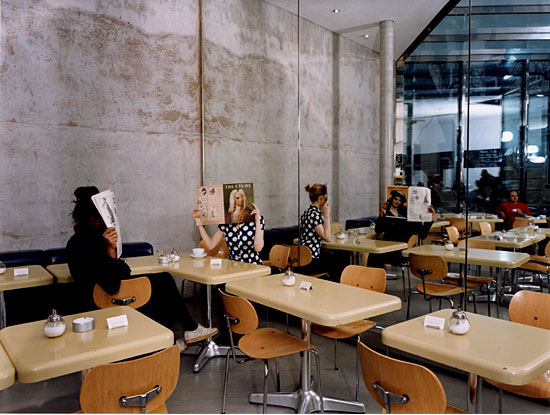


Earthling 2
2006
Earthling 2 was a photographic work that followed Earthling 1. In these pictures three locations were scouted: 1. Market Cafe near Spitafields market – a traditional british pub cafe, 2. Hookah Lounge, located on Brick Lane – a Middle Eastern smoking and tea lounge 3. Cafe Bravo – a modernist cafe located at KunstWerke in Berlin. In these staged images actors were given magazine covers from my own archive of 20th century magazines and newspapers. These magazines became optical/cultural apparatti. The magazines were altered by cutting out one or two of the eyes of the person on the cover. The size of the aperture and its location corresponed to the actors eye size and the displacement of the eyes from each other. Thus the optical axis of the physical eye and the magazine eye were lined up. In the case of the Cafe Bravo the mirror wall created another level of displaced looking and unveiling, since we see both sides of the magazine.


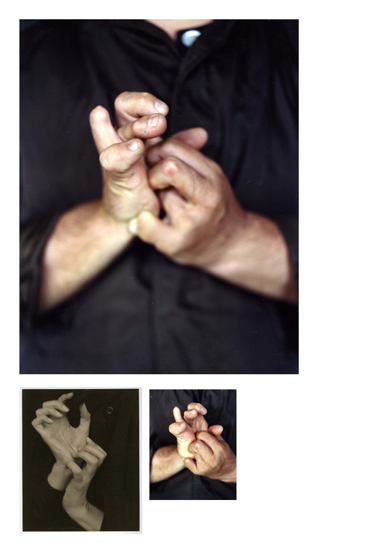


Shot Reverse Shot
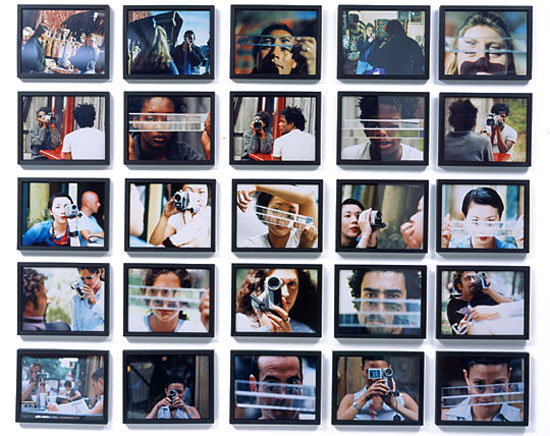
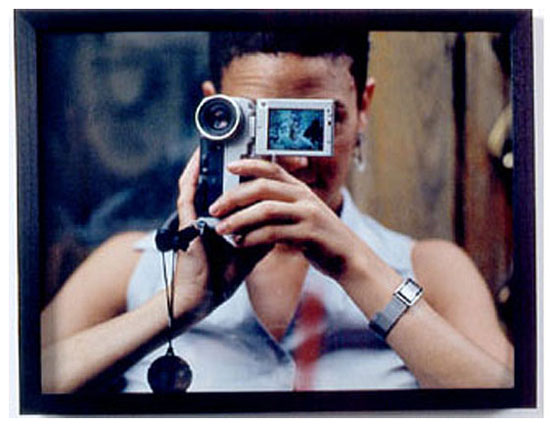
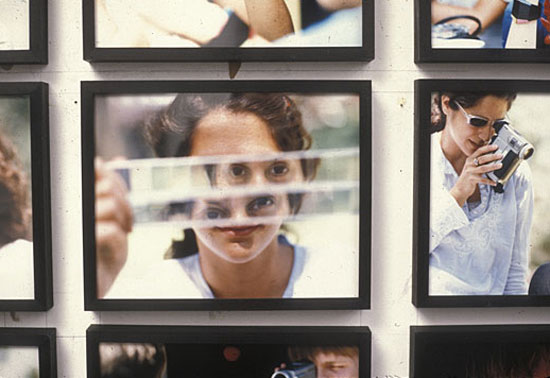
Shot Reverse Shot
The histories of cinema/photography and neuroscience mirror each other and are both essential for the understanding and production of our contemporary subjectivity. Shot Reverse Shot is a cinematic method of displaying two people while conversing and is in this case used as an apparatus to produce situations between actors. There are five different couples enacting five different situations, first with a video camera, then with a prisma bar –a neuro-opthalmologic instrument normally used to measure defects in ocular gaze but in this case creating dynamic movement of images through ever increasing lateral displacements.
Black Square, Triangle, Circle

Body-Wall Black Square, Triangle, Circle is a performative sculpture, determined by a set of questions raised in a specific architectural context. The pieces in this series investigate the inbetween hybrid states of architecture where the body can obtain new orientations, kinaesthisiologies, and new becomings. Each site-specific piece uses the found space as a vehicle for the realization of this work.
Black Square, Triangle, Circle

Body-Wall Black Square, Triangle, Circle is a performative sculpture, determined by a set of questions raised in a specific architectural context. The pieces in this series investigate the inbetween hybrid states of architecture where the body can obtain new orientations, kinaesthisiologies, and new becomings. Each site-specific piece uses the found space as a vehicle for the realization of this work.
Black Square, Triangle, Circle Fragment 2
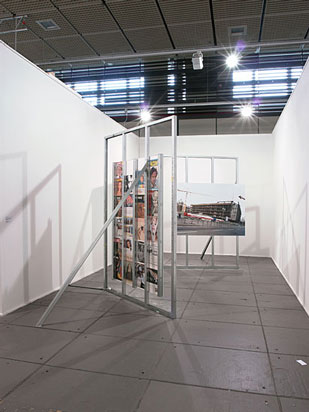
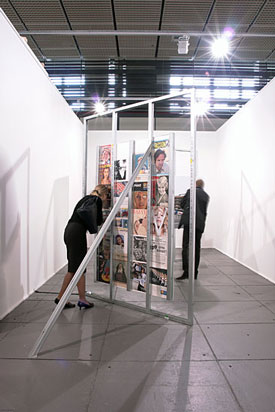
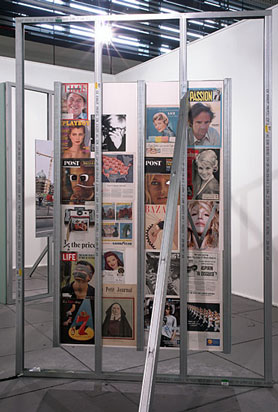
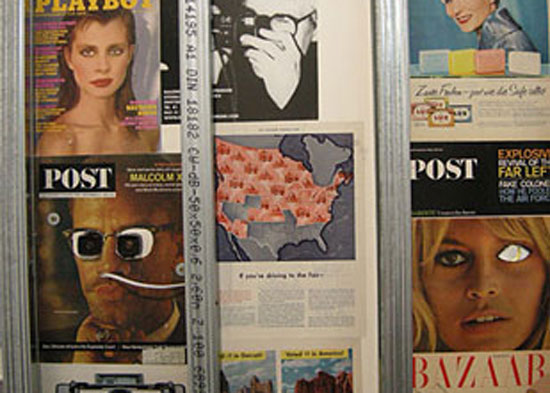
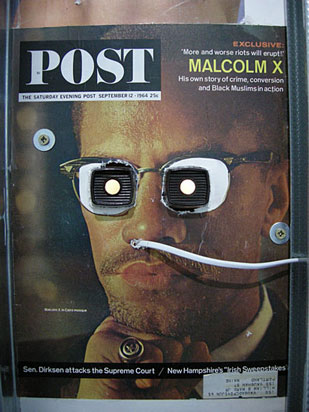
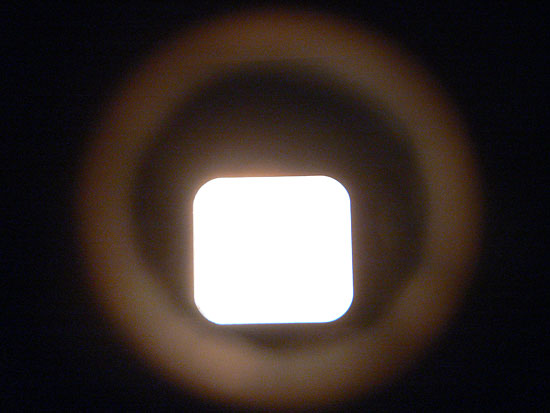

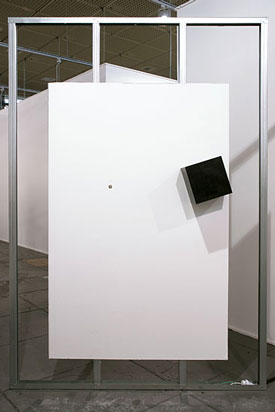
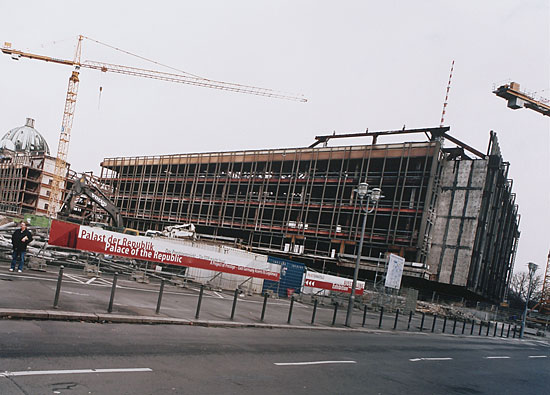
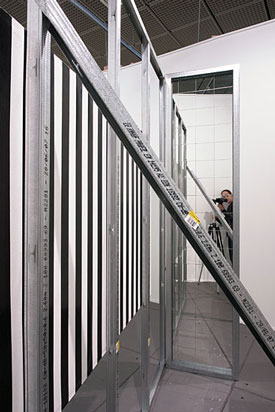
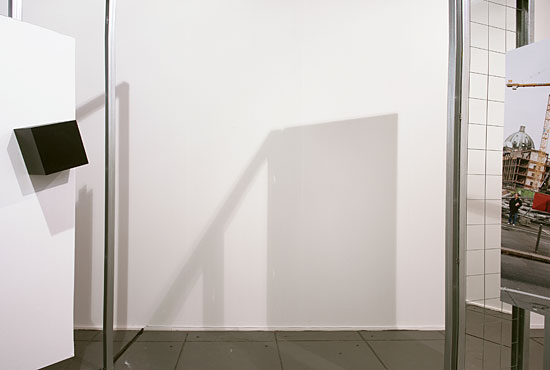
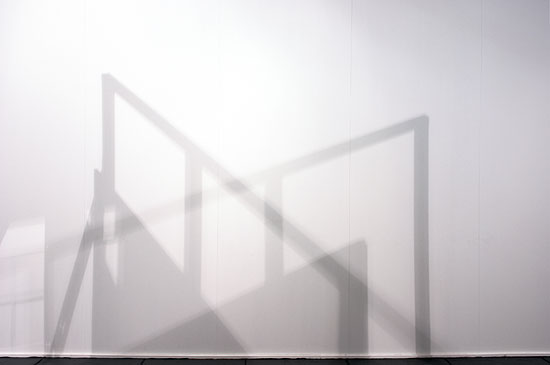
Black Square, Triangle, Circle Fragment 2
2007
Black Square, Circle, Triangle Remnant (2007) is the most recent manifestation of a series of performative sculptures that reenact the memory of itself as a fragment of a once enacted performative space. It is made up of two pieces that face each other. The first section to confront the viewer is the wall fragment. This 1.5m wide piece of drywall was taken from an installation called Black Square, Circle, Triangle, (2007) that I did in my studio which had been inspired by other works I called Body-Walls which are shown in this folio later on.
These walls are performative sculptures made over time that can be made in any space whatever. In the case of Untitled Program, 2006 a hybrid space measuring 60cm wide was created by building a mimetic wall that followed the contour of the already existing wall inside the gallery. Produced over a two-week period in the space itself this work was the result of a series of decisions made there. The work is a testament of that decision making process. Embedded in the wall were a number of viewing opportunities that ranged from a simple hole from which one could view the rest of the gallery to that of an opportunity to witness Catherine Deneuve looking through a peephole in the now famous scene from Belle de Jour. As such the visitors to the gallery became actors in a back stage scenario in which they enter the hybrid space of architectural memory to reenact the history of cinema itself through a series of transitional apparatti that produce new chances for observation. At the end of the exhibition this wall was cut up and undone and re-installed as Untitled Program, Remnant, (2006).
This same scenario created Black, Square, Circle, Triangle but in this case a wall was built in my own studio as a laboratory Merzbau in order to be able to experiment with different possibilities and potentials of these works. The studio in this instance is a place of resistance where research into ones own work and potential stands in for the resistant gestures of the Body-Wall works as they respond to the Institutional Space of the White Cube. The white cube as it is defined in the age of neo-liberal capitalism has become a space of containment where the gestures of market system, entertainment industry and museology mix together as a sovereign cocktail. In this work the constructed wall once again mimics an already existing one that separated the front and back of my studio. Again it became an armature supporting a number of historically active optical devices that produced opportunities for seeing. In this case two stereoscopic devices were used. One in which a lit blank screen confronted the viewer and the other a three dimensional image of a young girl of the DDR looking out upon the urban horizon. The former provided an opportunity to project ones imagination on a blank screen while the latter allowed one to ponder the conditions of history itself. The space was also monitored by a surveillance security camera which looped into an exposed video monitor. Thus the space also became a place of self-reflective body awareness. These devices were housed in wooden enclosures in shapes such as squares, circles and triangles that protruded out of the wall into the space itself; thus the works name. The inside of the walls were collaged with magazine and newspaper covers from the past 100 years which I had been collecting for the past 5 years and was a nod to my own experience as a child exploring haunted houses in which the inside of the walls were insulated with old magazines. This work became the mother structure for the production of Black, Square, Circle, Triangle, Remnant (2007).
Again this wall was undone and cut up to preserve the optical instruments. One such fragment 1.5m by 1m was re-installed with the help of aluminum studs used to make the structure of the original wall in the first place. This work was installed as a free standing entity with the inside wall facing backward as shown in the House Trip exhibition. This fragment faced a second section. A photograph of the Palast der Republik in the process of its own undoing was photographed in such a way with a large format camera that it appears to be falling down and breaking apart from the inside. It is secured with screws on a piece of drywall which is attached to another stud frame of the same dimension as its brother. The back side of this structure is made up of a mirror work which stands at 90 degrees from the front wall and adds support. The back of the drywall has been taped with alternating black and white tape to create an optical illusion. That taped wall is reflected in the mirror as a “mise-en-abyme”. The lighting of the work is very important. The transparent window like effect created by the open spaces left by the mounted works creates the opportunity for the production of shadows on the walls of the space embracing the works. Altogether the undoing of the Palast is metonymic for the process of undoing of Architecture as a cultural act. The Palast was not demolished but is being slowly and meticulously taken apart. The cultural undoing, assimilation and subsuming of the communist block by Capitalism after the fall of the Berlin is re-enacted in this work.


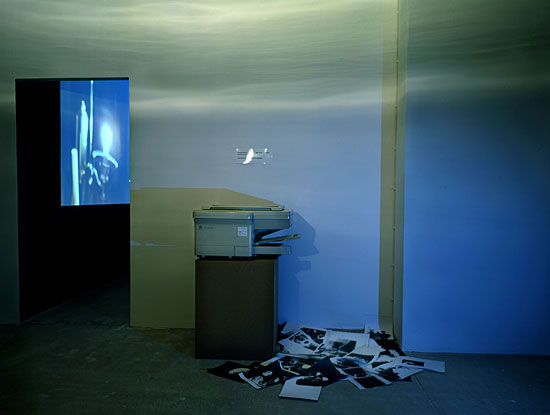

All Blown Out (2002)
All Blown Out
2002
Single Channel Video For Projection, 03:48
The final scene of Michelangelo Antonioni’s film Blow-Up has been digitally degraded to highlight the conditions of the main character’s mind at the end of the film.
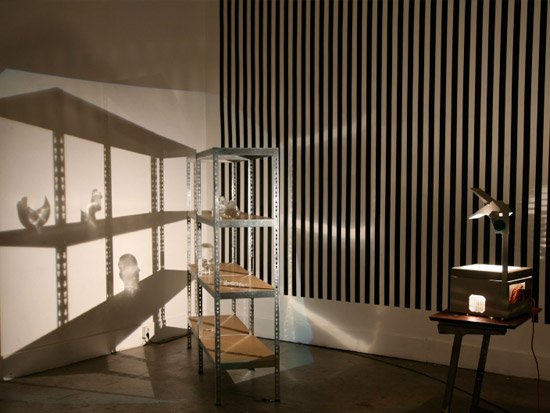
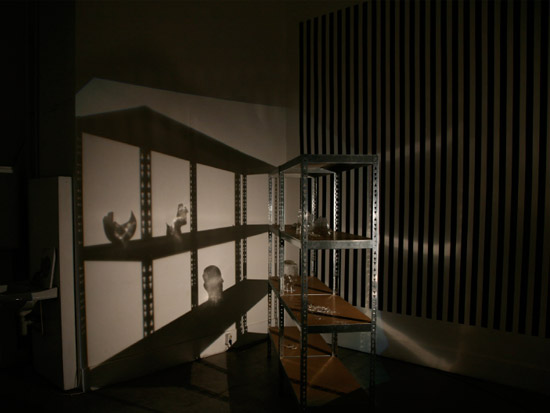
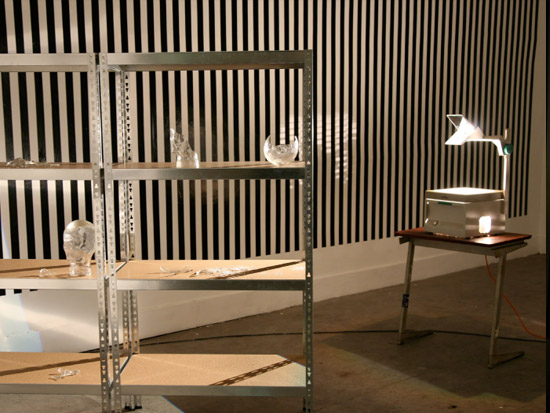
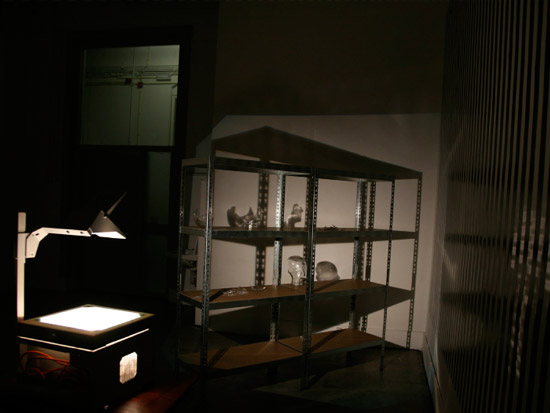


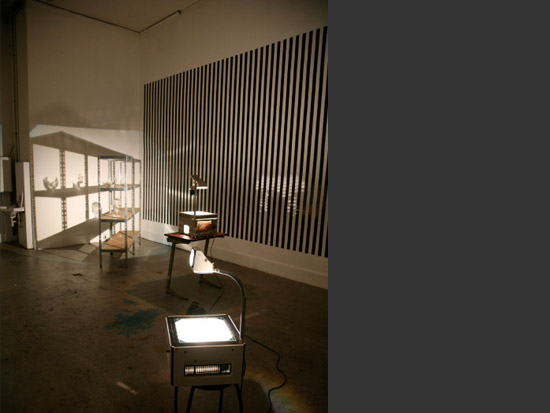
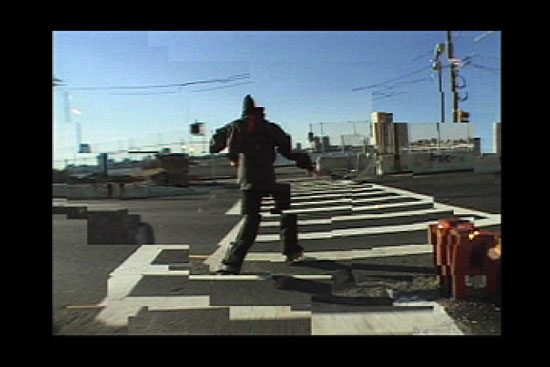
Being Prada Seen (2001)
Being Prada Seen
2001
Single Channel Video, 03:21
Optic Verve show at Ottawa Art Gallery, Ottawa, Canada, 2001
The idea of branding and its connection to the cultural, historical, economic, psychological and sociological field that surround and embrace it has captured my attention. In the year 1998-1999 the Prada fashion brand was extremely powerful and people wearing Prada clothes were unmistakable and highly attention grabbing or as Paul Virilio says “phatic”. In this video, I simply roller blade down the West Side Highway as seven video cameras at different camera angles videotape me. In the editing room these separate views are reassembled into a single work of art. Superimposed on this footage is a special effect made by digitalizing the video at a high speed. As such, it becomes a kind of contemporary motion study reminiscent of the work of Marey or Muybridge. This is significant because the original reason for Marey’s research in the Bois de Bologne, Paris was to investigate movement for the army who were interested in increasing the efficiency of their marching troops. The troops had to march long distances and were suffering from a 19th century problem called neuro asthenia which made them very tired. The fact that I wear a Prada outfit with the Prada brand displayed quite prominently signifies the extent to which the body has become incarcerated in a prison of signs manufactured by global capitalism. The body is but a pawn in the system of signs created to take hold of our desire. Being Prada Seen is investigates the alliance of technology and global capitalism in the production of the subject, a subject tethered to and defined almost solely by those networks.


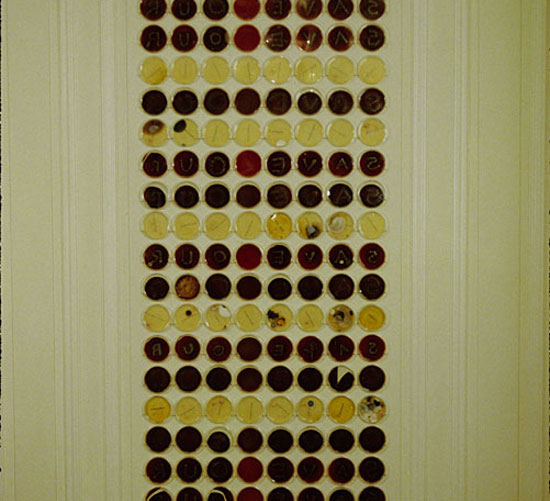


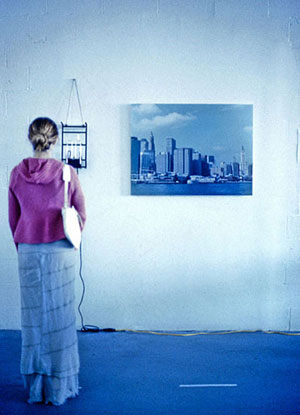
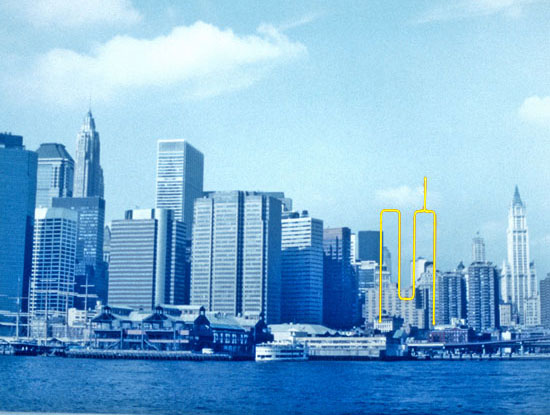

Taos, Pueblo, Looping (2000)
Taos, Pueblo, Looping
2000
Single Channel Video, 04:55
In this work I am not blind folded and again use the hybrid dialectic of video camera and blind mans stick to trace out seven different sections of the Pueblo in Taos, New Mexico. This work is a seven-screen projection work. Each looped section is a memory loop and represents a strictly defined neural network. The blind mans stick represents in this case a kind of cultural blindness in our attempts to understand and know other cultures. The looping is consistent with a type of obsessive-compulsive knowing that reiterates that which we know over and over again leaving out what is beyond that knowing. It is in the space of the cultural unknown that the truth resides.


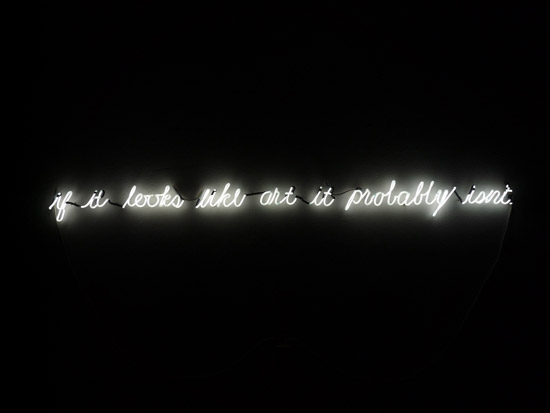

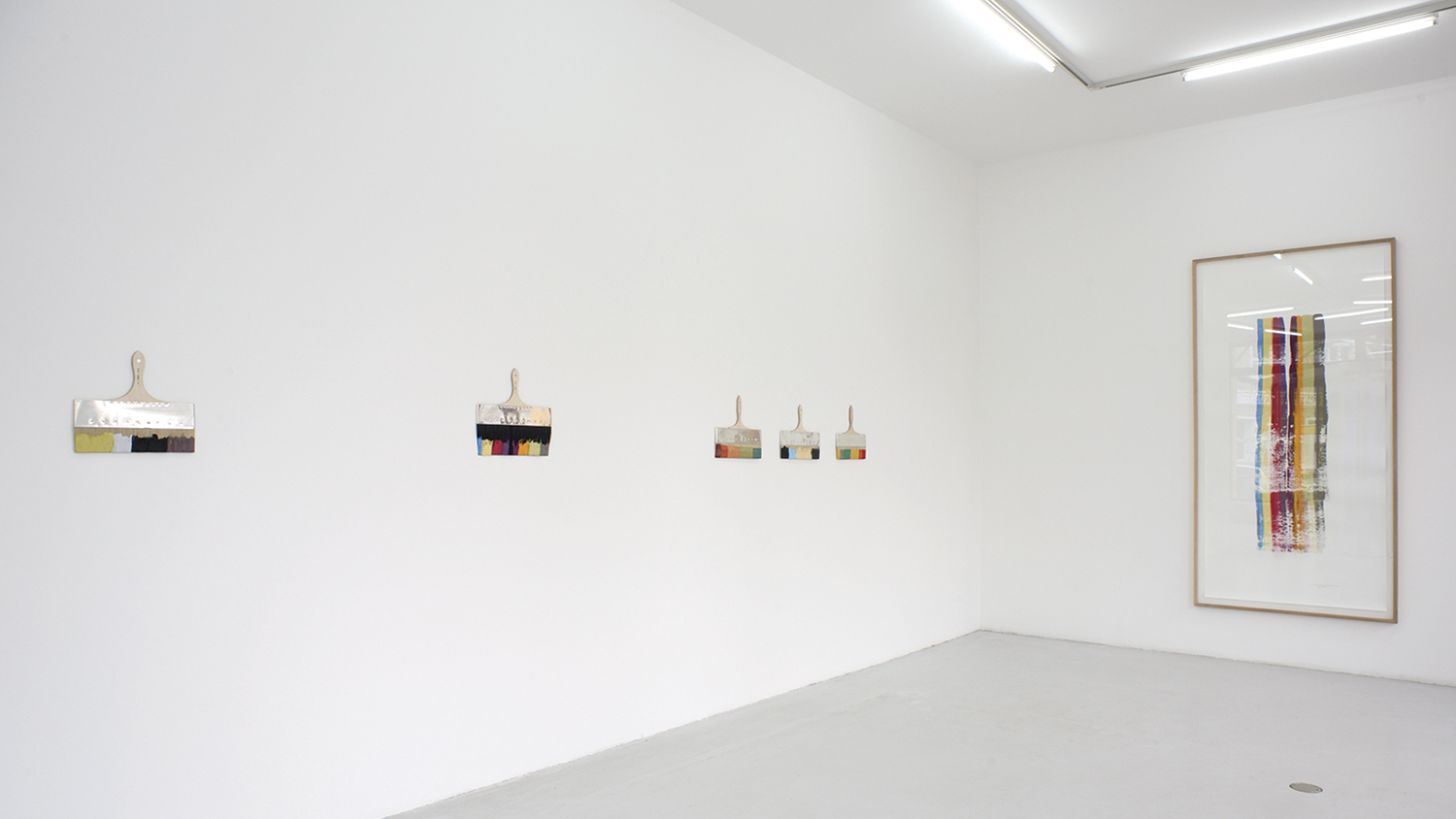
Rainbow Brushes (2008)
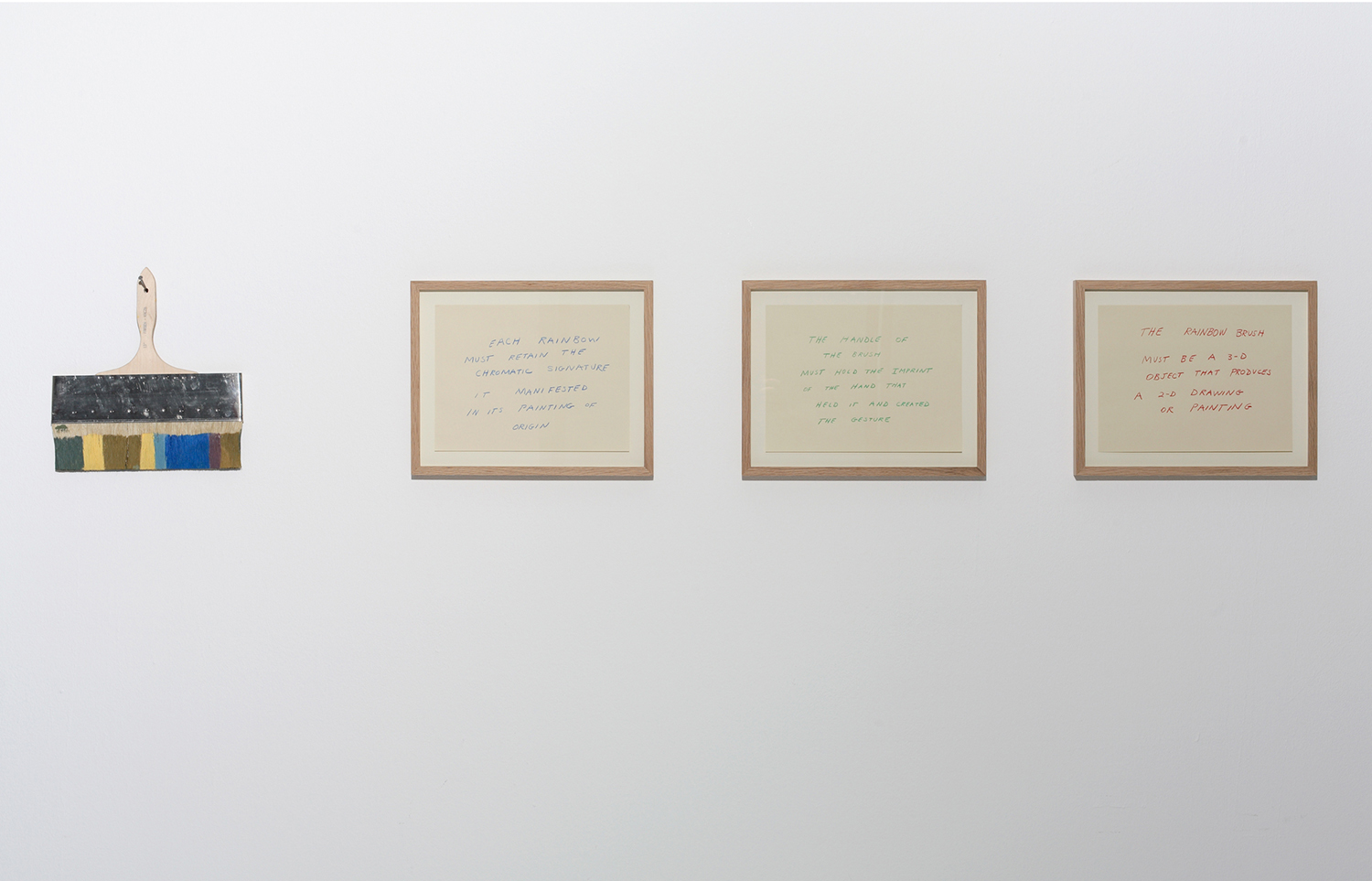
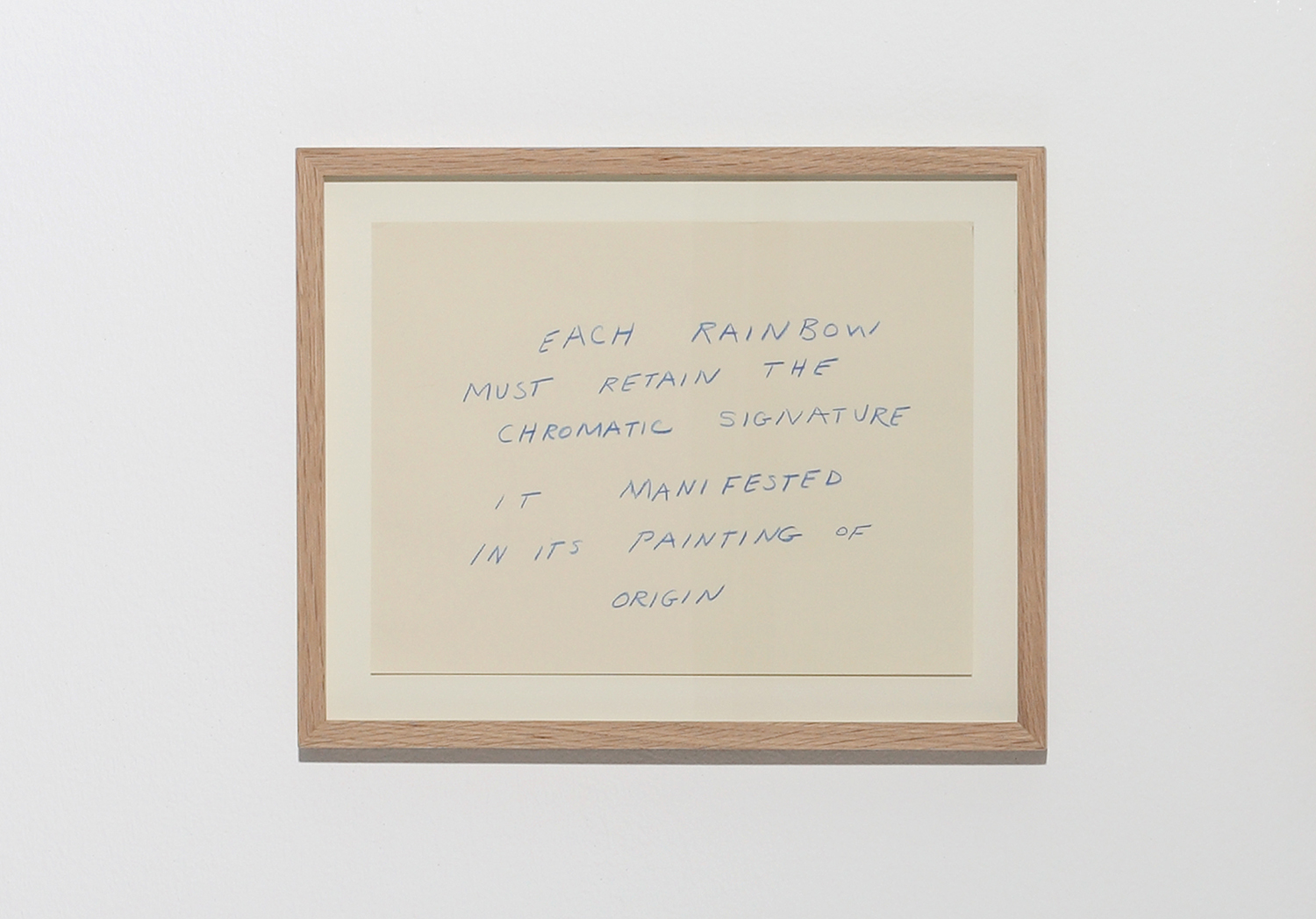
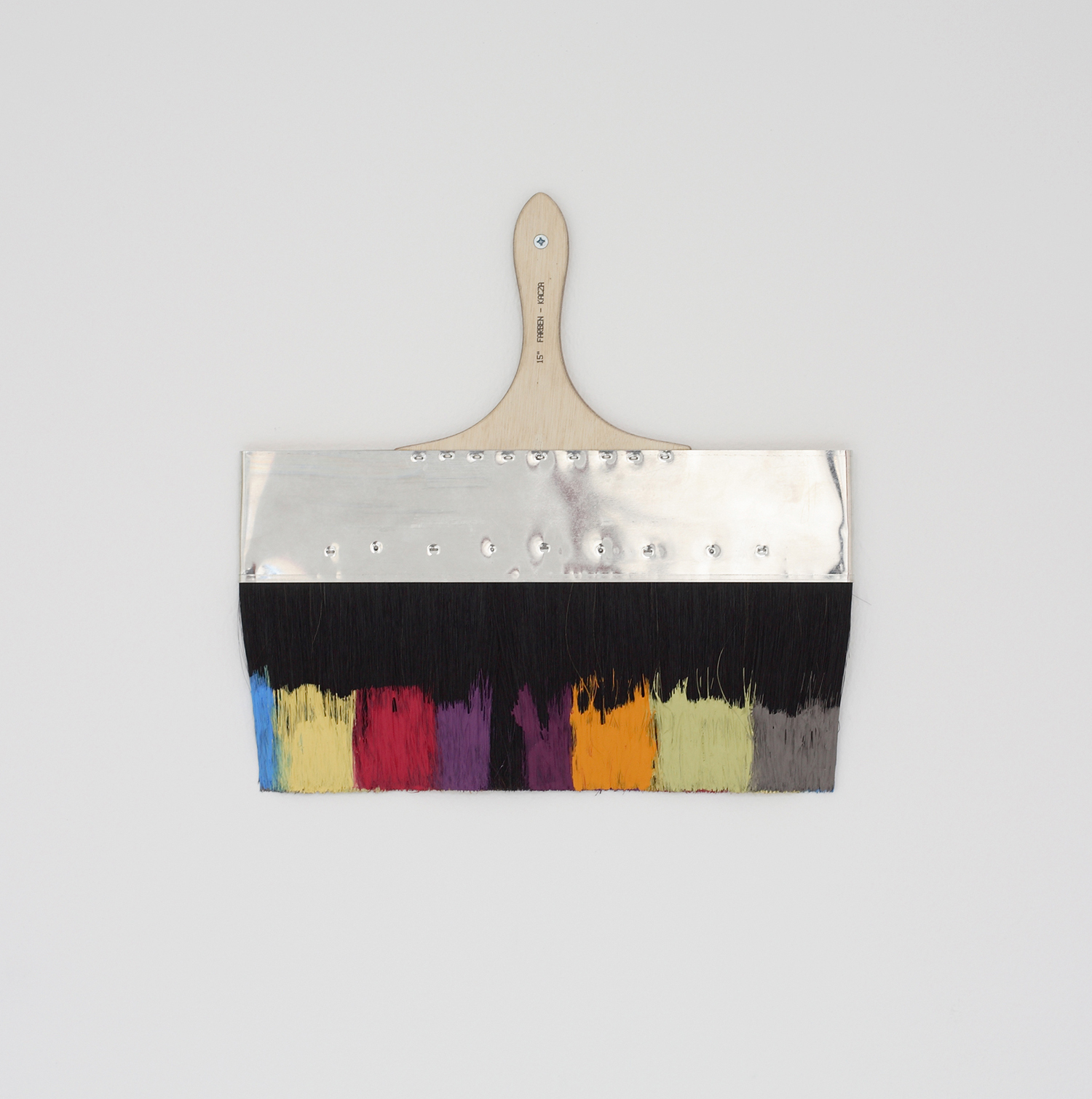
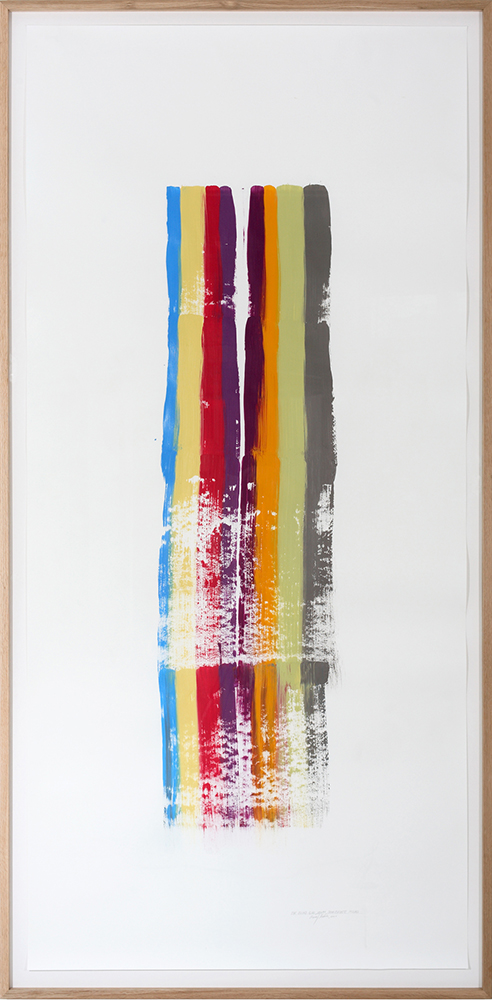

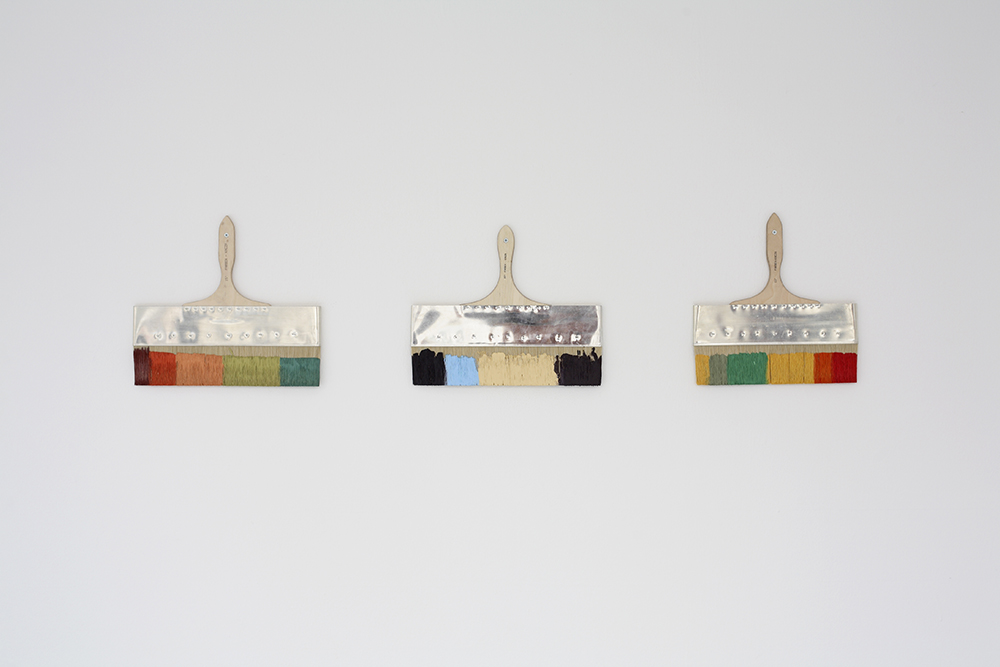
Rainbow Brushes
2008
Wooden Paint brushes with pig hair, Acrylic paint, Variable dimensions
Rainbows found in landscape painting in the past 1600 years were discovered to vary greatly in color and and order of hues. Some of the rainbows in fact had little to do with the scientific analysis of the rainbow and reflected instead cultural factors, like the colors of clothes worn by the king. Acrylic paint was first used to copy a section of a found rainbow upon a piece of 3 meters Fabriano paper. Next a large 13 or 15 inch brushes were pulled through the paint in one brushstroke to create the painting. This process left an afterimage of paint on the brush and the brushes were hung on the wall.